This is a brief live-on-air commentary just after the G7 announced that it would release 100M barrels of diesel fuel to supply markets that are tight due to the Hormuz crisis. This will go a long way to keep inflation in the US, Europe and Asian allies down, protecting consumers and economies.
While Hormuz is already, as I said, transiting as much CRUDE OIL as before the Iranian regime closed it – i.e., Tehran has lost control of the Straight to the US military, which is successfully escorting ships out even in daylight now.
Meanwhile, the amount of REFINED OIL products flowing out has not yet gotten up to pre-war levels, and so we see the present refined-fuel-market shortages and high prices.
This is part 1.0 of a series on the US-Iran war and the present US global energy offensive. Hormuz developments are altering some elements of the one, “Global Barrel” market-centered collective energy-security model that dates to 1973, and which I named this blog after 15 years ago (after I had apparently coined that name).
I will have No. 2.0 of this Iran series soon. Here is 1.0, my brief BBC interview of last night, with some comments below here.
This was my fourth interview with BBC Persian Service, London in recent months. It feels important to get things clear when I have the opportunity to speak directly to Iranians or to Ukrainians.
Comments:
The larger USA global oil-sector offensive involves Russia, Iran, Venezuela, India, and other countries. I’ve seen these each as USA “shaping operations” aimed at preparing the energy landscape favorably to the US and its allies before any future armed conflict with China might begin – or to prevent one.
As I explained earlier (e.g., Jerusalem Post interview), a problem for the Islamic Republic of Iran, in deciding to take control of Hormuz, is that its control can only degrade over time under US pressure.
In the past few weeks, as it’s grip was loosened by the US military, it needed to find a further lever. In the past few weeks Tehran tried two things to reverse its weakening Hormuz position:
The far-right AfD (Alternativ für Deutschland) won a sweeping election victory in the German state of Saxony-Anhalt last Sunday. I addressed the implications of and motivations for the AfD’s economic program.
In the interview, we spoke mostly about macroeconomic policies of the AfD, and its anti-immigrant social policies. However, the AfD seems to not have a fundamentally different economic orientation from other German parties over the past couple decades. It too is backward looking, full of nostalgia for “what worked” previously in the post-War German economic model. However, it also prioritizes going back to when there were fewer immigrants in Germany.
My work on the German economic model, however, especially my teaching and talks, has focused on the failure of Germany to embrace the tech, social-cultural organization, and research imperatives of the Third Industrial Revolution, the Information Age.
Germany, and the EU as well, have long failed to catch up with the USA, or for that matter Asian allies Japan and South Korea, in information technologies and the modernization of work organization-and-culture within the spheres of production, communication, commerce, research, education and business. This would have required reforms fostering a risk-tolerant culture of innovation, personal initiative, flexibility and entrepreneurialism, sweeping transformations away from the old, mid-20th-Century Fordist model “with German characteristics,” so to speak.
This strategy was both a theoretical and practical mistake – not because it addressed global warming, which indeed is a significant problem though, in my view, not the predominant global problem it is made to be in the last 15 years of German policy, but because it was offered as an alternative model of economic development to Europe embracing the “American” Information Revolution.
In reality, Europe had no option but to wholly embrace what it terms “digital technologies” and catch up to tje USA.
In addition to embracing its peculiar “green”, “clean” energy path to reindustrialization, the other German strategy, in parallel, was to double down on improving its renowned 1960-1980’s electro-mechanical technologies, which are typical of the previous Second Industrial Revolution, and massively export these into the Chinese market.
Nevertheless, Gerany did have a plan to move, at some point, beyond this hold-over tech. The strategy was to bank on development of “green” or, more recently, “clean” technologies.
It was widely claimed, for about 20 years (influenced by futurist green-energy theorists like US physicist Amory Lovens, that Europe could “spark a Fourth Industrial Revolution” by carrying out a “green energy transition” based on developing and deploying a “totally new” energy system” using only renewable sources such as windmills and solar panels along with all their required grid-expansion, -connection and energy storage technologies.
Yesterday, I had a long talk with ‘Post’ Mideast reporter Danielle Greyman-Kennard. My thanks to her. – Tom O’D.
Although 14 to 15 million barrels of oil passed through Hormuz per day before the war, an expert told the Post that it was entirely possible to manage without much of that supply.
27 Aug. 2026, updated 28 Aug. – Though the Islamic Republic of Iran has established a “sophisticated panoply” to protect itself against the possibility of regime change, its trump card, the Strait of Hormuz, is losing its strategic value and will continue to do so, former Wilson Center global fellow Thomas O’Donnell told The Jerusalem Post on Thursday. (Continue reading at GlobalBarrel.com or at Jerusalem Post here)
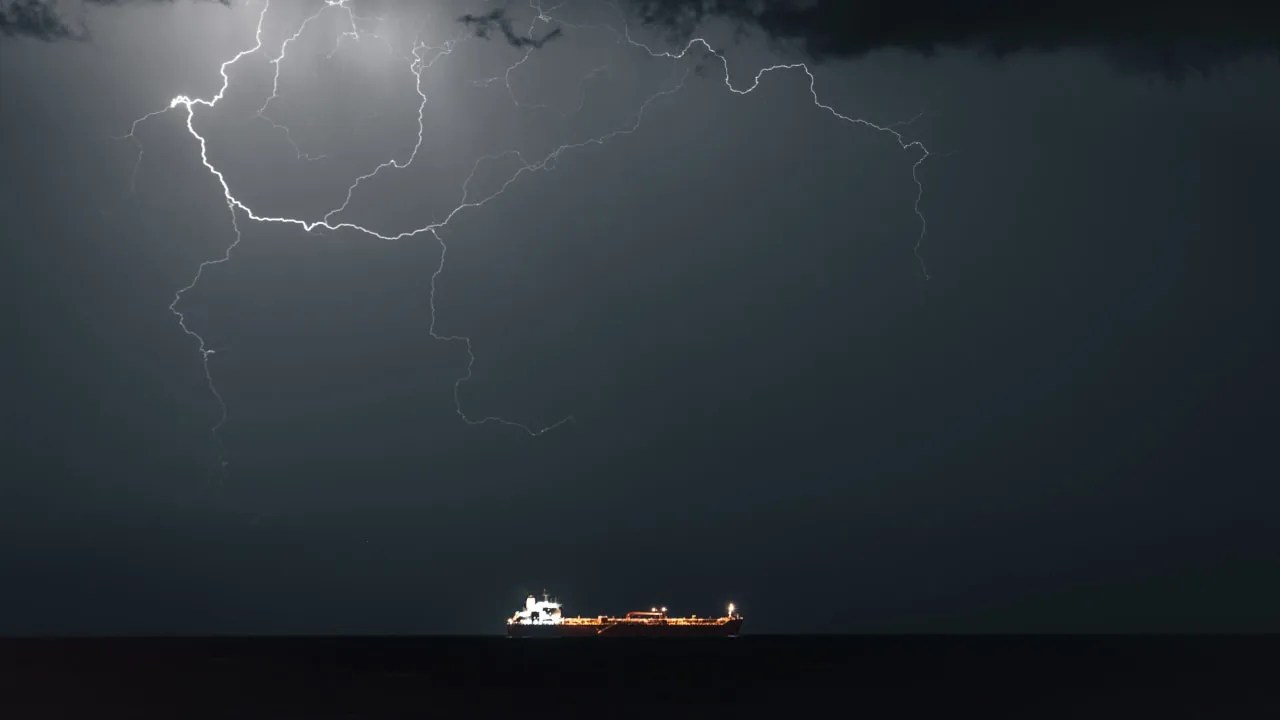
Lightning occurs when META 4, an Oil Products Tanker, sails into Muscat Anchorage on March 21, 2026 at Sultan Qaboos Port in Muscat, Oman.President Donald Trump had threatened to attack Iran’s energy infrastructure if it did not end its de facto blockade of the Strait of Hormuz by March 23.(photo credit: Elke Scholiers/Getty Images)
With many of the regime’s regional proxies degraded over years of war with Israel and its nuclear ambitions delayed after the 12 Day War in June last year, Tehran only has its rockets, drones, and ability to threaten the Strait of Hormuz left as an insurance policy against attempts to topple the regime, he noted.
These remaining elements will be used to dissuade action while it restores the others, but they are losing the weight they once carried, O’Donnell added.
Though 14 to 15 million barrels of oil traveled through Hormuz per day before the war, he argued that it was very possible to manage without much of that supply.
Saudi Arabia’s East-West Crude Oil Pipeline moves around five million barrels per day for non-domestic use, while the United Arab Emirates moves an average of 1.5 to 1.8m. bpd through its own pipeline, he calculated.
Some 400m. barrels of oil and refined petroleum products were unanimously approved for release by the 32 member nations of the International Energy Agency (IEA), while the US government committed 172 million barrels from its Strategic Petroleum Reserve.
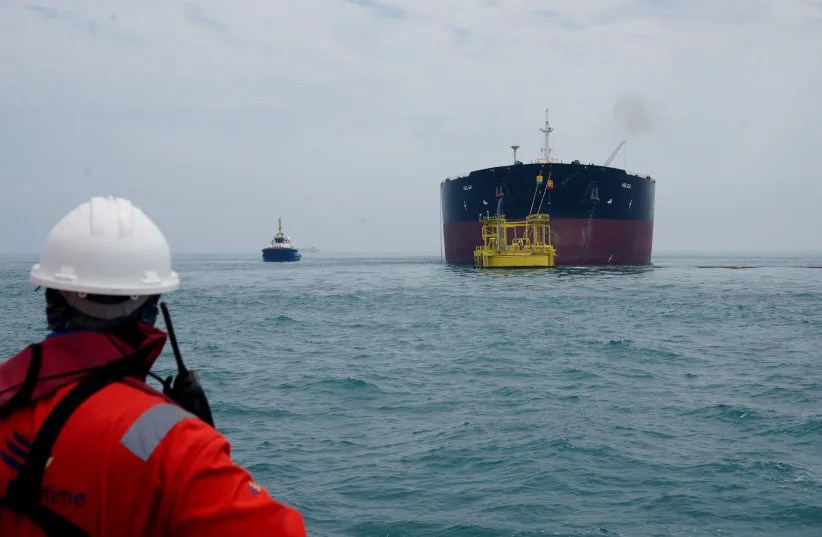
Oil tanker HELGA is moored at one of Iraq’s southern offshore oil terminals near Basra as it prepares to load crude oil, becoming the second vessel to arrive since the closure of the Strait of Hormuz, April 24, 2026. (credit: REUTERS/Mohammed Aty/File Photo)
None of this even touches on the oil supplied by the Western Hemisphere, where roughly 32% to 40% of the world’s total oil originates.
“There’s more production in other places, but [the disruption of] oil has not been anything like it would have been 20 years ago if they closed the strait,” he said, explaining how the US’s own oil and fracking industries have helped mitigate much of the damage.
Could Iran’s weakening control of Hormuz force a deal with the US?
“The oil price, it’ll go up and down. The fact that it went over $100 [a barrel], and the next day it was $80, that means that’s geostrategic variability. That’s not fundamental.”
ENGLISH version. Sky News (UAE), 20 August 2026, Dr. Tom O’Donnell (in Berlin).
I told Sky (UAE), Hormuz is now “a game of chicken” – who can wait the longest and bear the most pain. I tried to look objectively at the two sides.
a) On the Iran side, oil exports are reportedly zero since about 15 July. None of Iran’s oil ships seem to have left Hormuz. A massive accumulation of Iranian oil cargo sits on ships near Malaysia and Singapore, while perhaps 53 loaded ships are stuck in the Gulf due to the US Navy blockade. For a petrostate, this is devastating.
In addition, all Iranian ports are blocked form exporting or importing anything.
What oil can perhaps leave by train to China, say 70,000 barrels per train taking two weeks, is painfully small and costly.
Trump has now declared a push to block any payments or financial transfers to and from Iran. But, if no one is selling anything in either direction, there will be less and less financial flows to block.
For the regime, this is dire. It does not mean Iran will surrender, or even talk, but it is clearly devastating.
Pakistan TV, 9 Aug. We discussed the Trump administration’s two retreats from forcefully reopening Hormuz. This is not so simple as who is winning and who is losing.
The first of two key factors to note: It was GCC allies who sharply blocked Trump from executing planned big assaults on Iran to facilitate reopening Hormuz, on fear of Iranian missile punishment which would continue until the US military finished silencing most of Iran’s missile capacities. The Saudis and Qataris were most sharply opposed to accepting this punishment. What are the implications?
a) On the one hand, their refusal to allow Trump to use force to resolve the Hormuz crisis is a de facto success for the Iranian strategy of attacking all GCC states expecting them to then oppose USA military action against Iran.
b) On the other hand, I suspect the Trump-Vance response to GCC allies caving in to Iranian missiles was similar to the attitude the administration took to Europe and NATO in early 2025, for being seen as unwilling to really fight for either Ukraine or their own nations’ security, assuming the bulk of the task would be performed by the USA. Trump’s comments that Gulf allies should “pay the United States” for protecting them once the Straight is reopened, seems a reflection of this mindset.
Interestingly, we then see the rapid emergence of a new “Islamic NATO” mutual defense alliance between Saudi Arabia, Turkey, Pakistan, and perhaps soon Egypt. And simultaneously the Saudi-led new 19-country Red Sea defense league.
These are a striking departure from past Gulf practice. They should be seen, among other things, as an urgent Saudi recognition that the USA either refuses and/or is incapable of continuing to bear the burden of their defense, especially via American “boots on the ground.” I recall when the Obama administration told the Saudis the same, and indeed the Saudis made some military adjustments, including in Yemen, but obviously nothing anywhere like these alliances.
Now, with its new military alliances, the Saudis and their Gulf allies will increasingly be capable of fighting and be expected to actually join in any fight against Iran’s push for hegemony in Hormuz, in the Gulf Region and MENA generally.
The second large factor to note: I also explained how the Iranian leadership’s key lever, their ability to disrupt and partially close Hormuz, is seen by the US administration as a diminishing lever. There are two main indications of this:
First, the absence of what had been widely predicted to be astronomical oil price spikes after Hormuz was closed and,
Second, agreements are now in place in several Gulf states that four or five new oil pipelines to be built in the next couple years to bypass the Straight.
In fact, Sec. Bessent said exactly this shortly after my interview where I had anticipated this USA attitude. He (characteristically over-) confidently declared these pipelines mean the Straight will become “irrelevant”. And, shortly thereafter, Sec. of Energy Chris Wright was insistent that USA forces are now escorting eight or nine million barrels per day (mbd) of oil out of the Straight, implying a decreasing capacity of Iran to interrupt shipping.
As I have said before here, this tells the administration that it objectively has much more leeway, timewise, for resolving this crisis than any other administration would have before. This is part of their calculation that they can now, in effect pause any significant offensive military operations and focus on a new (really a second) “economic war” against Iran, to undermine it. However, IMHO, this in-itself cannot, with this particular IRGC-led regime, be sufficient to resolve the Hormuz crisis. In the end, this will require with the use of substantial USA force to accomplish physical occupation, with troops and electronically, of the shore-region of the Straight, and significant further erosion of Iranian missile and drone stocks and capacities to import and/or produce these. Alternatively, a USA back-down, a partial “surrender” is required, which would be almost impossible for any president to accept considering Iranian demands at present, which are hardly conciliatory.
TRT-London asked me tonight about oil-market impacts of the deal between Iran and Oman. The title says most of it.
Of course there has been hardship globally with higher energy prices and volatility. However, compared to what would have happened 10 or 20 years ago, this is very significantly smaller.
Oil on average has been up only 25%, and refined products 36% since 28 Feb. (“Why Oil Prices Could Hit a Breaking Point by Year End,” WSJ, Video, 3aug26). Why?
The huge surplus in oil production that was building globally for at least three or four years, plus the constantly falling energy intensity of the economy, plus the high degree of interconnectedness of the one-global-barrel market (the name of this blog for the past 15 years) explains this relatively mild impact thus far. I explained this, and the geopolitical advantage, the long time line, it has given Trump and Washington to go slow and talk a lot as compared to the urgency they would have had earlier.
This is both a case of:
a) More oil being produced globally due to huge advances in petroleum and gas exploration and production (E&P) technologies, Especially in the USA, where a new “Fracking 4.0” stage of the Shale Revolution seems to be underway, one that could boost extraction rates of previously drilled wells by factors of 50-300%, according to various industry tech reports. This is all about US high tech and perfecting of methodologies. (See, Javier Blas, “Shale Oil’s Next Revolution Should Worry OPEC” Bloomberg, 30Nov25).
In addition, there have also been significant tech improvements in deeper offshore production, and in exploration generally, leading to a lot of new, large-sized proven reserves to exploit And,
I spoke with Kyiv Kanal24’s Nataly Lutsenko on three issues. Jump to a topic here: 1) Ukrainian drones in Russia 00:00:192) G7 push v Russian oil. 00:05:253) Who won the US-Iran war? 00:10:27 Recorded 18 June 2026.
Note on number 3: I said it is not yet clear who won the US-Iran war. This has to do with military capacities which the USA (and its allies) could bring to bear but are now deeply reluctant or unwilling to bring to bear.
If Iran is unwilling to compromise or, worse, plays games, as it has already in the past few days with its “Persian Gulf Strait Authority,” the USA might decide it is constrained to employ whatever means necessary (Carter Doctrine) to end the Islamic Republic’s capacity to restrict the free flow of energy from the Gulf.
Trump and USA officials understand that a full-on military option is not an optimal resolution. This led them to accept an MoU that is quite conciliatory to Tehran in order to get the Straight reopened, and also apparently in response to many of its Gulf allies unwillingness to absorb the punishment Iranian missiles and drones would inflict before the Straight is forcibly reopened and Iran’s missile capacities are eventually suppressed. The administration knows that a massive bombing campaign of the entire country’s military-industrial and civilian infrastructure, plus an occupation of the Iranian coast along the Straight could likely achieved their aims of removing the Straight from Iranian hegemony. However, this in turn, is likely to require a protracted force commitment to contain whatever regime forces remain active. No matter how minor, remaining missiles and drones, proxy forces and terrorist capacities could require a long time to resolve.
One problem with giving a quick take on breaking news is that one can forget something. In the interview, I forgot about the US dollar swap line that the UAE had cajoled out of the USA –Trump and Bessent – just before it decided to quit OPEC. Below is the post I immediately wrote with many, IMHO, relevant issues underlying this move. These include national economic and geostrategic differences, often rather sharp, between the UAE and Saudis. However, the swap line issue is now included as point “Zero”.
-0.a- Regarding the swap line: there are so many pieces in motion that we need a litte overview refresher first.
As readers here know, my analysis is that the Trump administration’s sharp moves in the latter part of 2025 against Russian oil exports, together with the Ukrainians’ drone campaign, was at a point where it had begun threatening to force Russian oil exports offline. This, in turn, would force Russia to shut in its old and delicate West Siberian fields. I wrote a detailed study on this. This strategy is exactly like what the USA now openly says it intends to do to Iran by blocking exports from its Kharg Island oil terminal.
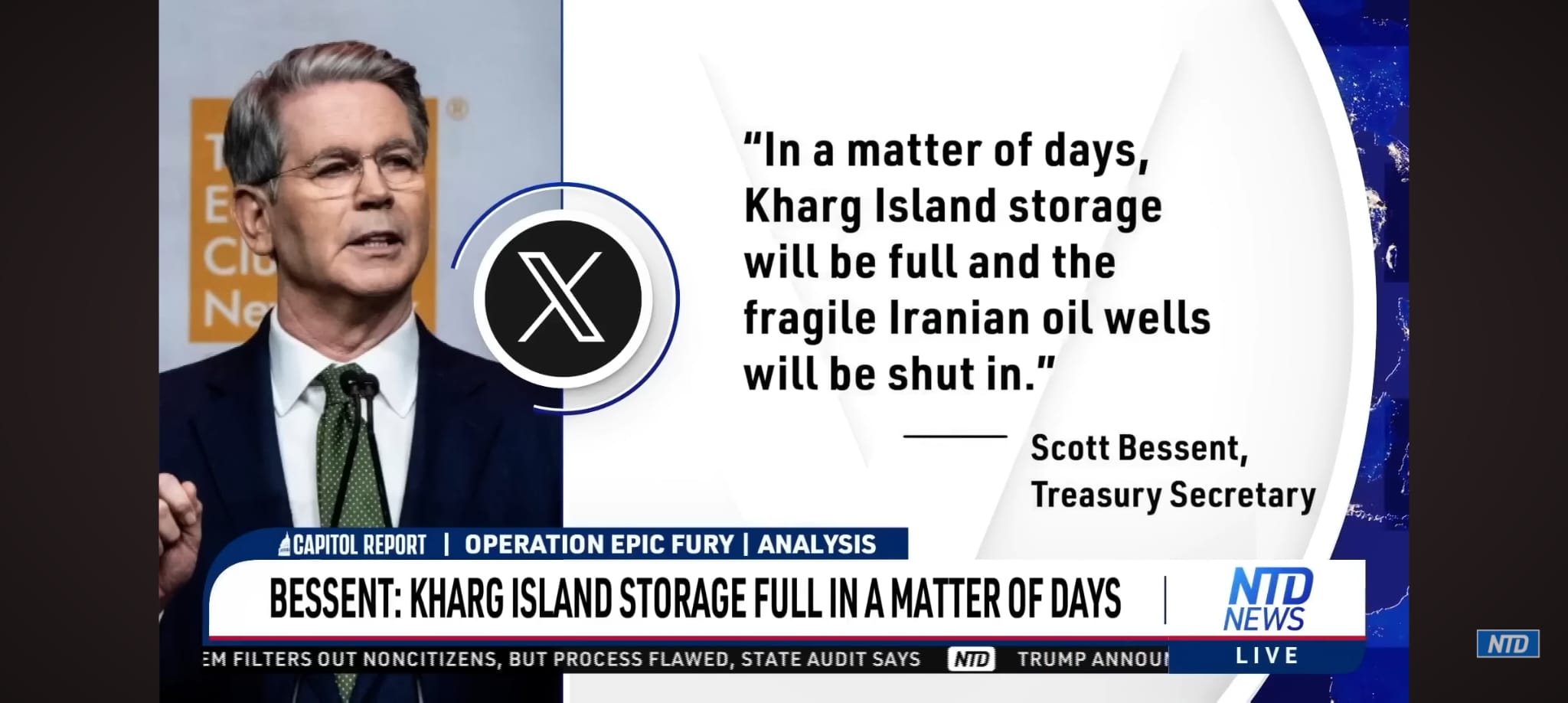
The Trump administration claims that the available Iranian storage on the island is near full (Scott Bessent has said this repeatedly). This will force wells to be shut in, likely ruining their productivity for the long term. (However, I believe the Iranian fields are not generally as fragile as Russia’s.)
-0.b- You will recall that Trump constrained and/or convinced India’s Modi to halt Russian oil imports as part of this larger anti-Russian oil campaign to press Putin to end the Ukraine war.
-0.c- However, before the USA proceeded to the next step vs. Russian exports, it went to Venezuela and took control of its oil sector, beginning a comprehensive and very rapid campaign there to bring Venezuelan oil back online.(I spoke at length to Swedish public radio on this again this week,)
The USA has shut off an approximately 2 million battels per day (mbd) stream of oil Venezuela was sending to China, and diverted that oil principally to India. That stream is now part of the USA effort to take care of India during the Iran crisis, so that it does not revert to taking Russian oil.
Guaranteeing Gulf energy flows to allies has always been a core US interest, while today’s Great Power Competition means China’s access will be rendered conditional.
This is not the Iraq war. If after operations to secure the coasts and islands and to clear mines, the Iranian regime resists, the USA plan is that Iran’s oil sector and economy would be destroyed by aerial bombardment. Washington neither desires nor needs to occupy Iran proper nor to change the regime. The US strategic imperative here is to secure, long term energy flows from the Region and, accordingly, to end the regime’s capacities to project regional power.
After almost 30 years of analysis and my university seminars, there is very little I see new here, save a new USA urgency.
In my view, this urgency flows from USA concerns over Great Power Competition, especially with China. This is exacerbated by the possibility that Iran could close the Strait in solidarity with China (or perhaps Russia) during any Great Power conflict elsewhere. The threat of Iran’s developing capacities in this regard, especially its missiles and drones, but also its nuclear weapons ambitions and intentions to rebuild its regional proxy allies, all act to undermine the prerogatives of the USA and its Gulf regional allies to secure the region and its energy flows.
In any case, the idea that Washington and Trump “have no strategy” is demonstratively wrong, and self-disarming. (See, for example, my EIES study of Trump administration energy policy since ca. April 2025 v. Russian oil.) One might not fully understand the strategy, or might disagree with it, but there is clearly a multifaceted strategy here under the general slogan of “USA Energy Dominance” (e.g., see posts here and here). Besides Iran, it especially includes Russia, Venezuela, India, and of course China, as well as US domestic oil, gas, nuclear and renewables policies.
Author’s screen shot from NTD News. The statement was posted on Tuesday.
Note, a third Amphibious Assault Group, an aircraft carrier with an additional Marine Expeditionary Unit of 2000-2500 troops, has just arrived to join two other already in the Region. This further shows that Trump is increasing preparations to seize Hormuz, not backing down.
Mar 12, 2026. Is the Iran war about the US containing China? For my part, I explained how control of Hormuz would give the US two key levers:
The USA will control half of China’s oil imports, 5.4 million barrels per day (mbd), which flow through Hormuz.
The USA will insure that during any Pacific war China might start that Iran, acting in solidarity with China, could not block oil flows to US Asian allies such as Japan, S. Korea, Australia, Philippines, or flows to others whose supplies it would also want to guarantee, such as Viet Nam, Indonesia, Malaysia, Singapore, etc..
-1- How US and other foreign oil firms can start immediately to stepwise developing three different types of oil fields. Yes, Venezuela can become a “powerhouse” oil producer. This could be a huge change in the global oil system.
-2- What is meant when Trump and oil firms talk about USA “security guarantees” for work in Venezuela. The USA government is unlikely to subsidize oil majors going into Venezuela. Instead, they are talking about somehow Washington managing a “regime change.” The KEY element of this is that the present pro-Chavista armed actors, both the state and non-state armed actors and the Chavista-state intelligence services, all of which are widespread in the country, are still intact and are still active, either agree to disband stepwise or to stepdown and not oppose the formation, eventually, of a new government elected freely. The instruments of state armed coercion that will remain, including elements of the police, intelligence services, national guard, army, must agree to serve whomsoever is democratically elected in future elections. However, as Trump himself points out, the foreign oil majors “are tough guys” and they have abundant experience and methods to work in countries having fairly dangerous situations.
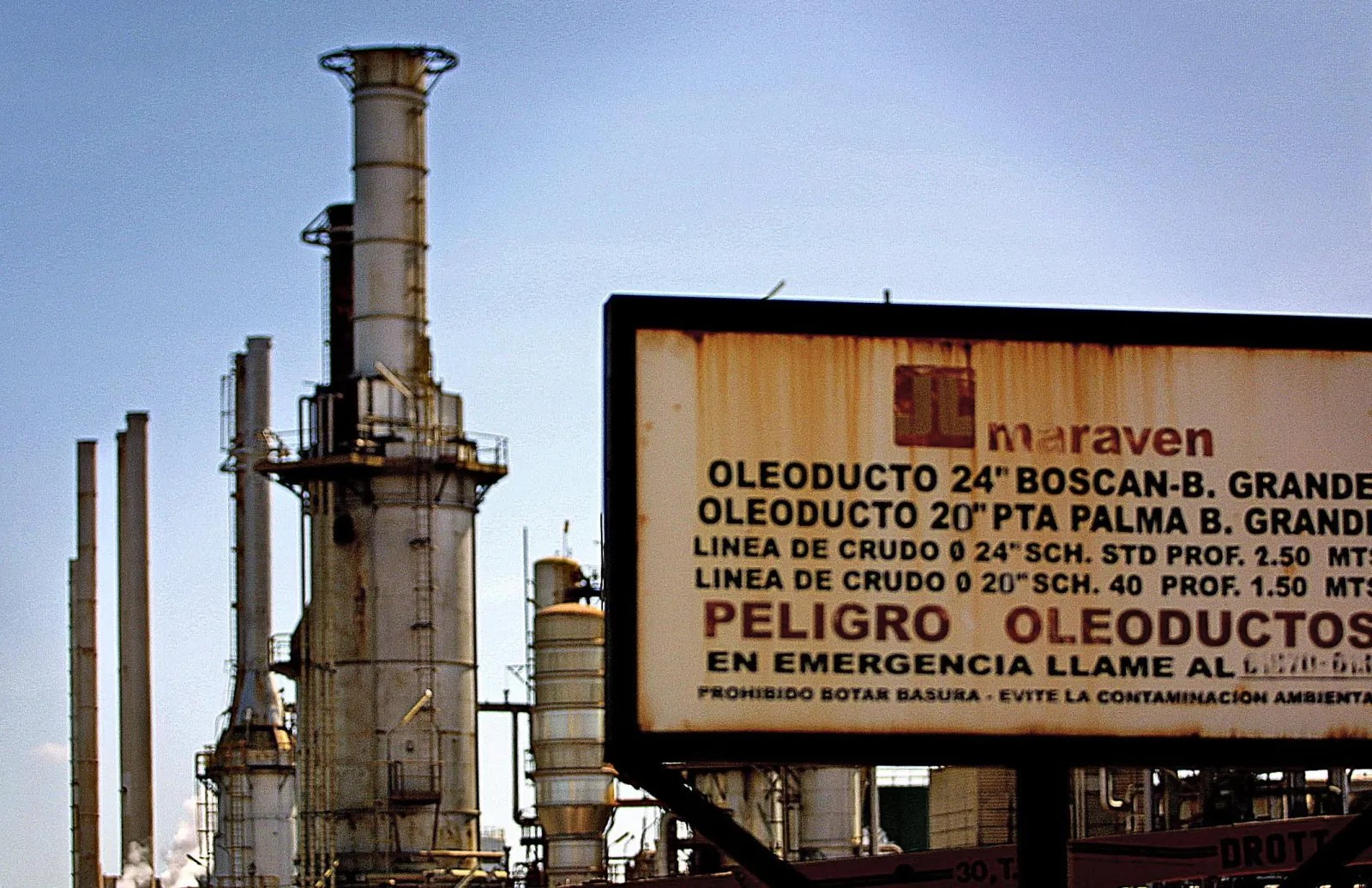
Image from 2002 shows an oil refinery in Maracaibo, Vzla. Photo ANDREW ALVAREZ
Published Jan 10, 2026 – By, Brendan Cole, Senior News Reporter
Developing Venezuela’s oil industry following the removal of its leader, Nicolas Maduro, would require major legal and commercial changes, Exxon CEO Darren Woods has told President Donald Trump.
Energy industry analyst, Thomas O’Donnell, told Newsweek on Saturday that one approach would be for companies to work on small projects to kickstart production before targeting the oil fields that require heavy investment.
Image from 2002 shows an oil refinery in Maracaibo, Vzla. Photo ANDREW ALVAREZ
Published Jan 10, 2026 – By, Brendan Cole, Senior News Reporter
Developing Venezuela’s oil industry following the removal of its leader, Nicolas Maduro, would require major legal and commercial changes, Exxon CEO Darren Woods has told President Donald Trump.
Energy industry analyst, Thomas O’Donnell, told Newsweek on Saturday that one approach would be for companies to work on small projects to kickstart production before targeting the oil fields that require heavy investment.
I was interviewed on CNN International’s “Newsroom” with host Kim Brunhuber – live, Friday, 12 Dec. 2025. The transcript is below. Kim asked about Venezuela’s oil industry, the impact of sanctions, what stricter enforcement could do to the Venezuelan economy, and what the US stands to gain if it ultimately gains greater access to the country’s oil reserves? He also wanted to know what Venezuelans are saying. / CNN says: “The show is broadcast around the world on CNN International, and in the US on our new platform All Access.”
On 5 November, I told Kanal24, Kyiv that a US-Ukraine campaign to disable the Russian petrostate’s oil sector is underway. I stressed that this is a multi-spectral campaign combining (i) severe USA sanctions and secondary tariffs on Russian oil exports in parallel with (ii) Ukrainian military action on oil refineries and export-terminal ports. These attacks are known to be conducted and planned in close cooperation with USA military intelligence (FT,12 Oct.).
This means that an assessment of either aspect of this campaign on its own is inadequate. The synergy of sanctions plus military hits is the issue.
Secondary Sanctions. It has been widely recognized that the USA would need to, as promised, vigorously impose secondary tariffs on any entities that violated its recent tariff announcement. Indeed, on Sunday, President Trump lent support to a bill being drafted in Congress to hit any entity “doing business with Russia.”, not only buying its oil (i.e., “Trump says Republicans drafting bill to sanction countries that trade with Russia, Reuters. November 17). This sounds similar to the Senators Lindsey Graham (R, SC) and Richard Blumenthal’s (D Conn) so-called “bone-crushing sanctions” bill (Politico, 7 June) endorsed by 83 senators on 3 June.
The apparent aim of the port drone and missile attacks is to slash oil exports from Russia’s three or four biggest westward facing terminals. The focus thus far is on Black Sea terminals: