Category Archives: Asharq

USA sees Gulf energy flow as core interest. If no deal soon, Marines will take Hormuz. | My Asharq TV

Guaranteeing Gulf energy flows to allies has always been a core US interest, while today’s Great Power Competition means China’s access will be rendered conditional.

This is not the Iraq war. If after operations to secure the coasts and islands and to clear mines, the Iranian regime resists, the USA plan is that Iran’s oil sector and economy would be destroyed by aerial bombardment. Washington neither desires nor needs to occupy Iran proper nor to change the regime. The US strategic imperative here is to secure, long term energy flows from the Region and, accordingly, to end the regime’s capacities to project regional power.

After almost 30 years of analysis and my university seminars, there is very little I see new here, save a new USA urgency.

In my view, this urgency flows from USA concerns over Great Power Competition, especially with China. This is exacerbated by the possibility that Iran could close the Strait in solidarity with China (or perhaps Russia) during any Great Power conflict elsewhere. The threat of Iran’s developing capacities in this regard, especially its missiles and drones, but also its nuclear weapons ambitions and intentions to rebuild its regional proxy allies, all act to undermine the prerogatives of the USA and its Gulf regional allies to secure the region and its energy flows.

In any case, the idea that Washington and Trump “have no strategy” is demonstratively wrong, and self-disarming. (See, for example, my EIES study of Trump administration energy policy since ca. April 2025 v. Russian oil.) One might not fully understand the strategy, or might disagree with it, but there is clearly a multifaceted strategy here under the general slogan of “USA Energy Dominance” (e.g., see posts here and here). Besides Iran, it especially includes Russia, Venezuela, India, and of course China, as well as US domestic oil, gas, nuclear and renewables policies.
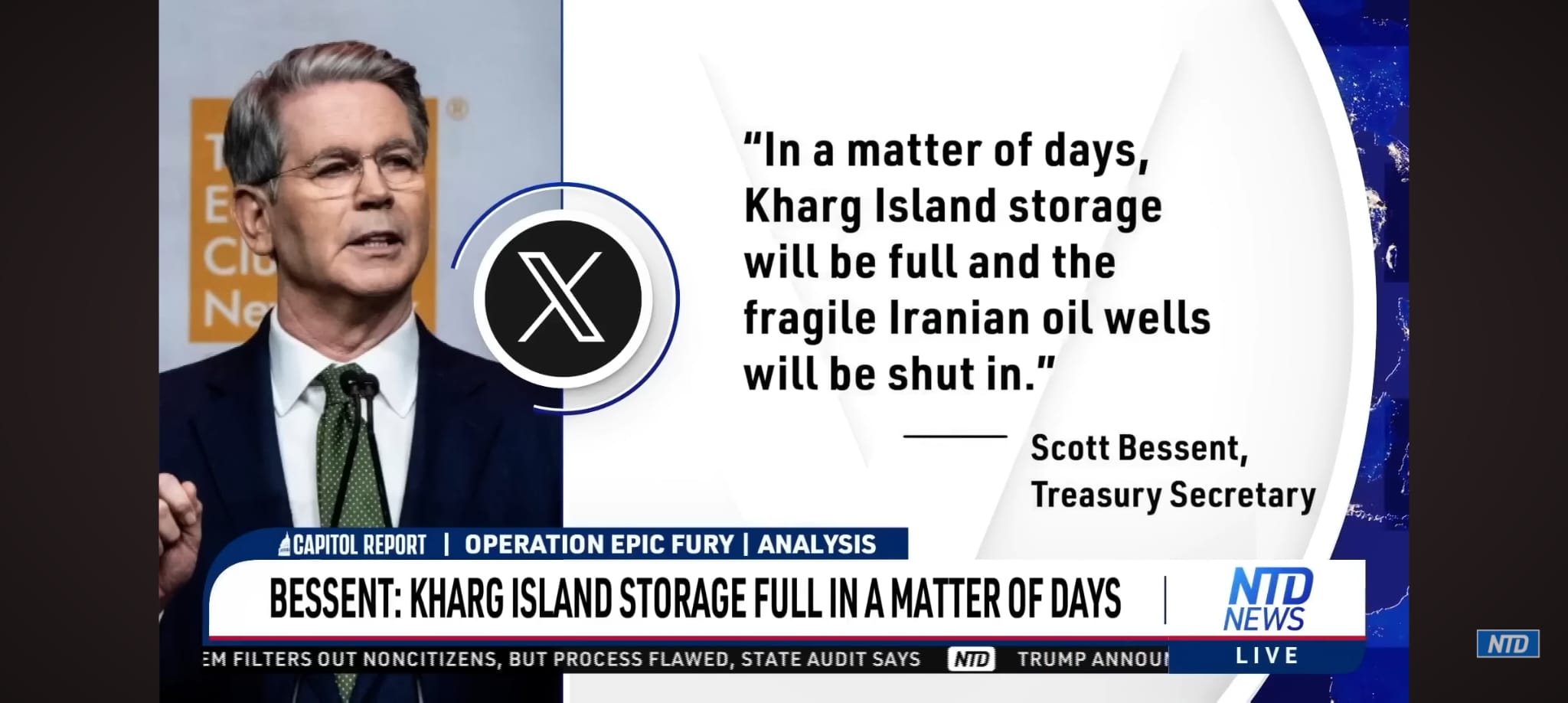
Author’s screen shot from NTD News. The statement was posted on Tuesday.

Note, a third Amphibious Assault Group, an aircraft carrier with an additional Marine Expeditionary Unit of 2000-2500 troops, has just arrived to join two other already in the Region. This further shows that Trump is increasing preparations to seize Hormuz, not backing down.

Continue reading

My Asharq: Russian oil to India, 40% of imports, ousting traditional suppliers. Borell wanted resale into EU stopped. OPEC: Investments must surge before Q3/Q4 Asian demand-&-price rise.

Asharq, Dubai (Bloomberg, Dubai) in Arabic, with Jordanian expert and myself. 22May23

I was interviewed (from Berlin) by Asharq (Bloomberg affiliate, Dubai) along with Jordanian oil and energy expert, Dr. Amer Al-Shobaki (from Amman) about OPEC leaders’ assertions that oil investment is urgently needed to meet an expected demand rebound, especially in Asia, in Q3-Q4 2023.

Investments have been precariously low for a long time, throughout COVID and even after 24 February 2022, with Russia’s full-on aggression against Ukraine. Now, OPEC warns later-2023 can bring big price spikes and deep economic problems.

I should note, this demand-and-price boost would be a boon to Russian oil prospects, complicating Ukrainian’s allies’ attempts to reduce Russian profits and limit the resale of Russian oil refined in India into the EU market. The G7/EU adoption of the USA-proposed price caps on Russian exports (enforced via constraints on oil-shipping insurance and banks financing of sales) instead of an “old fashioned” sanctions regime (such as specifically restricting Russian oil sales step-by-step via direct and secondary sanctions) has finally begun to significantly restrict the normally expected flow of oil-export-sales cash back into Moscow’s coffers, after a 2022 of high oil prices and big Russian profits.

EU foreign minister, EU Commission foreign relations chief, Josep Borell, has rightly asserted that the EU must do something to stop this resale, by adjusting present sanctions. However, unfortunately, the EU has now backed down substantially on this ambition.

On air, I referred to a report by Marianna Pàrrage, at Reuters, whose research has found that from January to April 2023, 1.69 million barrels per day (mbd), and 1.89 in May, went to India, now accounting for about 40% of India’s total. This has displaced India’s former Venezuelan, Middle East, African and USA suppliers.

Interestingly, Moscow has sold its oil, banned in the EU, USA and UK, in a very focused manner to India, China and Turkey, not Asia broadly, which could have market advantages for Moscow.

Continue reading

My Asharq with Saudi expert: MENA green hydrogen exports will be inefficient & counter-productive for climate. Renewables still almost “nonexistent”, nuclear is pragmatic.

My Asharq interview, along with Mohammed Al-Dabai, Saudi energy journalist, on 13 April 23. (This post has English interpreter’s audio and my voice over the Arabic. View in Arabic here.)

At about timestamp 5:30, I discuss the difficulties with the Gulf states exporting “green hydrogen” to Germany and the EU.

So little renewable carbon-free energy is produced in MENA and esp. in Gulf states (i.e., almost none), and it would be so inefficient to convert this into “green hydrogen” and then further into “green ammonia” (as many in Germany and the EU now advocate), and then to ship it all the way to Germany or elsewhere in the EU, that it would make little sense, except in so far as Germany and EU states are willing to pay a good price.

However, it would also leave the MENA region with little improvement in their carbon-heavy electricity consumption. Mr. Al-Dabai generally concurred on the “scientific” problems, as he described them, of producing and exporting green hydrogen.

We were discussing a recent Ember consultancy report (London, link below) on the progress of renewable electricity worldwide, and how there is little progress in the Gulf and larger MENA region.

However, I briefly pointed to nuclear developments, the building of new So. Korean Generation 3+ plants in the UAE, and to Saudi plans, as very promising.

However, as with other renewables-focused outfits, Ember doesn’t seem to see any value in this pragmatic approach, not to mention the benefits of coal-to-natural-gas switching as a very reasonable, carbon-emmissions-reduction strategy.

Continue reading

EU sets $60 Russian-oil-price cap. What now? [My Al Jazeera & Asharq (Blmbrg) interviews]

FIRST: Al Jazeera, 10:05 AM, 02.12.22 CET, Berlin & Doha: — English audio below, then Arabic video.

SECOND: Asharq (exclusive Bloomberg affiliate, Gulf) , about 10:00 PM, 02.12.22 CET, Berlin & Doha — English Audio below, then Arabic video.

Asharq live: No EU embargo agreed vs. Russian oil. Some too cautious (Germany), others pro-Putin (Hungary). Yet, EU has months of oil in storage. [EN audio, AR video]

Above: ENGLISH Audio }} Below: ARABIC video
I was on with the expert, Sona Muzikarova,a chief economist at GLOBSEC in Bratislava, Slovakia.

We discussed the EU’s repeated failures to impose an embargo in Russian oil. Now, (after Monday 30 May) they are considering a sea-borne-oil-only embargo.

Would EU sanctions on Russian oil cost Germany “too much”? No. Scholz & Habeck pose the wrong questions. [Asharq/Bloomberg live: En & Ar]

Above: English Audio || Below: Arabic Video
.

24 April 2022: My Asharq/live evening TV news interview is a bit over seven minutes.

Would an oil embargo be “effective”?

I respond, What is “effective”? Clearly it would not end the war. However, a Ukranian soldier who decides to give his life to resist the Russian invaders has no illusion that his or her sacrifice, on its own, will end the war. But, he will makes what contribution he can.

So, the German leadership refuses to send Ukraine heavy weapons, and certainly won’t send German troops. However, Germany and the EU can at least step up and make this contribution – sanctionRussian oil now. This will greatly hinder Putin’s ability, within two to three months, to finance his war.

  • We discuss the question raised by the German leadership – by Chancellor Scholz (SPD party), Energy and Environment Minister Habeck (Greens) and Finance Minister Lindner (FDP liberals) – that supposedly an embargo in Russian oil (or gas) would do more harm to German citizens than to the Russian leadership.
  • The argument heard repeatedly from Berlin is that this is “not worth it” and also, that such an embargo it “would not end the war.”
  • Also, I answer the question of how much oil could Putin’s Russia divert from Europe to India if the EU and Germany embargoed oil.

I think I posed useful answers to these questions given the time we had. Your thoughts and critiques are welcomed, and solicited.

Best, Tom O’Donnell, Berlin