Category Archives: oil

Answer to Ahmadinejad’s question over dinner: “To block your control of oil, like with Saddam.”

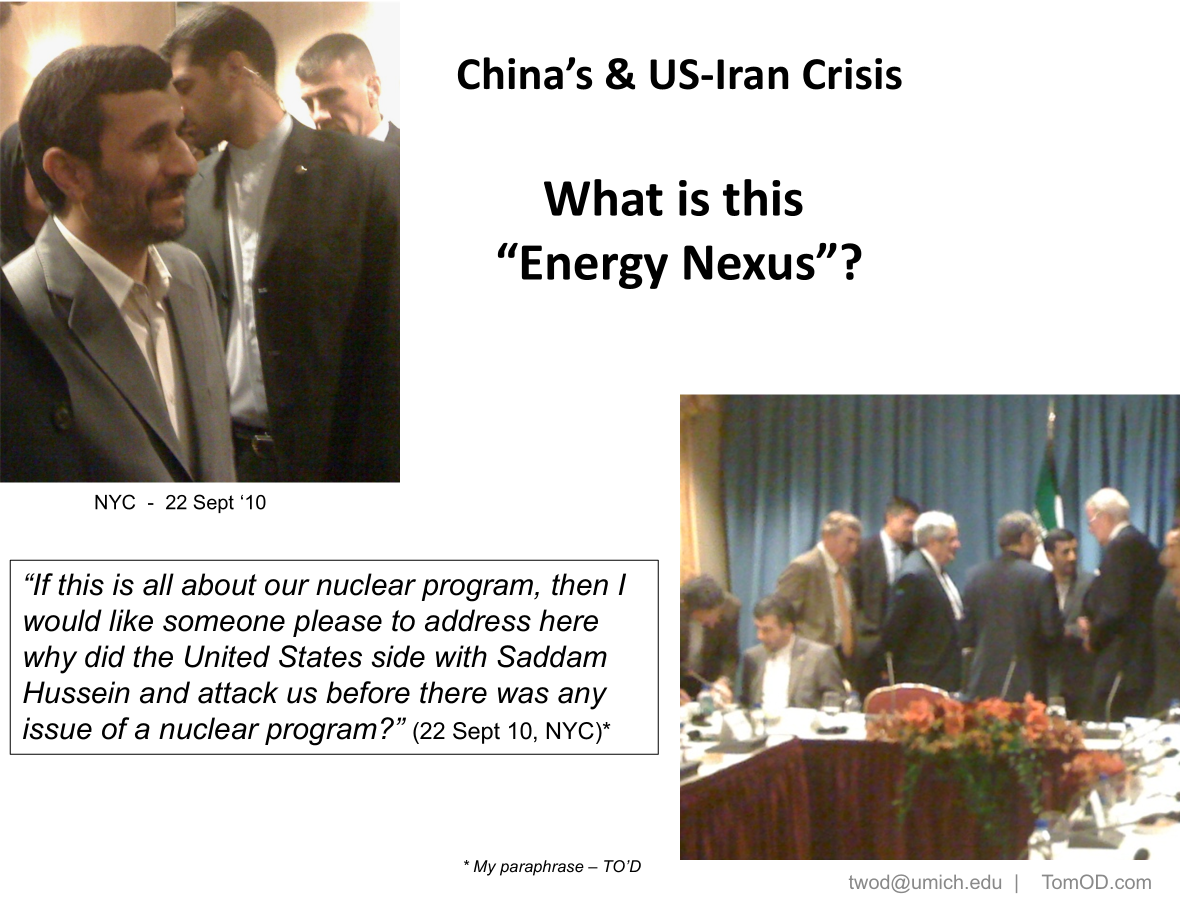
Pictures taken by the author (T.W.O’D) during a dinner and Q&A with President Ahmadinejad, in NYC during 2010 UN General Assembly opening. Note quote from Ahmadinejad.

Some years ago, I was invited to dinner with President Ahmadinejad in NYC during the annual opening of the General Assembly.

The American think-tanks, consultancies, and x-diplomats present went on and on asking detailed questions about this or that scenario where US experts might work with Iranian experts to observe or limit the Iranian nuclear enrichment program. (I mentioned this 2010 dinner in a later post: “China’s Iran-Oil Import Angst. Part I” Feb 13, 2012.)

It became rather tiresome. Ahmadinejad clearly was growing tired of it. He then asked us,

“If this is all about our nuclear program, then I would like someone please to address here why did the United States side with Saddam Hussein and attack us before there was any issue of a nuclear program?” (Iranian President M. Ahmadinejad, 22 Sept 10, NYC, my notes, T.O’D.)

Everyone ignored his question, and simply kept up with their obviously pre-prepared technical questions. But, what had he meant?

To me, clearly he was referring to the Iran-Iraq war (Sept.1980-Aug.1988), when the USA, at a certain point, decided to take Iraq’s side and, among other things, sunk the entire Iranian Navy in a day, took over air traffic control for the Iraqi air force, started directly advising Iraq on strategy, and etc.

In the end, Iran had to accept an Iraqi peace deal after a crushing defeat facilitated by the USA. I recall now all these details vividly. And, all this was indeed well before any nuclear program.

Aside: I find it disturbing that so many “experts” refer to the supposed “Iraqi defeat” in that war. This was all understood at the time. For example, I quote here from the NYT, (Sec. A, Page 1, of July 21, 1988): Ayatollah Khomeini had personally endorsed the cease-fire demanded by United Nations Security Council Resolution 598. Iran’s supreme religious leader confirmed, for the first time, that he had approved the resolution and added, with his characteristic rhetorical flair: ”Taking this decision was more deadly than taking poison. I submitted myself to God’s will and drank this drink for his satisfaction.” (Emphasis added to the most famous part of Khomeni’s statement. T.O’D.) Further research will quickly show he had to sign as Iran was being soundly defeated at the time, hence the “poison” he had to swallow. 

By the way, it is also known, at least in academic circles, from later extensive archival research, that the war with Iraq was planned and instigated by Iran, and that Iraq had attacked in response to Iranian provocations and signs of Tehran’s preparations, after warnings. I am happy to send references to those interested.

What I myself had been arguing, back then, during the Iran-Iraq War Ahmadinejad was referring to, was that the US-Iran confrontation was actually about the US opposition to any country, either from inside the Gulf Region or outside the Region, gaining hegemony over the Gulf and the Straits of Hormuz. This had to do with guaranteeing the free flow of oil, and that the global oil market would be a “real” market that no one state could unduly control. I had even coined a term, “The Global Barrel,” for this market-centered, post-OPEC-nationalizations collective oil-security system, a system initiated by Henry Kissinger in 1973.

Continue reading

USA sees Gulf energy flow as core interest. If no deal soon, Marines will take Hormuz. | My Asharq TV

Guaranteeing Gulf energy flows to allies has always been a core US interest, while today’s Great Power Competition means China’s access will be rendered conditional.

This is not the Iraq war. If after operations to secure the coasts and islands and to clear mines, the Iranian regime resists, the USA plan is that Iran’s oil sector and economy would be destroyed by aerial bombardment. Washington neither desires nor needs to occupy Iran proper nor to change the regime. The US strategic imperative here is to secure, long term energy flows from the Region and, accordingly, to end the regime’s capacities to project regional power.

After almost 30 years of analysis and my university seminars, there is very little I see new here, save a new USA urgency.

In my view, this urgency flows from USA concerns over Great Power Competition, especially with China. This is exacerbated by the possibility that Iran could close the Strait in solidarity with China (or perhaps Russia) during any Great Power conflict elsewhere. The threat of Iran’s developing capacities in this regard, especially its missiles and drones, but also its nuclear weapons ambitions and intentions to rebuild its regional proxy allies, all act to undermine the prerogatives of the USA and its Gulf regional allies to secure the region and its energy flows.

In any case, the idea that Washington and Trump “have no strategy” is demonstratively wrong, and self-disarming. (See, for example, my EIES study of Trump administration energy policy since ca. April 2025 v. Russian oil.) One might not fully understand the strategy, or might disagree with it, but there is clearly a multifaceted strategy here under the general slogan of “USA Energy Dominance” (e.g., see posts here and here). Besides Iran, it especially includes Russia, Venezuela, India, and of course China, as well as US domestic oil, gas, nuclear and renewables policies.

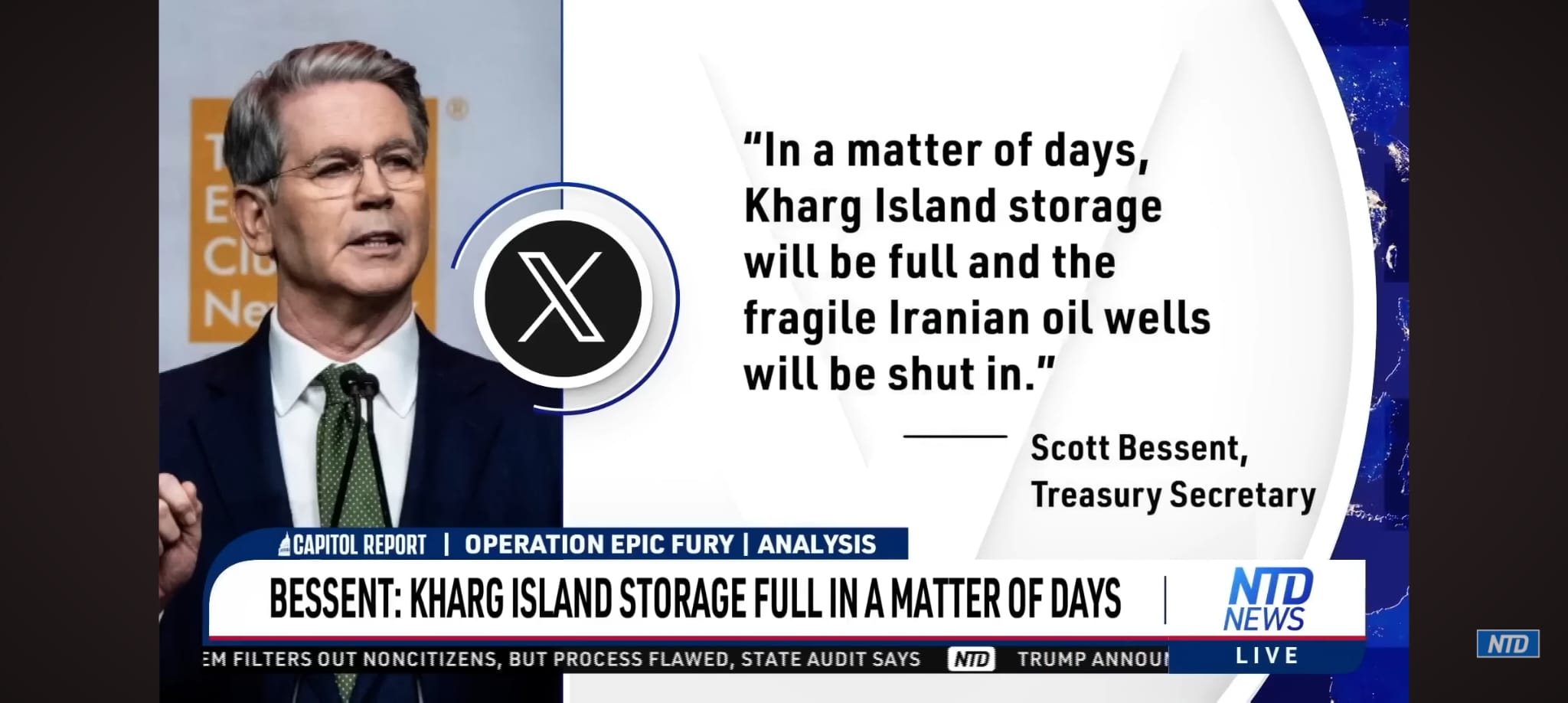
Author’s screen shot from NTD News. The statement was posted on Tuesday.

Note, a third Amphibious Assault Group, an aircraft carrier with an additional Marine Expeditionary Unit of 2000-2500 troops, has just arrived to join two other already in the Region. This further shows that Trump is increasing preparations to seize Hormuz, not backing down.

Continue reading

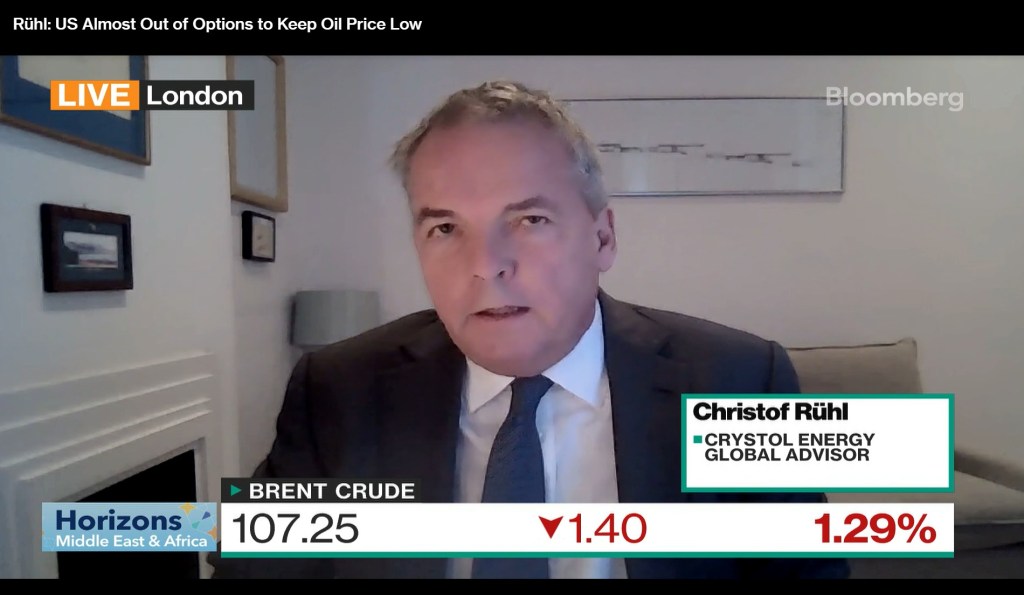
Trump’s Iran Talks & Oil Supply: Experts Rühl, Kemp & I Analyze

To watch at Bloomberg, click this URL

Both Christof Rühl (bio) and Jack Kemp (bio) had great, data-driven media this past week. I too addressed these issues (spoiler: I assess Trump is not bluffing on Iran talks, and oil supply remains adequate.) My conflict-trajectory take differs a bit from Chrisof, perhaps closer to Jack K here.. My Al Jazeera was just after Trump announced talks.

Jack Kemp with facts on oil supply vs. information one finds in the media.

“The Political Economy of Oil in the US-Iran Crisis,” T.W. O’Donnell, 2009. (Situating “US Energy Dominance”)

Dear readers, This paper, which I wrote in 2008-09, analyzed the evolution of interests underlying the US-Iran crisis till then, interests which persist in the 2026 US-Iran war.

That is, Trump’s “USA Energy Dominance” strategy does not seek to fundamentally alter the structure or logic of the post-1973 global, market-centered, USA-led-and-protected oil order. However, to preserve it, the USA now feels the necessity of removing the Iranian mullahs as custodians of Iran’s oil for persistently insisting on projecting power and seeking hegemony in the energy-critical Gulf Region.

What is new from 2008, is the bipartisan urgency felt in Washington to renovate the existing oil market-and-security order, reconsolidating the USA as primary arbiter of energy flows via Hormuz to both China and US allied and friendly states of the Indo-Pacific region. In addition, to be capable of significantly blocking Russian oil exports and thereby its petrostate-fueled aggression elsewhere.

In particular, it mush achieve these aims, vis-a-vis Russia and China, without causing global oil shocks. (continued in full-column below …)

Continue reading

TRT Roundtable: With Hormuz, the US will control half of China’s oil flow, secure Asian allies’ imports. Washington is taking Xi’s “by 2027” threat seriously.

My comments on the show.
Full show

Mar 12, 2026. Is the Iran war about the US containing China? For my part, I explained how control of Hormuz would give the US two key levers:

  1. The USA will control half of China’s oil imports, 5.4 million barrels per day (mbd), which flow through Hormuz.
  2. The USA will insure that during any Pacific war China might start that Iran, acting in solidarity with China, could not block oil flows to US Asian allies such as Japan, S. Korea, Australia, Philippines, or flows to others whose supplies it would also want to guarantee, such as Viet Nam, Indonesia, Malaysia, Singapore, etc..
Continue reading

With Iran & Hormuz, the US would act as arbiter of China’s Gulf oil & LNG access, while ensuring access for Indo-Asian allies. Venezuelan oil growth will enable Trump to impose phased cuts of Russian exports, after the Iran war. [Kanal24, Kyiv]

This is a longish, ca. 30 minute video. Host Nataly Lutsenko kindly told me she wanted to make a long interview.

(During time of crisis like this, I have so many TV and press interviews that I don’t have time to put most of them online. So, I will refrain from writing long posts to accompany videos to get more online, if I think they are useful interviews. – Tom O’D)

My TRT London: “US Energy Dominance” & global glut give Trump historic leeway to hit Iran without an oil crisis.

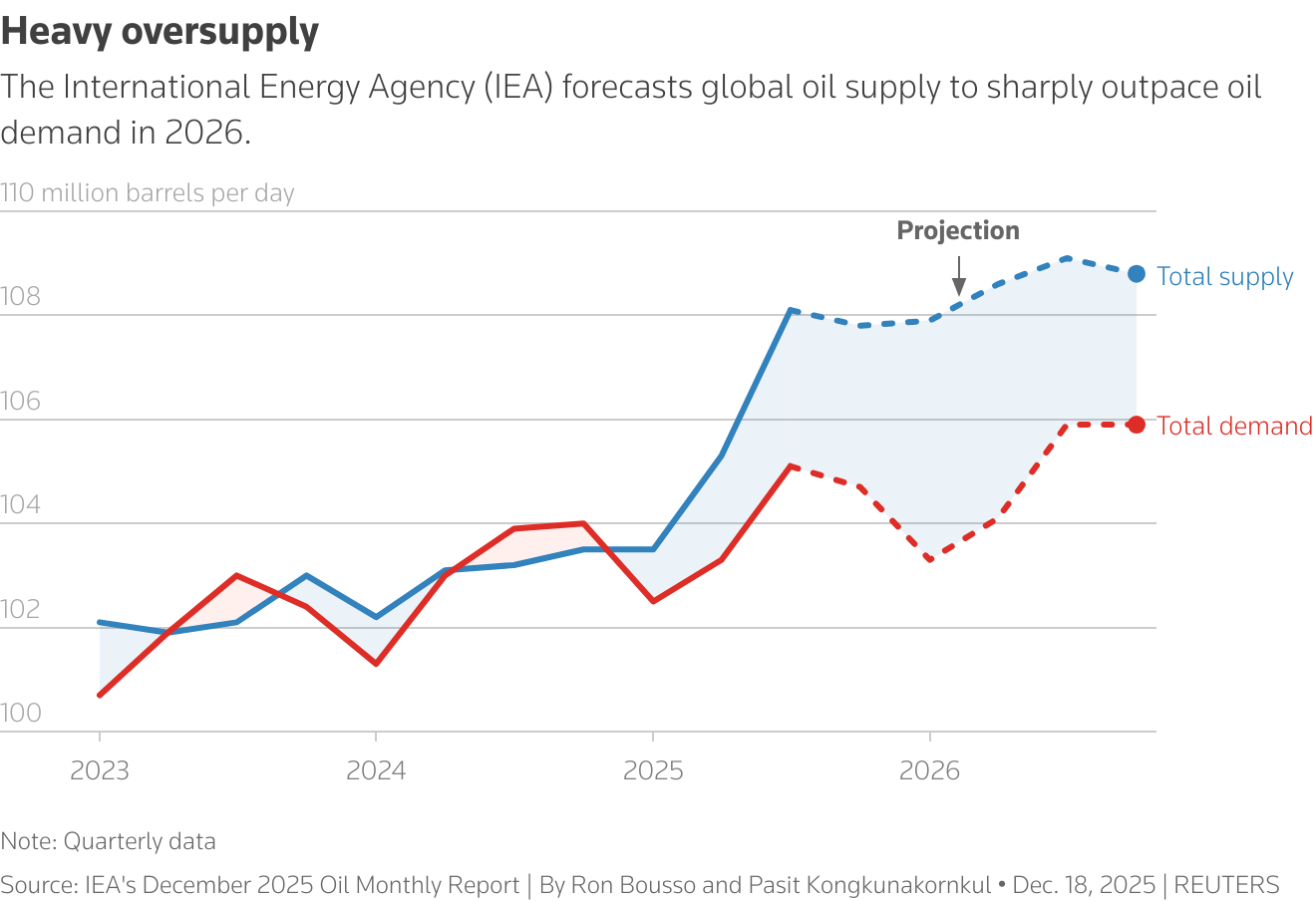
Last night on TRT World Global News (London), I emphasized that despite the modest spike in oil prices from about $70 to $78 per barrel as of yesterday, Trump has an historically unprecedented advantage for exercising “US Energy Dominance.”

Fig. 1. IEA projects global oil glut throughout 202

The campaigns against Venezuela and Iran, plus the turning of the Indian oil-consuming behemoth towards USA and Western interests vs Russian oil, are examples of the geopolitical leverage the USA’s now-dominant role in global oil affairs has afforded the Trump administration.

This oil-market advantage comes mainly from of two things:

Continue reading

“12-Day War”: Why no energy crisis? Iran regime was cornered. Seeing USA’s limited aims, it dared not escalate, gave up. | My Al Jazeera comments

The ceasefire Trump brokered will hopefully end this “12-Day War.” I want to discuss here why this war did not trigger a global energy crisis. [Here’s what I said about this to Al Jazeera last week, in the last five paragraphs. A PDF is also embedded below. I’ll also post a TRT-London show on Iran’s nuclear strategy, recorded Tuesday, soon.]

To assess the risk to energy supplies, understanding the aims of the combatants is key. Throughout this war, it was the USA-Israel side setting the agenda, and there were two strategic aims they could pursue. One was to “only” destroy Iran’s nuclear program and its existing conventional regional power-projection capacities. The second was to go beyond this to undermine the viability of the Islamic Republic, up to forcing a regime change. Why do I say this?

Continue reading

My Al Watan(Cairo): Iran would seek global energy crisis if an Israeli/USA strike threatened regime survival | IEA warns on EU winter gas

ENGLISH Interview | Al Watan, Cairo.  Thurs 10Oct24. 15 minutes
ARABIC Interview

At first, we focused on IEA warnings of a possible EU winder gas shortage due to supply-and-demand mismatches. I agree and expand on the IEA points.

Second, I explained that if Israel retaliates against Iran so strongly that it threatens the regimes survival, or is seen as intending to provoke regime change, then the Iranian leadership will have “nothing to lose” by in-turn escalating to the maximum. Aside from unleashing the maximum response of its proxies surrounding Israel, Tehran’s most potent weapon would be to spark a global oil and gas crisis.

Consider oil: Iran can either shut down the Straights of Hormuz (or simply make them unsafe for tankers) and/or, it can use missiles and drones to destroy significant parts of Saudi, UAE and other Gulf oil facilities, including perhaps even Azerbaijan’s as some Iranian propagandists have threatened.

Consider natural gas: Shutting the Straights or directly hitting Qatar’s massive LNG exports infrastructure would immediately stop Qatari LNG exports. As the world’s second largest LNG exporter, this would immediately cause a separate global natural gas crisis.

Continue reading

My BBC(Cairo)+Alhurra(Wash DC): What if Israel bombs Iran’s oil? Does Israel have an end strategy? “Smite enemies, repeat in 10 years”?

Again, oil security is determined by both global-market balances and geostrategic realities – at present the Mideast war and Russia’s War on Ukraine. My analyses this weekend were featured in: (a) an AlHurra video (LHS English, RHS Arabic), and below these (b) a detailed BBC-Cairo print interview (LHS English Google Translate, RHS Arabic original). where I make similar points as my Friday video in Warsaw.

Alhurra ENGLISH. My comments at 2:45 & 8:20. Date: 5 Oct 2024, with co-guest GPI President Paolo von Schirach, Washington.
Alhurra ARABIC, 5 October 2024

My BBC (CAIRO) print interview in Arabic and English (Google Translate):

Continue reading

What if Israel bombs Iran’s oil? Four points on market & geopolitics. Video-Warsaw 03oct24

Recorded Thurs AM, 03Oct24. Warsaw Old Town, Castle Square.

Will Israel hit Iranian oil infrastructure? And, what part of it? To what effect on markets, and geopolitics, (i.e., Mideast, OPEC, Russia and Ukraine war)? A video report.

MAIN POINTS (see transcript):

1. What if Israel hits Iran oil infrastructure in retaliation for missile strikes on Tel Aviv on Tuesday night? 1.a. The difference effects of hitting Iranian refineries vs oil export terminals In itself, neither target would make big difference in the market. The market would immediately jump, of course, but in principle the effect would be small. 1b OPEC+ and Western Hemisphere have plenty of spare capacity.

2. Consider Saudi market tactics … reportedly they want to now go for share over price support, as price support is failing after well over a year of output cuts (about 6 mb/d). Note: Shortly after this recording the Saudis repudiated the WSJ that reported the switch in tactics to defending share. Likely they’ll now want to wait and see what happens to Iranian exports, or if this Israel-Iran tit-for-tat gets out of hand.

Continue reading

Le dije a Radio Clarín Buenos Aires: Putin amenaza con cortarle el gas a la UE/Alemania, pero no tiene otra fuente de dinero. Si lo hace, Biden y la UE organizarán un “Gas-Lift” … [Spanish]

Lo sentimos, la calidad de la comunicación celular desde Alemania no es buena. Por lo tanto, he escrito mi respuesta larga a la primera pregunta a continuación. Las otras preguntas también están abajo. Muchas gracias a los periodistas de Radio Clarín y La Nacion en Argentina (y en París).

Re: Urgente Pedido de Entrevista Periodística – Corresponsales Clarín y La Nación – Argentina

De Maria E… … Fri, Apr 29, 11:50 PM

Dr. O ´Donnell, … Estas son las preguntas para la entrevista del domingo:

1¿Alemania tiene otra posibilidad que no sea seguir comprando el gas ruso? ¿Cuáles serían sus otras opciones?

Repuesta: Antes que nada, muchas gracias por esta oportunidad de hablar con su audiencia argentina.

Pues, debo señalar que hay dos problemas diferentes: el suministro de petróleo ruso a Alemania y Europa y el suministro de gas ruso a Alemania y Europa. Me preguntas por el gas. El gas es mucho más difícil para Europa y para Alemania que el petróleo Hay dos casos: una reducción gradual o parcial de gas o un corte inmediato.

Un corte gradual se puede manejar bastante bien. Ahora Putin está tratando de dividir y conquistar Europa cortando el suministro de gas a Polonia y Bulgaria.

Un recorte inmediato, ya sea por parte de Putin o debido a las sanciones de la UE, crearía una gran crisis energética en Europa. Sin embargo, es importante entender que, al final, Putin está en una posición mucho más débil.

Si Putin corta todos los suministros de gas a Europa, ahora no hay suficiente gas en el mercado mundial para compensar. Pero Occidente, y especialmente EE. UU., la administración Biden, se ha estado preparando para esto al menos dos meses antes de que Putin invadiera Ucrania, incluso antes de que Europa creyera las advertencias de EE. UU. de que Putin atacaría Ucrania.

Continue reading

Putin’s OPEC tactics: Iran sanctions and the Saudis [IBD cites me]

dc-Cover-p9fbkcs8ccuhvnnnubuhqc2fn7-20161201210531.Medi

June 2018 OPEC meeting’s key players (AP)

Last week, Gillian Rich at Investor’s Business Daily (Washington), asked me (Berlin) and others about the OPEC’s 20-21 June meeting. Below here, I give my views in more detail, including the tie-in to the Trump project to isolate Iran and my comment about Putin likely betraying the Iranians again.  The IBD piece is here: Trump Could Make OPEC’s Next Meeting As Dysfunctional As G-7 Summit. 15 June ’18.

We spoke about market and geopolitical aspects. On the latter, I emphasized both the Trump Administration’s evolving plan to sanction and isolate Iran, and Russia’s new role as a central player with OPEC ever since the 2016 joint Russian-OPEC decision to raise production.

That’s when Putin played a new role for any Russian leader. Not only did he coordinate Russian oil policy with OPEC’s, he got personally involved in heated discussions, getting on the phone late in the last night with Iranian and Saudi leaders to get the deal sealed. Continue reading

Putin’s new OPEC role reflects the toll of low oil prices on Russia [IBD quotes me]

I was interviewed by Gillian Rich at Investors Business Daily (Washington, DC) on non-OPEC Russia’s role in the production cut.  The article of December 9, is below. A few points first:

1: President Putin and his minister of energy Alexander Novak‘s participation in the OPEC decision – actually making middle-of-the-night phone calls to mediate between Iran and Saudi Arabia, plus publicly promising to cut Russian production – is totally unprecedented. Never did the Soviets, nor  post-Soviet Russia  ever do any such thing previously. Why now?

2: As Rich quotes me as saying, oil prices below $60/barrel impose severe constraints on the Russian state’s income. Indeed, the federal budget has actually been based on $50/barrel, and yet the difficulties are apparent. Although Russian oil production is now at a post-Soviet all-time high, low prices have caused the state’s oil and gas income to severely drop. Here is the EIA’s assessment as of October 2016, showing the correlation of Brent price fall (in both dollars and Rubles) on the left, and the decline in oil and gas federal budget revenue on the right:eia_russia_oil_20oct16

But, how much of Russian national export revenue is derived from oil and gas revenue? The EIA (in 2014) puts this at 68%. Here’s the breakdown:  eia_russian_oil_gas_exprot_revenue201300

Continue reading

My CNNMoney quote & 3 points: OPEC v shale, Russia’s new role & Trump-buddy Hamm is pro Saudi price band


160928163540-opec-algeria-384x216I was interviewed by Matt Egan of CNNMoney. Three points, if I may:

  1. This story echoes my message in Berlin Policy Journal earlier this week and my RTRadio interview: OPEC now has to live with a new oil-market paradigm where shale  won’t disappear (for now its in the US, but soon elsewhere too).  It is a technology more akin to manufacturing than traditional oil extraction and so more amenable to technological and operating innovation in a low-price regime (or in a price war such as the Saudis et al have just given up on waging against it). And, being much smaller-in-scale means it can ramp up at much lower initial costs and more rapidly than traditional oil fields. The CNNMoney story is below here, or here’s the CNN ink .
  2. Another totally new phenomena seen in this OPEC deal was that a Russian leader was deeply involved in the tense OPEC negotiations, specifically between Iran and Saudi Arabia. Russia has never done this before. Historically, it has also never carried through on previous promises to support an OPEC cut, instead free-riding on higher prices effected by OPEC/Saudi cuts.  In this case, Putin was instrumental in getting the Saudi’s to agree, as they always have before, to swallow most of the cuts. But, Putin has agreed to cut too (in ambiguous language, but repeatedly). We shall now see if he and Igor Sechin (CEO of Rosneft, that produces 40% of Russian oil, and who is, by the way, a great friend of Venezuela’s miserably failing chavista leadership, where his company is now the biggest foreign oil producer) … do as they have promised OPEC and the Saudis. If they do not, the fallout with Saudis and their allies will be significant.
  3. Now, also, we shall see how US shale responds. Of course, IEA head, Fatih Birol, has understandably predicted that US shale and other producers, will likely hike production if oil reaches $60/barrel and simply eat up the present OPEC cuts in about nine months or so. (Aside: of course, the present output cuts, even if they ‘fail’ in the long run to sustain higher prices, would still have had been a significant cash-boosting relief to all OPEC states and to Russia while they lasted.)  However, take a look at the Bloomberg video link at the end of my Berlin Policy Journal piece – an interview with Howard Hamm, Trump’s billionaire fracking close-ally (who has just turned down an offer to run the Department of Energy). He had told Bloomberg he expects OPEC to make a deal because “it makes sense” and, further, that he expects/hopes his US fracking colleagues will show ‘discipline’ after the price rise, i.e., not expanding too fast so as to keep prices up.  An interesting, de facto recognition that price wars, in the end (in the long run), do not benefit either side, and goes on to approvingly say that the Saudi’s want to once again maintain prices “in a band” as they used to do. It is clear from Hamm that this would all be very welcomed from the US side. (Note, Hamm’s Continental Energy company made $3 billion in just three hours after the OPEC deal boosted prices! ) Indeed, in light of such everlasting market realities, it is difficult to imagine Trump’s attitude to the Saudi’s will be much different than other US president’s over the years. Which has geopolitical implications for Iran, of course, as the Saudi-Iranian geopolitical competition for regional influence and their parallel oil-market competition both continue to heat up.

Here’s the CNNMoney piece by M. Egan of 1 December 2016 (with my quote highlighted): Continue reading