Guaranteeing Gulf energy flows to allies has always been a core US interest, while today’s Great Power Competition means China’s access will be rendered conditional.
This is not the Iraq war. If after operations to secure the coasts and islands and to clear mines, the Iranian regime resists, the USA plan is that Iran’s oil sector and economy would be destroyed by aerial bombardment. Washington neither desires nor needs to occupy Iran proper nor to change the regime. The US strategic imperative here is to secure, long term energy flows from the Region and, accordingly, to end the regime’s capacities to project regional power.
After almost 30 years of analysis and my university seminars, there is very little I see new here, save a new USA urgency.
In my view, this urgency flows from USA concerns over Great Power Competition, especially with China. This is exacerbated by the possibility that Iran could close the Strait in solidarity with China (or perhaps Russia) during any Great Power conflict elsewhere. The threat of Iran’s developing capacities in this regard, especially its missiles and drones, but also its nuclear weapons ambitions and intentions to rebuild its regional proxy allies, all act to undermine the prerogatives of the USA and its Gulf regional allies to secure the region and its energy flows.
In any case, the idea that Washington and Trump “have no strategy” is demonstratively wrong, and self-disarming. (See, for example, my EIES study of Trump administration energy policy since ca. April 2025 v. Russian oil.) One might not fully understand the strategy, or might disagree with it, but there is clearly a multifaceted strategy here under the general slogan of “USA Energy Dominance” (e.g., see posts here and here). Besides Iran, it especially includes Russia, Venezuela, India, and of course China, as well as US domestic oil, gas, nuclear and renewables policies.
Note, a third Amphibious Assault Group, an aircraft carrier with an additional Marine Expeditionary Unit of 2000-2500 troops, has just arrived to join two other already in the Region. This further shows that Trump is increasing preparations to seize Hormuz, not backing down.
If there is no deal with the regime “soon”, in the Pakistan talks or otherwise, US Marines will take the shores and islands of the Straight, which is what “marine” forces do, while the Navy continues its ongoing robotic clearing of mines.
On the other hand, if Iran makes a deal, besides ensuring US control of Hormuz, Trump will very likely ensure that the 80% of Iran’s oil exports, which are shipped via Kharg, will be permanently placed under USA supervision, as already are both Iraq and Venezuela’s oil revenues.
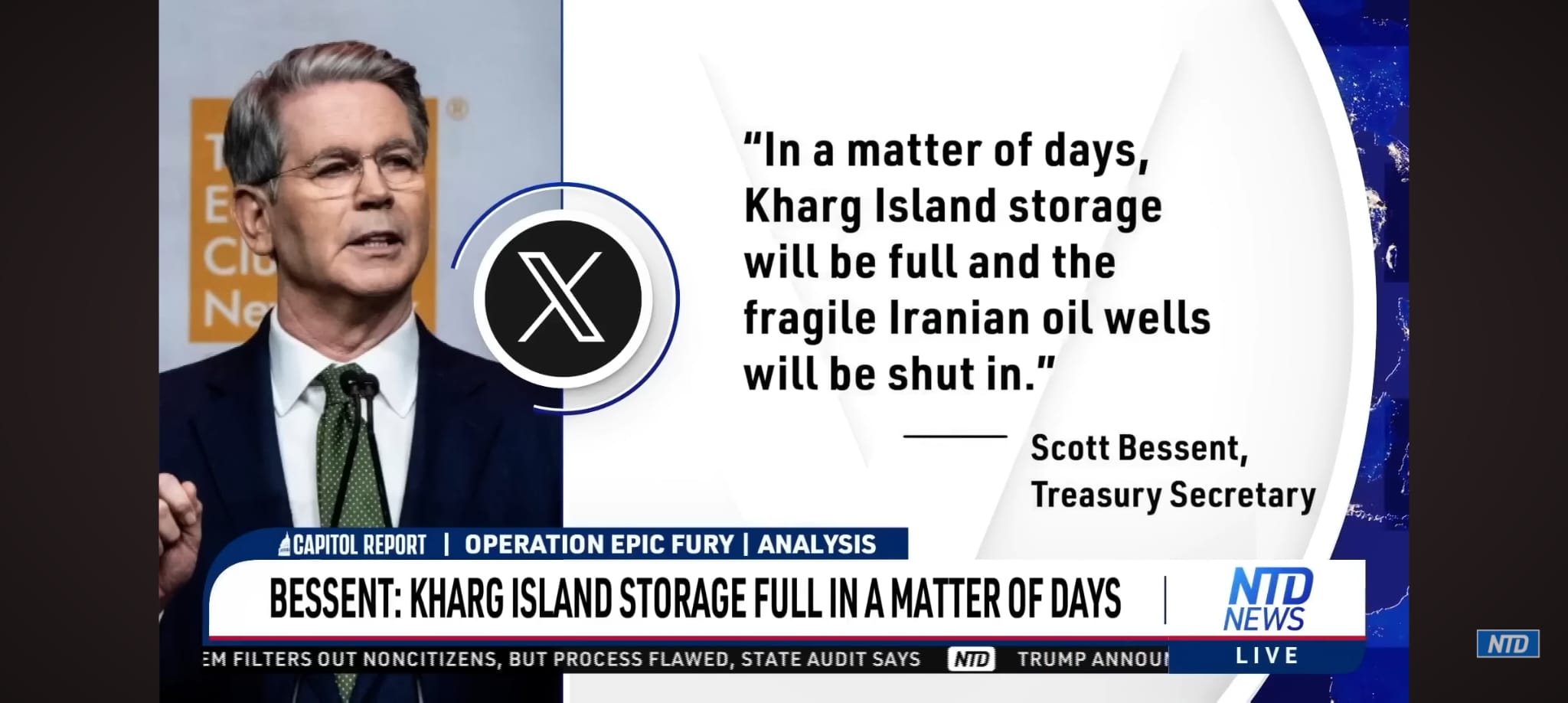
Furthermore, as to the seriousness of economic pressure being applied: Treasury Sec. Bessent wrote earlier this week(see screen shot graphic) that, because the USA has blocked Iranian exports, Kharg Island storage tanks were only “four days” from being full. This, he explained, will force Iran to “shut in” “fragile oil fields.” In other words, the USA is credibly threatening long-term destruction of a significant part of the resource basis of Iran’s national economy.
Meanwhile, what would happen to the rest of Iran, to its large cities and inhabited country sides? Occupation or detailed control of the country proper is not a USA “core interest.” If Iran were to continue to threaten Hormuz or USA Gulf allies, I have no doubt that Trump would simply channel former-V.P. Dick Cheney and President G.W. Bush’s often-stated strategy of not putting “boots on the ground” but, rather, to simply “stand off” and “bomb them back to the Stone Age” – a well-known Cheney formulation, which Trump has lately revived.
I would assess that this general strategy has a reasonably good chance of success, though there are many “unknown knowns” as well as “unknown unknowns” as former-Secretary of Defense Donald Rumsfeld would put it, where IRCG and Iranian Armed Forces might persist in costly strikes against both US force and shipping. This possible resistance has to be taken very seriously. However, this is quite different from resistance by local forces to occupation in heavily populated areas, or similar, such as was involved in Iraq and Afghanistan. Here, the Straight is bordered by relatively empty territory, albeit mountainous. I interpret the fact that Trump is going to such lengths to try to make a deal – something Dick Cheney or Donald Rumsfeld never significantly bothered to engage in when threatening Iran- speaks to the US interest in avoiding such future long-term costs.
I should stress that, independent of whomsoever is president, USA Gulf Regional energy predominance, specifically protection of and prerogatives over its energy flows, has consistently been at the core of the USA’s global superpower status. More particularly, this control has become a key for US success in today’s “Great Power Competition” against Russia, the great oil exporter, and against China, the great oil importer
For example, Barak Obama, as president, bluntly told the UN General Assembly, that the “free flow of energy” from the Region is a USA “core interest,” which it was his job to “guarantee” — as I wrote here in 2013. (“For Obama, an Iran deal trumped Syrian aid: USA “core interests” are in “flow of energy” Nov. 16, 2013). Trump clearly agrees, as has every other president since 1973.
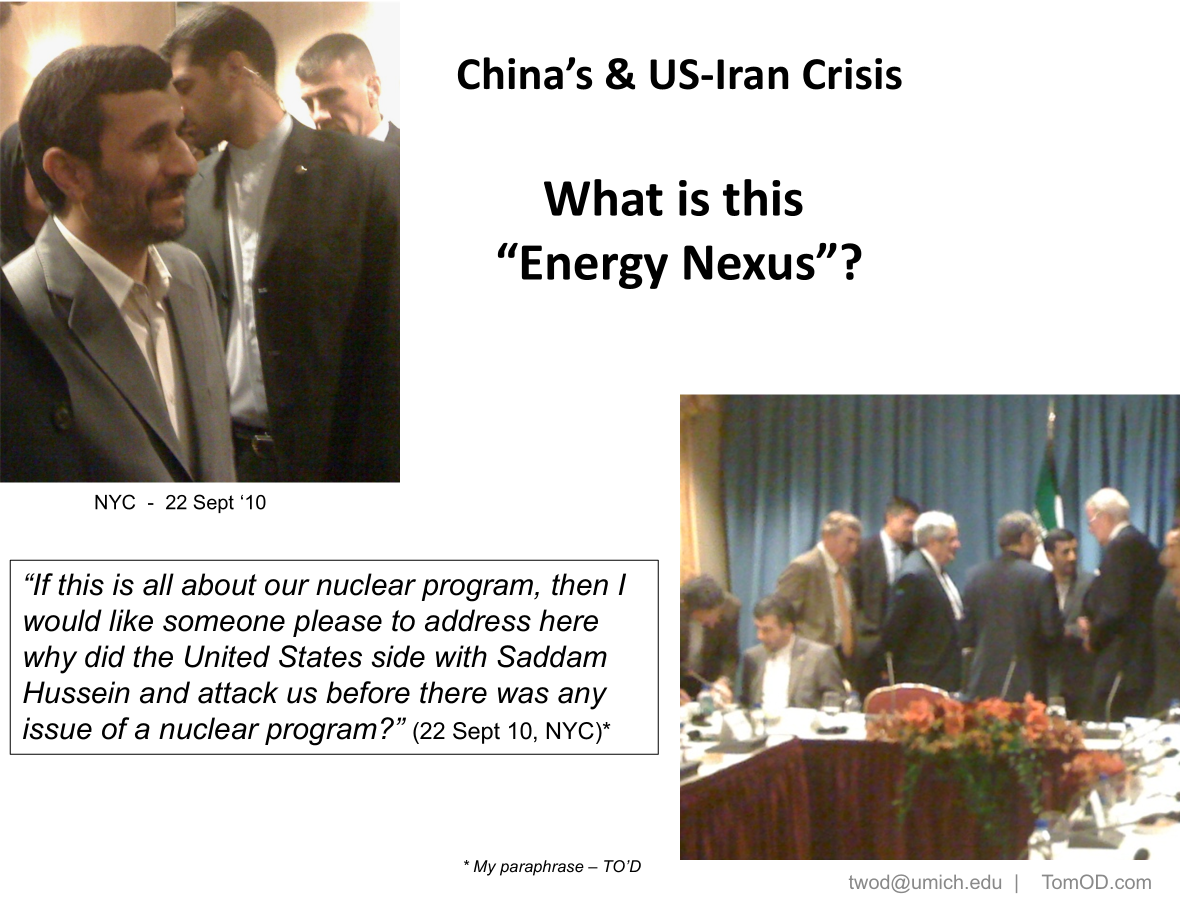
A question Iran’s President Ahmadinejad once asked us, over dinner in NYC, illuminates all this. (To be continued in another post, soon. T. O’D.)