TRT-London asked me tonight about oil-market impacts of the deal between Iran and Oman. The title says most of it.
Of course there has been hardship globally with higher energy prices and volatility. However, compared to what would have happened 10 or 20 years ago, this is very significantly smaller.
Oil on average has been up only 25%, and refined products 36% since 28 Feb. (“Why Oil Prices Could Hit a Breaking Point by Year End,” WSJ, Video, 3aug26). Why?
The huge surplus in oil production that was building globally for at least three or four years, plus the constantly falling energy intensity of the economy, plus the high degree of interconnectedness of the one-global-barrel market (the name of this blog for the past 15 years) explains this relatively mild impact thus far. I explained this, and the geopolitical advantage, the long time line, it has given Trump and Washington to go slow and talk a lot as compared to the urgency they would have had earlier.
This is both a case of:
a) More oil being produced globally due to huge advances in petroleum and gas exploration and production (E&P) technologies, Especially in the USA, where a new “Fracking 4.0” stage of the Shale Revolution seems to be underway, one that could boost extraction rates of previously drilled wells by factors of 50-300%, according to various industry tech reports. This is all about US high tech and perfecting of methodologies. (See, Javier Blas, “Shale Oil’s Next Revolution Should Worry OPEC” Bloomberg, 30Nov25).
In addition, there have also been significant tech improvements in deeper offshore production, and in exploration generally, leading to a lot of new, large-sized proven reserves to exploit And,
Maxym Krapivnyy, host at Ukraine’s Kanal24 in Kyiv, spoke with me recently while I was in the USA about: Ukraine’s drone war vs. Russian energy, Russia’s economy, and the USA’s expanding energy war targeting Russia, Iran, Venezuela, and India’s Russian oil imports. I explained that soon, the late-Lindsey Graham’s (R, S.C.) and Richard Blumenthal’s (D., Conn.) “draconian” secondary sanctions bill is expected to be signed by Trump, blocking most Russian oil exports. (Note: the Senate yesterday voted 86-12, to advance the bill. See Blumenthal, here.)
However, Maxym also then asked my view on the likeliness of Putin soon agreeing to serious peace talks. I said I expected Russia would be unwilling to soon end the war even if its forces were pushed back to the Russian border. Why? To admit defeat would devastate Russian credibility as a Great Power in Eurasia and beyond. (See below for a comparison to the USA in Vietnam.)
On the energy war, I stressed that Russia is well known to be a petrostate. Russia’s wealth and capacity to finance aggression abroad overwhelmingly depends on its oil export revenues. Russia’s continued existence as a-petrostate is what the ongoing Ukrainian and USA energy offensives are targeting, on two main fronts.
There are two sides to this energy war. One is the Ukrainian’s kinetic war against Russia’s domestic refineries, the other is the USA and allies’ global sanctions offensive. Both aspects are evolving in breath and complexity:
First, there is the Ukrainian drone and missile campaign, including deep strikes against domestic Russian oil refineries and infrastructure. This has been gaining in success. I pointed out that these attacks have to, however, increase still more, requiting heavier missiles to close refineries and oil export terminal ports for sufficient time to render repairs unprofitable. However, Ukraine is now testing and has begun to produce such heavier weapons, which should be available in the short-to-medium term. We discussed Russia’s refined product supply problems, and what Ukraine must yet accomplish.
Second, oil which increasingly cannot be refined is pouring into Russian export terminals, its big Baltic and Black Sea oil ports. This was already the situation before the Iran war began on February 28. At that time, oil that could not be refined due to drone attacks was being loaded on ships for export. However, with USA sanctions having been intensified, many of these ships had no customers, it had nowhere to go. During the initial phase of the Iran war, the USA allowed India and other allies to purchase this oil (i.e., it unsanctioned oil already loaded on ships without any clear destination) to avert it going to China. This accumulation is apparently again building up, for the same reasons.
the USA now maintains sanctions against Russian oil firms Rosneft and Lukoil, and is working to supply India with non-Russian oil to end its Russian oil purchases, making it harder for Russia to find export markets besides China. However, the reclosing of Hormuz will of course make this somewhat easier for Russia to find buyers.
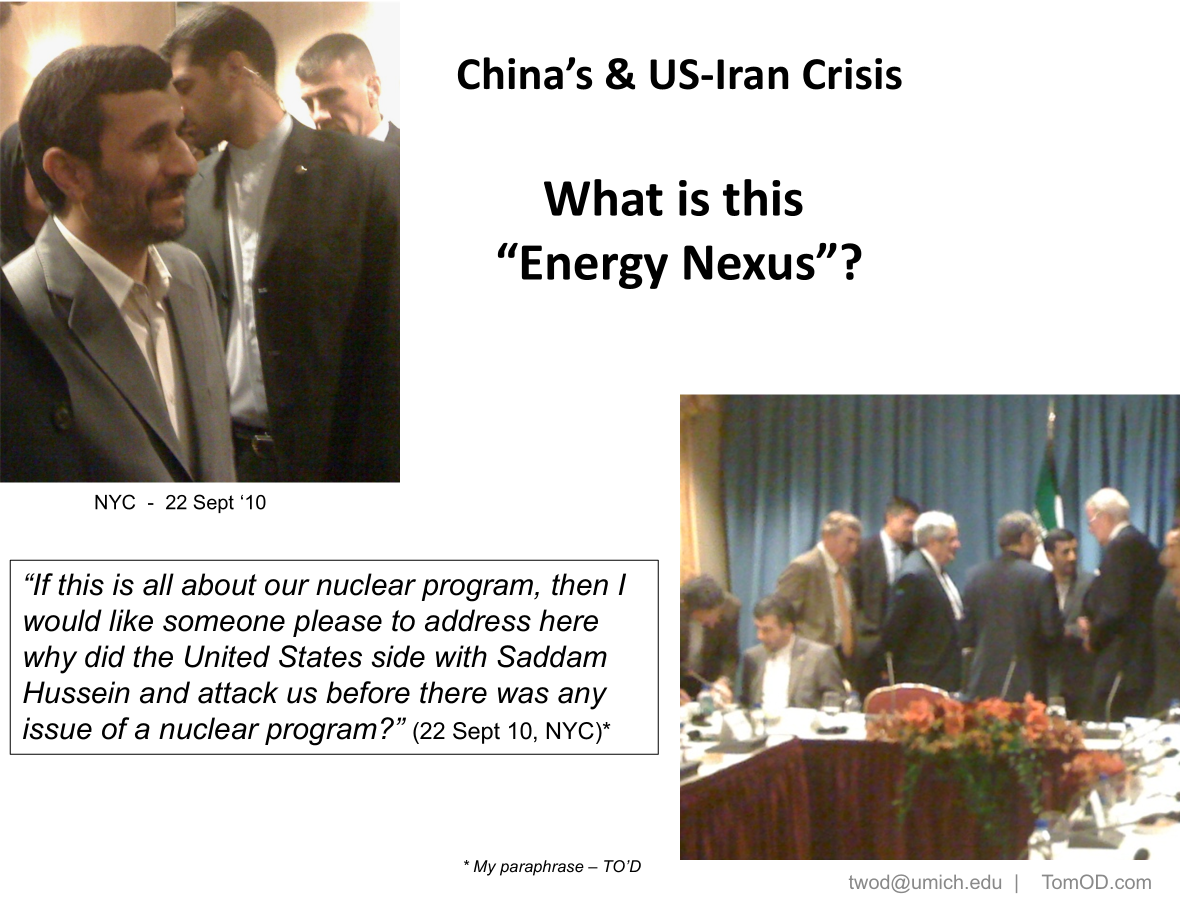
Pictures taken by the author (T.W.O’D) during a dinner and Q&A with President Ahmadinejad, in NYC during 2010 UN General Assembly opening. Note quote from Ahmadinejad.
Some years ago, I was invited to dinner with President Ahmadinejad in NYC during the annual opening of the General Assembly.
The American think-tanks, consultancies, and x-diplomats present went on and on asking detailed questions about this or that scenario where US experts might work with Iranian experts to observe or limit the Iranian nuclear enrichment program. (I mentioned this 2010 dinner in a later post: “China’s Iran-Oil Import Angst. Part I” Feb 13, 2012.)
It became rather tiresome. Ahmadinejad clearly was growing tired of it. He then asked us,
“If this is all about our nuclear program, then I would like someone please to address here why did the United States side with Saddam Hussein and attack us before there was any issue of a nuclear program?” (Iranian President M. Ahmadinejad, 22 Sept 10, NYC, my notes, T.O’D.)
Everyone ignored his question, and simply kept up with their obviously pre-prepared technical questions. But, what had he meant?
To me, clearly he was referring to the Iran-Iraq war (Sept.1980-Aug.1988), when the USA, at a certain point, decided to take Iraq’s side and, among other things, sunk the entire Iranian Navy in a day, took over air traffic control for the Iraqi air force, started directly advising Iraq on strategy, and etc.
In the end, Iran had to accept an Iraqi peace deal after a crushing defeat facilitated by the USA. I recall now all these details vividly. And, all this was indeed well before any nuclear program.
Aside: I find it disturbing that so many “experts” refer to the supposed “Iraqi defeat” in that war. This was all understood at the time. For example, I quote here from the NYT, (Sec. A, Page 1, of July 21, 1988): Ayatollah Khomeini had personally endorsed the cease-fire demanded by United Nations Security Council Resolution 598. Iran’s supreme religious leader confirmed, for the first time, that he had approved the resolution and added, with his characteristic rhetorical flair: ”Taking this decision was more deadly than taking poison. I submitted myself to God’s will and drank this drink for his satisfaction.” (Emphasis added to the most famous part of Khomeni’s statement. T.O’D.) Further research will quickly show he had to sign as Iran was being soundly defeated at the time, hence the “poison” he had to swallow.
By the way, it is also known, at least in academic circles, from later extensive archival research, that the war with Iraq was planned and instigated by Iran, and that Iraq had attacked in response to Iranian provocations and signs of Tehran’s preparations, after warnings. I am happy to send references to those interested.
What I myself had been arguing, back then, during the Iran-Iraq War Ahmadinejad was referring to, was that the US-Iran confrontation was actually about the US opposition to any country, either from inside the Gulf Region or outside the Region, gaining hegemony over the Gulf and the Straits of Hormuz. This had to do with guaranteeing the free flow of oil, and that the global oil market would be a “real” market that no one state could unduly control. I had even coined a term, “The Global Barrel,” for this market-centered, post-OPEC-nationalizations collective oil-security system, a system initiated by Henry Kissinger in 1973.
Guaranteeing Gulf energy flows to allies has always been a core US interest, while today’s Great Power Competition means China’s access will be rendered conditional.
This is not the Iraq war. If after operations to secure the coasts and islands and to clear mines, the Iranian regime resists, the USA plan is that Iran’s oil sector and economy would be destroyed by aerial bombardment. Washington neither desires nor needs to occupy Iran proper nor to change the regime. The US strategic imperative here is to secure, long term energy flows from the Region and, accordingly, to end the regime’s capacities to project regional power.
After almost 30 years of analysis and my university seminars, there is very little I see new here, save a new USA urgency.
In my view, this urgency flows from USA concerns over Great Power Competition, especially with China. This is exacerbated by the possibility that Iran could close the Strait in solidarity with China (or perhaps Russia) during any Great Power conflict elsewhere. The threat of Iran’s developing capacities in this regard, especially its missiles and drones, but also its nuclear weapons ambitions and intentions to rebuild its regional proxy allies, all act to undermine the prerogatives of the USA and its Gulf regional allies to secure the region and its energy flows.
In any case, the idea that Washington and Trump “have no strategy” is demonstratively wrong, and self-disarming. (See, for example, my EIES study of Trump administration energy policy since ca. April 2025 v. Russian oil.) One might not fully understand the strategy, or might disagree with it, but there is clearly a multifaceted strategy here under the general slogan of “USA Energy Dominance” (e.g., see posts here and here). Besides Iran, it especially includes Russia, Venezuela, India, and of course China, as well as US domestic oil, gas, nuclear and renewables policies.
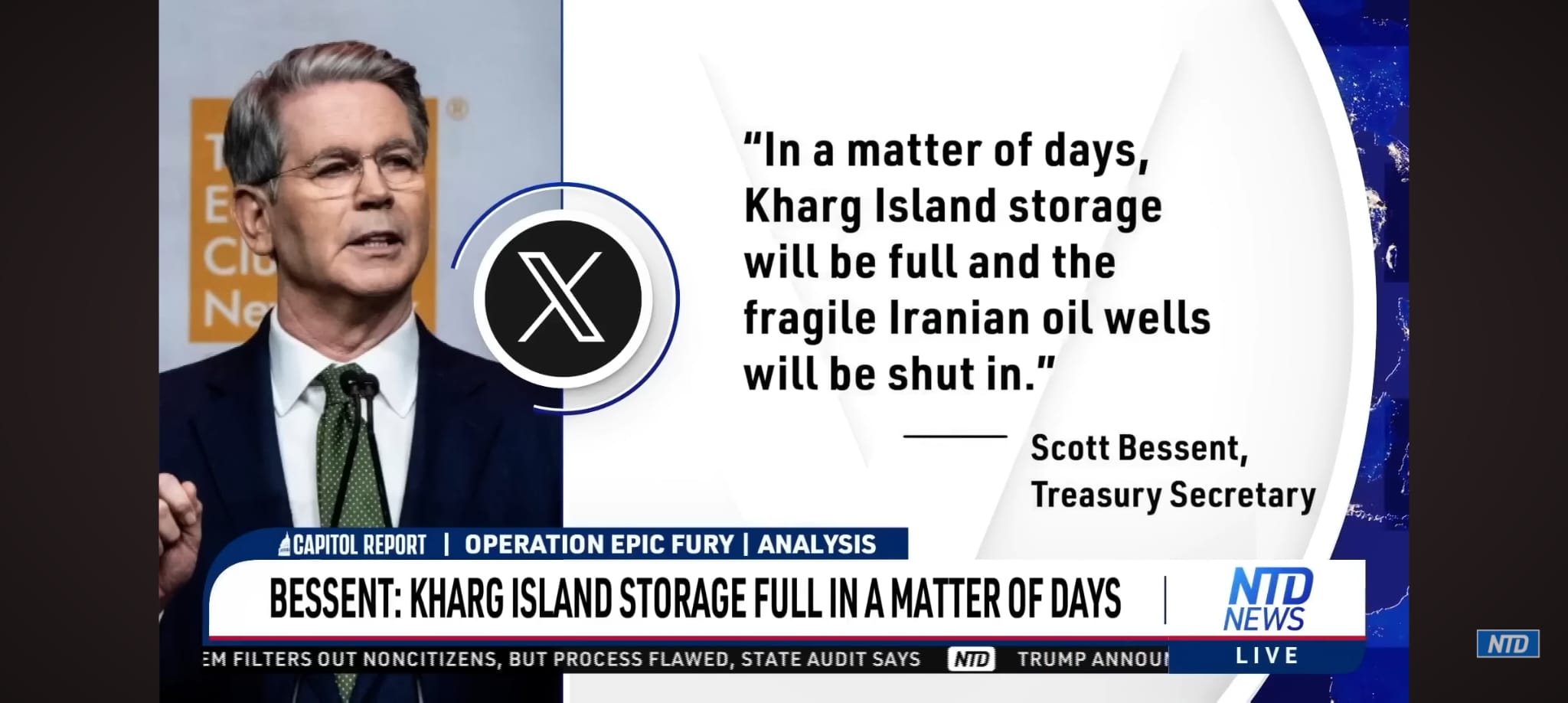
Author’s screen shot from NTD News. The statement was posted on Tuesday.
Note, a third Amphibious Assault Group, an aircraft carrier with an additional Marine Expeditionary Unit of 2000-2500 troops, has just arrived to join two other already in the Region. This further shows that Trump is increasing preparations to seize Hormuz, not backing down.
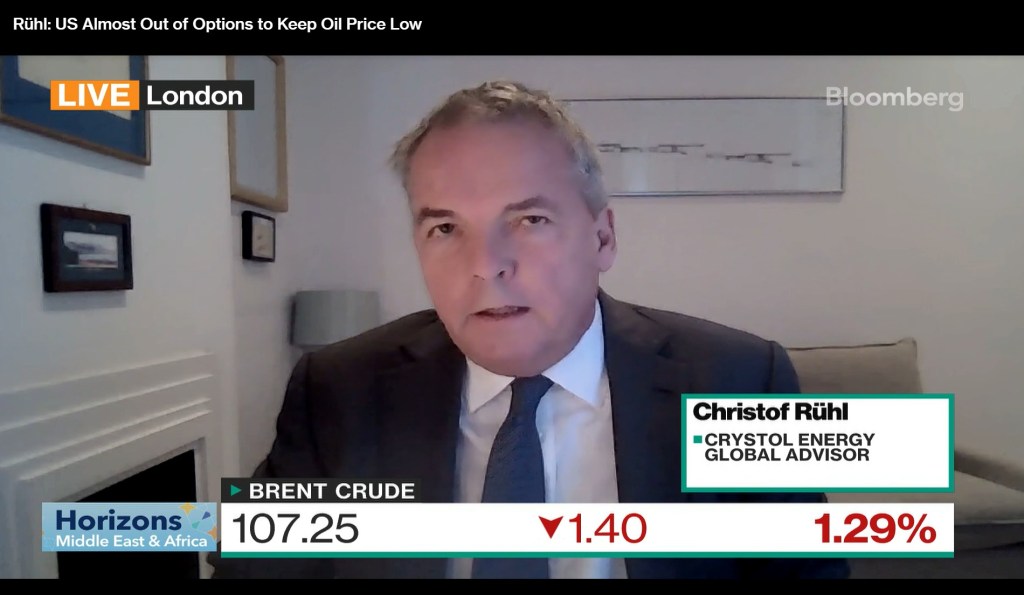
Both Christof Rühl (bio) and Jack Kemp (bio) had great, data-driven media this past week. I too addressed these issues (spoiler: I assess Trump is not bluffing on Iran talks, and oil supply remains adequate.) My conflict-trajectory take differs a bit from Chrisof, perhaps closer to Jack K here.. My Al Jazeera was just after Trump announced talks.
Mar 12, 2026. Is the Iran war about the US containing China? For my part, I explained how control of Hormuz would give the US two key levers:
The USA will control half of China’s oil imports, 5.4 million barrels per day (mbd), which flow through Hormuz.
The USA will insure that during any Pacific war China might start that Iran, acting in solidarity with China, could not block oil flows to US Asian allies such as Japan, S. Korea, Australia, Philippines, or flows to others whose supplies it would also want to guarantee, such as Viet Nam, Indonesia, Malaysia, Singapore, etc..
A new USA-Ukrainian strategy has replaced the failed Russian oil-price cap. Oil is the material basis of Moscow’s capacity not only to fight Ukraine, but for its subversion in former USSR states, in Africa, Latin America and elsewhere. In the US, one finds strong bipartisan sentiment that “Russia is a gas station, masquerading as a state,” as former-Senator John McCain famously remarked, and that Moscow must be deprived of its easy petrosate riches.
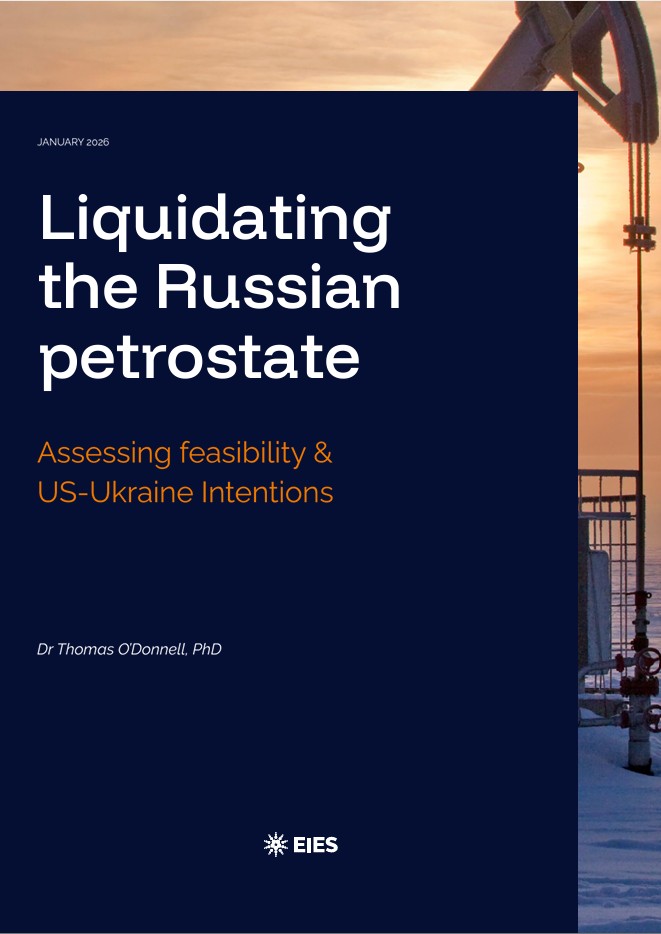
My study for European Initiative for Energy Security (EIES,based in Brussels, is associated with SAFE in Washington, DC, though policy-independent), traces the new USA-Ukrainian joint war on Russian oil, which includes sanctions, tariffs; drone strikes on Russian refineries, ports and oil tankers, and seizures of shadow fleet ships at sea. All these are part of a coherent campaign begun in Spring 2025, as the Trump administration realized that its focus on offering Putin economic enticements to end the war was proving ineffective. It became clear that the application of “pain”, as Trump put it, would be necessary.
The present study shows, in some technical detail, how it is possible to, first, physically stop the majority of Russian seaborn oil exports, secondly, that this can force the shutdown of old, delicate W. Siberian oil fields in winter resulting in the permanent or semi-permanent ruin of these fields, the material basis of the Russian petrostate economy.
This, in fact, is the real threat, the “pain”, which Putin has begun to fear, inducing him to engage for the first time a bit more seriously in negotiations.
The Report also draws attention to and analyses the unfortunate incapacity of many European expert observers and think tanks to see the outlines of this coherent oil war strategy, distracted by the considerable bluster and threats employed by President Trump.
Third, in parallel, the study explains presently favorable oil market conditions consisting of a persistent supply glut, making any major cutoff of Russian seaborne oil exports feasible without sparking a lasting spike in world prices. I show how the OPEC-Gulf states, especially the Saudis and UAE, have facilitated this glut in coordination with President Trump et al, with the prospect of regaining much of the Indian and Chinese market discounted Russian oil has taken since 2022.
For the longer term, however, in the conclusion to this report, it is shown how the return of Venezuelan barrels to the market (and perhaps Iranian barrels as well) are part of a comprehensive USA energy strategy to create market conditions enabling both persistent low prices and, if necessary, the permanent “Liquidation of the Russian Petrostate,” to end the Ukraine war and Moscow’s international significance-in-general.
This is all seen to be part-and-parcel of the Trump administrations detailed commitment – with significant bipartisan support – to exercise “USA Energy Dominance” as a pillar of USA geo-economic power and geostrategy.
I am available for interviews and speaking on this Report’s topic. Contact EIES or me directly.
My Kanal24 interview with Nataly Lutsenko, who was in Kyiv, Ukraine on11Jan25, posted here 18Jan.. I explained:
— The stepwise manner in which different Venezuelan oil basins can start being brought to market rapidly while recovery and new production can proceed to more complex and higher-investment projects over time.
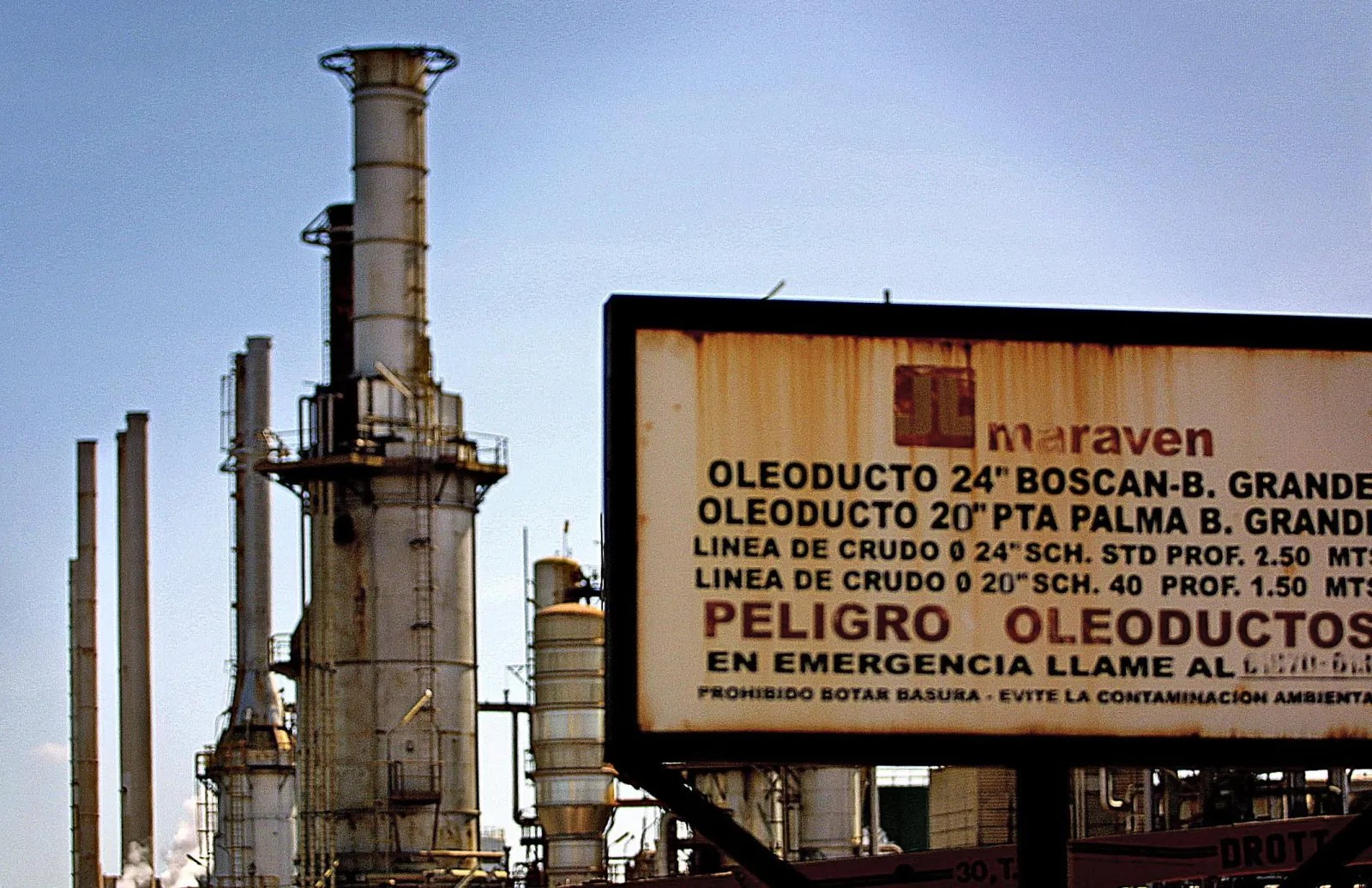
Image from 2002 shows an oil refinery in Maracaibo, Vzla. Photo ANDREW ALVAREZ
Published Jan 10, 2026 – By, Brendan Cole, Senior News Reporter
Developing Venezuela’s oil industry following the removal of its leader, Nicolas Maduro, would require major legal and commercial changes, Exxon CEO Darren Woods has told President Donald Trump.
Energy industry analyst, Thomas O’Donnell, told Newsweek on Saturday that one approach would be for companies to work on small projects to kickstart production before targeting the oil fields that require heavy investment.
Image from 2002 shows an oil refinery in Maracaibo, Vzla. Photo ANDREW ALVAREZ
Published Jan 10, 2026 – By, Brendan Cole, Senior News Reporter
Developing Venezuela’s oil industry following the removal of its leader, Nicolas Maduro, would require major legal and commercial changes, Exxon CEO Darren Woods has told President Donald Trump.
Energy industry analyst, Thomas O’Donnell, told Newsweek on Saturday that one approach would be for companies to work on small projects to kickstart production before targeting the oil fields that require heavy investment.
Nataly Lutsenko at Kanal24 TV in Kyiv, invited me again to an interview. We discussed, in detail, what I see as “the oil war” jointly waged by Ukraine and the USA against Russia. Each has its role:
(i) Ukraine is waging an air campaign with drones and missiles against Russian refineries, oil export terminal ports, and oil tankers. This is an audacious and expanding campaign seriously impeding Russian capacity to handle export of the oil its fields produce.
It is important to note, politically, that these attacks are assisted by USA intelligence, as reported in October by the FT. Ukraine’s intelligence chief also spoke of Ukraine’s crucial dependence on US intelligence assets on 20 December, and later on the depth. Unlike the former “oil price cap” strategy of the Biden administration and the early months of the second-Trump administration, the present, much expanded air war on Russian oil is now clearly embraced by the USA.
(ii) For its part, the USA’s role in this oil-war – along with NATO, UK, EU and G7 allies – involves increasingly harsh tariffs and sanctions against Russian oil exports.
My thanks to Tor Klaveness at Kapital, Norway’s oldest and leading, business magazine. Below is an English translation, then the Norwegian original. – Tom O’D.
“Bone-crushing” and “draconian”: The law that could choke Putin’s oil revenues
If peace talks between Ukraine and Russia break down, the US Senate is ready to pass a sanctions package that could strangle Russia’s oil exports. In that case, it could significantly strengthen the oil market.
Energy Published 29 Nov. | Paywall removed, Updated 9 Dec.
“President Trump said this weekend, ‘Send me the bill.’ So we have to send him the bill to help end this war.”
Dr. Thomas O’Donnell, energy and geopolitical strategist
This was stated by Republican Senator Lindsey Graham in a panel debate on November 19 with Democratic Senator Richard Blumenthal. The debate was moderated by Clayton Seigle, a senior fellow at the think tank Center for Strategic and International Studies (CSIS), which also organized the debate.
The bill Graham referred to is the Sanctioning Russia Act , which he is co-sponsoring with Blumenthal. The bill already has the support of 85 of the 100 US senators and would give US authorities the right to impose punitive tariffs of no less than 500 percent on countries importing Russian energy.
PHOTO: Alexander Kazakov, Sputnik, Kremlin Pool Photo via AP/NTB
With a stick and a carrot
Dr. Thomas O’Donnell is an energy and geopolitical strategist, founder of GlobalBarrel.com and former global fellow at the Wilson Center in Washington, D.C. He believes Congress is now poised to give President Trump an extremely potent weapon.
The proposal is being described as “bone-crushing” and “draconian,” and is set to be voted through almost unanimously in the Senate.
I was interviewed on CNN International’s “Newsroom” with host Kim Brunhuber – live, Friday, 12 Dec. 2025. The transcript is below. Kim asked about Venezuela’s oil industry, the impact of sanctions, what stricter enforcement could do to the Venezuelan economy, and what the US stands to gain if it ultimately gains greater access to the country’s oil reserves? He also wanted to know what Venezuelans are saying. / CNN says: “The show is broadcast around the world on CNN International, and in the US on our new platform All Access.”
Here is the video of our 10 Nov. event, organized by EIES (European Institute for Energy Security). Our topic was the turn in US Trump administration policy on ending Russia’s war against Ukraine and the Russian oil sector.
My sincere thanks to EIES, and especially Executive Director Albéric Mongrenier, for inviting me along with distinguished energy and geopolitics experts. (Note: EIES is affiliated with, but policy-independent of, SAFE in Washington).
Our distinguished expert panel included:
Dr. Jaak Aviksoo, Former Minister of Defence of Estonia, EIES Energy Security Leadership Council
Christof Rühl, Senior Research Scholar at Columbia University’s Center on Global Energy Policy, former BP Chief Economist
Dr. Thomas O’Donnell, Energy and Geopolitical Strategist and Founder of GlobalBarrel.com
Moderated by Rosemary Griffin, OPEC+ Lead Reporter, S&P Global Commodity Insights
Opened by Peter Flory, Senior Fellow, EIES, Former NATO Assistant Secretary General
A central question we addressed was the turn in the Trump administration policy to apply significant coercive measures against the Russian oil sector to undermine the ability of the Putin government to continue its was in Ukraine. We discussed how effective the new sanctions on Rosneft and Lukoil might be and what is the synergistic effect of the Ukrainian drone and missile campaign against Russian domestic refineries and oil export terminal ports.
For an update on expanded attacks on Russian Black Sea oil ports and their meaning, see the written comments accompanying my Kanal24 video interview, posted on Monday, 17 Nov. “The US & Ukraine pound Russian oil | my Kanal24, Kyiv“).
On 5 November, I told Kanal24, Kyiv that a US-Ukraine campaign to disable the Russian petrostate’s oil sector is underway. I stressed that this is a multi-spectral campaign combining (i) severe USA sanctions and secondary tariffs on Russian oil exports in parallel with (ii) Ukrainian military action on oil refineries and export-terminal ports. These attacks are known to be conducted and planned in close cooperation with USA military intelligence (FT,12 Oct.).
This means that an assessment of either aspect of this campaign on its own is inadequate. The synergy of sanctions plus military hits is the issue.
Secondary Sanctions. It has been widely recognized that the USA would need to, as promised, vigorously impose secondary tariffs on any entities that violated its recent tariff announcement. Indeed, on Sunday, President Trump lent support to a bill being drafted in Congress to hit any entity “doing business with Russia.”, not only buying its oil (i.e., “Trump says Republicans drafting bill to sanction countries that trade with Russia, Reuters. November 17). This sounds similar to the Senators Lindsey Graham (R, SC) and Richard Blumenthal’s (D Conn) so-called “bone-crushing sanctions” bill (Politico, 7 June) endorsed by 83 senators on 3 June.
The apparent aim of the port drone and missile attacks is to slash oil exports from Russia’s three or four biggest westward facing terminals. The focus thus far is on Black Sea terminals:
You are invited to register now for Monday, 10 Nov. at 14:00 UK || 15:00 CET || 9:00 ET, an EIES Webinar. [My view: the USA, Ukraine & allies can dismantle the Russian petrostate. My posts on this are linked at the end]. I’m honored to join experts:
Dr. Jaak Aviksoo, Former Minister of Defence of Estonia, EIES Energy Security Leadership Council
Christof Rühl, Senior Research Scholar at Columbia University’s Center on Global Energy Policy, former BP Chief Economist
Dr. Thomas O’Donnell, Energy and Geopolitical Strategist and Founder of GlobalBarrel.com
Moderated by Rosemary Griffin, OPEC+ Lead Reporter, S&P Global Commodity Insights
Opened by Peter Flory, Senior Fellow, EIES, Former NATO Assistant Secretary General
Dismantling the Petrostate: Moment of Truth for Russian Oil? – Webinar: Monday 10 Nov.
Register Now – Allies have so far failed to break Putin’s war machine. The EU recently agreed on a 19th round of sanctions and plans to further ramp down Russian energy supplies. But EU sanctions have shown their limits, political leaders have not been able to use Russia’s frozen assets to aid Ukraine, and Moscow’s hydrocarbons still flow into the Union and other major markets.
Washington’s and London’s most recent sanctions may change the game. As we enter another winter of war, can Europe and the United States build on hard-won Transatlantic convergence to strike a decisive blow to the engine of the Kremlin’s aggression: Russia’s oil exports? Can the EU agree to and successfully manage the phaseout of Russian oil and gas?