Category Archives: India

Answer to Ahmadinejad’s question over dinner: “To block your control of oil, like with Saddam.”

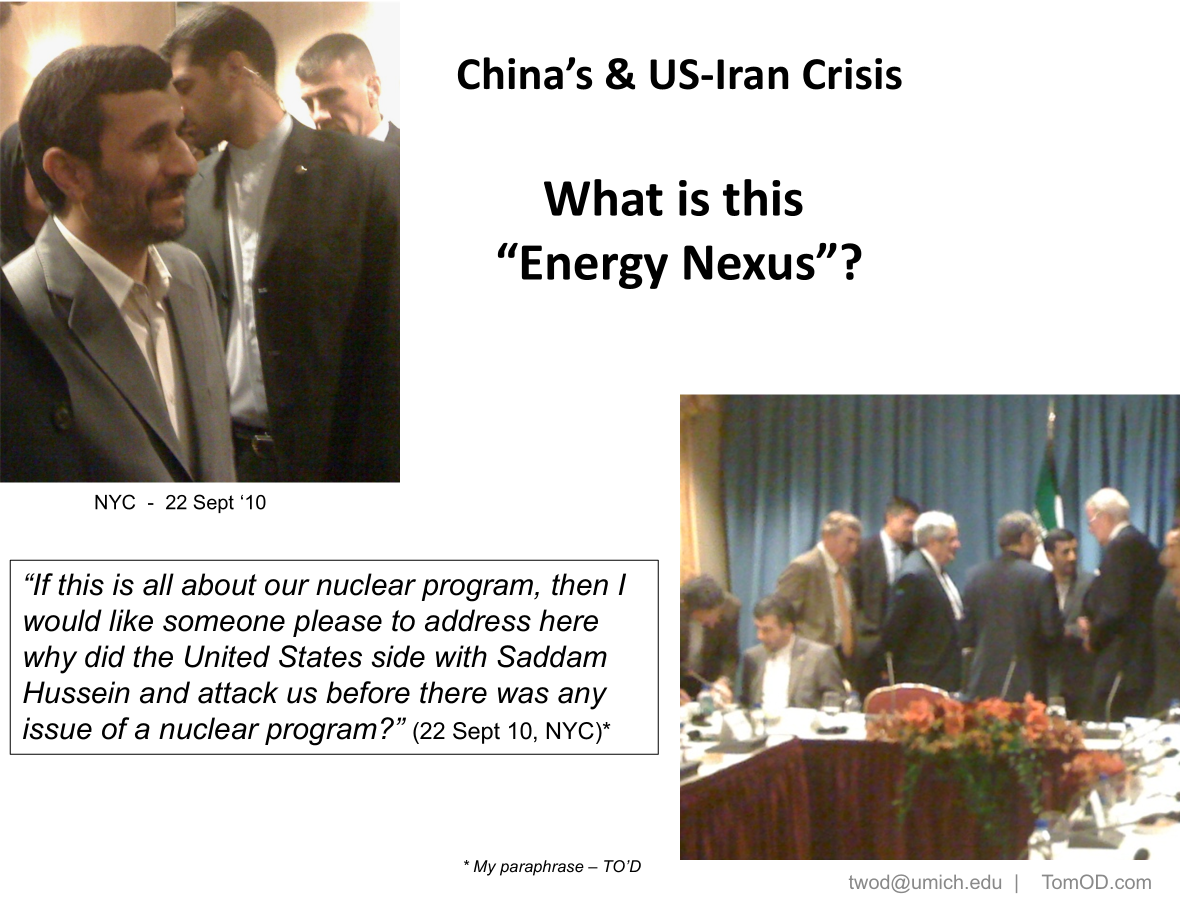
Pictures taken by the author (T.W.O’D) during a dinner and Q&A with President Ahmadinejad, in NYC during 2010 UN General Assembly opening. Note quote from Ahmadinejad.

Some years ago, I was invited to dinner with President Ahmadinejad in NYC during the annual opening of the General Assembly.

The American think-tanks, consultancies, and x-diplomats present went on and on asking detailed questions about this or that scenario where US experts might work with Iranian experts to observe or limit the Iranian nuclear enrichment program. (I mentioned this 2010 dinner in a later post: “China’s Iran-Oil Import Angst. Part I” Feb 13, 2012.)

It became rather tiresome. Ahmadinejad clearly was growing tired of it. He then asked us,

“If this is all about our nuclear program, then I would like someone please to address here why did the United States side with Saddam Hussein and attack us before there was any issue of a nuclear program?” (Iranian President M. Ahmadinejad, 22 Sept 10, NYC, my notes, T.O’D.)

Everyone ignored his question, and simply kept up with their obviously pre-prepared technical questions. But, what had he meant?

To me, clearly he was referring to the Iran-Iraq war (Sept.1980-Aug.1988), when the USA, at a certain point, decided to take Iraq’s side and, among other things, sunk the entire Iranian Navy in a day, took over air traffic control for the Iraqi air force, started directly advising Iraq on strategy, and etc.

In the end, Iran had to accept an Iraqi peace deal after a crushing defeat facilitated by the USA. I recall now all these details vividly. And, all this was indeed well before any nuclear program.

Aside: I find it disturbing that so many “experts” refer to the supposed “Iraqi defeat” in that war. This was all understood at the time. For example, I quote here from the NYT, (Sec. A, Page 1, of July 21, 1988): Ayatollah Khomeini had personally endorsed the cease-fire demanded by United Nations Security Council Resolution 598. Iran’s supreme religious leader confirmed, for the first time, that he had approved the resolution and added, with his characteristic rhetorical flair: ”Taking this decision was more deadly than taking poison. I submitted myself to God’s will and drank this drink for his satisfaction.” (Emphasis added to the most famous part of Khomeni’s statement. T.O’D.) Further research will quickly show he had to sign as Iran was being soundly defeated at the time, hence the “poison” he had to swallow. 

By the way, it is also known, at least in academic circles, from later extensive archival research, that the war with Iraq was planned and instigated by Iran, and that Iraq had attacked in response to Iranian provocations and signs of Tehran’s preparations, after warnings. I am happy to send references to those interested.

What I myself had been arguing, back then, during the Iran-Iraq War Ahmadinejad was referring to, was that the US-Iran confrontation was actually about the US opposition to any country, either from inside the Gulf Region or outside the Region, gaining hegemony over the Gulf and the Straits of Hormuz. This had to do with guaranteeing the free flow of oil, and that the global oil market would be a “real” market that no one state could unduly control. I had even coined a term, “The Global Barrel,” for this market-centered, post-OPEC-nationalizations collective oil-security system, a system initiated by Henry Kissinger in 1973.

Continue reading
USA sees Gulf energy flow as core interest. If no deal soon, Marines will take Hormuz. | My Asharq TV

Guaranteeing Gulf energy flows to allies has always been a core US interest, while today’s Great Power Competition means China’s access will be rendered conditional.

This is not the Iraq war. If after operations to secure the coasts and islands and to clear mines, the Iranian regime resists, the USA plan is that Iran’s oil sector and economy would be destroyed by aerial bombardment. Washington neither desires nor needs to occupy Iran proper nor to change the regime. The US strategic imperative here is to secure, long term energy flows from the Region and, accordingly, to end the regime’s capacities to project regional power.

After almost 30 years of analysis and my university seminars, there is very little I see new here, save a new USA urgency.

In my view, this urgency flows from USA concerns over Great Power Competition, especially with China. This is exacerbated by the possibility that Iran could close the Strait in solidarity with China (or perhaps Russia) during any Great Power conflict elsewhere. The threat of Iran’s developing capacities in this regard, especially its missiles and drones, but also its nuclear weapons ambitions and intentions to rebuild its regional proxy allies, all act to undermine the prerogatives of the USA and its Gulf regional allies to secure the region and its energy flows.

In any case, the idea that Washington and Trump “have no strategy” is demonstratively wrong, and self-disarming. (See, for example, my EIES study of Trump administration energy policy since ca. April 2025 v. Russian oil.) One might not fully understand the strategy, or might disagree with it, but there is clearly a multifaceted strategy here under the general slogan of “USA Energy Dominance” (e.g., see posts here and here). Besides Iran, it especially includes Russia, Venezuela, India, and of course China, as well as US domestic oil, gas, nuclear and renewables policies.

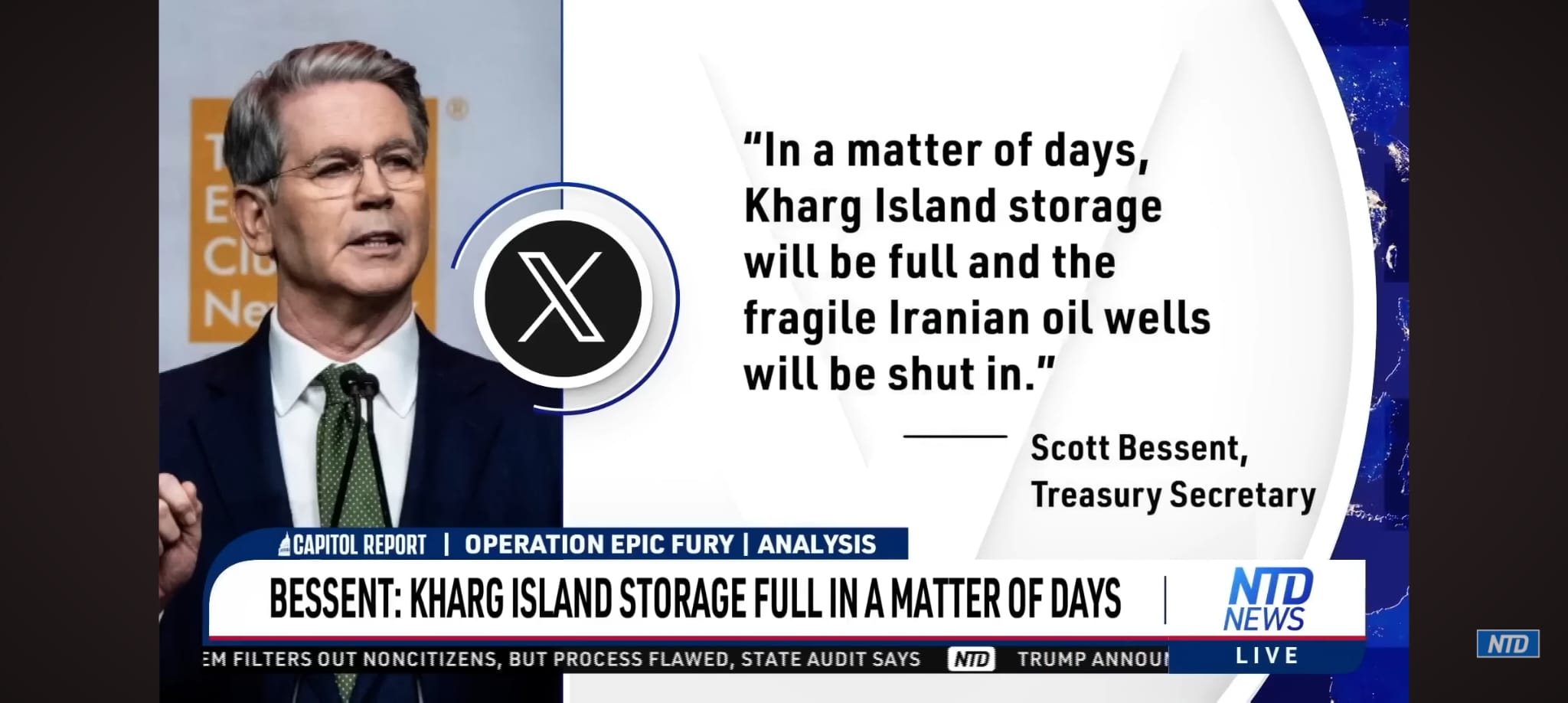
Author’s screen shot from NTD News. The statement was posted on Tuesday.

Note, a third Amphibious Assault Group, an aircraft carrier with an additional Marine Expeditionary Unit of 2000-2500 troops, has just arrived to join two other already in the Region. This further shows that Trump is increasing preparations to seize Hormuz, not backing down.

Continue reading

My TRT London: “US Energy Dominance” & global glut give Trump historic leeway to hit Iran without an oil crisis.

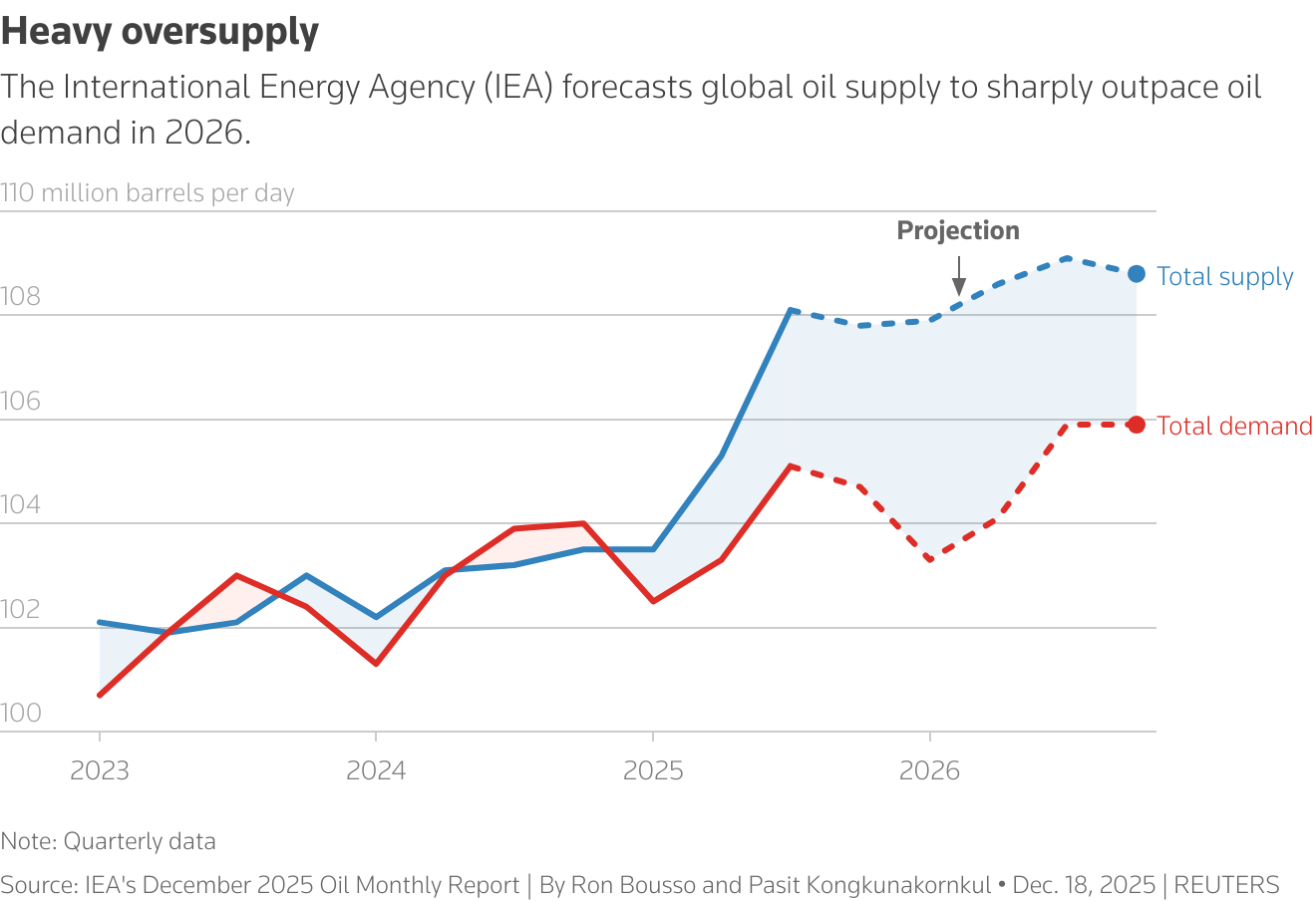
Last night on TRT World Global News (London), I emphasized that despite the modest spike in oil prices from about $70 to $78 per barrel as of yesterday, Trump has an historically unprecedented advantage for exercising “US Energy Dominance.”

Fig. 1. IEA projects global oil glut throughout 202

The campaigns against Venezuela and Iran, plus the turning of the Indian oil-consuming behemoth towards USA and Western interests vs Russian oil, are examples of the geopolitical leverage the USA’s now-dominant role in global oil affairs has afforded the Trump administration.

This oil-market advantage comes mainly from of two things:

Continue reading

My Newsweek interview (USA): India won’t buy Russia’s USA-sanctioned ‘Arctic LNG2.’ A big blow to Putin.

Below, I am quoted repeatedly (marked in bold -TO’D), by Newsweek’s intrepid Brendan Cole, reporting from London on Russia and Ukraine. I was on the Berlin-Warsaw express, heading to the Warsaw Security Forum. At the end are links to several other-language versions. Read on …

Putin’s Arctic Project Suffers Blow From Top Trade Ally

By Brendan Cole Senior News Reporter FOLLOW

India has refused to buy liquefied natural gas (LNG) from Vladimir Putin‘s flagship Arctic energy project delivering a “major blow” to Moscow’s fuel exports, an energy analyst has told Newsweek.

India’s oil secretary, Pankaj Jain, has said that New Delhi is “not touching” any commodity from the Arctic LNG 2 project due to sanctions that followed Putin’s full-scale invasion of Ukraine aimed at stifling Russian energy revenues, which the United States stepped up this month.

Putin had high hopes for the seaborne resource after losing the lucrative European market for pipeline gas due to sanctions and the president’s move to weaponize the fuel, which only spurred countries to find other suppliers.

Following huge losses, Gazprom cut its fuel production while a proposed Power of Siberia 2 pipeline to transport increasingly stranded Russian gas resources to China remains delayed amid haggling over price.

However, attempts by state firm Novatek to get Russia’s gas to market through the Arctic LNG 2 project have so far failed after Jain said last Friday, “We are not buying any sanctioned commodity.”

Newsweek reached out to Novatek for comment.

Berlin-based energy analyst Tom O’Donnell said Russia’s switch to boosting LNG exports has been fraught with difficulties due to sanctions.

“They have had to considerably cut back because they can’t get either the equipment to build it or the ships to transport it,” he told Newsweek.

“LNG from the new Arctic LNG 2 project was very important for Putin to be able to ship it to India and to China,” he said. “With India dropping out, this will be a major blow.”

Russia plans to triple its LNG exports by 2030 to 100 million tons. The country is expected to play a key role in India’s energy strategy, which has built terminals to receive the fuel.

Continue reading