This is part 1.0 of a series on the US-Iran war and the present US global energy offensive. Hormuz developments are altering some elements of the one, “Global Barrel” market-centered collective energy-security model that dates to 1973, and which I named this blog after 15 years ago (after I had apparently coined that name).
I will have No. 2.0 of this Iran series soon. Here is 1.0, my brief BBC interview of last night, with some comments below here.
This was my fourth interview with BBC Persian Service, London in recent months. It feels important to get things clear when I have the opportunity to speak directly to Iranians or to Ukrainians.
Comments:
The larger USA global oil-sector offensive involves Russia, Iran, Venezuela, India, and other countries. I’ve seen these each as USA “shaping operations” aimed at preparing the energy landscape favorably to the US and its allies before any future armed conflict with China might begin – or to prevent one.
As I explained earlier (e.g., Jerusalem Post interview), a problem for the Islamic Republic of Iran, in deciding to take control of Hormuz, is that its control can only degrade over time under US pressure.
In the past few weeks, as it’s grip was loosened by the US military, it needed to find a further lever. In the past few weeks Tehran tried two things to reverse its weakening Hormuz position:
Yesterday, I had a long talk with ‘Post’ Mideast reporter Danielle Greyman-Kennard. My thanks to her. – Tom O’D.
Although 14 to 15 million barrels of oil passed through Hormuz per day before the war, an expert told the Post that it was entirely possible to manage without much of that supply.
27 Aug. 2026, updated 28 Aug. – Though the Islamic Republic of Iran has established a “sophisticated panoply” to protect itself against the possibility of regime change, its trump card, the Strait of Hormuz, is losing its strategic value and will continue to do so, former Wilson Center global fellow Thomas O’Donnell told The Jerusalem Post on Thursday. (Continue reading at GlobalBarrel.com or at Jerusalem Post here)
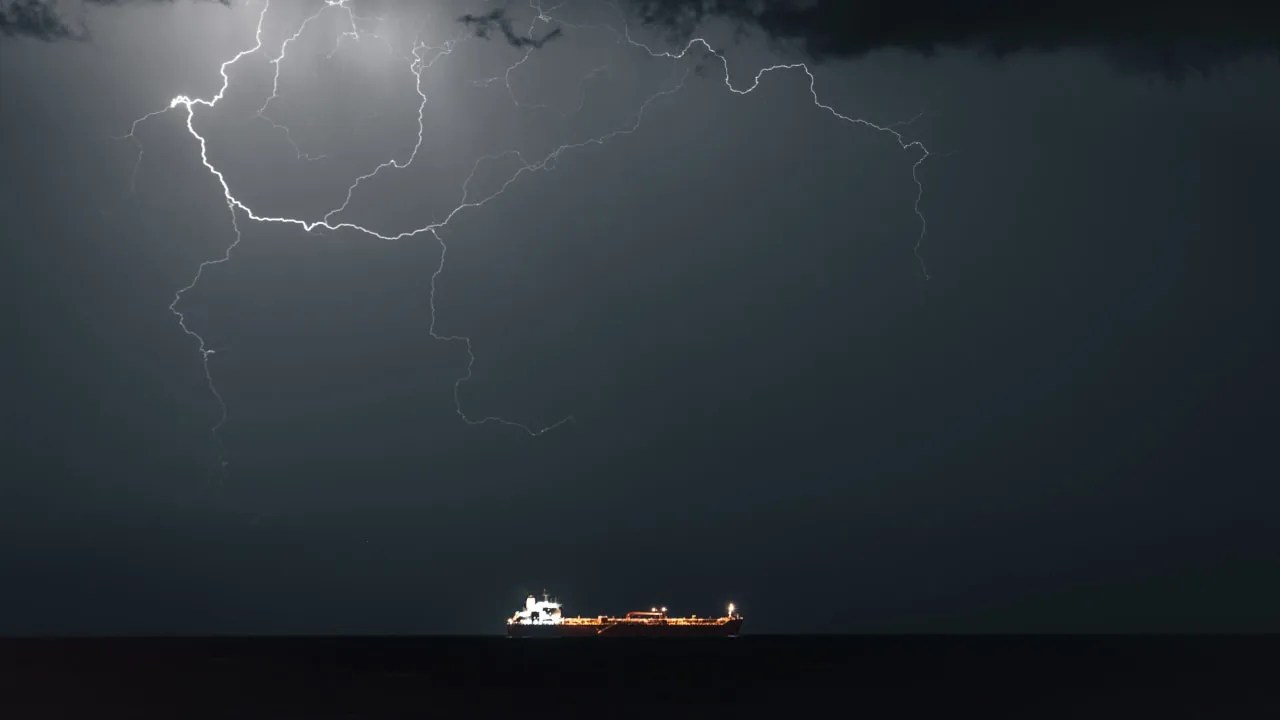
Lightning occurs when META 4, an Oil Products Tanker, sails into Muscat Anchorage on March 21, 2026 at Sultan Qaboos Port in Muscat, Oman.President Donald Trump had threatened to attack Iran’s energy infrastructure if it did not end its de facto blockade of the Strait of Hormuz by March 23.(photo credit: Elke Scholiers/Getty Images)
With many of the regime’s regional proxies degraded over years of war with Israel and its nuclear ambitions delayed after the 12 Day War in June last year, Tehran only has its rockets, drones, and ability to threaten the Strait of Hormuz left as an insurance policy against attempts to topple the regime, he noted.
These remaining elements will be used to dissuade action while it restores the others, but they are losing the weight they once carried, O’Donnell added.
Though 14 to 15 million barrels of oil traveled through Hormuz per day before the war, he argued that it was very possible to manage without much of that supply.
Saudi Arabia’s East-West Crude Oil Pipeline moves around five million barrels per day for non-domestic use, while the United Arab Emirates moves an average of 1.5 to 1.8m. bpd through its own pipeline, he calculated.
Some 400m. barrels of oil and refined petroleum products were unanimously approved for release by the 32 member nations of the International Energy Agency (IEA), while the US government committed 172 million barrels from its Strategic Petroleum Reserve.
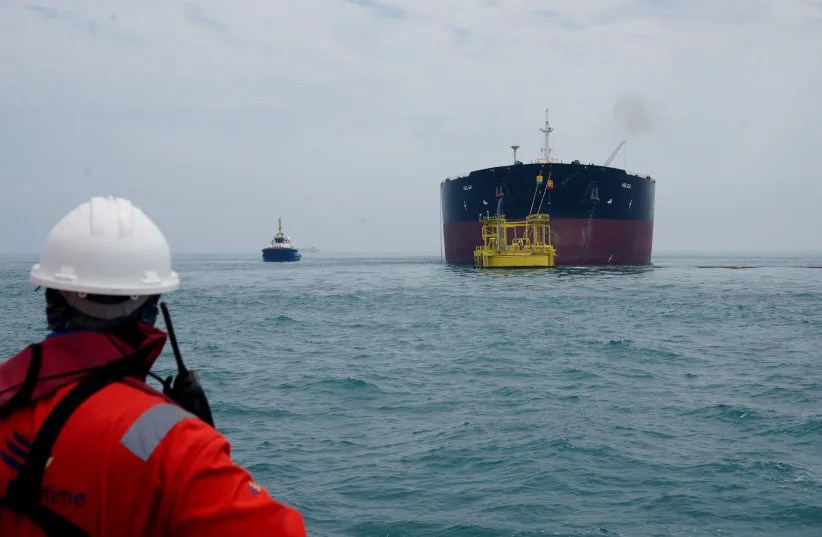
Oil tanker HELGA is moored at one of Iraq’s southern offshore oil terminals near Basra as it prepares to load crude oil, becoming the second vessel to arrive since the closure of the Strait of Hormuz, April 24, 2026. (credit: REUTERS/Mohammed Aty/File Photo)
None of this even touches on the oil supplied by the Western Hemisphere, where roughly 32% to 40% of the world’s total oil originates.
“There’s more production in other places, but [the disruption of] oil has not been anything like it would have been 20 years ago if they closed the strait,” he said, explaining how the US’s own oil and fracking industries have helped mitigate much of the damage.
Could Iran’s weakening control of Hormuz force a deal with the US?
“The oil price, it’ll go up and down. The fact that it went over $100 [a barrel], and the next day it was $80, that means that’s geostrategic variability. That’s not fundamental.”
Pakistan TV, 9 Aug. We discussed the Trump administration’s two retreats from forcefully reopening Hormuz. This is not so simple as who is winning and who is losing.
The first of two key factors to note: It was GCC allies who sharply blocked Trump from executing planned big assaults on Iran to facilitate reopening Hormuz, on fear of Iranian missile punishment which would continue until the US military finished silencing most of Iran’s missile capacities. The Saudis and Qataris were most sharply opposed to accepting this punishment. What are the implications?
a) On the one hand, their refusal to allow Trump to use force to resolve the Hormuz crisis is a de facto success for the Iranian strategy of attacking all GCC states expecting them to then oppose USA military action against Iran.
b) On the other hand, I suspect the Trump-Vance response to GCC allies caving in to Iranian missiles was similar to the attitude the administration took to Europe and NATO in early 2025, for being seen as unwilling to really fight for either Ukraine or their own nations’ security, assuming the bulk of the task would be performed by the USA. Trump’s comments that Gulf allies should “pay the United States” for protecting them once the Straight is reopened, seems a reflection of this mindset.
Interestingly, we then see the rapid emergence of a new “Islamic NATO” mutual defense alliance between Saudi Arabia, Turkey, Pakistan, and perhaps soon Egypt. And simultaneously the Saudi-led new 19-country Red Sea defense league.
These are a striking departure from past Gulf practice. They should be seen, among other things, as an urgent Saudi recognition that the USA either refuses and/or is incapable of continuing to bear the burden of their defense, especially via American “boots on the ground.” I recall when the Obama administration told the Saudis the same, and indeed the Saudis made some military adjustments, including in Yemen, but obviously nothing anywhere like these alliances.
Now, with its new military alliances, the Saudis and their Gulf allies will increasingly be capable of fighting and be expected to actually join in any fight against Iran’s push for hegemony in Hormuz, in the Gulf Region and MENA generally.
The second large factor to note: I also explained how the Iranian leadership’s key lever, their ability to disrupt and partially close Hormuz, is seen by the US administration as a diminishing lever. There are two main indications of this:
First, the absence of what had been widely predicted to be astronomical oil price spikes after Hormuz was closed and,
Second, agreements are now in place in several Gulf states that four or five new oil pipelines to be built in the next couple years to bypass the Straight.
In fact, Sec. Bessent said exactly this shortly after my interview where I had anticipated this USA attitude. He (characteristically over-) confidently declared these pipelines mean the Straight will become “irrelevant”. And, shortly thereafter, Sec. of Energy Chris Wright was insistent that USA forces are now escorting eight or nine million barrels per day (mbd) of oil out of the Straight, implying a decreasing capacity of Iran to interrupt shipping.
As I have said before here, this tells the administration that it objectively has much more leeway, timewise, for resolving this crisis than any other administration would have before. This is part of their calculation that they can now, in effect pause any significant offensive military operations and focus on a new (really a second) “economic war” against Iran, to undermine it. However, IMHO, this in-itself cannot, with this particular IRGC-led regime, be sufficient to resolve the Hormuz crisis. In the end, this will require with the use of substantial USA force to accomplish physical occupation, with troops and electronically, of the shore-region of the Straight, and significant further erosion of Iranian missile and drone stocks and capacities to import and/or produce these. Alternatively, a USA back-down, a partial “surrender” is required, which would be almost impossible for any president to accept considering Iranian demands at present, which are hardly conciliatory.
TRT-London asked me tonight about oil-market impacts of the deal between Iran and Oman. The title says most of it.
Of course there has been hardship globally with higher energy prices and volatility. However, compared to what would have happened 10 or 20 years ago, this is very significantly smaller.
Oil on average has been up only 25%, and refined products 36% since 28 Feb. (“Why Oil Prices Could Hit a Breaking Point by Year End,” WSJ, Video, 3aug26). Why?
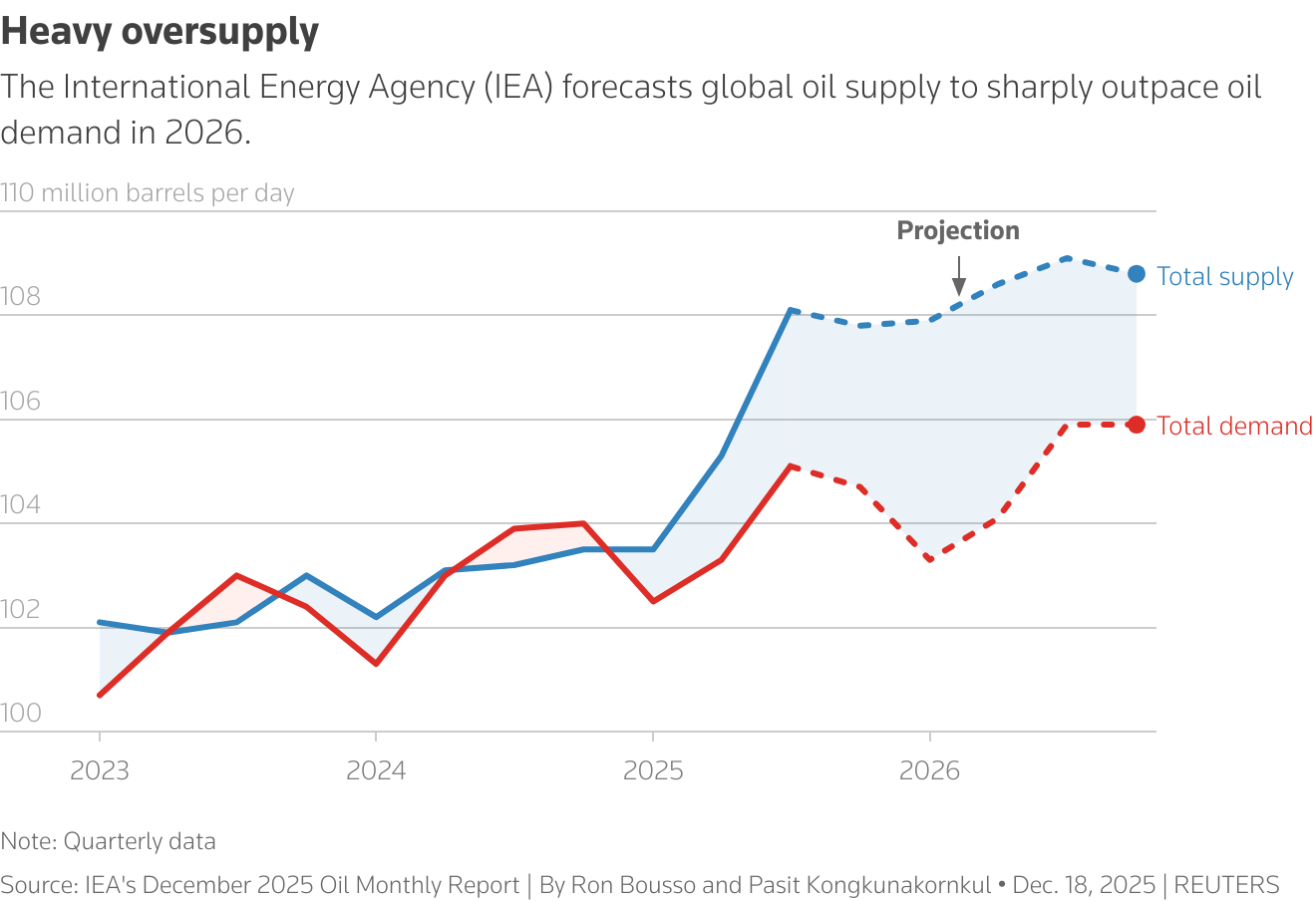
The huge surplus in oil production that was building globally for at least three or four years, plus the constantly falling energy intensity of the economy, plus the high degree of interconnectedness of the one-global-barrel market (the name of this blog for the past 15 years) explains this relatively mild impact thus far. I explained this, and the geopolitical advantage, the long time line, it has given Trump and Washington to go slow and talk a lot as compared to the urgency they would have had earlier.
This is both a case of:
a) More oil being produced globally due to huge advances in petroleum and gas exploration and production (E&P) technologies, Especially in the USA, where a new “Fracking 4.0” stage of the Shale Revolution seems to be underway, one that could boost extraction rates of previously drilled wells by factors of 50-300%, according to various industry tech reports. This is all about US high tech and perfecting of methodologies. (See, Javier Blas, “Shale Oil’s Next Revolution Should Worry OPEC” Bloomberg, 30Nov25).
In addition, there have also been significant tech improvements in deeper offshore production, and in exploration generally, leading to a lot of new, large-sized proven reserves to exploit And,
I spoke with Kyiv Kanal24’s Nataly Lutsenko on three issues. Jump to a topic here: 1) Ukrainian drones in Russia 00:00:192) G7 push v Russian oil. 00:05:253) Who won the US-Iran war? 00:10:27 Recorded 18 June 2026.
Note on number 3: I said it is not yet clear who won the US-Iran war. This has to do with military capacities which the USA (and its allies) could bring to bear but are now deeply reluctant or unwilling to bring to bear.
If Iran is unwilling to compromise or, worse, plays games, as it has already in the past few days with its “Persian Gulf Strait Authority,” the USA might decide it is constrained to employ whatever means necessary (Carter Doctrine) to end the Islamic Republic’s capacity to restrict the free flow of energy from the Gulf.
Trump and USA officials understand that a full-on military option is not an optimal resolution. This led them to accept an MoU that is quite conciliatory to Tehran in order to get the Straight reopened, and also apparently in response to many of its Gulf allies unwillingness to absorb the punishment Iranian missiles and drones would inflict before the Straight is forcibly reopened and Iran’s missile capacities are eventually suppressed. The administration knows that a massive bombing campaign of the entire country’s military-industrial and civilian infrastructure, plus an occupation of the Iranian coast along the Straight could likely achieved their aims of removing the Straight from Iranian hegemony. However, this in turn, is likely to require a protracted force commitment to contain whatever regime forces remain active. No matter how minor, remaining missiles and drones, proxy forces and terrorist capacities could require a long time to resolve.
One problem with giving a quick take on breaking news is that one can forget something. In the interview, I forgot about the US dollar swap line that the UAE had cajoled out of the USA –Trump and Bessent – just before it decided to quit OPEC. Below is the post I immediately wrote with many, IMHO, relevant issues underlying this move. These include national economic and geostrategic differences, often rather sharp, between the UAE and Saudis. However, the swap line issue is now included as point “Zero”.
-0.a- Regarding the swap line: there are so many pieces in motion that we need a litte overview refresher first.
As readers here know, my analysis is that the Trump administration’s sharp moves in the latter part of 2025 against Russian oil exports, together with the Ukrainians’ drone campaign, was at a point where it had begun threatening to force Russian oil exports offline. This, in turn, would force Russia to shut in its old and delicate West Siberian fields. I wrote a detailed study on this. This strategy is exactly like what the USA now openly says it intends to do to Iran by blocking exports from its Kharg Island oil terminal.
The Trump administration claims that the available Iranian storage on the island is near full (Scott Bessent has said this repeatedly). This will force wells to be shut in, likely ruining their productivity for the long term. (However, I believe the Iranian fields are not generally as fragile as Russia’s.)
-0.b- You will recall that Trump constrained and/or convinced India’s Modi to halt Russian oil imports as part of this larger anti-Russian oil campaign to press Putin to end the Ukraine war.
-0.c- However, before the USA proceeded to the next step vs. Russian exports, it went to Venezuela and took control of its oil sector, beginning a comprehensive and very rapid campaign there to bring Venezuelan oil back online.(I spoke at length to Swedish public radio on this again this week,)
The USA has shut off an approximately 2 million battels per day (mbd) stream of oil Venezuela was sending to China, and diverted that oil principally to India. That stream is now part of the USA effort to take care of India during the Iran crisis, so that it does not revert to taking Russian oil.
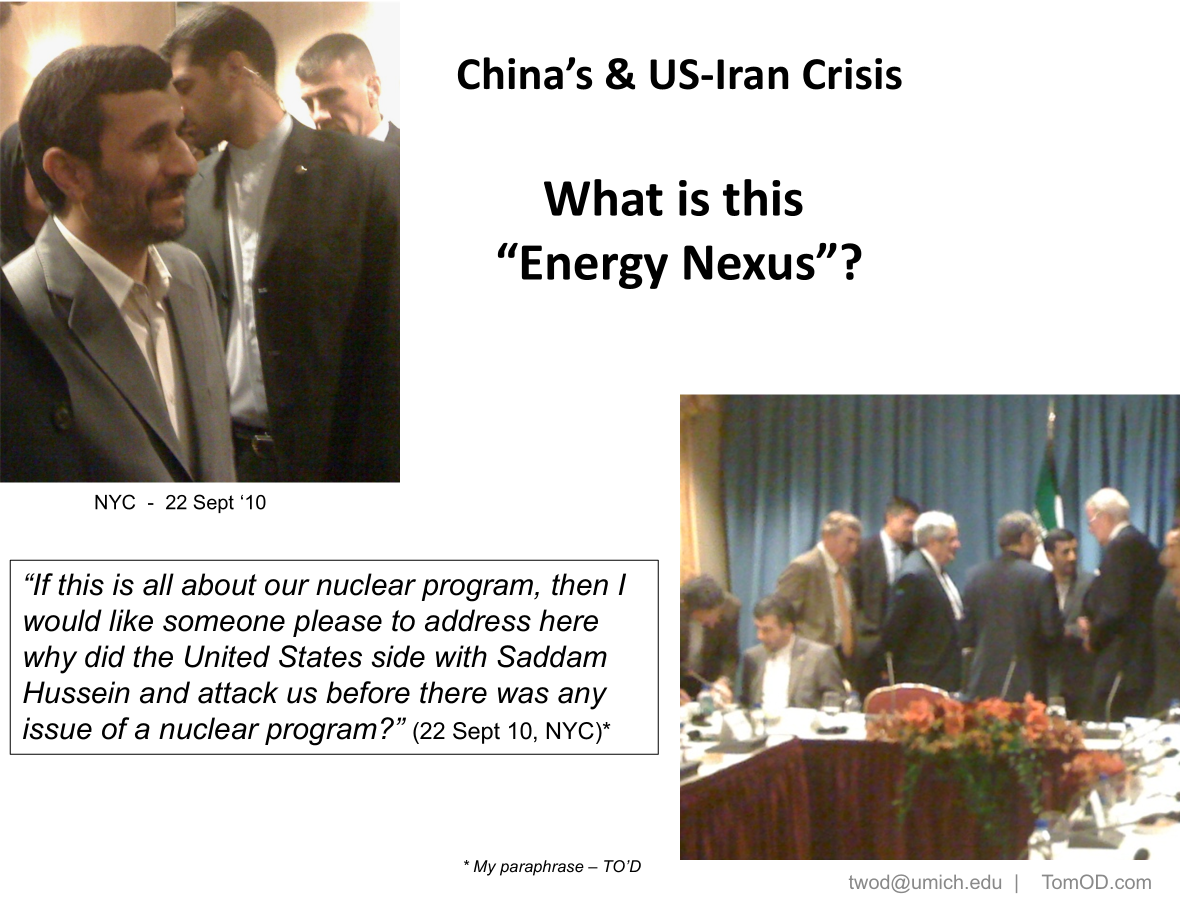
Pictures taken by the author (T.W.O’D) during a dinner and Q&A with President Ahmadinejad, in NYC during 2010 UN General Assembly opening. Note quote from Ahmadinejad.
Some years ago, I was invited to dinner with President Ahmadinejad in NYC during the annual opening of the General Assembly.
The American think-tanks, consultancies, and x-diplomats present went on and on asking detailed questions about this or that scenario where US experts might work with Iranian experts to observe or limit the Iranian nuclear enrichment program. (I mentioned this 2010 dinner in a later post: “China’s Iran-Oil Import Angst. Part I” Feb 13, 2012.)
It became rather tiresome. Ahmadinejad clearly was growing tired of it. He then asked us,
“If this is all about our nuclear program, then I would like someone please to address here why did the United States side with Saddam Hussein and attack us before there was any issue of a nuclear program?” (Iranian President M. Ahmadinejad, 22 Sept 10, NYC, my notes, T.O’D.)
Everyone ignored his question, and simply kept up with their obviously pre-prepared technical questions. But, what had he meant?
To me, clearly he was referring to the Iran-Iraq war (Sept.1980-Aug.1988), when the USA, at a certain point, decided to take Iraq’s side and, among other things, sunk the entire Iranian Navy in a day, took over air traffic control for the Iraqi air force, started directly advising Iraq on strategy, and etc.
In the end, Iran had to accept an Iraqi peace deal after a crushing defeat facilitated by the USA. I recall now all these details vividly. And, all this was indeed well before any nuclear program.
Aside: I find it disturbing that so many “experts” refer to the supposed “Iraqi defeat” in that war. This was all understood at the time. For example, I quote here from the NYT, (Sec. A, Page 1, of July 21, 1988): Ayatollah Khomeini had personally endorsed the cease-fire demanded by United Nations Security Council Resolution 598. Iran’s supreme religious leader confirmed, for the first time, that he had approved the resolution and added, with his characteristic rhetorical flair: ”Taking this decision was more deadly than taking poison. I submitted myself to God’s will and drank this drink for his satisfaction.” (Emphasis added to the most famous part of Khomeni’s statement. T.O’D.) Further research will quickly show he had to sign as Iran was being soundly defeated at the time, hence the “poison” he had to swallow.
By the way, it is also known, at least in academic circles, from later extensive archival research, that the war with Iraq was planned and instigated by Iran, and that Iraq had attacked in response to Iranian provocations and signs of Tehran’s preparations, after warnings. I am happy to send references to those interested.
What I myself had been arguing, back then, during the Iran-Iraq War Ahmadinejad was referring to, was that the US-Iran confrontation was actually about the US opposition to any country, either from inside the Gulf Region or outside the Region, gaining hegemony over the Gulf and the Straits of Hormuz. This had to do with guaranteeing the free flow of oil, and that the global oil market would be a “real” market that no one state could unduly control. I had even coined a term, “The Global Barrel,” for this market-centered, post-OPEC-nationalizations collective oil-security system, a system initiated by Henry Kissinger in 1973.
Dear readers, This paper, which I wrote in 2008-09, analyzed the evolution of interests underlying the US-Iran crisis till then, interests which persist in the 2026 US-Iran war.
That is, Trump’s “USA Energy Dominance” strategy does not seek to fundamentally alter the structure or logic of the post-1973 global, market-centered, USA-led-and-protected oil order. However, to preserve it, the USA now feels the necessity of removing the Iranian mullahs as custodians of Iran’s oil for persistently insisting on projecting power and seeking hegemony in the energy-critical Gulf Region.
What is new from 2008, is the bipartisan urgency felt in Washington to renovate the existing oil market-and-security order, reconsolidating the USA as primary arbiter of energy flows via Hormuz to both China and US allied and friendly states of the Indo-Pacific region. In addition, to be capable of significantly blocking Russian oil exports and thereby its petrostate-fueled aggression elsewhere.
In particular, it mush achieve these aims, vis-a-vis Russia and China, without causing global oil shocks. (continued in full-column below …)
Mar 12, 2026. Is the Iran war about the US containing China? For my part, I explained how control of Hormuz would give the US two key levers:
The USA will control half of China’s oil imports, 5.4 million barrels per day (mbd), which flow through Hormuz.
The USA will insure that during any Pacific war China might start that Iran, acting in solidarity with China, could not block oil flows to US Asian allies such as Japan, S. Korea, Australia, Philippines, or flows to others whose supplies it would also want to guarantee, such as Viet Nam, Indonesia, Malaysia, Singapore, etc..
Last night on TRT World Global News (London), I emphasized that despite the modest spike in oil prices from about $70 to $78 per barrel as of yesterday, Trump has an historically unprecedented advantage for exercising “US Energy Dominance.”
Fig. 1. IEA projects global oil glut throughout 202
The campaigns against Venezuela and Iran, plus the turning of the Indian oil-consuming behemoth towards USA and Western interests vs Russian oil, are examples of the geopolitical leverage the USA’s now-dominant role in global oil affairs has afforded the Trump administration.
This oil-market advantage comes mainly from of two things:
MY COMMENTS: 1) USA long-planned surprise strategy 2) Iran leaders’ 20-year nukes brinkmanship strategy aimed for USA ssecurity-guarantee deal
ALL GUESTS – TRT-London, USA bombing
I was invited on TRT-World, London, 24 June, for a panel after US strikes on Iranian nuclear sites (see the panelist lineup below. I answered two questions at some length – see the 2nd video.)
In summary: Trump claims USA Operation Midnight Hammer “obliterated” the country’s nuclear capacity, but how much have they really been degraded?
My analysis is that it does not matter. If the USA decides to bomb again at will, without Iran having air defenses the USA and Israel can destroy or disrupt most any renewed Iranian work on its nuclear or conventional missile program. If, as he stated, repeat bombings as needed are Trump’s intention, then this should be the case. This now leaves Iran very little negotiating leverage. The regional proxies it always intended to use for retaliation in just such a scenario have been decimated by Israel.
Therefore, there is a high likelihood Iran will be forced by Trump to negotiate from a now much weaker position. If Tehran resists, it could fall back to rely on state-sponsored terrorist methods, which are of limited usefulness for maintaining a modern functioning state and economy.
Overall, I emphasize that this “12 Day War” has been especially motivated, by Trump, to assure USA Gulf allies that they can now safely enter into the Abraham Accords with Israel and the USA, establishing a new regional security structure. Trump will be constrained to do whatever is necessary, militarily and in negotiations, to insure the Iranian threat these allies have felt acutely remains under control. In turn, if these accords, which Trump’s chief negotiator, Steve Witkoff, was reportedly already working on among the USA’s Gulf Arab allies immediately after the USA bombing is intended to allow the USA to move on, focusing more squarely on Great Power competition elsewhere.
This is my general assessment. There are many details and some possible derailments here, of course. – Tom O’D.
The ceasefire Trump brokered will hopefully end this “12-Day War.” I want to discuss here why this war did not trigger a global energy crisis. [Here’s what I said about this to Al Jazeera last week, in the last five paragraphs. A PDF is also embedded below. I’ll also post a TRT-London show on Iran’s nuclear strategy, recorded Tuesday, soon.]
To assess the risk to energy supplies, understanding the aims of the combatants is key. Throughout this war, it was the USA-Israel side setting the agenda, and there were two strategic aims they could pursue. One was to “only” destroy Iran’s nuclear program and its existing conventional regional power-projection capacities. The second was to go beyond this to undermine the viability of the Islamic Republic, up to forcing a regime change. Why do I say this?
ENGLISH Interview | Al Watan, Cairo. Thurs 10Oct24. 15 minutes
ARABIC Interview
At first, we focused on IEA warnings of a possible EU winder gas shortage due to supply-and-demand mismatches. I agree and expand on the IEA points.
Second, I explained that if Israel retaliates against Iran so strongly that it threatens the regimes survival, or is seen as intending to provoke regime change, then the Iranian leadership will have “nothing to lose” by in-turn escalating to the maximum. Aside from unleashing the maximum response of its proxies surrounding Israel, Tehran’s most potent weapon would be to spark a global oil and gas crisis.
Consider oil: Iran can either shut down the Straights of Hormuz (or simply make them unsafe for tankers) and/or, it can use missiles and drones to destroy significant parts of Saudi, UAE and other Gulf oil facilities, including perhaps even Azerbaijan’s as some Iranian propagandists have threatened.
Consider natural gas: Shutting the Straights or directly hitting Qatar’s massive LNG exports infrastructure would immediately stop Qatari LNG exports. As the world’s second largest LNG exporter, this would immediately cause a separate global natural gas crisis.
Again, oil security is determined by both global-market balances and geostrategic realities – at present the Mideast war and Russia’s War on Ukraine. My analyses this weekend were featured in: (a)an AlHurra video (LHS English, RHS Arabic), and below these (b)a detailed BBC-Cairo print interview (LHS English Google Translate, RHS Arabic original). where I make similar points as my Friday video in Warsaw.
Alhurra ENGLISH. My comments at 2:45 & 8:20. Date: 5 Oct 2024, with co-guest GPI President Paolo von Schirach, Washington.
Alhurra ARABIC, 5 October 2024
My BBC (CAIRO) print interview in Arabic and English (Google Translate):
Recorded Thurs AM, 03Oct24. Warsaw Old Town, Castle Square.
Will Israel hit Iranian oil infrastructure? And, what part of it? To what effect on markets, and geopolitics, (i.e., Mideast, OPEC, Russia and Ukraine war)? A video report.
MAIN POINTS (see transcript):
1. What if Israel hits Iran oil infrastructure in retaliation for missile strikes on Tel Aviv on Tuesday night? 1.a. The difference effects of hitting Iranian refineries vs oil export terminals In itself, neither target would make big difference in the market. The market would immediately jump, of course, but in principle the effect would be small. 1b OPEC+ and Western Hemisphere have plenty of spare capacity.
2. Consider Saudi market tactics … reportedly they want to now go for share over price support, as price support is failing after well over a year of output cuts (about 6 mb/d). Note: Shortly after this recording the Saudis repudiated the WSJ that reported the switch in tactics to defending share. Likely they’ll now want to wait and see what happens to Iranian exports, or if this Israel-Iran tit-for-tat gets out of hand.