I’m at the Warsaw Security Conference, an annual high-level gathering of European and US experts and officials, 12-13 Oct.
Everyone is trying to figure what in the world Trump thinks he’s doing by buying diesel from Putin and claiming Putin agreed to an energy ceasefire. Meanwhile, Russia foreign minister Sergey Lavrov rudely rejected any energy ceasefire, contradicting Trump, saying that Ukraine “does not deserve” a ceasefire.
All indications are that this deal is dead on arrival. I answered several questions and theorized what Trump hopes to accomplish.
It is clear from both European and American security experts and officials here in Warsaw, that no one thinks this “deal” will fly, or that it can really lower diesel prices. Instead, there is deep indignation that the President of the USA would so blatantly undermine the struggle against the Russian petrostate for its aggression in Ukraine. And, there are also market implications beyond the direct undermining Ukraine’s defensive war and allies’ Russian energy sanctions.
This is a brief live-on-air commentary just after the G7 announced that it would release 100M barrels of diesel fuel to supply markets that are tight due to the Hormuz crisis. This will go a long way to keep inflation in the US, Europe and Asian allies down, protecting consumers and economies.
While Hormuz is already, as I said, transiting as much CRUDE OIL as before the Iranian regime closed it – i.e., Tehran has lost control of the Straight to the US military, which is successfully escorting ships out even in daylight now.
Meanwhile, the amount of REFINED OIL products flowing out has not yet gotten up to pre-war levels, and so we see the present refined-fuel-market shortages and high prices.
This is part 1.0 of a series on the US-Iran war and the present US global energy offensive. Hormuz developments are altering some elements of the one, “Global Barrel” market-centered collective energy-security model that dates to 1973, and which I named this blog after 15 years ago (after I had apparently coined that name).
I will have No. 2.0 of this Iran series soon. Here is 1.0, my brief BBC interview of last night, with some comments below here.
This was my fourth interview with BBC Persian Service, London in recent months. It feels important to get things clear when I have the opportunity to speak directly to Iranians or to Ukrainians.
Comments:
The larger USA global oil-sector offensive involves Russia, Iran, Venezuela, India, and other countries. I’ve seen these each as USA “shaping operations” aimed at preparing the energy landscape favorably to the US and its allies before any future armed conflict with China might begin – or to prevent one.
As I explained earlier (e.g., Jerusalem Post interview), a problem for the Islamic Republic of Iran, in deciding to take control of Hormuz, is that its control can only degrade over time under US pressure.
In the past few weeks, as it’s grip was loosened by the US military, it needed to find a further lever. In the past few weeks Tehran tried two things to reverse its weakening Hormuz position:
I spoke with Al Jazeera on what we know about this new deal between the US and Venezuela.
Trump’s talk of “ownership” is hype aimed at voters. In reality, he is creating reassuring conditions for US firms hesitant to make the big investments required to recover and grow Venezuela’s enormous extra-heavy oil reserves in the Faja del Orinoco region.
In general, the deal seems to follow the outlines of the new hydrocarbon law passed in January by the chavista controlled (and illegitimate) National Assembly. It seems essentially aimed to assure US and other firms that if they invest to develop Venezuelan oil that the US will protect their investments.
US courts will decide contract disagreements, the US Treasury will handle payments, and the US is encouraging repairs and expansion of the dilapidated national infrastructure the oil sector requires as do the people of the country.
PS I spent two years in Venezuela researching “The political economy of Venezuelan oil under Chavismo” as a US Fulbright scholar and visiting professor at CENDES (Centro de Estudios del Desarrollo) at UCV (University Central de Venezuela), and returned a number of times.
I am available for keynotes, seminars, consults, commissioned analysis, and on-air expert commentary.
ENGLISH version. Sky News (UAE), 20 August 2026, Dr. Tom O’Donnell (in Berlin).
I told Sky (UAE), Hormuz is now “a game of chicken” – who can wait the longest and bear the most pain. I tried to look objectively at the two sides.
a) On the Iran side, oil exports are reportedly zero since about 15 July. None of Iran’s oil ships seem to have left Hormuz. A massive accumulation of Iranian oil cargo sits on ships near Malaysia and Singapore, while perhaps 53 loaded ships are stuck in the Gulf due to the US Navy blockade. For a petrostate, this is devastating.
In addition, all Iranian ports are blocked form exporting or importing anything.
What oil can perhaps leave by train to China, say 70,000 barrels per train taking two weeks, is painfully small and costly.
Trump has now declared a push to block any payments or financial transfers to and from Iran. But, if no one is selling anything in either direction, there will be less and less financial flows to block.
For the regime, this is dire. It does not mean Iran will surrender, or even talk, but it is clearly devastating.
TRT-London asked me tonight about oil-market impacts of the deal between Iran and Oman. The title says most of it.
Of course there has been hardship globally with higher energy prices and volatility. However, compared to what would have happened 10 or 20 years ago, this is very significantly smaller.
Oil on average has been up only 25%, and refined products 36% since 28 Feb. (“Why Oil Prices Could Hit a Breaking Point by Year End,” WSJ, Video, 3aug26). Why?
The huge surplus in oil production that was building globally for at least three or four years, plus the constantly falling energy intensity of the economy, plus the high degree of interconnectedness of the one-global-barrel market (the name of this blog for the past 15 years) explains this relatively mild impact thus far. I explained this, and the geopolitical advantage, the long time line, it has given Trump and Washington to go slow and talk a lot as compared to the urgency they would have had earlier.
This is both a case of:
a) More oil being produced globally due to huge advances in petroleum and gas exploration and production (E&P) technologies, Especially in the USA, where a new “Fracking 4.0” stage of the Shale Revolution seems to be underway, one that could boost extraction rates of previously drilled wells by factors of 50-300%, according to various industry tech reports. This is all about US high tech and perfecting of methodologies. (See, Javier Blas, “Shale Oil’s Next Revolution Should Worry OPEC” Bloomberg, 30Nov25).
In addition, there have also been significant tech improvements in deeper offshore production, and in exploration generally, leading to a lot of new, large-sized proven reserves to exploit And,
One problem with giving a quick take on breaking news is that one can forget something. In the interview, I forgot about the US dollar swap line that the UAE had cajoled out of the USA –Trump and Bessent – just before it decided to quit OPEC. Below is the post I immediately wrote with many, IMHO, relevant issues underlying this move. These include national economic and geostrategic differences, often rather sharp, between the UAE and Saudis. However, the swap line issue is now included as point “Zero”.
-0.a- Regarding the swap line: there are so many pieces in motion that we need a litte overview refresher first.
As readers here know, my analysis is that the Trump administration’s sharp moves in the latter part of 2025 against Russian oil exports, together with the Ukrainians’ drone campaign, was at a point where it had begun threatening to force Russian oil exports offline. This, in turn, would force Russia to shut in its old and delicate West Siberian fields. I wrote a detailed study on this. This strategy is exactly like what the USA now openly says it intends to do to Iran by blocking exports from its Kharg Island oil terminal.
The Trump administration claims that the available Iranian storage on the island is near full (Scott Bessent has said this repeatedly). This will force wells to be shut in, likely ruining their productivity for the long term. (However, I believe the Iranian fields are not generally as fragile as Russia’s.)
-0.b- You will recall that Trump constrained and/or convinced India’s Modi to halt Russian oil imports as part of this larger anti-Russian oil campaign to press Putin to end the Ukraine war.
-0.c- However, before the USA proceeded to the next step vs. Russian exports, it went to Venezuela and took control of its oil sector, beginning a comprehensive and very rapid campaign there to bring Venezuelan oil back online.(I spoke at length to Swedish public radio on this again this week,)
The USA has shut off an approximately 2 million battels per day (mbd) stream of oil Venezuela was sending to China, and diverted that oil principally to India. That stream is now part of the USA effort to take care of India during the Iran crisis, so that it does not revert to taking Russian oil.
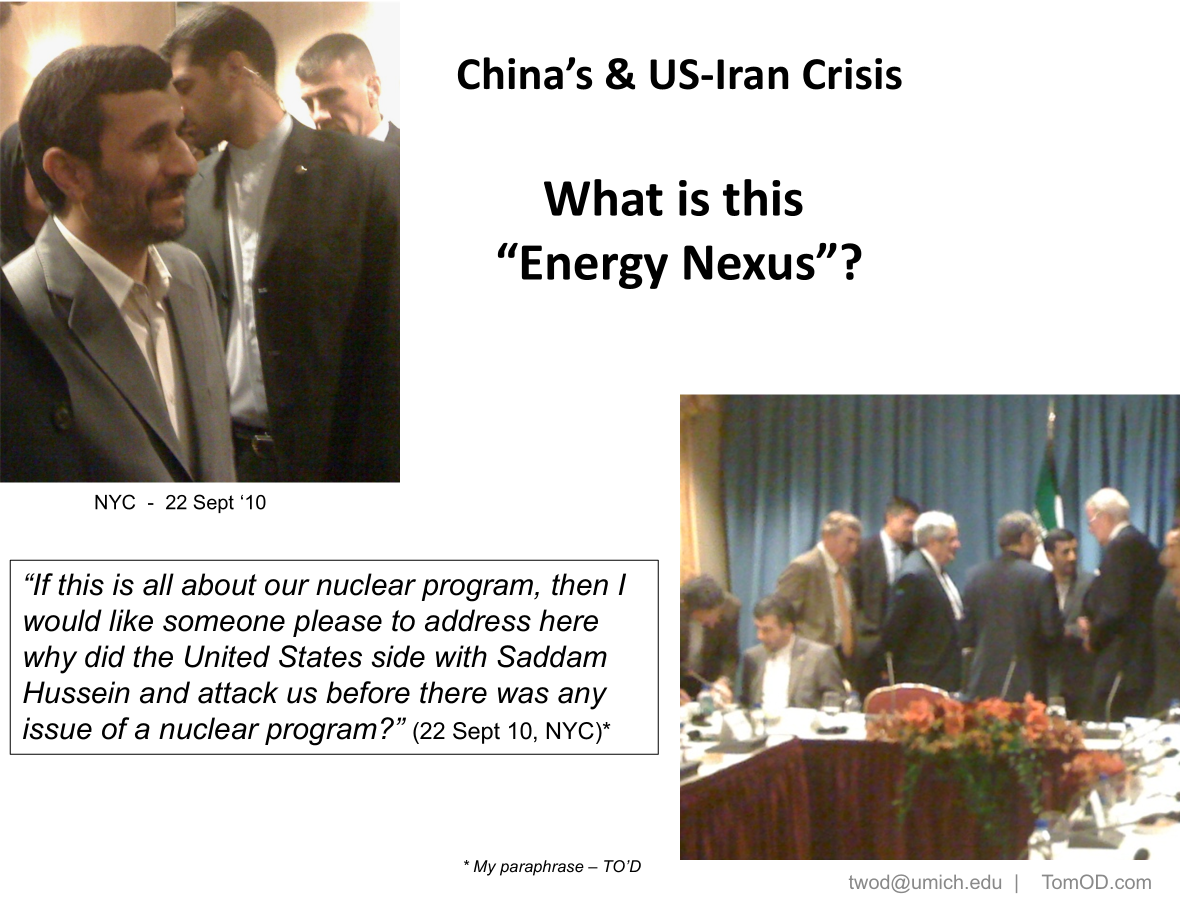
Pictures taken by the author (T.W.O’D) during a dinner and Q&A with President Ahmadinejad, in NYC during 2010 UN General Assembly opening. Note quote from Ahmadinejad.
Some years ago, I was invited to dinner with President Ahmadinejad in NYC during the annual opening of the General Assembly.
The American think-tanks, consultancies, and x-diplomats present went on and on asking detailed questions about this or that scenario where US experts might work with Iranian experts to observe or limit the Iranian nuclear enrichment program. (I mentioned this 2010 dinner in a later post: “China’s Iran-Oil Import Angst. Part I” Feb 13, 2012.)
It became rather tiresome. Ahmadinejad clearly was growing tired of it. He then asked us,
“If this is all about our nuclear program, then I would like someone please to address here why did the United States side with Saddam Hussein and attack us before there was any issue of a nuclear program?” (Iranian President M. Ahmadinejad, 22 Sept 10, NYC, my notes, T.O’D.)
Everyone ignored his question, and simply kept up with their obviously pre-prepared technical questions. But, what had he meant?
To me, clearly he was referring to the Iran-Iraq war (Sept.1980-Aug.1988), when the USA, at a certain point, decided to take Iraq’s side and, among other things, sunk the entire Iranian Navy in a day, took over air traffic control for the Iraqi air force, started directly advising Iraq on strategy, and etc.
In the end, Iran had to accept an Iraqi peace deal after a crushing defeat facilitated by the USA. I recall now all these details vividly. And, all this was indeed well before any nuclear program.
Aside: I find it disturbing that so many “experts” refer to the supposed “Iraqi defeat” in that war. This was all understood at the time. For example, I quote here from the NYT, (Sec. A, Page 1, of July 21, 1988): Ayatollah Khomeini had personally endorsed the cease-fire demanded by United Nations Security Council Resolution 598. Iran’s supreme religious leader confirmed, for the first time, that he had approved the resolution and added, with his characteristic rhetorical flair: ”Taking this decision was more deadly than taking poison. I submitted myself to God’s will and drank this drink for his satisfaction.” (Emphasis added to the most famous part of Khomeni’s statement. T.O’D.) Further research will quickly show he had to sign as Iran was being soundly defeated at the time, hence the “poison” he had to swallow.
By the way, it is also known, at least in academic circles, from later extensive archival research, that the war with Iraq was planned and instigated by Iran, and that Iraq had attacked in response to Iranian provocations and signs of Tehran’s preparations, after warnings. I am happy to send references to those interested.
What I myself had been arguing, back then, during the Iran-Iraq War Ahmadinejad was referring to, was that the US-Iran confrontation was actually about the US opposition to any country, either from inside the Gulf Region or outside the Region, gaining hegemony over the Gulf and the Straits of Hormuz. This had to do with guaranteeing the free flow of oil, and that the global oil market would be a “real” market that no one state could unduly control. I had even coined a term, “The Global Barrel,” for this market-centered, post-OPEC-nationalizations collective oil-security system, a system initiated by Henry Kissinger in 1973.
Yet, tragically, even Merz’s conservatives-in-power still profess faith in 100% renewables “eventually” & nuclear “never” … despite deindustrialization.
The title above says it all. I pointed out that Germany produced about half its electricity from renewables in 2025 such as wind and solar.
However, more renewables have only caused prices to soar, and helped to drive German deindustrialization.. Much of the rest of the EU has similar problems from over-installation of renewables (Note: I coined the term “Renewables Fundamentalism” to describe this), as a Green panacea for both climate change mitigation and supposed energy independence. Aside from the high complexity of integrating ever more renewables that are highly-distributed (spread out over large land masses) and hard to integrate (requiring complete rebuilds and extensions of grids), while the problems of their unreliability (variability, depends on wind speed and amount of sunshine), is their Achilles Heel.
As I told Al Jazeera in this brief interview, once a country has over about 25% dependence on renewables, it requires a complete and highly expensive total rebuild of their grids, and a system of alternative-to-renewable generation in periods of low wind and solar, which the Germans call Dunkelflaute.
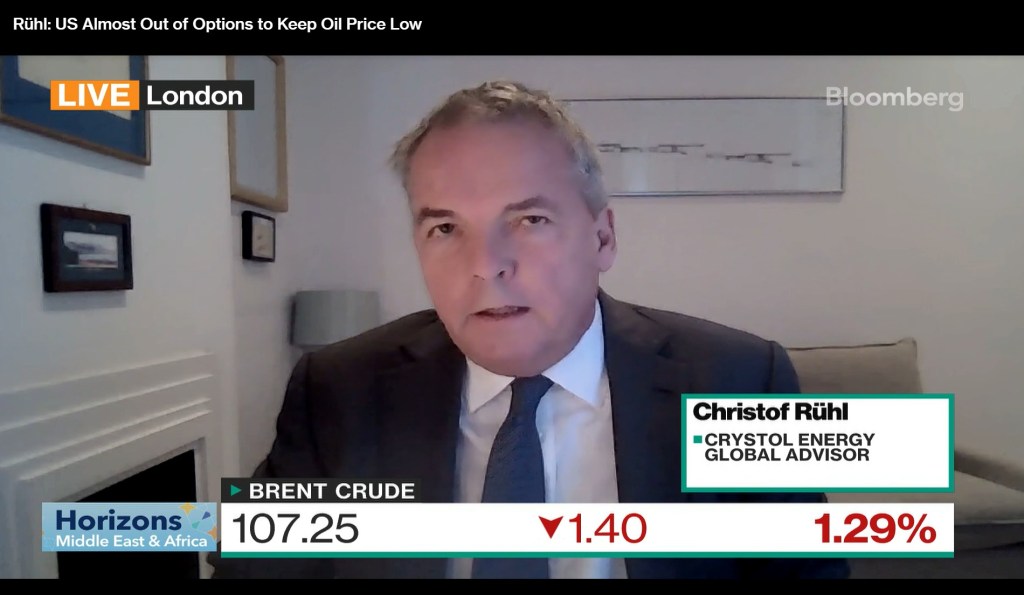
Both Christof Rühl (bio) and Jack Kemp (bio) had great, data-driven media this past week. I too addressed these issues (spoiler: I assess Trump is not bluffing on Iran talks, and oil supply remains adequate.) My conflict-trajectory take differs a bit from Chrisof, perhaps closer to Jack K here.. My Al Jazeera was just after Trump announced talks.
Dear readers, This paper, which I wrote in 2008-09, analyzed the evolution of interests underlying the US-Iran crisis till then, interests which persist in the 2026 US-Iran war.
That is, Trump’s “USA Energy Dominance” strategy does not seek to fundamentally alter the structure or logic of the post-1973 global, market-centered, USA-led-and-protected oil order. However, to preserve it, the USA now feels the necessity of removing the Iranian mullahs as custodians of Iran’s oil for persistently insisting on projecting power and seeking hegemony in the energy-critical Gulf Region.
What is new from 2008, is the bipartisan urgency felt in Washington to renovate the existing oil market-and-security order, reconsolidating the USA as primary arbiter of energy flows via Hormuz to both China and US allied and friendly states of the Indo-Pacific region. In addition, to be capable of significantly blocking Russian oil exports and thereby its petrostate-fueled aggression elsewhere.
In particular, it mush achieve these aims, vis-a-vis Russia and China, without causing global oil shocks. (continued in full-column below …)
Mar 12, 2026. Is the Iran war about the US containing China? For my part, I explained how control of Hormuz would give the US two key levers:
The USA will control half of China’s oil imports, 5.4 million barrels per day (mbd), which flow through Hormuz.
The USA will insure that during any Pacific war China might start that Iran, acting in solidarity with China, could not block oil flows to US Asian allies such as Japan, S. Korea, Australia, Philippines, or flows to others whose supplies it would also want to guarantee, such as Viet Nam, Indonesia, Malaysia, Singapore, etc..
This is a longish, ca. 30 minute video. Host Nataly Lutsenko kindly told me she wanted to make a long interview.
(During time of crisis like this, I have so many TV and press interviews that I don’t have time to put most of them online. So, I will refrain from writing long posts to accompany videos to get more online, if I think they are useful interviews. – Tom O’D)
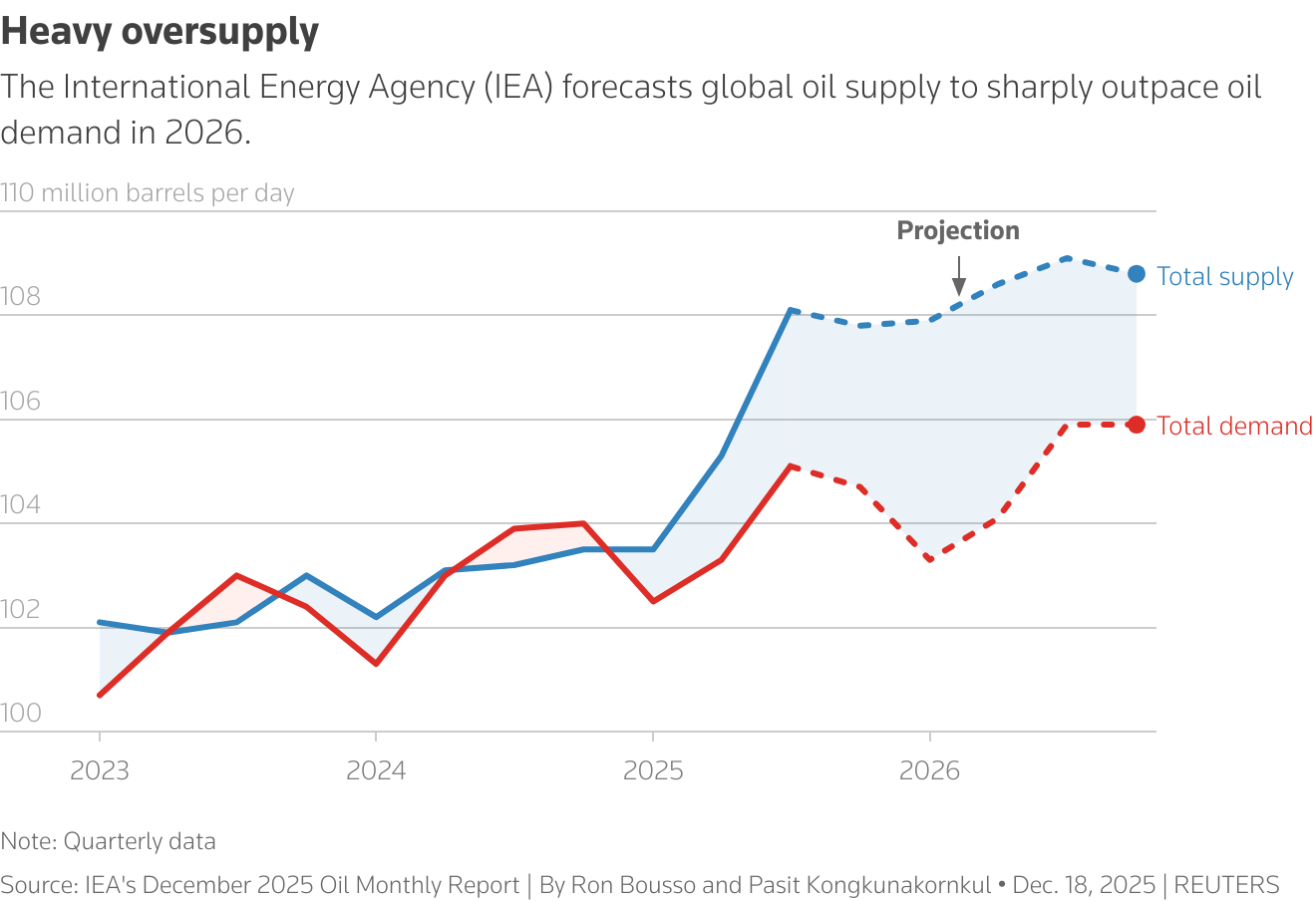
Last night on TRT World Global News (London), I emphasized that despite the modest spike in oil prices from about $70 to $78 per barrel as of yesterday, Trump has an historically unprecedented advantage for exercising “US Energy Dominance.”
Fig. 1. IEA projects global oil glut throughout 202
The campaigns against Venezuela and Iran, plus the turning of the Indian oil-consuming behemoth towards USA and Western interests vs Russian oil, are examples of the geopolitical leverage the USA’s now-dominant role in global oil affairs has afforded the Trump administration.
This oil-market advantage comes mainly from of two things:
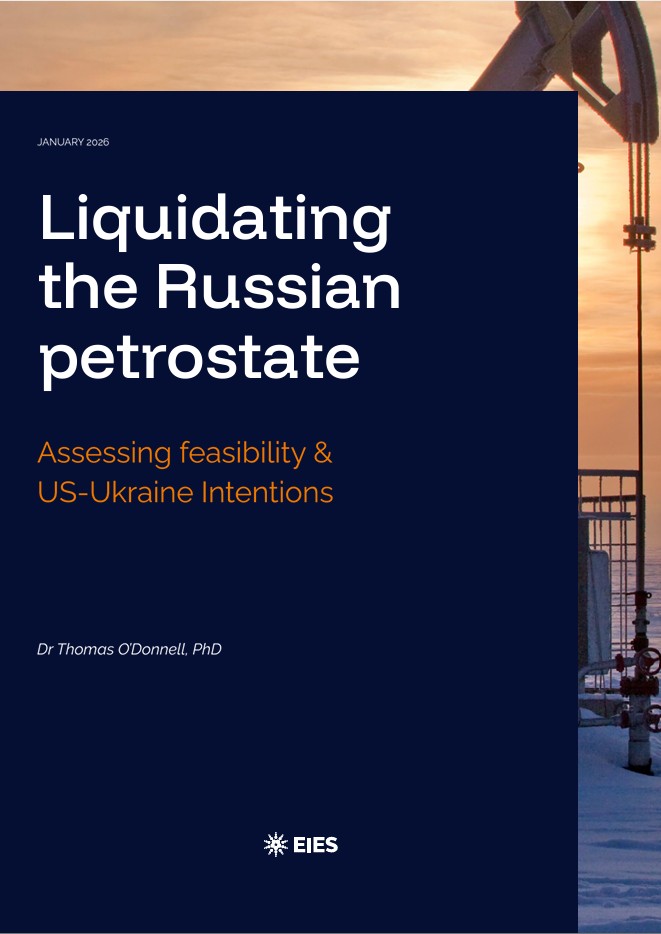
A new USA-Ukrainian strategy has replaced the failed Russian oil-price cap. Oil is the material basis of Moscow’s capacity not only to fight Ukraine, but for its subversion in former USSR states, in Africa, Latin America and elsewhere. In the US, one finds strong bipartisan sentiment that “Russia is a gas station, masquerading as a state,” as former-Senator John McCain famously remarked, and that Moscow must be deprived of its easy petrosate riches.
My study for European Initiative for Energy Security (EIES,based in Brussels, is associated with SAFE in Washington, DC, though policy-independent), traces the new USA-Ukrainian joint war on Russian oil, which includes sanctions, tariffs; drone strikes on Russian refineries, ports and oil tankers, and seizures of shadow fleet ships at sea. All these are part of a coherent campaign begun in Spring 2025, as the Trump administration realized that its focus on offering Putin economic enticements to end the war was proving ineffective. It became clear that the application of “pain”, as Trump put it, would be necessary.
The present study shows, in some technical detail, how it is possible to, first, physically stop the majority of Russian seaborn oil exports, secondly, that this can force the shutdown of old, delicate W. Siberian oil fields in winter resulting in the permanent or semi-permanent ruin of these fields, the material basis of the Russian petrostate economy.
This, in fact, is the real threat, the “pain”, which Putin has begun to fear, inducing him to engage for the first time a bit more seriously in negotiations.
The Report also draws attention to and analyses the unfortunate incapacity of many European expert observers and think tanks to see the outlines of this coherent oil war strategy, distracted by the considerable bluster and threats employed by President Trump.
Third, in parallel, the study explains presently favorable oil market conditions consisting of a persistent supply glut, making any major cutoff of Russian seaborne oil exports feasible without sparking a lasting spike in world prices. I show how the OPEC-Gulf states, especially the Saudis and UAE, have facilitated this glut in coordination with President Trump et al, with the prospect of regaining much of the Indian and Chinese market discounted Russian oil has taken since 2022.
For the longer term, however, in the conclusion to this report, it is shown how the return of Venezuelan barrels to the market (and perhaps Iranian barrels as well) are part of a comprehensive USA energy strategy to create market conditions enabling both persistent low prices and, if necessary, the permanent “Liquidation of the Russian Petrostate,” to end the Ukraine war and Moscow’s international significance-in-general.
This is all seen to be part-and-parcel of the Trump administrations detailed commitment – with significant bipartisan support – to exercise “USA Energy Dominance” as a pillar of USA geo-economic power and geostrategy.
I am available for interviews and speaking on this Report’s topic. Contact EIES or me directly.