This is a longish, ca. 30 minute video. Host Nataly Lutsenko kindly told me she wanted to make a long interview.
(During time of crisis like this, I have so many TV and press interviews that I don’t have time to put most of them online. So, I will refrain from writing long posts to accompany videos to get more online, if I think they are useful interviews. – Tom O’D)
I discussed with Artur Ciechanowicz (BizNesAlert.pl) how Chancellor Merz and Energy Minister Reiche refuse the one reform that can really boost German energy security: focusing on nuclear energy as France has, and Poland has begun to do. (Read below in English or in Polish) — Twice last week, Merz indicated willingness to work with Russia when the Ukraine war ends. For two decades before the war, working with Russia meant more Russian gas imports, building Nord Stream 1 & 2. Now Merz worries about dependence on USA LNG. However, the German model he continues, one of installing BOTH a full-scale, wildly complex renewables system, plus a full-scale natural-gas backup system, guarantees high-cost energy, deindustrialization and foreign energy dependence.(Polish at BizNesAlert.pl)
Amerykański ekspert: Niemcy znów myślą o gazie z Rosji
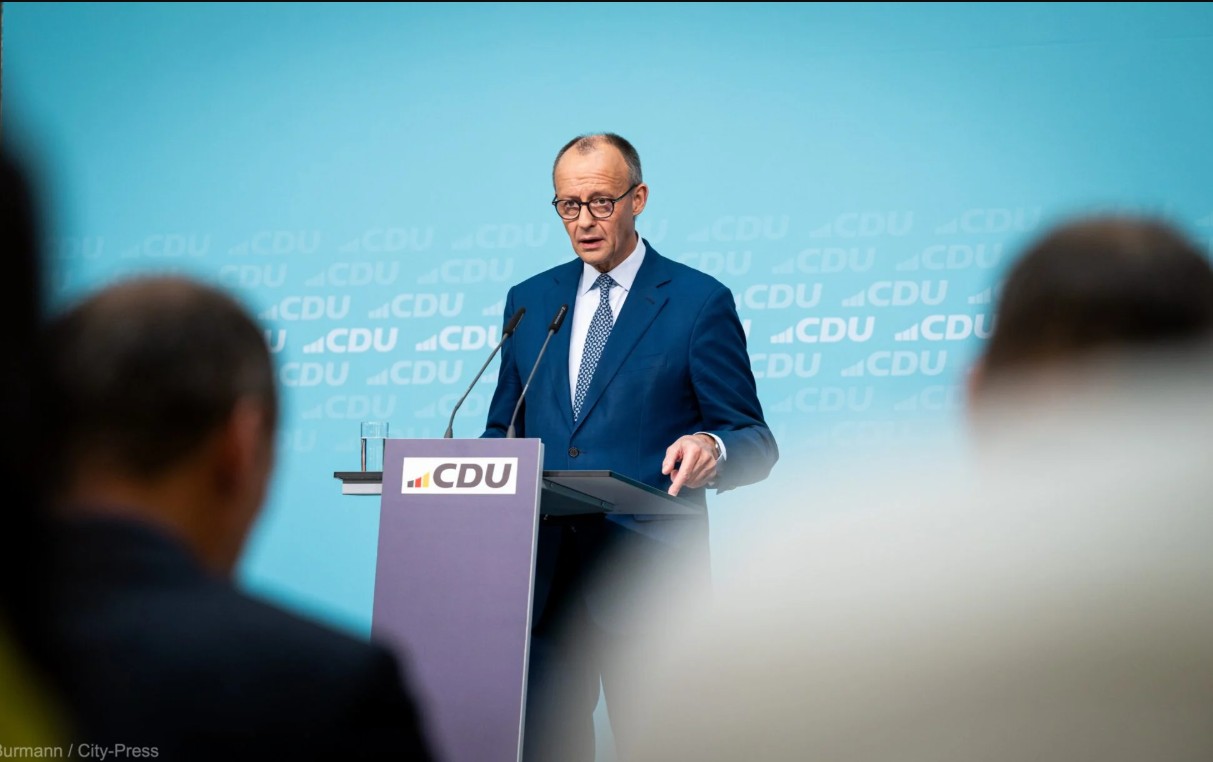
Wcześniej czy później Niemcy ponownie będą racjonalizować podporządkowanie się Gazpromowi Putina w imię +dywersyfikacji+ dostaw – ocenia Thomas O’Donnell, ekspert ds. energii i geopolityki z amerykańskiego think-tanku Wilson Center. Na zdjęciu kanclerz Niemiec Friedrich Merz.FOTO: x.com/_FriedrichMerz
Berlin zaczyna zmieniać kurs wobec Rosji i znów będzie racjonalizować współpracę z Putinem w imię „dywersyfikacji” dostaw gazu. Stanie się tak, bo Niemcy nadal opierają swoją strategię energetyczną na OZE wspierane gazem, zamiast postawić na atom jako priorytet – ocenia w rozmowie z Biznes Alert amerykański ekspert Thomas O’Donnell.
Wypowiedzi kanclerza Niemiec Friedricha Merza o potrzebie „pojednania” z Rosją, wygłoszone dwukrotnie nie da się traktować, jako wyrwanych z kontekstu i przypadkowych. To sygnał polityczny. Najbogatsze państwo Europy i przemysłowy motor Unii Europejskiej zaczyna rewidować swoją linię wobec Moskwy.
Merz z ufnością o Rosji
– Jeśli uda nam się przywrócić pokój i wolność w Europie, jeśli ponownie odnajdziemy równowagę w relacjach z naszym największym europejskim sąsiadem, czyli z Rosją, jeśli zapanuje pokój i zostanie zapewniona wolność – jeśli to wszystko nam się powiedzie, wtedy Unia Europejska, a wraz z nią my w Niemczech, przejdziemy kolejny test i będziemy mogli z ufnością patrzeć w przyszłość także po 2026 roku – powiedział szef niemieckiego rządu na spotkaniu noworocznym z przedstawicielami przemysłu i handlu 14 stycznia w Halle, dodając potem: „(…) jeśli w dłuższej perspektywie uda nam się na nowo przywrócić równowagę w relacjach z Rosją, gdy zapanuje pokój i gdy wolność będzie zagwarantowana”.
Niemiecki przemysł od 2023 roku zmaga się z wysokimi cenami energii, spadkiem konkurencyjności, rosnącą presją chińskich producentów oraz stagnacją wzrostu gospodarczego. W 2024 roku niemiecka gospodarka formalnie weszła w recesję techniczną, a prognozy wzrostu na 2025 rok były jednymi z najsłabszych w UE.
Wypowiedzi Merza nie oznaczają natychmiastowego zwrotu w polityce wobec Moskwy ani propozycji zniesienia sankcji. Nie są ofertą pokoju ani jednostronnym gestem. Wskazują jednak na rosnące przekonanie w niemieckich elitach politycznych i gospodarczych, że obecny stan konfrontacji – bez realistycznej strategii wyjścia – osiągnął dla nich próg bólu.
„Powrót do „mafijnego bossa od gazu”
Thomas O’Donnell, ekspert ds. energii i geopolityki z amerykańskiego think-tanku Wilson Center wyjaśnia w rozmowie z Biznes Alertem intencje Merza: „Niemieckiemu kanclerzowi chodzi przede wszystkim o uniezależnienie się od pełnego sojuszu z USA, od zależności od Stanów Zjednoczonych. Jednak powrót do starego +mafijnego bossa od gazu+, Władimira Putina, trudno nazwać niezależną strategią”.
Z analizowanych przez O’Donnella wypowiedzi i komentarzy, a także z poufnych rozmów wynika, że niemieccy urzędnicy rządowi traktują amerykańską energię, jako potencjalnie równie zawodną jak tę z Rosji.
– Merz zlecił w związku z tym swoim ludziom znalezienie rozwiązań. Oczywiście, metody Donalda Trumpa w relacjach z sojusznikami nie są konstruktywne. Mimo że Niemcy są teraz ogromnym odbiorcą LNG z USA, to amerykański prezydent traktuje te biznesowe więzi również jako instrument nacisku – zaznacza ekspert.
– Jednak źródło problemu leży w nierealistycznej polityce energetycznej ostatnich czterech kanclerzy. Merz dostrzega problem silnie subsydiowanych odnawialnych źródeł energii oraz nadmiernej zależności od rosyjskiego gazu. Ale wciąż nie widzi, że Niemcy nie mogą zapewnić sobie bezpieczeństwa energetycznego ani przystępnych cen, opierając się na zależnych od pogody OZE wspieranych gazem. Postawienie na nową energetykę jądrową jako priorytet to jedyna droga — co Francja jasno udowodniła – dodaje.
Niemcy znowu pomyślą o gazie z Rosji
O’Donnell zwraca uwagę, że Merz i jego rząd popierają kontynuację budowy tych samych dwóch równoległych systemów, które tworzyli poprzedni dwaj kanclerze: jednego opartego wyłącznie na OZE i drugiego — gazowego — jako zaplecza na dni bez wiatru lub słońca.
– W praktyce tak zwana reforma polityki energetycznej Merza polega na tym, że dalsza rozbudowa OZE i sieci ma być teraz w większym zakresie finansowana z prywatnych środków, a planowane ogromne instalacje turbin gazowych również mają powstać — tyle że zasilane LNG z USA, a nie rosyjskim gazem – podkreśla Thomas O’Donnell i ocenia, że nie jest to radykalna, strukturalna reforma energetyczno‑przemysłowa, której Niemcy potrzebują, a jedynie kosmetyczna zmiana.
– W sposób konieczny wcześniej czy później doprowadzi to do tego, że Niemcy ponownie będą racjonalizować podporządkowanie się Gazpromowi Putina w imię +dywersyfikacji+ dostaw. Czy to z powodu ideologiczno‑technologiczno‑politycznego zamieszania, czy oportunizmu — niemieccy przywódcy nie dostrzegają, że już istniejące OZE i każda nowa generacja gazowa powinny być traktowane jedynie jako rozwiązania pomostowe, podczas gdy rozwój energetyki jądrowej powinien być priorytetem – jako jedyna realna droga – podsumowuje amerykański ekspert.
Artur Ciechanowicz
American expert: Germany is considering gas from Russia again
Sooner or later, Germany will once again rationalize its subordination to Putin’s Gazprom in the name of “diversification” of supplies, says Thomas O’Donnell, an energy and geopolitics expert at the American think tank Wilson Center. Pictured is German Chancellor Friedrich Merz. PHOTO: x.com/_FriedrichMerz
Berlin is beginning to change course towards Russia and will once again rationalize cooperation with Putin in the name of “diversifying” gas supplies. This will happen because Germany continues to base its energy strategy on renewable energy supported by gas, instead of prioritizing nuclear power, American expert Thomas O’Donnell told Biznes Alert.
German Chancellor Friedrich Merz’s statements about the need for “reconciliation” with Russia, made twice, cannot be dismissed as out of context or coincidental. They are a political signal. Europe’s richest country and the industrial engine of the European Union is beginning to reconsider its stance towards Moscow.
Merz with confidence about Russia
– If we manage to restore peace and freedom in Europe, if we manage to find balance again in relations with our largest European neighbor, Russia, if peace prevails and freedom is guaranteed – if all this succeeds, then the European Union, and with it we in Germany, will have passed another test and will be able to look to the future with confidence even after 2026 – said the head of the German government at a New Year’s meeting with representatives of industry and trade on January 14 in Halle, later adding: “(…) if in the long term we manage to restore balance again in relations with Russia, when peace prevails and freedom is guaranteed.”
German industry has been struggling with high energy prices, declining competitiveness, increasing pressure from Chinese manufacturers, and stagnant economic growth since 2023. In 2024, the German economy formally entered a technical recession, and growth forecasts for 2025 were among the weakest in the EU.
Merz’s statements do not signal an immediate shift in policy toward Moscow or a proposal to lift sanctions . They are not an offer of peace or a unilateral gesture. However, they indicate a growing conviction among German political and economic elites that the current state of confrontation—without a realistic exit strategy—has reached their pain threshold.
“Return to the ‘Mafia Gas Boss'”
Thomas O’Donnell, an energy and geopolitics expert from the American think-tank Wilson Center, explains Merz’s intentions in an interview with Biznes Alert: “The German chancellor is primarily concerned with becoming independent from a full alliance with the United States, from dependence on the United States. However, returning to the old ‘mafia gas boss’, Vladimir Putin, is hardly an independent strategy.”
Statements and comments analyzed by O’Donnell, as well as confidential conversations, indicate that German government officials view American energy as potentially as unreliable as that from Russia.
“Merz has therefore tasked his people with finding solutions. Of course, Donald Trump’s methods in relations with allies are not constructive. Even though Germany is now a huge recipient of LNG from the US, the American president also uses these business ties as a tool for pressure,” the expert notes.
“However, the root of the problem lies in the unrealistic energy policies of the last four chancellors. Merz recognizes the problem of heavily subsidized renewable energy sources and excessive dependence on Russian gas. But he still fails to see that Germany cannot ensure energy security and affordable prices by relying on weather-dependent renewable energy sources supported by gas. Prioritizing new nuclear energy is the only way forward—as France has clearly demonstrated,” he adds.
Germany will think about gas from Russia again
O’Donnell points out that Merz and his government support the continuation of the construction of the same two parallel systems that the previous two chancellors created: one based solely on renewable energy and the other – gas – as a backup for days without wind or sun.
– In practice, the so-called Merz energy policy reform means that further expansion of renewable energy sources and the grid is now to be financed to a greater extent from private funds, and the planned huge gas turbine installations are also to be built – but powered by LNG from the USA, not Russian gas – emphasizes Thomas O’Donnell, assessing that this is not the radical, structural energy and industrial reform that Germany needs, but merely a cosmetic change.
“Sooner or later, this will inevitably lead to Germany once again rationalizing its subordination to Putin’s Gazprom in the name of ‘diversification’ of supplies. Whether due to ideological, technological, and political confusion or opportunism, German leaders fail to recognize that existing renewable energy sources and any new gas-fired generation should be treated merely as bridge solutions, while the development of nuclear energy should be a priority—the only viable path,” the American expert concludes.
-1- How US and other foreign oil firms can start immediately to stepwise developing three different types of oil fields. Yes, Venezuela can become a “powerhouse” oil producer. This could be a huge change in the global oil system.
-2- What is meant when Trump and oil firms talk about USA “security guarantees” for work in Venezuela. The USA government is unlikely to subsidize oil majors going into Venezuela. Instead, they are talking about somehow Washington managing a “regime change.” The KEY element of this is that the present pro-Chavista armed actors, both the state and non-state armed actors and the Chavista-state intelligence services, all of which are widespread in the country, are still intact and are still active, either agree to disband stepwise or to stepdown and not oppose the formation, eventually, of a new government elected freely. The instruments of state armed coercion that will remain, including elements of the police, intelligence services, national guard, army, must agree to serve whomsoever is democratically elected in future elections. However, as Trump himself points out, the foreign oil majors “are tough guys” and they have abundant experience and methods to work in countries having fairly dangerous situations.
Nataly Lutsenko at Kanal24 TV in Kyiv, invited me again to an interview. We discussed, in detail, what I see as “the oil war” jointly waged by Ukraine and the USA against Russia. Each has its role:
(i) Ukraine is waging an air campaign with drones and missiles against Russian refineries, oil export terminal ports, and oil tankers. This is an audacious and expanding campaign seriously impeding Russian capacity to handle export of the oil its fields produce.
It is important to note, politically, that these attacks are assisted by USA intelligence, as reported in October by the FT. Ukraine’s intelligence chief also spoke of Ukraine’s crucial dependence on US intelligence assets on 20 December, and later on the depth. Unlike the former “oil price cap” strategy of the Biden administration and the early months of the second-Trump administration, the present, much expanded air war on Russian oil is now clearly embraced by the USA.
(ii) For its part, the USA’s role in this oil-war – along with NATO, UK, EU and G7 allies – involves increasingly harsh tariffs and sanctions against Russian oil exports.
My thanks to Tor Klaveness at Kapital, Norway’s oldest and leading, business magazine. Below is an English translation, then the Norwegian original. – Tom O’D.
“Bone-crushing” and “draconian”: The law that could choke Putin’s oil revenues
If peace talks between Ukraine and Russia break down, the US Senate is ready to pass a sanctions package that could strangle Russia’s oil exports. In that case, it could significantly strengthen the oil market.
Energy Published 29 Nov. | Paywall removed, Updated 9 Dec.
“President Trump said this weekend, ‘Send me the bill.’ So we have to send him the bill to help end this war.”
Dr. Thomas O’Donnell, energy and geopolitical strategist
This was stated by Republican Senator Lindsey Graham in a panel debate on November 19 with Democratic Senator Richard Blumenthal. The debate was moderated by Clayton Seigle, a senior fellow at the think tank Center for Strategic and International Studies (CSIS), which also organized the debate.
The bill Graham referred to is the Sanctioning Russia Act , which he is co-sponsoring with Blumenthal. The bill already has the support of 85 of the 100 US senators and would give US authorities the right to impose punitive tariffs of no less than 500 percent on countries importing Russian energy.
PHOTO: Alexander Kazakov, Sputnik, Kremlin Pool Photo via AP/NTB
With a stick and a carrot
Dr. Thomas O’Donnell is an energy and geopolitical strategist, founder of GlobalBarrel.com and former global fellow at the Wilson Center in Washington, D.C. He believes Congress is now poised to give President Trump an extremely potent weapon.
The proposal is being described as “bone-crushing” and “draconian,” and is set to be voted through almost unanimously in the Senate.
I was interviewed on CNN International’s “Newsroom” with host Kim Brunhuber – live, Friday, 12 Dec. 2025. The transcript is below. Kim asked about Venezuela’s oil industry, the impact of sanctions, what stricter enforcement could do to the Venezuelan economy, and what the US stands to gain if it ultimately gains greater access to the country’s oil reserves? He also wanted to know what Venezuelans are saying. / CNN says: “The show is broadcast around the world on CNN International, and in the US on our new platform All Access.”
Dear colleagues and friends — there are two key energy aspects in this detailed interview with Nataliia Lutsenko of Channel 24, an all-news TV channel from Kyiv: (1) Ukraine’s attritional war on Russia’s domestic oil sector and (2) whether Ukrainian long-range drone capacities will be called upon (viz., permitted by the USA) to accomplish what the new US policy of ending Russian oil exports seeks to accomplish through secondary tariffs. Elaborating:
(1) Domestic Russian oil refining capacities: I explained that, If Ukraine can sustain these new drone attacks at a faster rate than Russia can repair them, this will be a major blow to the supply of diesel fuel required by the Russian war economy, especially to war industries, railways (i.e., to locomotive fuel), for harvesting of crops this fall, and to supply the war front and occupied Ukraine. The last time this was tried on a large scale, roughly two years ago, Ukraine caused significant hardships to Russian refining, but ultimately it did not achieve sustained damage at a rate necessary to collapse Russia’s immense national refining capacity. However, as I pointed out to Nataliia, Ukraine’s drone production and sophistication is now greater, and chances of success therefore better. We should know in some weeks or perhaps a few months if Ukraine can now overwhelm Russia’s repair capacities.
Already, fuel prices have spiked in Russia, with Moscow deciding to insure refiners receive a special subsidy they would otherwise not get due to high prices they are charging for fuel, to address difficulties with the renewed drone war. (Russian Refiners Hit Rough Patch, Hope for State Support, E.I., 20August25, [paywall].)
(2) Russian oil export capacities: Why does Ukraine’s war on the Russian oil sector not include destruction of Russia’s three westward facing oil ports, the terminals it uses to export the overwhelming bulk of its oil exports? These are Ust-Luga and Primorsk in the Baltic, and Novorossiya on the Black Sea. Why has the oil export capacities of these ports essentially never been hit?
I felt greatly honored to speak in Ireland, the home of my ancestors, at a high-level Irish-Polish event, invited by the Polish embassy as part of Poland’s Presidency of the European Council. [Spoiler alert: my assessment of the Green Deal’s impact on EU energy security and competitiveness was highly critical. And, I called for a radical reform, modeled on the 1970-80’s French Messmer nuclear program, the response to a similarly dire European energy and competitiveness crisis.]
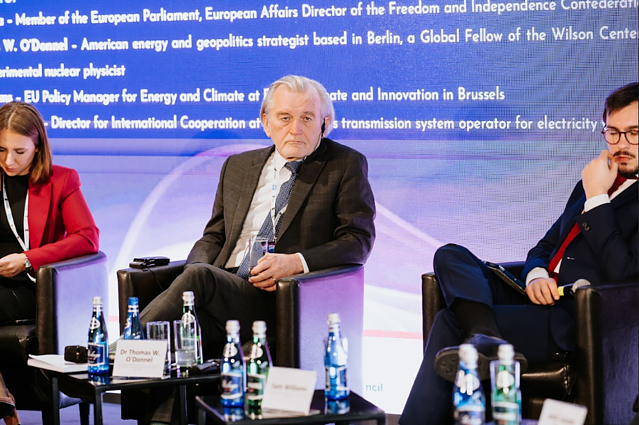
For Ireland we had Secretary General Oonagh Buckley and Wind Energy Ireland CEO Noel Cunniffee; for Poland, Daniel Piekarsky, Head of Energy Security Unit in the Foreign Ministry, and myself, Global Fellow of the Wilson Center, Washington (external) working in Europe, from Berlin.
Our moderator, from the Polish Embassy, Dublin, was the Polish diplomat and patriot, Dr. Jacek Rosa — a good friend, with whom I had the great pleasure of closely collaborating, for several years, in opposition to the Russian-German Nord Stream 2 gas-pipeline partnership, before the 2022 full-scale invasion of Ukraine. Below is the lineup, the initial invitation and some pictures. The event was off-the-record, so I show here only my own, slightly redacted talk.
Opening of Nord Stream1 pipeline, 2011. Gazprom via PAP
Below are links to 12 articles that appeared in the Polish press in the last few months, interviewing or quoting me on four topics I feel are important. The topics are listed in the title above.
The links are below, sorted by topic. The first or left column has English translations of the titles, and the second or right column has the original Polish — which unfortunately I don’t speak! If you follow the links, Google Translate or Deepl will translated the Polish articles pretty well into English. My special thanks to the intrepid Polish journalist, Artur Ciechanowicz at BiznesAlert in Warsaw for his interviews in the list. (I also had about 33 quotes or interviews in several other languages since December [1]).
ENGLISH titles and links:
On German (far-right) & USA (Trump) each plotting a Russian gas return to Germany
A former Stasi agent lobbies for the resumption of Nord Stream. Expert: One of the gas pipeline lines ready to be launched,, By,:Artur Ciechanowicz, March 3, 2025, biznesAlert.pl
Some EU countries believed that Gazprom gas would be in Europe forever BiznesAlert.pl
“Like a Drug Addict Returning to Heroin.” Analyst on the Idea of Unblocking Gas Imports from Russia to Europe, Author: Artur Ciechanowicz, February 1, 2025, 07:21
Failures of EU Green Deal on technology and energy security.
American expert: recommendation to reduce emissions by 90 percent by 2040 is “fantasy” | Energetyka24
Expert: EC recommendation to reduce gas emissions is fantasy wpolityce.pl
Unrealistic EU climate plan. Expert opinion crushes – Super Business
“Rearranging deckchairs on the sinking Titanic”. Expert slams the eco-target dictates of Brussels Eurocrats – PCH24.pl
Trump, EU & Poland: Ukraine War crisis.
First talk with Putin. Trump has visions of ending the war in Ukraine | Newsweek Jan 21
How Trump Can Bring Down the Russian Economy: Analysts: He Has an Arsenal of Means to Do It, By Artur Ciechanowicz, Jan 24, 2025 | Biznes Alert
Trump may use [oil] sanctions to finish off Moscow, which is running out of money for the National Welfare Fund. – 16 January 2026 UBN
Expert: Washington, London, Warsaw should work quickly. Kiev can’t afford to be patient – Dziennik.pl
German deindustrialization: Energy & economic crisis
Major shoe retailer goes bankrupt A sharp increase in bankruptcies in Germany
Polish titles and links:
First topic.
Agent Stasi lobbuje za wznowieniem Nord Stream. Ekspert: Jedna z nitek gazociągu gotowa do uruchomienia biznesalert.pl
Część krajów Unii uwierzyła, że gaz z Gazpromu będzie w Europie na zawsze BiznesAlert.pl
“Jak powrót narkomana do heroiny”. Analityk o pomyśle odblokowania importu gazu z Rosji do Europy | BizNes Alert
2nd Topic
Amerykański ekspert: zalecenie redukcji emisji o 90 proc. do 2040 r. to „fantastyka” | Energetyka24
Ekspert: Zalecenie KE redukcji emisji gazów to fantastyka wpolityce.pl
Nierealny plan klimatyczny UE. Opinia eksperta miażdży – Super Business
“Przestawianie leżaków na tonącym Titanicu”. Ekspert nie zostawia suchej nitki na eko-dyktaturze brukselskich eurokratów – PCH24.pl
Third topic
Donald Trump chce uchronić świat przed III wojną światową | Newsweek
Jak Trump może złamać rosyjską gospodarkę?
Trump may use [oil] sanctions to finish off Moscow, which is running out of money for the National Welfare Fund. – UBN
Ekspert: Waszyngton, Londyn, Warszawa powinny szybko działać. Kijowa nie stać na cierpliwość – Dziennik.pl
[1] Other than being cited/interviewed in Poland, I was also quoted elsewhere about 33 times so far in 2025, mainly in the USA, with many then translated to languages of Europe, Asia and Latin America. I never know what to do with all these print interviews. Here at GlobalBarrel.com, I often publish videos of some of my live-on-air expert commentary, usually accompanied by a detailed blog post. So, my idea is I will make a new tab at the top of the GlobalBarrel.com site, next to the “About Me” tab, where I can simply list link to my recent press citations or Op-Eds. [Back to text]
TRT asked me to be ready to comment, live, on the Oval Office meeting just before it blew up. I said Vance acted “infantile”. What I should have stressed, however, is that understanding Vance’s decision to blow up the meeting is key to understanding Trump’s strategy towards Russia, Ukraine, and Europe. (So, in this post the written analysis is the main thing, not the video.)
My TRT quick take, 28 Feb. See my later analysis, in the blog post.
There is plenty of facile analyses of this clash. Many say the blowup reflected “chaos” in Trump’s policy on Ukraine and Russia, or that Trump has an “impulsive” strategy, that he “dislikes Ukraine”, he’s “pro-Russian,” or that the blowup was a “prearranged ambush” to “humiliate” Zelensky, or similar.
Too few consider the possibility that the rebuke is consistent with a well-defined USA strategy. What quickly becomes clear from listening, at face value, to multiple statements by Trump himself and his team is that they have a consistent strategy. This is clearly not the first Trump administration. This second administration is different in its unity and consistency on its Ukraine, Russia, and Europe policies.
What was the purpose of the “minerals” deal that Zelensky came to sign?
The weeks-long USA-Ukrainian clash over this deal has reflected their geostrategic differences on a peace deal with Russia. After heated exchanges and compromises, clearly the Ukrainian side was not pleased with the issues it had had to give up in the minerals deal. Nevertheless, Zelensky’s Council of Ministers voted to endorse the deal, and Zelensky went to DC explicitly to sign it.
Interestingly, just before he went to the White House, President Zelensky met with a group of Republican and Democratic senators, who had “… all told him sign the deal and don’t get into an argument.” (War on the Rocks, timestamp 7:58-8:19, 06.03.25). Alas, if one watches Zelensky’s public argumentation, from the start of the press conference, and his telling Trump that a deal without a US security guarantee won’t work, all of which is in contradiction to the deal he is about to sign, it is clear that he precipitated the breakdown. In my reading of the event, he seemed to not be able to restrain himself, seemingly out of an understandable deep anguish at being about to sign an accord contrary to his better judgment.
What did each side want in the “minerals” deal, and who got what?
Everything I found to have been said by the actors on the USA and Ukrainian sides as to what each wanted in the document is quite consistent.
On the Ukrainian side, the big one was a USA security guarantee for any deal Trump makes with Putin. The Ukrainians certainly welcome the willingness of European allies to extend security guarantees for any deal, especially the public commitments made by both the UK and France to contribute troops, but they were clear that they did not think this can substitute for a USA guarantee standing behind theirs. Related to this, the Ukrainians opposed taking NATO membership for them off the table. Another was a seat at the table for Ukraine and the Europeans during negotiations with Russia (Trump wants something more like a shuttle diplomacy between the two.) Related to this, is that the USA should not negotiate a cease fire deal without them. Still another was refusing to agree beforehand to give up any Ukrainian territory that has been occupied by Russia.
Obviously the USA disagreed and de facto or openly refused all these conditions. However, the disagreement over the security guarantee seemed to be the most hot-button issue between them. Trump flatly refused. His reasoning, as explained to the press was interesting, revealing a lot about his philosophy or method for negotiating a peace deal. He said that the two sides obviously hated one another and he had to go between the two to negotiate anything. (Read Trump’s own words, in the transcript below.)
The Trump concept of economic interests and security interests
He also said that they had to trust him, saying that it just would not work if he first gave a security guarantee, taking Ukraine’s side so clearly beforehand. He also said that the ultimate security guarantee “is the easy part” and getting the deal “is the hard part.” He said the guarantees can “come later.” It became clear that, in his approach, this minerals deal was to be the signal to Putin that the USA would have long-term economic interests in Ukraine and would, of course, in Trump’s view of how the world works, defend against any threats to those economic interests.
This approach is clearly seen as highly risky by Ukraine, which has been abandoned once before under what was an explicit security guarantee, the Bucharest Memorandum, extended in return for giving up its nuclear weapons in the 1990’s. As Zelensky recounted for Trump, no signatories of the Minsk Accords extended security guarantees after Russia’s 2014 aggression, and Putin broke them constantly
The text of the final document, the one the Ukrainian ministers approved, is known; it was published in Kyiv two days before the Oval Office meeting. (The full text of the Ukraine-US Minerals Agreement, European Pravda, Kyiv, 26.02.25). So, it is easy to see that Kyiv didn’t get its main demands, although the USA did compromise, in a sense, on one of them, agreeing to an explicit mention of a “security guarantee.” However, the USA did not extend one as a quid-pro-quo for the minerals deal, rather in Section 10. the wording is:
The Government of the United States of America supports Ukraine’s efforts to obtain security guarantees needed to establish lasting peace. Participants will seek to identify any necessary steps to protect mutual investments, as defined in the Fund Agreement.
So, the USA vision of security, to “protect mutual investments,” is asserted in association..
My long print interview at Lithuania’s LRT [Lithuanian PDF | English PDF] with Aleksandra Ketlerienė, deputy editor-in-chief of Lithuania’s LRT.lt, published 7January. We spoke in Warsaw, 19 November. My thanks to Aleksandra for her insightful questioning and editorial care. We discussed:
The EU’s systemic energy-policy “own goals” since its initial energy-crisis win after Moscow began cutting gas exports early in 2021.
Reforming failed/ineffective Russian price-cap sanctions for real sanctions, and how the global oil market is now favorable for “maximum pressure.”
Historical perspectives on oil, gas, renewables, and nuclear sectors, essential for realistic policy formation.
An historical overview of China’s decades-long effort to overcome its energy security, learning lessons of Japan’s WW2 weaknesses.
Again, oil security is determined by both global-market balances and geostrategic realities – at present the Mideast war and Russia’s War on Ukraine. My analyses this weekend were featured in: (a)an AlHurra video (LHS English, RHS Arabic), and below these (b)a detailed BBC-Cairo print interview (LHS English Google Translate, RHS Arabic original). where I make similar points as my Friday video in Warsaw.
Alhurra ENGLISH. My comments at 2:45 & 8:20. Date: 5 Oct 2024, with co-guest GPI President Paolo von Schirach, Washington.
Alhurra ARABIC, 5 October 2024
My BBC (CAIRO) print interview in Arabic and English (Google Translate):
Below, I am quoted repeatedly (marked in bold -TO’D), by Newsweek’s intrepid Brendan Cole, reporting from London on Russia and Ukraine. I was on the Berlin-Warsaw express, heading to the Warsaw Security Forum. At the end are links to several other-language versions. Read on …
Putin’s Arctic Project Suffers Blow From Top Trade Ally
India has refused to buy liquefied natural gas (LNG) from Vladimir Putin‘s flagship Arctic energy project delivering a “major blow” to Moscow’s fuel exports, an energy analyst has told Newsweek.
India’s oil secretary, Pankaj Jain, has said that New Delhi is “not touching” any commodity from the Arctic LNG 2 project due to sanctions that followed Putin’s full-scale invasion of Ukraine aimed at stifling Russian energy revenues, which the United States stepped up this month.
Putin had high hopes for the seaborne resource after losing the lucrative European market for pipeline gas due to sanctions and the president’s move to weaponize the fuel, which only spurred countries to find other suppliers.
Following huge losses, Gazprom cut its fuel production while a proposed Power of Siberia 2 pipeline to transport increasingly stranded Russian gas resources to China remains delayed amid haggling over price.
However, attempts by state firm Novatek to get Russia’s gas to market through the Arctic LNG 2 project have so far failed after Jain said last Friday, “We are not buying any sanctioned commodity.”
Newsweek reached out to Novatek for comment.
Berlin-based energy analyst Tom O’Donnell said Russia’s switch to boosting LNG exports has been fraught with difficulties due to sanctions.
“They have had to considerably cut back because they can’t get either the equipment to build it or the ships to transport it,” he told Newsweek.
“LNG from the new Arctic LNG 2 project was very important for Putin to be able to ship it to India and to China,” he said. “With India dropping out, this will be a major blow.”
Russia plans to triple its LNG exports by 2030 to 100 million tons. The country is expected to play a key role in India’s energy strategy, which has built terminals to receive the fuel.
First, a personal note: As some of you know, this is an idea I’ve been floating in Berlin since well before Corona. Then, last October, I had an experimental test run, a one-off, sponsored by the Qatari embassy’s Divan – and it went very well.
However, the biggest success from that event was that Ben Aris, co-founder and editor-in-chief of bne IntelliNews enthusiastically joined me to found the Berlin Energy Forum as a regular monthly sort of membership club. Amongst the longest serving foreign correspondents in Eastern Europe, Ben has been covering Russia since 1993, with stints in the Baltics and Central Asia. He is a former Moscow bureau chief for the Daily Telegraph and was a contributing editor at The Banker and Euromoney for a decade amongst writing for many other publications. He is also a professional photographer, and nowadays based in Berlin.
Ben is one of those rare people who relishes doing analysis and data-driven writing (non-stop!), AND who knows how to do business – and thoroughly enjoys doing it. Just the partner for this endeavor.
My model and inspiration for this forum was always the New York Energy Forum, which has run for over 40 years now. I happily attended while teaching in NYC. My experience with that forum, plus familiarity with a few top DC think tanks, and various foreign diplomats (esp. in NYC/UN), is how, as an academic, I got to know a broad spectrum of USA oil and gas executives, journalists, financial-institution analysts and government officials. Those personal connections have, over the years, anchored my assessments of USA, of OPEC MENA-and-Latin American members’, and of Russian and Chinese strategy. This sort of community doesn’t exist in Europe in such a focused manner, save perhaps in London. Perhaps we can now bring a bit of that world to Berlin with our new BEF.







 The Global Barrel