Tag Archives: Ukraine

My NATO ARW talk in Montenegro: The Green Deal’s infrastructure model caused the 2025 gas crisis

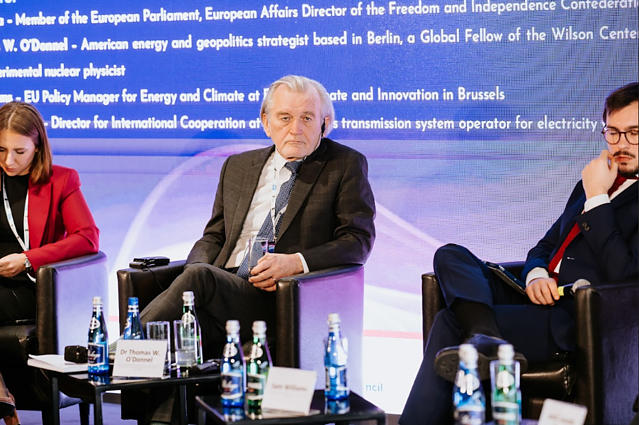
10-12 February, I was invited to contribute to the NATO Advanced Research Workshop (ARW) on critical European infrastructure, organized in Podgorica by the Atlantic Council of Montenegro, a NATO member, and The International Society for Risk Management (ISRM), Serbia, a non-NATO member. This partnership plus experts from neighboring states made the workshop on risks to regional and West Balkan infrastructure very informative. I felt quite honored, as a regional outsider, an American working on EU energy and geosecurity (based in Berlin), to be invited. Conference FB link

I planned to discuss drivers of EU deindustrialization, but decided to focus on one sharp example: how tech failures in the EU’s energy-infrastructure model, the Green Deal, is causing the unexpected 2025 EU natural gas crisis. This comes while gas prices were still high and supply still problematic from the 2022-23 Energy War – caused by Russia maliciously stopping Nord Stream pipeline flows. This new hit to European competitiveness and security was, however, an eminently avoidable “own goal.” (The workshop discussion is off the record, but I may post my own talk.)

How has the Green Deal model caused another gas crisis?

The EU Green Deal model requires installation of high percentages of wind and solar renewables. However, to supply energy reliably, installation of wind and solar renewable (RE) technology must be paired with installation of sufficient universal, long-term, grid-scale storage (ULTGSS) technology. The idea is excess electricity generated on very sunny, windy and mild days should be stored to compensate supply on dark, calm and cold days. (Let’s put aside, for now, expert debunking of this RE-plus-storage model using weather and tech data.) Over-installation of solar and wind beyond what can be backed up by some other source, is a critical vulnerability to energy infrastructure reliability during periods of cloudy, calm and cold weather. This is called “Dunkelflaute” in German.

However, the reality is that, after some four decades of storage-tech R&D, such a technology still does not exist. There is no lack of studies and data on this. However, EU members remain mandated by the Green Deal and ancillary EU and/or national laws to continue installing ever higher percentages of renewable generation.

As a result, Dunkelflaute conditions in late-November and early December 2024, and again in February 2025 across northern Europe led to prolonged periods of plunging RE generation. Without the aforementioned ULTGSS backup (my acronym), the “de facto ULTGSS” has primarily been natural-gas-fueled generation, plus importing of nuclear, hydro and coal generation from neighboring countries having excess capacity in these.

My talk was an analysis the root cause for another EU natural gas crisis this winter. I explained that the EU’s initial win in the energy war imposed on it by Putin, overcoming the initial, acute crisis of 2022, is nevertheless evolving dangerously into a Pyrrhic victory – into a defeat. This is because EU energy policy, the Green Deal, has critical technological failings, and the present EU Commission leadership refuses to reform it, rejects any serious criticism of the model, and is instead doubling down on an all-renewables system ASAP. In fact, it is assumed that Van der Leyen will announce, late in February, adoption of a new, more “ambitious” target of 90% net-zero emissions by 2040 relative to 1990. (GlobalBarrel.com readers might recall I termed this as “fantasy” in Op-Eds last year in the Polish daily press and elsewhere.)

A Green Deal reform, based on science, is not inherently “right”, “center” or “left”

I explained why a radical reform of this Green Deal model should not be a matter of political philosophy, rather ait requires only an honest recognition that the tech simply does not exist for this scale of installations. Refusal to reform is no longer only anti-science Green populism. After ca. 15 years of this Green Model’s hegemony in various member states, then in Brussels, ALL PARTIES are beset with ideological-scientific confusion and need a certain fresh start, a reeducation or green-energy deprogramming. In particular, center-right parties, such as the CDU in Germany, are typically confused in that they tend to see the entire problem as one of the methods of financing the Green Deal (and the German Energiewende, which provided the model the Green Deal is based on). They focus on having less government mandates, less subsidies, more public financing, and a more liberal, interconnected electricity market in Europe. All well and fine. However, if one is talking about alchemy, funding the transmutation of lead into gold, then it matters little how efficiently it is financed, and how liberal is the market model. In this case, the problem is that a highly RE based model (much less the German, Spanish, Austrian, etc. model of 100% renewables), lacking any universally applicable, long-term, grid-scale storage, is simply energy-infrastructure “alchemy”. It is simply impossible without an entire parallel natural gas system on standby awaiting any instance of Dunkelfloute. This is a disaster, an impossibly complex and expensive model that guarantees ever deeper EU deindustrialization.

Even the farthest right and left parties are hesitant to embrace a fundamentally different model of massive large-scale nuclear as the basis, with also extensive electricity-fueled mass transit build-outs as a clearly already-proven model. The alternative is further high energy prices, deindustrialization and undercutting of European security.
Our Gdansk chat: Baltic energy risks | USA ousting China from post-war order | “Transition” will be simple: nuclear & mass-transit. “Critical” minerals overblown | EU’s failing model: all-renewables, new grids, grid-storage & EVs | Poland’s risk: China uses Russia

This is in English, after Eugene Romer of Układ Sił media introduces me in Polish. This was at the “3 Seas -1 Opportunity Forum” in Gdansk, last June 4-5, 2024. I have been wanting to post it ever since, as the questions remain relevant. My thanks to Eugene and his team, and to his Opportunity Think Tank colleagues.

My panel at the forum was on problems of relying on energy security that arrives via the sea. So, think Poland and Lithuania’s LNG terminals, of the many sub-sea pipelines, power and communications cables between Baltic and Nordic states. And, since June, all the incidents where ships leaving Russian ports “accidentally” dragged their anchors, cutting such vital links. So, this conference was rather prescient. My sincere thanks to our hosts The Opportunity Institute for Foreign Affairs.

Continue reading →

My TVP: To cripple Putin, Trump can sanction oil ports, let Ukraine strike them / Seeking a new North Stream deal is Merkel 2.0; realism is a new, nuclear ‘Green’ Deal

[TWO “discoveries” just after this interview:

First, Bloomberg reported Ukraine had destroyed an oil pumping station on the pipeline feeding Russia’s big Ust Luga oil export terminal on the Baltic Sea. This is the first time Kyiv has shutdown a Russian oil port, … which is exactly what I advocated in the interview above and since early-2024 as a military tactic to accompany imposition of “real” USA-EU oil sanctions on the three Russian west-facing oil ports, replacing the failed “oil price cap” policy.

Second, Christof Ruhl, former-BP VP, and -World Bank Moscow rep., now at the Columbia U. Energy Center, had an OP-ED in the FT, with a similar argument that Russian oil can be replaced with OPEC crude. I recommend it: “Trump should call on Opec in his bid to negotiate with Putin Ukraine’s western allies must join forces with the oil cartel to really squeeze Russia’s war economy” Christof Ruhl, 30jan25.]

There are two topics in this interview with Diana Skya of Poland’s national broadcaster, TVP:

  1. Putin’s oil export income can be slashed via new sanctions and military policies, in line with Trump’s interest in forcing a “deal”
  2. EU member states that seek a new Putin gas partnership are dysfunctionally replaying Merkel-ism and avoiding the real solution of reforming the Green Deal to put nuclear energy in the center. (See: “EU debates return to Russian gas as part of Ukraine peace deal. Advocates say reopening pipelines could help settlement with Moscow and cut energy costs” Henry Foy and Alice Hancock in Brussels and Christopher Miller in Kyiv, FT, 30jan25)
  1. OIL SANCTIONS:

I have argued for three years that the rationale behind the USA-EU imposition of a Russian “oil-price cap” rather than simply imposing real oil sanctions has been flawed, and the policy has failed.

It was conceived in early-2022, apparently by former-central-banker Mario Draghi of Italy and taken up by then-USA-Treasury-head Janet Yellen, neither of whom understood global oil trade sufficiently to see how easily the Russians could get around this scheme, as they have with a “shadow fleet” of oil tankers insured by Chinese, Russian or other non-EU, non-UK firms.

Continue reading →

My Asharq-Bloomberg: Ukraine OKs Azerbaijani-only gas transit; Orban & Fico vote Russian sanctions | Trump could crush RU oil if Putin won’t deal

English here (Arabic is below). Asharq-Bloomberg.
(Arabic. English is above). Asharq-Bloomberg spot.

Last night, Asharq, the Mideast Bloomberg news affiliate, asked me three questions (roughly translated):

  1. The the EU wants to extend the sanctions (on Russian gas), at the same time they want to open open the Russian pipeline through Ukraine. What is this contradiction? How to understand it in practise?
  2. How will Ukraine respond to these talks? Don’t you think that Ukraine will accept, for example, to open this project or to reopen these pipelines to resupply gas? Don’t you think the other European nations that were impacted neglecting or abandoning this Russian gas?
  3. Doctor, don’t you think that there has been a change in US policies, economic and political policies towards Russia after the reelection of Trump? Do you think we may see a change?

Here is a transcript of the Q&A (AI generated)

1
00:00:00,052 –> 00:00:02,772
are joined by Doctor Thomas Odoner. From

2
00:00:02,932 –> 00:00:05,052
Berlin. Welcome back, Doctor. Happy to

3
00:00:05,052 –> 00:00:07,972
have you with us tonight. So the EU

Continue reading →

My interview at Lithuania’s LRT: Trump could seriously harm Russia if he wants to | Trumpas, jeigu tik norėtų, galėtų stipriai pakenkti Rusijai

My long print interview at Lithuania’s LRT [Lithuanian PDF | English PDF​] with Aleksandra ​Ketlerienė, deputy editor-in-chief of Lithuania’s LRT.lt, published 7January. We spoke in Warsaw, 19 November. My thanks to Aleksandra for her insightful questioning and editorial care. We discussed:

  • The EU’s systemic energy​-policy “own goals” ​since its initial energy-crisis win ​after Moscow began cutting gas exports early in 2021​.
  • Reforming failed/ineffective Russian price-cap sanctions for real sanctions, and how the global oil market is now favorable for “maximum pressure.”
  • Historical perspectives on oil, gas, renewables, and nuclear sectors, essential for realistic policy formation.
  • An historical overview of China’s decades-long effort to overcome its energy security, learning lessons of Japan’s WW2 weaknesses.
  • (​See topics summary))
Continue reading →

My two Sky News: Russian gas via Ukraine not needed: 1) EU has won initial Energy War. 2) But, crisis continues: Volatile EU wind/solar gobbling gas, boosting prices & deindustrialization. Green Deal needs reform. 3) Trump’s demand EU buy more US LNG has seller & buyer risks.

1st row: English (my voice). 2nd row: Arabic (all). EN transcripts below.

EN SkyNews 01.01.25
EN SkyNews 02.01.25
AR SkyNews 01.01.25
AR SkyNews 01.01.25
Continue reading →

My Asharq/Bloomberg: European gas surplus slashed as (1) Russian gas via Ukraine ends, (2) low wind & sun starve renewables. Yet the EU rejects new long-term gas import deals, betting on green-hydrogen. [EN/AR]

English voice-over version.

I appeared alongside Dr. Hashem Aqel, Oil and Energy Expert, Associate Fellow at Oxford Institute for Energy Studies, who contributed several insights. Asharq News is the Mideast Bloomberg partner. My further analysis follows:

Arabic, original broadcast version.

The recent rise in EU gas prices and the rapid depletion of what had been a significant surplus in EU storage, is principally a two-sided story.

  1. One side is indeed about the impending cutoff of Russian gas, still flowing across Ukraine. This has been expected for months, and so is already largely priced in. Expectations of new transit across Ukraine of Russian-origin gas re-labelled as Azerbaijani was being negotiated. However, this deal fell apart, with the final nail in its coffin being when Ukraine’s President Zelensky asserted that Ukraine would not transit any further Russian-origin gas after 31 December unless payments to Russia are withheld until after the war ends. This seems a very reasonable demand for a country fighting for its survival against a Russian invasion. [See “Ukraine will not allow transit of Russian gas with Azeri label, Zelenskyy says, dashing Slovak hopes,” EuroNews, Jorge Liboreir 19 Dec. 2024.] This marks the end of the five-year contract, which was only agreed to at the last moment before New Year 2020, when the US Senate finally forced then-President Trump to agree to sanctions on Nord Stream 2 construction (I was in Kyiv, for Naftogaz, and on Ukrainian television, analyzing Washington sanctions, Kyiv-Moscow negotiations, and the pro-Nord Stream position of Berlin.)
  2. The other side is a story of yet another European energy own-goal, a consequence of its over-reliance on weather-dependent renewable energy generation. This overreliance has made its electricity supply increasingly volatile, in sync with the weather. In November and early December, especially north and western Europe experienced what the Germans call “Dunkelflaute“, a protracted wind and solar drought. Batteries can only substitute for perhaps 40 minutes, or at best an hour. So, the de facto long-term, grid-scale “storage” backing up Europe’s plethora of wind and sun generation is really just natural-gas turbine electrical generation plants. The reality of increased generation (and hence, electricity market) volatility and dependence on gas backup generation was analyzed this week in a data-driven manner by the Oxford Institute for Energy Studies. [See: “Dunkelflaute: Driving Europe Gas Demand Volatility” Energy Insight: 161, by Anouk Honoré and Jack Sharples, Senior Research Fellows, OIES, 2024/12.]
Continue reading →

My BiznesAlert: German elites have no idea how to get out of the crisis / Ekspert dla Biznes Alert: niemieckie elity nie mają pomysłu na wyjście zkryzysu

Last night, leaving the Polish Sejm, after a long discussion, invited by a leader.

URL CORRECTIONS: ENGLISH Biznes Interview LINK & POLISH Biznes Interview LINK

[Warsaw, 21 Nov] Here’s my interview with BiznesAlert’s Artur Ciechanowicz (in EN & Pl) on Germany’s energy, industrial and political crises. I spoke here in Warsaw Monday at the CEE Energy Security Conference, attended Wednesday’s 25 Years of NATO Membership conference, and was invited yesterday evening, by a leader of the Sejm (parliament) for a long talk in his offices, joined by Mark Voyger (American University Kyiv and former-NATO). More soon. Tom O’D.

Continue reading →

My Al Watan(Cairo): Iran would seek global energy crisis if an Israeli/USA strike threatened regime survival | IEA warns on EU winter gas

ENGLISH Interview | Al Watan, Cairo.  Thurs 10Oct24. 15 minutes
ARABIC Interview

At first, we focused on IEA warnings of a possible EU winder gas shortage due to supply-and-demand mismatches. I agree and expand on the IEA points.

Second, I explained that if Israel retaliates against Iran so strongly that it threatens the regimes survival, or is seen as intending to provoke regime change, then the Iranian leadership will have “nothing to lose” by in-turn escalating to the maximum. Aside from unleashing the maximum response of its proxies surrounding Israel, Tehran’s most potent weapon would be to spark a global oil and gas crisis.

Consider oil: Iran can either shut down the Straights of Hormuz (or simply make them unsafe for tankers) and/or, it can use missiles and drones to destroy significant parts of Saudi, UAE and other Gulf oil facilities, including perhaps even Azerbaijan’s as some Iranian propagandists have threatened.

Consider natural gas: Shutting the Straights or directly hitting Qatar’s massive LNG exports infrastructure would immediately stop Qatari LNG exports. As the world’s second largest LNG exporter, this would immediately cause a separate global natural gas crisis.

Continue reading →

My BBC(Cairo)+Alhurra(Wash DC): What if Israel bombs Iran’s oil? Does Israel have an end strategy? “Smite enemies, repeat in 10 years”?

Again, oil security is determined by both global-market balances and geostrategic realities – at present the Mideast war and Russia’s War on Ukraine. My analyses this weekend were featured in: (a) an AlHurra video (LHS English, RHS Arabic), and below these (b) a detailed BBC-Cairo print interview (LHS English Google Translate, RHS Arabic original). where I make similar points as my Friday video in Warsaw.

Alhurra ENGLISH. My comments at 2:45 & 8:20. Date: 5 Oct 2024, with co-guest GPI President Paolo von Schirach, Washington.
Alhurra ARABIC, 5 October 2024

My BBC (CAIRO) print interview in Arabic and English (Google Translate):

Continue reading →

My Newsweek interview (USA): India won’t buy Russia’s USA-sanctioned ‘Arctic LNG2.’ A big blow to Putin.

Below, I am quoted repeatedly (marked in bold -TO’D), by Newsweek’s intrepid Brendan Cole, reporting from London on Russia and Ukraine. I was on the Berlin-Warsaw express, heading to the Warsaw Security Forum. At the end are links to several other-language versions. Read on …

Putin’s Arctic Project Suffers Blow From Top Trade Ally

By Brendan Cole Senior News Reporter FOLLOW

India has refused to buy liquefied natural gas (LNG) from Vladimir Putin‘s flagship Arctic energy project delivering a “major blow” to Moscow’s fuel exports, an energy analyst has told Newsweek.

India’s oil secretary, Pankaj Jain, has said that New Delhi is “not touching” any commodity from the Arctic LNG 2 project due to sanctions that followed Putin’s full-scale invasion of Ukraine aimed at stifling Russian energy revenues, which the United States stepped up this month.

Putin had high hopes for the seaborne resource after losing the lucrative European market for pipeline gas due to sanctions and the president’s move to weaponize the fuel, which only spurred countries to find other suppliers.

Following huge losses, Gazprom cut its fuel production while a proposed Power of Siberia 2 pipeline to transport increasingly stranded Russian gas resources to China remains delayed amid haggling over price.

However, attempts by state firm Novatek to get Russia’s gas to market through the Arctic LNG 2 project have so far failed after Jain said last Friday, “We are not buying any sanctioned commodity.”

Newsweek reached out to Novatek for comment.

Berlin-based energy analyst Tom O’Donnell said Russia’s switch to boosting LNG exports has been fraught with difficulties due to sanctions.

“They have had to considerably cut back because they can’t get either the equipment to build it or the ships to transport it,” he told Newsweek.

“LNG from the new Arctic LNG 2 project was very important for Putin to be able to ship it to India and to China,” he said. “With India dropping out, this will be a major blow.”

Russia plans to triple its LNG exports by 2030 to 100 million tons. The country is expected to play a key role in India’s energy strategy, which has built terminals to receive the fuel.

Continue reading →

What if Israel bombs Iran’s oil? Four points on market & geopolitics. Video-Warsaw 03oct24

Recorded Thurs AM, 03Oct24. Warsaw Old Town, Castle Square.

Will Israel hit Iranian oil infrastructure? And, what part of it? To what effect on markets, and geopolitics, (i.e., Mideast, OPEC, Russia and Ukraine war)? A video report.

MAIN POINTS (see transcript):

1. What if Israel hits Iran oil infrastructure in retaliation for missile strikes on Tel Aviv on Tuesday night? 1.a. The difference effects of hitting Iranian refineries vs oil export terminals In itself, neither target would make big difference in the market. The market would immediately jump, of course, but in principle the effect would be small. 1b OPEC+ and Western Hemisphere have plenty of spare capacity.

2. Consider Saudi market tactics … reportedly they want to now go for share over price support, as price support is failing after well over a year of output cuts (about 6 mb/d). Note: Shortly after this recording the Saudis repudiated the WSJ that reported the switch in tactics to defending share. Likely they’ll now want to wait and see what happens to Iranian exports, or if this Israel-Iran tit-for-tat gets out of hand.

Continue reading →

At ‘Berlin Energy Forum,’ 2 Sept., I’ll argue: Germany’s green-hydrogen import strategy is unrealistic & ignores African needs

NOTE: Last call to Sign Up Here for our 2nd Berlin Energy Forum, on “Germany’s Quest for Green Hydrogen: from Ukraine to Mauritania & back,” 4:00 – 5:30 PM (CET), Berlin Capital Club, followed by networking and drinks. The Capital Club is atop the Hilton Hotel, adjacent to Gendarme Market in Berlin’s Mitte district. Looks like we’ll have a full house again. There is also a delayed-video sign-up option. -o-o-o-o-o- Speakers: I’ll be joined by Dr. Dawud Ansari of SWP think tank where he leads H2 research, and Ms. Olena Pavlenko, President Kyiv’s Dixie Group via video link. Moderation: Ben Aris, Editor-in-chief & founder of bneIntelliNews, & our forum co-organizer.

Second: While writing my talk, I began rethinking a 2023 post on Germany’s  green-hydrogen import scheme for Mauritania. Below is my update. — Tom O’D.

German Green Hydrogen Import Strategy is Unworkable & Ignores Mauritania’s needs

Referring to the green hydrogen MOU signed with Mauritania in 2023, Conjuncta CEO Stefan Liebing said, “(This project) will have a strong link to Germany both as a technology provider and a potential offtaker of green energy.” (“Consortium signs $34 billion MoU for hydrogen project in Mauritania,” Reuters, 8 Mar 23.)

German public broadcaster Deutsche Welle seemed quite impressed: “It has a planned capacity of 10 gigawatts – the output of roughly five to six standard nuclear power plants. The first phase of the project is set to be completed by 2028” (“Mauritania set to export green hydrogen to Germany,” DW Business, 09Mar23 archived at YouTube.)

Indeed, the MOU aims for “10 gigawatts” of electrolyzers outputting “8 million tonnes/year” (Mt/y) of green hydrogen (H2) and other products, such as ammonia. However, according to the press announcement, in 2028 the facility will have a 400 MW capacity, or one-twenty-fifth of 10 gigawatts envisioned .

The German coalition government faces a formidable energy dilemma.

On one hand, it must urgently develop enough natural gas generation capacity at a reasonable cost to halt deindustrialization, and shut coal plants it brought back online when it closed the last nuclear plants To this end, Minister Habeck (Greens) urgently won approval for installation of 25 GW capacity of new natural gas turbine generation by 2030. In addition, this new natural gas capacity is needed to back up Germany’s growing, renewable-electricity dependence, as it simply has no feasible grid storage tech to offset its weather-variability.

So too, in response to Russia cutting off gas deliveries to Germany, as part of its full scale invasion of Ukraine, Germany urgently moved to install up to seven offshore LNG floating regasification ships (FRSOs). These aimed for a new natural gas import capacity of 25 bcm/year as LNG in 2023,

In January 2024, the Bundesnetzagentur (BNetzA) reported that, “According to preliminary figures, the total volume of natural gas imported into Germany in 2023 was 968 T”Wh (2022: 1,437 TWh).” of which 7% or almost 70 TWh was LNG. The reduction from 2022 largely reflects the fall in industrial production it is now suffering.

On the other hand, Germany urgently seeks enough future “green energy” import projects to eventually replace all this natural gas if it is to meet its decarbonization targets. The government published its “National Hydrogen Strategy” in summer 2023. (Also, “Gremany’s National Hydrogen Strategy,” Factsheet, 26 Jul 2023, by Sören Amelang and Julian Wettengela, Clean Energy Wire, is very useful.)

The (IMHO) dogmatic insistence on refusing to re-open several still-operable nuclear plants and to develop new German nuclear capacity means that the only low-carbon way the government coalition and many other political and business actors can imagine to replace all this natural gas is with green hydrogen produced from renewables in distant African, Mideast, Latin American and other states, or from developing new renewable-generated electricity it can import from nearby European countries.

This self-induced straitjacketing of the German energy system is, as I have described it, a sort of “renewable fundamentalism” — a maximalist insistence to fuel everything with 100% renewables and absolutely no nuclear.

How much of Germany’s new LNG-supplied energy could the Mauritania project replace in 2028?

Continue reading →

My Briefing Paper for USA House Foreign Affairs Committee hearing, “… Ending Global Dependence on Putin’s Nuclear Energy Sector.”

—– Click image to open PDF

I was asked to write a Brief for the USA House of Representatives’ Committee on Foreign Affairs (Europe Subcommittee) 12 March hearing: “Going Nuclear on Rosatom: Ending Global Dependence on Putin’s Nuclear Energy Sector,” submitted via Wilson Center in Washington, where I am a Global Fellow (external). There are two aspects to the Brief:

  1. My assessment of how threats posed to the 3-Seas-Region Member States executing a pragmatic energy transition incorporating nuclear energy emanate both from the role of Russia’s Rosneft, and equally from the activities of seven anti-nuclear Member States led by Germany, and
  2. Detailed research on Russia’s nuclear energy dangers contributed by colleagues in Poland and Ukraine.  Their research includes:
  • Appendix A: Some facts and policy recommendations on Rosatom activities, based on research by Warsaw colleagues at The Polish Economic Institute (PEI), Dr. Adam Juszczak, and Mr. Kamil Lipiński (p. 6);
  • Appendix B. Rosatom may be assisting in circumventing sanctions., from research by colleagues at DiXiE Group, Kyiv, Ukraine, especially Mr. Roman Nitsovych, and Ms. Olena Pavlenko (p. 7);
  • Appendix C. Why sanction Rosatom: Link between “peaceful” Rosatom energy & Russian nuclear weapons, based on research by CGS Strategy XXI , Kyiv, Ukraine, in particular Mykhailo M. Gonchar, Founder and President, and Chief Editor of the Black Sea Security Journal (p. 11.)

I highly recommend their three Appendices.

I should note that what I wrote in the main body was likely unexpected. I wrote that, for accomplishing a pragmatic, nuclear-power-inclusive energy transition in the 3-Seas Region (i.e., the EU’s Central and Eastern Europe, Baltic, and Balkan Member States), the continued dependencies on Russia’s Rosatom are not the only threats. The threat from the Group of Seven anti-nuclear states, led by Germany, is clearly equally or more disruptive to the Region accomplishing a pragmatic energy security-and-transition policy. I’ll quote a bit of the report on this point:

Continue reading →

1st “Berlin Energy Forum” 21 May | A monthly disruption of the local ‘energy echo chamber.’

Dear Colleagues & friends, Below is an invite to our first Berlin Energy Forum (jump to details | jump to register), but first a personal note.

First, a personal note: As some of you know, this is an idea I’ve been floating in Berlin since well before Corona. Then, last October, I had an experimental test run, a one-off, sponsored by the Qatari embassy’s Divan – and it went very well.

However, the biggest success from that event was that Ben Aris, co-founder and editor-in-chief of bne IntelliNews enthusiastically joined me to found the Berlin Energy Forum as a regular monthly sort of membership club. Amongst the longest serving foreign correspondents in Eastern Europe, Ben has been covering Russia since 1993, with stints in the Baltics and Central Asia. He is a former Moscow bureau chief for the Daily Telegraph and was a contributing editor at The Banker and Euromoney for a decade amongst writing for many other publications. He is also a professional photographer, and nowadays based in Berlin.

Ben is one of those rare people who relishes doing analysis and data-driven writing (non-stop!), AND who knows how to do business – and thoroughly enjoys doing it. Just the partner for this endeavor.

My model and inspiration for this forum was always the New York Energy Forum, which has run for over 40 years now. I happily attended while teaching in NYC. My experience with that forum, plus familiarity with a few top DC think tanks, and various foreign diplomats (esp. in NYC/UN), is how, as an academic, I got to know a broad spectrum of USA oil and gas executives, journalists, financial-institution analysts and government officials. Those personal connections have, over the years, anchored my assessments of USA, of OPEC MENA-and-Latin American members’, and of Russian and Chinese strategy. This sort of community doesn’t exist in Europe in such a focused manner, save perhaps in London. Perhaps we can now bring a bit of that world to Berlin with our new BEF.

Continue reading →