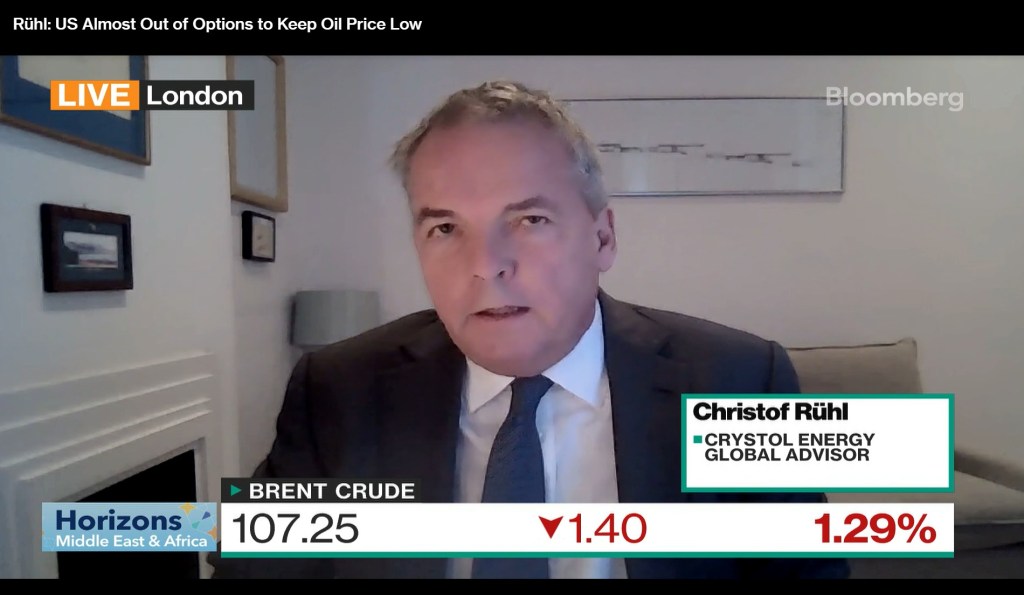
Both Christof Rühl (bio) and Jack Kemp (bio) had great, data-driven media this past week. I too addressed these issues (spoiler: I assess Trump is not bluffing on Iran talks, and oil supply remains adequate.) My conflict-trajectory take differs a bit from Chrisof, perhaps closer to Jack K here.. My Al Jazeera was just after Trump announced talks.
I was a bit insistent that the spike during the day today, to over $100 at some point, was overblown.
As I mentioned, Fatih Birol at IEA (I forgot to mention also Chris Wright, USA Secretary of Energy),who had said the same thing, insisting last Friday that there is plenty of oil in the market. (See Wright and Bloomberg’s Steven Stapczynski elaborate here). That is NOT a problem now.
And, in the interview, I detailed some facts about this (e.g., before the war started nine days ago, there were about 1.4 billion(!) barrels floating on the water, an unprecedented amount, and the Russians had nowhere to put their unsellable oil).
So, It turns out that late Monday evening news (EST USA time), the news coming from the USA vindicates my suspicions. For now, there is no plan by the administration to release SPR reserves into the market.
Notice what I explained about this likely being a short-lived boost for Russian oil That is, after the Venezuelan campaign, if the Trump admin. Iran campaign works, both China and Russia will be in a very restricted position in the now-USA tightly controlled international oil market supply chain.
Here is the WSJ saying the prices of oil dropped quite a bit, and the stock market rebounded as well by the end of the day. Following that is a Bloomberg take too.
This is a longish, ca. 30 minute video. Host Nataly Lutsenko kindly told me she wanted to make a long interview.
(During time of crisis like this, I have so many TV and press interviews that I don’t have time to put most of them online. So, I will refrain from writing long posts to accompany videos to get more online, if I think they are useful interviews. – Tom O’D)
Investitionswillige Unternehmen stehen in Venezuela vor großen Hürden: Sicherheitsrisiken, eine verfallene Infrastruktur, ungeklärte Rechtsfragen zum US-Einsatz und die Gefahr langfristiger politischer Unruhen. (Foto: IMAGO/IlluPics)
Trumps Plan klingt ambitioniert: US-Ölkonzerne sollen nach Venezuela zurückkehren und Milliarden in die stark beschädigte Infrastruktur investieren. Im Interview erklärt Energiestratege Thomas O’Donnell, wie schnell das Land nach Jahren politischer und wirtschaftlicher Krise wieder zu alter Stärke finden kann.
ntv.de: Trumps Versprechen klingt vollmundig: US-Ölkonzerne sollen nach dem Angriff auf Venezuela ins Land zurückkehren und Milliarden von Dollar investieren, die stark beschädigte Ölinfrastruktur reparieren und damit beginnen, Geld zu verdienen. Wird dieser Plan aufgehen?
I was interviewed 05 Jan. by Juliane Kipper, Business Editor at Germany’s ntv.de, for this print article. Lies es Auf Deutsch— Read In English (from Google Translate). Or, read at ntv.de.
Investitionswillige Unternehmen stehen in Venezuela vor großen Hürden: Sicherheitsrisiken, eine verfallene Infrastruktur, ungeklärte Rechtsfragen zum US-Einsatz und die Gefahr langfristiger politischer Unruhen. (Foto: IMAGO/IlluPics)
Trumps Plan klingt ambitioniert: US-Ölkonzerne sollen nach Venezuela zurückkehren und Milliarden in die stark beschädigte Infrastruktur investieren. Im Interview erklärt Energiestratege Thomas O’Donnell, wie schnell das Land nach Jahren politischer und wirtschaftlicher Krise wieder zu alter Stärke finden kann.
ntv.de: Trumps Versprechen klingt vollmundig: US-Ölkonzerne sollen nach dem Angriff auf Venezuela ins Land zurückkehren und Milliarden von Dollar investieren, die stark beschädigte Ölinfrastruktur reparieren und damit beginnen, Geld zu verdienen. Wird dieser Plan aufgehen?
I was interviewed by David Karalvanov at bTV (Bulgaria) on the US-Venezuela confrontation under Trump and Maduro (01Dec). David used excerpts for a documentary and kindly gave me the full video here. An outline of the five questions and answers is below here.
Three Asides:
I recall vividly how Trump and co., in his first term, easily misled a naively dependent Venezuelan opposition into believing that the USA was planning to forcibly remove Maduro. In turn, the opposition convinced the country’s population that the USA was preparing to forcibly liberate them. This belief was deeply corrosive to advancing any self-reliant domestic anti-Maduro pro-democracy movement. In the end, the Trump administration tried a poorly prepared putsch. John Bolton, Trump’s then-National Security Advisor, the organizer, was embarrassingly gamed by the Venezuelan regime’s intelligence police. Meanwhile, the present Venezuelan opposition has long been unwilling to organize or endorse any popular movement to forcibly restore democracy from below.
In a recent CNN interview I spoke about Trump rationales for the present confrontation. See: “Why Trump wants a Venezuelan oil boom …“) and dangers of not preparing for the day-after possibilities of chaotic events, terrorism or resistance by armed pro-Chavista military or collectivo groups, and/or x-Colombian guerilla groups long active in the country.
I’ve written for 20 years on Venezuela, Chavismo and oil, including two years as visiting professor, Universidad Central de Venezuela’s UCV/CENDES, Caracas.–I’m happy to speak or consult on Ven.-US-China-Russia-Iran-Colombian-EU-… and/or Ven. domestic matters in English or Spanish.- Tom O’D
I was interviewed on CNN International’s “Newsroom” with host Kim Brunhuber – live, Friday, 12 Dec. 2025. The transcript is below. Kim asked about Venezuela’s oil industry, the impact of sanctions, what stricter enforcement could do to the Venezuelan economy, and what the US stands to gain if it ultimately gains greater access to the country’s oil reserves? He also wanted to know what Venezuelans are saying. / CNN says: “The show is broadcast around the world on CNN International, and in the US on our new platform All Access.”
On 5 November, I told Kanal24, Kyiv that a US-Ukraine campaign to disable the Russian petrostate’s oil sector is underway. I stressed that this is a multi-spectral campaign combining (i) severe USA sanctions and secondary tariffs on Russian oil exports in parallel with (ii) Ukrainian military action on oil refineries and export-terminal ports. These attacks are known to be conducted and planned in close cooperation with USA military intelligence (FT,12 Oct.).
This means that an assessment of either aspect of this campaign on its own is inadequate. The synergy of sanctions plus military hits is the issue.
Secondary Sanctions. It has been widely recognized that the USA would need to, as promised, vigorously impose secondary tariffs on any entities that violated its recent tariff announcement. Indeed, on Sunday, President Trump lent support to a bill being drafted in Congress to hit any entity “doing business with Russia.”, not only buying its oil (i.e., “Trump says Republicans drafting bill to sanction countries that trade with Russia, Reuters. November 17). This sounds similar to the Senators Lindsey Graham (R, SC) and Richard Blumenthal’s (D Conn) so-called “bone-crushing sanctions” bill (Politico, 7 June) endorsed by 83 senators on 3 June.
The apparent aim of the port drone and missile attacks is to slash oil exports from Russia’s three or four biggest westward facing terminals. The focus thus far is on Black Sea terminals:
MY COMMENTS: 1) USA long-planned surprise strategy 2) Iran leaders’ 20-year nukes brinkmanship strategy aimed for USA ssecurity-guarantee deal
ALL GUESTS – TRT-London, USA bombing
I was invited on TRT-World, London, 24 June, for a panel after US strikes on Iranian nuclear sites (see the panelist lineup below. I answered two questions at some length – see the 2nd video.)
In summary: Trump claims USA Operation Midnight Hammer “obliterated” the country’s nuclear capacity, but how much have they really been degraded?
My analysis is that it does not matter. If the USA decides to bomb again at will, without Iran having air defenses the USA and Israel can destroy or disrupt most any renewed Iranian work on its nuclear or conventional missile program. If, as he stated, repeat bombings as needed are Trump’s intention, then this should be the case. This now leaves Iran very little negotiating leverage. The regional proxies it always intended to use for retaliation in just such a scenario have been decimated by Israel.
Therefore, there is a high likelihood Iran will be forced by Trump to negotiate from a now much weaker position. If Tehran resists, it could fall back to rely on state-sponsored terrorist methods, which are of limited usefulness for maintaining a modern functioning state and economy.
Overall, I emphasize that this “12 Day War” has been especially motivated, by Trump, to assure USA Gulf allies that they can now safely enter into the Abraham Accords with Israel and the USA, establishing a new regional security structure. Trump will be constrained to do whatever is necessary, militarily and in negotiations, to insure the Iranian threat these allies have felt acutely remains under control. In turn, if these accords, which Trump’s chief negotiator, Steve Witkoff, was reportedly already working on among the USA’s Gulf Arab allies immediately after the USA bombing is intended to allow the USA to move on, focusing more squarely on Great Power competition elsewhere.
This is my general assessment. There are many details and some possible derailments here, of course. – Tom O’D.
10-12 February, I was invited to contribute to the NATO Advanced Research Workshop (ARW) on critical European infrastructure, organized in Podgorica by the Atlantic Council of Montenegro, a NATO member, and The International Society for Risk Management (ISRM), Serbia, a non-NATO member. This partnership plus experts from neighboring states made the workshop on risks to regional and West Balkan infrastructure very informative. I felt quite honored, as a regional outsider, an American working on EU energy and geosecurity (based in Berlin), to be invited. Conference FB link
I planned to discuss drivers of EU deindustrialization, but decided to focus on one sharp example: how tech failures in the EU’s energy-infrastructure model, the Green Deal, is causing the unexpected 2025 EU natural gas crisis. This comes while gas prices were still high and supply still problematic from the 2022-23 Energy War – caused by Russia maliciously stopping Nord Stream pipeline flows. This new hit to European competitiveness and security was, however, an eminently avoidable “own goal.” (The workshop discussion is off the record, but I may post my own talk.)
How has the Green Deal model caused another gas crisis?
The EU Green Deal model requires installation of high percentages of wind and solar renewables. However, to supply energy reliably, installation of wind and solar renewable (RE) technology must be paired with installation of sufficient universal, long-term, grid-scale storage (ULTGSS) technology. The idea is excess electricity generated on very sunny, windy and mild days should be stored to compensate supply on dark, calm and cold days. (Let’s put aside, for now, expert debunking of this RE-plus-storage model using weather and tech data.) Over-installation of solar and wind beyond what can be backed up by some other source, is a critical vulnerability to energy infrastructure reliability during periods of cloudy, calm and cold weather. This is called “Dunkelflaute” in German.
However, the reality is that, after some four decades of storage-tech R&D, such a technology still does not exist. There is no lack of studies and data on this. However, EU members remain mandated by the Green Deal and ancillary EU and/or national laws to continue installing ever higher percentages of renewable generation.
As a result, Dunkelflaute conditions in late-November and early December 2024, and again in February 2025 across northern Europe led to prolonged periods of plunging RE generation. Without the aforementioned ULTGSS backup (my acronym), the “de facto ULTGSS” has primarily been natural-gas-fueled generation, plus importing of nuclear, hydro and coal generation from neighboring countries having excess capacity in these.
My talk was an analysis the root cause for another EU natural gas crisis this winter. I explained that the EU’s initial win in the energy war imposed on it by Putin, overcoming the initial, acute crisis of 2022, is nevertheless evolving dangerously into a Pyrrhic victory – into a defeat. This is because EU energy policy, the Green Deal, has critical technological failings, and the present EU Commission leadership refuses to reform it, rejects any serious criticism of the model, and is instead doubling down on an all-renewables system ASAP. In fact, it is assumed that Van der Leyen will announce, late in February, adoption of a new, more “ambitious” target of 90% net-zero emissions by 2040 relative to 1990. (GlobalBarrel.com readers might recall I termed this as “fantasy” in Op-Eds last year in the Polish daily press and elsewhere.)
A Green Deal reform, based on science, is not inherently “right”, “center” or “left”
I explained why a radical reform of this Green Deal model should not be a matter of political philosophy, rather ait requires only an honest recognition that the tech simply does not exist for this scale of installations. Refusal to reform is no longer only anti-science Green populism. After ca. 15 years of this Green Model’s hegemony in various member states, then in Brussels, ALL PARTIES are beset with ideological-scientific confusion and need a certain fresh start, a reeducation or green-energy deprogramming. In particular, center-right parties, such as the CDU in Germany, are typically confused in that they tend to see the entire problem as one of the methods of financing the Green Deal (and the German Energiewende, which provided the model the Green Deal is based on). They focus on having less government mandates, less subsidies, more public financing, and a more liberal, interconnected electricity market in Europe. All well and fine. However, if one is talking about alchemy, funding the transmutation of lead into gold, then it matters little how efficiently it is financed, and how liberal is the market model. In this case, the problem is that a highly RE based model (much less the German, Spanish, Austrian, etc. model of 100% renewables), lacking any universally applicable, long-term, grid-scale storage, is simply energy-infrastructure “alchemy”. It is simply impossible without an entire parallel natural gas system on standby awaiting any instance of Dunkelfloute. This is a disaster, an impossibly complex and expensive model that guarantees ever deeper EU deindustrialization.
Even the farthest right and left parties are hesitant to embrace a fundamentally different model of massive large-scale nuclear as the basis, with also extensive electricity-fueled mass transit build-outs as a clearly already-proven model. The alternative is further high energy prices, deindustrialization and undercutting of European security.
[Warsaw, 21 Nov] Here’s my interview with BiznesAlert’s Artur Ciechanowicz (in EN & Pl)on Germany’s energy, industrial and political crises. I spoke here in Warsaw Monday at the CEE Energy Security Conference, attended Wednesday’s 25 Years of NATO Membership conference, and was invited yesterday evening, by a leader of the Sejm (parliament) for a long talk in his offices, joined by Mark Voyger (American University Kyiv and former-NATO). More soon. Tom O’D.
I’ve been thinking about what to say on Monday in Warsaw: at the “Energy Security in Central & Eastern Europe” conference. As soon as I saw the title of my panel: “Does EU Climate Policy Need Evolution or Revolution? What Should We Change in the European Green Deal?” I accepted! This question goes beyond politics – left, right or center – it is a pressing matter for European energy security
Then, I recalled my syndicated interview with Polish AP’s Arthur Ciechanowicz (Brussels) this February. It’s exactly what I should say in Warsaw (see below: LHS in EN, RHS in PL), especially given President Von der Leyen’s choices of long-time anti-nuclear politicians to be her top commissioners for climate and (re)industrialization (Teresa Ribera), and for energy (Dan Jørgensen). (**Details in footnotes). See what you think.
ENGLISH Interview | Al Watan, Cairo. Thurs 10Oct24. 15 minutes
ARABIC Interview
At first, we focused on IEA warnings of a possible EU winder gas shortage due to supply-and-demand mismatches. I agree and expand on the IEA points.
Second, I explained that if Israel retaliates against Iran so strongly that it threatens the regimes survival, or is seen as intending to provoke regime change, then the Iranian leadership will have “nothing to lose” by in-turn escalating to the maximum. Aside from unleashing the maximum response of its proxies surrounding Israel, Tehran’s most potent weapon would be to spark a global oil and gas crisis.
Consider oil: Iran can either shut down the Straights of Hormuz (or simply make them unsafe for tankers) and/or, it can use missiles and drones to destroy significant parts of Saudi, UAE and other Gulf oil facilities, including perhaps even Azerbaijan’s as some Iranian propagandists have threatened.
Consider natural gas: Shutting the Straights or directly hitting Qatar’s massive LNG exports infrastructure would immediately stop Qatari LNG exports. As the world’s second largest LNG exporter, this would immediately cause a separate global natural gas crisis.
Recorded Thurs AM, 03Oct24. Warsaw Old Town, Castle Square.
Will Israel hit Iranian oil infrastructure? And, what part of it? To what effect on markets, and geopolitics, (i.e., Mideast, OPEC, Russia and Ukraine war)? A video report.
MAIN POINTS (see transcript):
1. What if Israel hits Iran oil infrastructure in retaliation for missile strikes on Tel Aviv on Tuesday night? 1.a. The difference effects of hitting Iranian refineries vs oil export terminals In itself, neither target would make big difference in the market. The market would immediately jump, of course, but in principle the effect would be small. 1b OPEC+ and Western Hemisphere have plenty of spare capacity.
2. Consider Saudi market tactics … reportedly they want to now go for share over price support, as price support is failing after well over a year of output cuts (about 6 mb/d). Note: Shortly after this recording the Saudis repudiated the WSJ that reported the switch in tactics to defending share. Likely they’ll now want to wait and see what happens to Iranian exports, or if this Israel-Iran tit-for-tat gets out of hand.
In an Easter Sunday interview in 20+ Polish papers [POLISH & ENGLISH below], I said White House reasons for Ukraine not to hit Russian refineries don’t make sense. The “elephant in the room” alarming DC is that Ukraine can now disrupt Primorsk, UST-Luga and Novorossiskya oil ports, needed for 60% of Russian exports.
This would not only deny Moscow vital oil revenues needed to wage war, it would also spark a spectacular global oil market shock. I explain that the USA and allies can urgently prepare for this, while the Ukrainians are still maintaining strategic patience.
“O’Donnell told Newsweek that that if Ukrainians really wanted to hit oil exports, they would go after Novorossiysk Fuel Oil Terminal in the [eastern] Black Sea and Primorsk Oil Terminal at the end of the Baltic Pipeline System.
“‘These are the two major exports sites for Russian oil and they are demonstrated to be within range of aerial drones and perhaps, in the case the Black Sea, their seaborne drones,’ he said. ‘If they really want to cut Russia’s oil income, they would go after those ports and they haven’t—that might be in deference to Americans concerns.’“ (Russia Faces Major Gas Headache After Ukraine Strikes, Newsweek, article by Brendan Cole, Mar 25, 2024.)
Last week, Newsweek (USA) twice cited my analysis of Ukrainian drone strikes. In one instance, I had the honor of following an interview with General Ben Hodges, former Commander of US Army, Europe, with whom I concur in regretting the USA opposition.
(Aside: I hope to have an Op-Ed, perhaps tomorrow, in Europe, assessing that (i) the USA’s stated reasons versus Ukraine’s drone strikes to date do not make sense, and (ii) the “elephant in the room,” which must really have alarmed the White House, is that Ukraine’s strikes on refineries ipso facto demonstrate they COULD, if they so chose, disrupt anywhere up to 60% of Russian oil exports. Lastly,(iii) if the USA, EU and allies do not rapidly prepare non-Russian oil-sector producers for this eventuality, a global oil price shock could result.)
Here are the links to last week’s two new interviews/citations by Newsweek:



 The Global Barrel