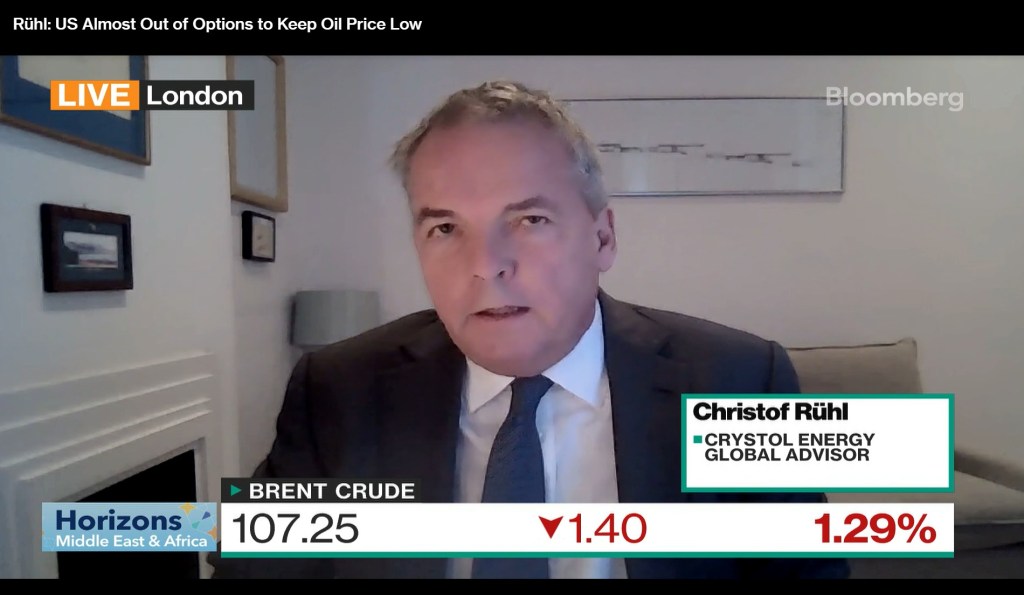
Both Christof Rühl (bio) and Jack Kemp (bio) had great, data-driven media this past week. I too addressed these issues (spoiler: I assess Trump is not bluffing on Iran talks, and oil supply remains adequate.) My conflict-trajectory take differs a bit from Chrisof, perhaps closer to Jack K here.. My Al Jazeera was just after Trump announced talks.
Dear readers, This paper, which I wrote in 2008-09, analyzed the evolution of interests underlying the US-Iran crisis till then, interests which persist in the 2026 US-Iran war.
That is, Trump’s “USA Energy Dominance” strategy does not seek to fundamentally alter the structure or logic of the post-1973 global, market-centered, USA-led-and-protected oil order. However, to preserve it, the USA now feels the necessity of removing the Iranian mullahs as custodians of Iran’s oil for persistently insisting on projecting power and seeking hegemony in the energy-critical Gulf Region.
What is new from 2008, is the bipartisan urgency felt in Washington to renovate the existing oil market-and-security order, reconsolidating the USA as primary arbiter of energy flows via Hormuz to both China and US allied and friendly states of the Indo-Pacific region. In addition, to be capable of significantly blocking Russian oil exports and thereby its petrostate-fueled aggression elsewhere.
In particular, it mush achieve these aims, vis-a-vis Russia and China, without causing global oil shocks. (continued in full-column below …)
Mar 12, 2026. Is the Iran war about the US containing China? For my part, I explained how control of Hormuz would give the US two key levers:
The USA will control half of China’s oil imports, 5.4 million barrels per day (mbd), which flow through Hormuz.
The USA will insure that during any Pacific war China might start that Iran, acting in solidarity with China, could not block oil flows to US Asian allies such as Japan, S. Korea, Australia, Philippines, or flows to others whose supplies it would also want to guarantee, such as Viet Nam, Indonesia, Malaysia, Singapore, etc..
I was a bit insistent that the spike during the day today, to over $100 at some point, was overblown.
As I mentioned, Fatih Birol at IEA (I forgot to mention also Chris Wright, USA Secretary of Energy),who had said the same thing, insisting last Friday that there is plenty of oil in the market. (See Wright and Bloomberg’s Steven Stapczynski elaborate here). That is NOT a problem now.
And, in the interview, I detailed some facts about this (e.g., before the war started nine days ago, there were about 1.4 billion(!) barrels floating on the water, an unprecedented amount, and the Russians had nowhere to put their unsellable oil).
So, It turns out that late Monday evening news (EST USA time), the news coming from the USA vindicates my suspicions. For now, there is no plan by the administration to release SPR reserves into the market.
Notice what I explained about this likely being a short-lived boost for Russian oil That is, after the Venezuelan campaign, if the Trump admin. Iran campaign works, both China and Russia will be in a very restricted position in the now-USA tightly controlled international oil market supply chain.
Here is the WSJ saying the prices of oil dropped quite a bit, and the stock market rebounded as well by the end of the day. Following that is a Bloomberg take too.
This is a longish, ca. 30 minute video. Host Nataly Lutsenko kindly told me she wanted to make a long interview.
(During time of crisis like this, I have so many TV and press interviews that I don’t have time to put most of them online. So, I will refrain from writing long posts to accompany videos to get more online, if I think they are useful interviews. – Tom O’D)
Nataly Lutsenko at Kanal24 TV in Kyiv, invited me again to an interview. We discussed, in detail, what I see as “the oil war” jointly waged by Ukraine and the USA against Russia. Each has its role:
(i) Ukraine is waging an air campaign with drones and missiles against Russian refineries, oil export terminal ports, and oil tankers. This is an audacious and expanding campaign seriously impeding Russian capacity to handle export of the oil its fields produce.
It is important to note, politically, that these attacks are assisted by USA intelligence, as reported in October by the FT. Ukraine’s intelligence chief also spoke of Ukraine’s crucial dependence on US intelligence assets on 20 December, and later on the depth. Unlike the former “oil price cap” strategy of the Biden administration and the early months of the second-Trump administration, the present, much expanded air war on Russian oil is now clearly embraced by the USA.
(ii) For its part, the USA’s role in this oil-war – along with NATO, UK, EU and G7 allies – involves increasingly harsh tariffs and sanctions against Russian oil exports.
I was interviewed on CNN International’s “Newsroom” with host Kim Brunhuber – live, Friday, 12 Dec. 2025. The transcript is below. Kim asked about Venezuela’s oil industry, the impact of sanctions, what stricter enforcement could do to the Venezuelan economy, and what the US stands to gain if it ultimately gains greater access to the country’s oil reserves? He also wanted to know what Venezuelans are saying. / CNN says: “The show is broadcast around the world on CNN International, and in the US on our new platform All Access.”
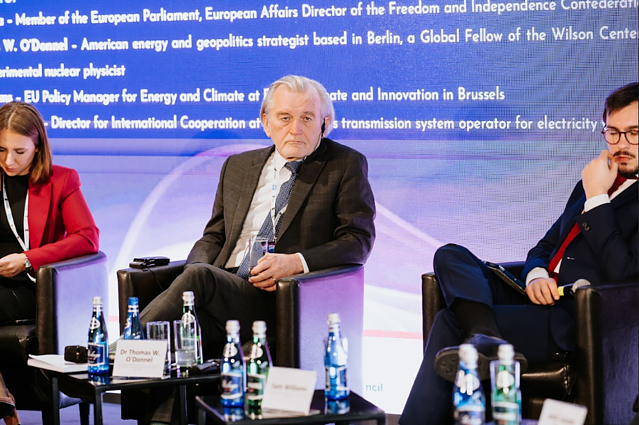
Here is the video of our 10 Nov. event, organized by EIES (European Institute for Energy Security). Our topic was the turn in US Trump administration policy on ending Russia’s war against Ukraine and the Russian oil sector.
My sincere thanks to EIES, and especially Executive Director Albéric Mongrenier, for inviting me along with distinguished energy and geopolitics experts. (Note: EIES is affiliated with, but policy-independent of, SAFE in Washington).
Our distinguished expert panel included:
Dr. Jaak Aviksoo, Former Minister of Defence of Estonia, EIES Energy Security Leadership Council
Christof Rühl, Senior Research Scholar at Columbia University’s Center on Global Energy Policy, former BP Chief Economist
Dr. Thomas O’Donnell, Energy and Geopolitical Strategist and Founder of GlobalBarrel.com
Moderated by Rosemary Griffin, OPEC+ Lead Reporter, S&P Global Commodity Insights
Opened by Peter Flory, Senior Fellow, EIES, Former NATO Assistant Secretary General
A central question we addressed was the turn in the Trump administration policy to apply significant coercive measures against the Russian oil sector to undermine the ability of the Putin government to continue its was in Ukraine. We discussed how effective the new sanctions on Rosneft and Lukoil might be and what is the synergistic effect of the Ukrainian drone and missile campaign against Russian domestic refineries and oil export terminal ports.
For an update on expanded attacks on Russian Black Sea oil ports and their meaning, see the written comments accompanying my Kanal24 video interview, posted on Monday, 17 Nov. “The US & Ukraine pound Russian oil | my Kanal24, Kyiv“).
You are invited to register now for Monday, 10 Nov. at 14:00 UK || 15:00 CET || 9:00 ET, an EIES Webinar. [My view: the USA, Ukraine & allies can dismantle the Russian petrostate. My posts on this are linked at the end]. I’m honored to join experts:
Dr. Jaak Aviksoo, Former Minister of Defence of Estonia, EIES Energy Security Leadership Council
Christof Rühl, Senior Research Scholar at Columbia University’s Center on Global Energy Policy, former BP Chief Economist
Dr. Thomas O’Donnell, Energy and Geopolitical Strategist and Founder of GlobalBarrel.com
Moderated by Rosemary Griffin, OPEC+ Lead Reporter, S&P Global Commodity Insights
Opened by Peter Flory, Senior Fellow, EIES, Former NATO Assistant Secretary General
Dismantling the Petrostate: Moment of Truth for Russian Oil? – Webinar: Monday 10 Nov.
Register Now – Allies have so far failed to break Putin’s war machine. The EU recently agreed on a 19th round of sanctions and plans to further ramp down Russian energy supplies. But EU sanctions have shown their limits, political leaders have not been able to use Russia’s frozen assets to aid Ukraine, and Moscow’s hydrocarbons still flow into the Union and other major markets.
Washington’s and London’s most recent sanctions may change the game. As we enter another winter of war, can Europe and the United States build on hard-won Transatlantic convergence to strike a decisive blow to the engine of the Kremlin’s aggression: Russia’s oil exports? Can the EU agree to and successfully manage the phaseout of Russian oil and gas?
The ceasefire Trump brokered will hopefully end this “12-Day War.” I want to discuss here why this war did not trigger a global energy crisis. [Here’s what I said about this to Al Jazeera last week, in the last five paragraphs. A PDF is also embedded below. I’ll also post a TRT-London show on Iran’s nuclear strategy, recorded Tuesday, soon.]
To assess the risk to energy supplies, understanding the aims of the combatants is key. Throughout this war, it was the USA-Israel side setting the agenda, and there were two strategic aims they could pursue. One was to “only” destroy Iran’s nuclear program and its existing conventional regional power-projection capacities. The second was to go beyond this to undermine the viability of the Islamic Republic, up to forcing a regime change. Why do I say this?
Above: Audio of my comments to (various) press on 22 April 25, on the impact of falling oil prices on Russia’s capacity to war on Ukraine. Also, a scenario I have discussed for over a year, first privately and then publicly, of how the USA could shut down the great majority of Russia’s seaborne oil exports, to devastating consequences for its oil sector and capacity to continue the war. In the present market situation of oversupply and anticipated continued weak demand, this could be done in a way that does not spike global oil prices.
This will only be done if Trump decides he needs to use harsh coercion to force Putin into an acceptable peace deal with Ukraine, AND if Trump were willing to impose lasting harm on the older Russian oil fields.
My long print interview at Lithuania’s LRT [Lithuanian PDF | English PDF] with Aleksandra Ketlerienė, deputy editor-in-chief of Lithuania’s LRT.lt, published 7January. We spoke in Warsaw, 19 November. My thanks to Aleksandra for her insightful questioning and editorial care. We discussed:
The EU’s systemic energy-policy “own goals” since its initial energy-crisis win after Moscow began cutting gas exports early in 2021.
Reforming failed/ineffective Russian price-cap sanctions for real sanctions, and how the global oil market is now favorable for “maximum pressure.”
Historical perspectives on oil, gas, renewables, and nuclear sectors, essential for realistic policy formation.
An historical overview of China’s decades-long effort to overcome its energy security, learning lessons of Japan’s WW2 weaknesses.
According to energy and geopolitics expert Tom O’Donnell, Ukrainian allies’ oil price cap, in conjunction with Ukrainian drones’ physical damage could be a significant hit to Russian revenues.
Tom O’Donnell, PhD, an expert on energy and geopolitics, sat down with Kyiv Post to explain what Ukraine’s attacks on Russia’s energy sector will mean for the larger Russian energy sector.
It sounds like a huge number. But how much do you think losing 12 percent of production, in a day, will affect Russia?
First off, although these refineries hit by Ukrainian drones yesterday represent about 12 percent of Russian production, experience shows that they might not each be totally impaired from production. Nevertheless, there are two particularly significant implications for Russia.
First, whatever percentage of Russian refined oil products this impairs, the damage will both deprive the war economy of needed export revenues and/or of much-needed fuels to keep the domestic war economy running.
Already, Russia had announced it will ban the export of gasoline from March 1 in order to tame prices for consumers in the runup to the presidential elections mid-month. In 2023 about 17 percent of Russian gasoline was exported.
What is the origin of the current price pressure?
The present price pressure is both a result of the demands of the war economy as well as previously successful Ukrainian hits on other refineries that began in January.
This gets to my second point – the successful refinery strikes of yesterday, involving a reported launch of 58 drones, as well as recent hits on a Russian domestic gas transmission pipeline, all demonstrate that the January successes were not one-off special operations, but rather the beginning of what will be a sustained Ukraine armed forces campaign capable of, over time, significantly disrupting Russia’s all-important oil and gas import revenues and internal refined-product supplies.
Kyiv has launched some of its largest air attacks on Russia this week ahead of the vote, which is set to hand President Vladimir Putin another six-year term in the Kremlin.
If Russia continues to lose refineries, which appears likely, what new complications will it create for Russia?
First, from a strategic point of view, it is important to see these physical strikes against Russian oil and gas infrastructure in conjunction with the sanctions efforts of the USA, EU and other allies aimed at reducing Russian oil profits. These drone strikes should be seen as a “force multiplier” to allied oil sanctions.
How so?
Consider that, with Russia no longer having the Druzba oil pipeline flowing into Central Europe due to EU sanctions, this has forced it to shift its Urals-region oil exports to seaports on the Baltic coast of Russia and to a new western-Arctic port. Hence, hitting any refining or export facilities inside Russia along this general Urals-oil export corridor has a significant effect on Russia sustaining export revenues. This oil mainly flows to Turkey, India and China, with Russian oil tankers representing the main users of the Suez and then the Red Sea. Due to sanctions, most of these ships are now either directly or indirectly Russian-controlled, to avoid the sanctions oil-price cap.
There has been a discussion in US-EU security-and-sanctions circles that these ships could be stopped for inspection by Sweden and/or Denmark in the Baltic, in the straights between their countries, and many might be refused passage due to having sketchy insurance and/or being unsafe, old vessels.
Advertisement
What do you think of the oil price cap? Is it a good idea?
From the point of view of strategic impact, the allies’ choice of an oil-price cap has been, in my view, a weak and overly complex-to-enforce instrument. However, in conjunction with Ukrainian drones’ physical damage, the overall hit to Russian revenues might become significant.
Secondly, Ukraine has also hit refineries in Russia just east of its own territory, which will mainly undermine the region’s war economy and complicate supplying the massive demand from Russia’s invasion forces. This region already has chronic fuel-supply problems, with farmers last year protesting against a lack of diesel for harvests, causing Russia to ban diesel exports during that season.
Dr. Tom O’Donnell is Berlin-based and is a Global Fellow of the Wilson Center.
Jason Jay Smart, Ph.D., is a political adviser who has lived and worked in Ukraine, Moldova, Kyrgyzstan, Kazakhstan, Russia, and Latin America. Due to his work with the democratic opposition to Pres. Vladimir Putin, Smart was persona non grata, for life, by Russia in 2010. His websites can be found at http://www.JasonJaySmart.com / http://www.AmericanPoliticalServices.com / fb.com/jasonjaysmart / Twitter: @OfficeJJSmart
Related references for assertions I made in my interview – Tom O’D.
Above: English Audio – translator asking question (low) and my (louder) answers.
Al Jazeera interview, Doha [Arabic] on the ramifications of the Russian Central Bank default due to USA sanctions. (13 Mar 2022, 22:40, from Berlin).
Note: It is indeed possible for the EU – including Germany too – to immediately cut Russian oil imports to zero and not suffer prolonged high oil prices. How? I will explain in a coming post. This is a topic I have been working on intensively the past couple weeks.
I mention some of my (and others’) rationale for saying this in my answer to the second question from Al Jazeera. NOTE: A very good reference on this is: Christof Rühl speaking last week to bne inelligence. I strongly concur with him. (this note added 15 Mar.)
StraitTalk, 8 October. My comments (from Berlin) begin at 2:30, with Aura Sabadus of ICIS (in London) and TRT’s Ause Suberker interviewing (in Stockholm).
On Friday, 8 October, I was interviewed, with Aura Sabadus (@ASabadus) of ICIS-London, about Nord Stream 2’s impact on European energy politics on”Strait Talk” with TRT host Ayse Suberker. We discussed the geopolitical aims of Russian and German leaders for partnering on this pipeline.
I stressed, the issue is not whether Europe is dependent on Russian gas – it is and it will remain so for the foreseeable future for up to 40% of its imports. The issue is what route this gas takes to arrive from Russia into Europe.
Consider: Russia historically exported 80% of the gas it sends to Europe using massive Soviet-era pipelines transiting Ukraine, the remainder via a Belarus-Poland-Germany pipeline. However, for 20 years Continue reading →






 The Global Barrel