Category Archives: geopolitics

My Briefing Paper for USA House Foreign Affairs Committee hearing, “… Ending Global Dependence on Putin’s Nuclear Energy Sector.”

—– Click image to open PDF

I was asked to write a Brief for the USA House of Representatives’ Committee on Foreign Affairs (Europe Subcommittee) 12 March hearing: “Going Nuclear on Rosatom: Ending Global Dependence on Putin’s Nuclear Energy Sector,” submitted via Wilson Center in Washington, where I am a Global Fellow (external). There are two aspects to the Brief:

  1. My assessment of how threats posed to the 3-Seas-Region Member States executing a pragmatic energy transition incorporating nuclear energy emanate both from the role of Russia’s Rosneft, and equally from the activities of seven anti-nuclear Member States led by Germany, and
  2. Detailed research on Russia’s nuclear energy dangers contributed by colleagues in Poland and Ukraine.  Their research includes:
  • Appendix A: Some facts and policy recommendations on Rosatom activities, based on research by Warsaw colleagues at The Polish Economic Institute (PEI), Dr. Adam Juszczak, and Mr. Kamil Lipiński (p. 6);
  • Appendix B. Rosatom may be assisting in circumventing sanctions., from research by colleagues at DiXiE Group, Kyiv, Ukraine, especially Mr. Roman Nitsovych, and Ms. Olena Pavlenko (p. 7);
  • Appendix C. Why sanction Rosatom: Link between “peaceful” Rosatom energy & Russian nuclear weapons, based on research by CGS Strategy XXI , Kyiv, Ukraine, in particular Mykhailo M. Gonchar, Founder and President, and Chief Editor of the Black Sea Security Journal (p. 11.)

I highly recommend their three Appendices.

I should note that what I wrote in the main body was likely unexpected. I wrote that, for accomplishing a pragmatic, nuclear-power-inclusive energy transition in the 3-Seas Region (i.e., the EU’s Central and Eastern Europe, Baltic, and Balkan Member States), the continued dependencies on Russia’s Rosatom are not the only threats. The threat from the Group of Seven anti-nuclear states, led by Germany, is clearly equally or more disruptive to the Region accomplishing a pragmatic energy security-and-transition policy. I’ll quote a bit of the report on this point:

Continue reading

1st “Berlin Energy Forum” 21 May | A monthly disruption of the local ‘energy echo chamber.’

Dear Colleagues & friends, Below is an invite to our first Berlin Energy Forum (jump to details | jump to register), but first a personal note.

First, a personal note: As some of you know, this is an idea I’ve been floating in Berlin since well before Corona. Then, last October, I had an experimental test run, a one-off, sponsored by the Qatari embassy’s Divan – and it went very well.

However, the biggest success from that event was that Ben Aris, co-founder and editor-in-chief of bne IntelliNews enthusiastically joined me to found the Berlin Energy Forum as a regular monthly sort of membership club. Amongst the longest serving foreign correspondents in Eastern Europe, Ben has been covering Russia since 1993, with stints in the Baltics and Central Asia. He is a former Moscow bureau chief for the Daily Telegraph and was a contributing editor at The Banker and Euromoney for a decade amongst writing for many other publications. He is also a professional photographer, and nowadays based in Berlin.

Ben is one of those rare people who relishes doing analysis and data-driven writing (non-stop!), AND who knows how to do business – and thoroughly enjoys doing it. Just the partner for this endeavor.

My model and inspiration for this forum was always the New York Energy Forum, which has run for over 40 years now. I happily attended while teaching in NYC. My experience with that forum, plus familiarity with a few top DC think tanks, and various foreign diplomats (esp. in NYC/UN), is how, as an academic, I got to know a broad spectrum of USA oil and gas executives, journalists, financial-institution analysts and government officials. Those personal connections have, over the years, anchored my assessments of USA, of OPEC MENA-and-Latin American members’, and of Russian and Chinese strategy. This sort of community doesn’t exist in Europe in such a focused manner, save perhaps in London. Perhaps we can now bring a bit of that world to Berlin with our new BEF.

Continue reading

Jerusalem Post asked me: “Why can’t Israel make unilateral decisions on its multifront war?”

I was asked by Debbie Mohblatt for the Jerusalem Post on Thursday: Why can’t Israel make unilateral decisions [i.e., as to whether and how to attack Iran]? Two other geopolitical experts interviewed were Jack Kennedy, head of Middle East and North Africa Country Risk at S&P Global Market Intelligence, and Noa Meir, founder of the Gideon Meir Diplomacy Center. My quoted remarks follow, the full article is here, and farther below I put today’s performative Israeli response in perspective..

Israel dependent on American decisions

Dr. Thomas O’Donnell, a global fellow of the Woodrow Wilson Center in Washington who teaches in Berlin, told The Media Line that Israel was very dependent on American decisions. He added that in this case, Israel could carry out some small-scale symbolic response that would not necessarily draw an additional Iranian attack leading to escalation.

“Israel has always gotten huge amounts of support from the United States—military and otherwise. It’s quite clear that it [Israel] can’t sustain a protracted war, especially a protracted war of the nature it would be against Iran, without the United States’ support, and there’s no other country that is capable or willing to give that support,” he said.

O’Donnell added that very few of the world’s countries can make these kinds of decisions without considering their allies. “A small country can go to war with another small country. But if this is going to bring in larger powers, they have to be very careful,” he continued.

… O’Donnell explained that ever since President George W. Bush’s administration, which came before Presidents Barack Obama and Donald Trump, the United States has been very clear that it made a mistake by putting too many boots on the ground in the Middle East and that it must get out of the region. “It has to focus on great power competition against Russia and China. And this is becoming more urgent by the day,” he continued, explaining part of the rationale behind the US not wanting a major escalation between Israel and Iran. (Read the entire article for the others’ comments.)

Continue reading

Why USA alarm? [PL/EN] Analityk: Ukraina pokazała, że może zakłócić eksport rosyjskiej ropy przez porty /Analyst: Ukraine has shown it could disrupt Russian ports exporting oil

Money.pl Getty …

In an Easter Sunday interview in 20+ Polish papers [POLISH & ENGLISH below], I said White House reasons for Ukraine not to hit Russian refineries don’t make sense. The “elephant in the room” alarming DC is that Ukraine can now disrupt Primorsk, UST-Luga and Novorossiskya oil ports, needed for 60% of Russian exports.

This would not only deny Moscow vital oil revenues needed to wage war, it would also spark a spectacular global oil market shock. I explain that the USA and allies can urgently prepare for this, while the Ukrainians are still maintaining strategic patience.

Continue reading

My Newsweek: 1) Ukraine could hit Russian oil exports-but hasn’t. 2) Gen. Hodges is right–USA stand regrettable.

Credit: Kyiv Post 13mar24

“O’Donnell told Newsweek that that if Ukrainians really wanted to hit oil exports, they would go after Novorossiysk Fuel Oil Terminal in the [eastern] Black Sea and Primorsk Oil Terminal at the end of the Baltic Pipeline System.

“‘These are the two major exports sites for Russian oil and they are demonstrated to be within range of aerial drones and perhaps, in the case the Black Sea, their seaborne drones,’ he said. ‘If they really want to cut Russia’s oil income, they would go after those ports and they haven’t—that might be in deference to Americans concerns.’ (Russia Faces Major Gas Headache After Ukraine Strikes, Newsweek, article by Brendan Cole, Mar 25, 2024.)

Last week, Newsweek (USA) twice cited my analysis of Ukrainian drone strikes. In one instance, I had the honor of following an interview with General Ben Hodges, former Commander of US Army, Europe, with whom I concur in regretting the USA opposition.

(Aside: I hope to have an Op-Ed, perhaps tomorrow, in Europe, assessing that (i) the USA’s stated reasons versus Ukraine’s drone strikes to date do not make sense, and (ii) the “elephant in the room,” which must really have alarmed the White House, is that Ukraine’s strikes on refineries ipso facto demonstrate they COULD, if they so chose, disrupt anywhere up to 60% of Russian oil exports. Lastly,(iii) if the USA, EU and allies do not rapidly prepare non-Russian oil-sector producers for this eventuality, a global oil price shock could result.)

Here are the links to last week’s two new interviews/citations by Newsweek:

Continue reading

“Is Europe winning the energy war?” Roundtable views: (i) Russian oil-price cap failing; anti-trust tax could help. (ii) Green-energy inflation & subsidies plus low oil & gas development disarm Europe.

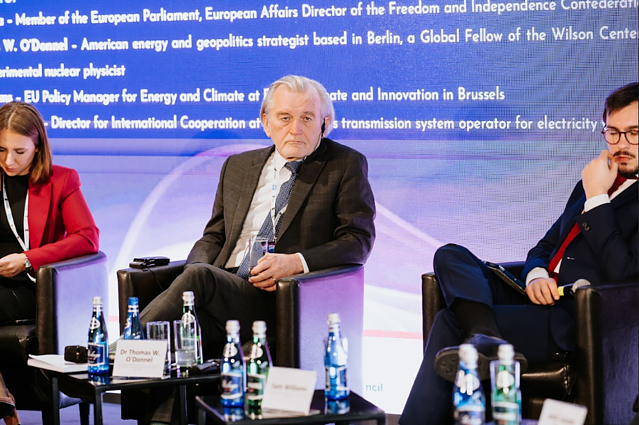
Berlin Energy Roudtable. L to R: Ben Aris, Tom O’Donnell, Morten Frisch & Andriy Kobolyev (video link from Kyiv) 24 October 2023, Haus der Bunderpresskonferenz – PHOTO GALLERY BELOW (Divan staff)

On 24 October, I was honored to moderate a great roundtable in Berlin with three European energy experts, sponsored by Der Divan Kulturehaus. SUGGESTION: While listening, open up that speaker’s file below. You’ll find Ben Aris’ data-slides on Russian price-cap failings, Andriy Kobolyev’s proposal to tax Moscow’s oil & Morten Frisch’s slides on EU renewable shortcomings & continued oil and gas needs.

Continue reading

My AlJazeera: Russia cuts exports via Nord Stream 1 by 60%, further weaponizing EU over-dependence, as part of its war against Ukraine. EU winter gas rationing is possible.

Jun 17, 2022 Today, Gazprom announced a further cut in exports of gas via Nord Stream 1 to Germany and on into Europe. Earlier this week, they had cut 40%, now it is 60% of the 55 billion cubic meters per year (bcm) that normally flows in this pipe.

I explained that the Gazprom excuse – -that it could not re-import some compressor parts it had sent to Siemens to repair in Canada due to sanctions — appears as a convenient, manufactured excuse.

I pointed out that a one-off sanctions waiver from the USA, EU and/or Canada for the reimportation of these very specific parts could likely be easily arranged – and if the gas did not again flow fully, Gazprom’s ruse would be clearly exposed.

However, as I said, this is more accurately understood as simply another step in the weaponization of the over-dependence of the European Union (and esp. of Germany, Austria and Italy) on Russian gas imports, a game which Mr. Putin began in earnest in August of 2021.

Continue reading

My Al Jazeera: Finland, the Baltics & Poland prepared well for Gazprom’s cutoff. Germany & Austria did the opposite, putting EU at risk.

ABOVE is English audio — BELOW is Arabic video. Recorded live; Al Jazeera, 21 May 2022.

I told Al Jazeera that Finland is well prepared, having worked since 2017 with Estonia, Latvia and Lithuania – the Baltic states – and with Poland to connect them all together with new pipelines, also to access LNG, storage and soon, new supplies from Norway.

Finland has also rented a regasification ship, from a US firm, to receive 5 billion cubic meters per year of LNG, whch will be plenty to supply both itself and Estonia in the wake of Putin cutting off Gazprom supplies of natural gas. Finland refuses, as did Poland too, to pay Moscow in rubles and so are being punished by Putin.

Continue reading

My Kosatka (Kyiv) Q&A: “Biden’s ‘gas airlift’ & Kremlin revenue. Tom O’Donnell on Russian gas embargo” [Ru/En/Ua]

Kostaka.Media (Kyiv) independent journalists continue informing the Ukranian people on energy affairs. I was interviewed from afar by YAROSLAV MARKIN, TETIANA HUZENKO. We focused on gas issues – would Putin cut Europe’s gas? What have the Americans been organizing, now with the Europeans? How would this affect Europe, Ukraine and Putin’s income?

Below are links to the article in Kostaka’s three languages (EN, RU, UA). I pasted in the English one below, in case you have access problems. This interview had to be written, not audio/video, due to wartime difficulties. [Also, here’s my previous (in-person Kyiv) interview with Kostaka.Media.]

Biden’s Gas Air Lift and the impact on Kremlin revenue: Thomas W. O’Donnell on the russian gas embargo
28 April 2022 — Author YAROSLAV MARKIN, TETIANA HUZENKO

Europe is going to cut the consumption of gas by a ⅔ in 2022, that is obviously will affect the Kremlin’s revenue. However, an embargo is highly possible as well. Both the Kremlin and the EU, in response to Russia’s new war crimes in Ukraine, could stop the gas flows.
In such a case, LNG supplies are to help weather the crisis of 2022-2023 via Biden Air Lift. The last mentioned is being set up by the US and EU diplomats and is patterned on the Berlin Air Lift of 1949. Berlin Air Lift was a system of food and coal supply during the times when the USSR had been blocking land routes.
This would be the end of Russian gas supplies to Europe forever, an international expert and senior energy and geopolitics analyst at GlobalBarrel.com, Dr Thomas W. O’Donnell believes.
He told Kosatka.Media how quickly Europe would be able to abandon Russian gas, what alternative supply routes could be used, and whether Hungary and Austria, obsessed with Russian gas, could prevent this.

The analogue of Putin’s army in the energy sector
How much gas does Europe import from Russia per year? Who are the major consumers?

There are two different market processes whereby Russian gas is purchased by Europe. If we speak about only gas delivered by pipeline, these are:
І. Via long-term contracts, agreements which are for natural gas to be delivered for several years, perhaps from five to as much as 20 years.

ІІ. Via the “spot” market. These are short-term contracts for gas to be delivered the following month. It is also possible to buy gas day-by-day, where traders agree to a price for gas delivered the next day. Here, gas traders consult the future’s market, which has set the price for gas delivered the next day, or the next month, or some number of months in the future.

Continue reading

Le dije a Radio Clarín Buenos Aires: Putin amenaza con cortarle el gas a la UE/Alemania, pero no tiene otra fuente de dinero. Si lo hace, Biden y la UE organizarán un “Gas-Lift” … [Spanish]

Lo sentimos, la calidad de la comunicación celular desde Alemania no es buena. Por lo tanto, he escrito mi respuesta larga a la primera pregunta a continuación. Las otras preguntas también están abajo. Muchas gracias a los periodistas de Radio Clarín y La Nacion en Argentina (y en París).

Re: Urgente Pedido de Entrevista Periodística – Corresponsales Clarín y La Nación – Argentina

De Maria E… … Fri, Apr 29, 11:50 PM

Dr. O ´Donnell, … Estas son las preguntas para la entrevista del domingo:

1¿Alemania tiene otra posibilidad que no sea seguir comprando el gas ruso? ¿Cuáles serían sus otras opciones?

Repuesta: Antes que nada, muchas gracias por esta oportunidad de hablar con su audiencia argentina.

Pues, debo señalar que hay dos problemas diferentes: el suministro de petróleo ruso a Alemania y Europa y el suministro de gas ruso a Alemania y Europa. Me preguntas por el gas. El gas es mucho más difícil para Europa y para Alemania que el petróleo Hay dos casos: una reducción gradual o parcial de gas o un corte inmediato.

Un corte gradual se puede manejar bastante bien. Ahora Putin está tratando de dividir y conquistar Europa cortando el suministro de gas a Polonia y Bulgaria.

Un recorte inmediato, ya sea por parte de Putin o debido a las sanciones de la UE, crearía una gran crisis energética en Europa. Sin embargo, es importante entender que, al final, Putin está en una posición mucho más débil.

Si Putin corta todos los suministros de gas a Europa, ahora no hay suficiente gas en el mercado mundial para compensar. Pero Occidente, y especialmente EE. UU., la administración Biden, se ha estado preparando para esto al menos dos meses antes de que Putin invadiera Ucrania, incluso antes de que Europa creyera las advertencias de EE. UU. de que Putin atacaría Ucrania.

Continue reading

Would EU sanctions on Russian oil cost Germany “too much”? No. Scholz & Habeck pose the wrong questions. [Asharq/Bloomberg live: En & Ar]

Above: English Audio || Below: Arabic Video
.

24 April 2022: My Asharq/live evening TV news interview is a bit over seven minutes.

Would an oil embargo be “effective”?

I respond, What is “effective”? Clearly it would not end the war. However, a Ukranian soldier who decides to give his life to resist the Russian invaders has no illusion that his or her sacrifice, on its own, will end the war. But, he will makes what contribution he can.

So, the German leadership refuses to send Ukraine heavy weapons, and certainly won’t send German troops. However, Germany and the EU can at least step up and make this contribution – sanctionRussian oil now. This will greatly hinder Putin’s ability, within two to three months, to finance his war.

  • We discuss the question raised by the German leadership – by Chancellor Scholz (SPD party), Energy and Environment Minister Habeck (Greens) and Finance Minister Lindner (FDP liberals) – that supposedly an embargo in Russian oil (or gas) would do more harm to German citizens than to the Russian leadership.
  • The argument heard repeatedly from Berlin is that this is “not worth it” and also, that such an embargo it “would not end the war.”
  • Also, I answer the question of how much oil could Putin’s Russia divert from Europe to India if the EU and Germany embargoed oil.

I think I posed useful answers to these questions given the time we had. Your thoughts and critiques are welcomed, and solicited.

Best, Tom O’Donnell, Berlin

Kyiv’s Wall of Remembrance to 4,000 Ukrainian soldiers already killed vs. Russian aggression | Thoughts on my video at St Michaels Monastery

This is a simple post. I wanted to share my video of the Wall of Remembrance in Kyiv fo;r 4,000 Ukrainian soldiers killed fighting Russian aggression since 2014. I estimated there were photos of about 3,100 of these soldiers on the wall. I made the video 26 October 2021; by then, the photos went to July 2020.

I was in Kyiv for a congress, and the video was spontaneous, intended for family back in Berlin and the States.

This wall is around the St. Michaels Monastery. I hadn’t come up this path to St. Michaels and on into central Kyiv before. So, as I was making this video, I was discovering the soldiers’ memorial for the first time. On other visits,, I’d taken the cable car up, and passed by the Maidan martyrs’ memorial wall – which is at the end of this video. This time I had walked some kilometers, at sunset, from my hotel across from the Rada and the Presidential Palace, which are below, at the level of the Dnieper River.

Why am I posting this video now, for the public?

One reason is to put human faces on the geopolitics I analyze in this blog and in my work.

More particularly, I was reading about the classified briefings on Capital Hill last week for senators and representatives by US Secretary of Defense Austin and Secretary of State Blinken. They reportedly outlined various scenarios they deem likely for what sort of military aggression Putin is planning.

The numbers of Ukrainian casualties they reportedly projected – mostly civilians – number in the many thousands depending on the particular invasion scenario Moscow chooses (see the NYT). Of course, there are disagreements between European and USA officials as to which scenario Putin will choose; but that is irrelevant as to the essential character of what Putin’s Russian Federation is threatening: an offensive, an invasion, a war of aggression. Under any of the scenarios, many more Ukrainians will die than have died since 2014, … and I was thinking that their faces will look exactly like the faces here in my video.

So here is a medium-to-long-term scenario:

Continue reading

My TRT/Istanbul: Biden names Qatar a “major non-NATO ally,” seeks LNG for EU. Energy scenarios of a Russian war vs. Ukraine.

Strait Talk with host Aisha-Aura Sbadus @suberker in Istanbul. My co-panelist was Tom Marzec-Manser @tmarzecmanser Head of Gas Analytics at @ICISOfficial

We discussed scenarios for how the EU energy crisis might go in a new Russian war against Ukraine, and the significance of USA President Biden designating Qatar as a “major non-NATO ally.”

In particular, we discussed how much could Qatari LNG be made available and what its impact would be alongside the massive US LNG deliveries so far this year.

Continue reading

EU Energy Crisis: Germany & EU long ignored US warnings that Putin can weaponize gas, attack Ukraine – On David Foster’s Roundtable, London

26.01.2022. Experts Wahid Machram, market analyst in Dubai; Samuel Ramadi at Oxford University, UK. and TRT Roundtable host David Foster in London made important points. Here’s a key assessment I made.:

There is a new and growing asymmetry between the European Union and Russia in energy supplies – one increasingly favoring Moscow.

Europe has opened itself to energy blackmail. The present winter 2021-22 gas shortage and skyrocketing prices are only one part. There is also the real possibility of Putin cutting off the pipeline gas he is still supplying in the event that Europe, esp. Germany, opposes any Russian invasion of Ukraine.

About the new EU-Russia growing energy asymmetry:

  • On the demand side, Germany and Europe generally increasingly need natural gas, and are growing more dependent on Russian supplies, contrary to the promises of rapid progress to a carbon-free future of the German Green Party and others. The EU, and especially Berlin, have adopted ideologically-determind, technologically unrealistic and expensive energy-transition policies, with little concern for energy-supply security. This has made Europe increasingly dependent on Russian gas imports – 40% at present of total gas imports,
  • Meanwhile, on the supply side, Russia, the major European supplier, is increasingly finding ways to diversify its gas customer base away from Europe, to the Far East, especially to China, and to Eurasia generally. It also has new outlets for its vast Arctic gas resources by converting it to LNG that can go by ship to anywhere in the world.
Continue reading

Plan C: Gazprom’s failures on Nord Stream 2 | My talk, Ukrainian Energy Security Dialogue [English & Ukrainian]

ENGLISH – Dr. Tom O’Donnell spoke from Berlin (Українське відео розміщене нижче)
Українська мова: з Берліна говорив доктор Томас О’Доннел

Here is my talk [English & Ukrainian videos] for the Ukraine Energy Security Dialogue of 01.12.21, via Zoom, organized by Kyiv’s Dixie Group. Program & Speakers are below.

I outlined failures of the legal and political models Russia’s Gazprom has embraced to eventually bring the Nord Stream 2 pipeline into operation under the anti-monopoly provisions of the EU’s Third Energy Package law..

Critical observers have understandably interpreted the public optimism and “gas-Godfather”-like posturing of Kremlin and Gazprom officials as evidence of self-confidence, even arrogance. In contrast, here I outlined what actually amounts to a history of repeated failures of Nord Stream 2 AG strategies.

I termed its first two failed strategies as “Plan A” and “Plan B,” and the current one as “Plan C.”

Continue reading