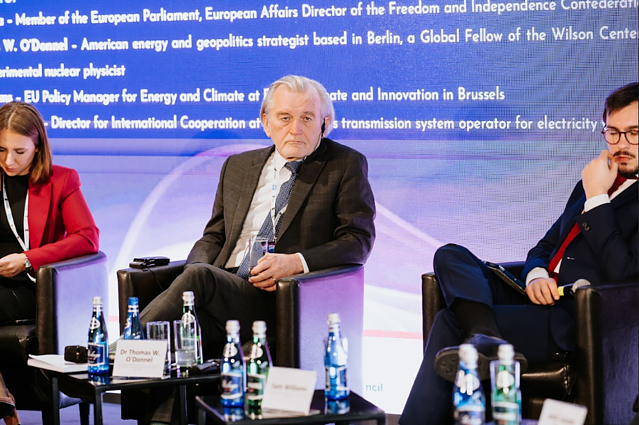
Recorded Thurs AM, 03Oct24. Warsaw Old Town, Castle Square.
Will Israel hit Iranian oil infrastructure? And, what part of it? To what effect on markets, and geopolitics, (i.e., Mideast, OPEC, Russia and Ukraine war)? A video report.
MAIN POINTS (see transcript):
1. What if Israel hits Iran oil infrastructure in retaliation for missile strikes on Tel Aviv on Tuesday night? 1.a. The difference effects of hitting Iranian refineries vs oil export terminals In itself, neither target would make big difference in the market. The market would immediately jump, of course, but in principle the effect would be small. 1b OPEC+ and Western Hemisphere have plenty of spare capacity.
2. Consider Saudi market tactics … reportedly they want to now go for share over price support, as price support is failing after well over a year of output cuts (about 6 mb/d). Note: Shortly after this recording the Saudis repudiated the WSJ that reported the switch in tactics to defending share. Likely they’ll now want to wait and see what happens to Iranian exports, or if this Israel-Iran tit-for-tat gets out of hand.
See my pre-interview research reference & notes below this post. Tom O’D.
This epitomizes today’s LNG-geostrategic nexus.
One way to look at the Turkey-Shell LNG deal is that Mr. Erdogan wants Turkey to avoid Germany’s blunder in relying heavily on Putin’s Russia for its imported natural gas. He obviously wants Turkey to diversify its natural gas imports. In this regard, the opening comment by Tom Marzec-Manser, head of Gas Analytics at ICIS, London, that “this is a big deal” for Turkey – is correct.
Turkey uses about 50 bcm (billion cubic meters) of natural gas per year. This is currently supplied almost entirely via pipelines, mainly from Russia, also from Iran and from Azerbaijan. As I pointed out, Mr. Erdogan is well aware how Putin cut off German and EU Russian gas supplies as a geostrategic weapon in preparation for his full-scale invasion of Ukraine. This plunged Germany and the entire EU into the acute 2022-2023 European energy crisis. Germany, especially, still has not fully recovered.
I was interviewed along with Dr. Michael Amoah (LSE), by TRT, Türkiye’s national broadcaster, on the Istanbul show “Straight Talk,” on 23 July 2024. Topic: Turkey’s new energy and mineral deals with Niger and Somalia. The TRT blurb:
What Is Türkiye’s Energy Strategy in Africa? It was a busy week for Türkiye’s energy diplomacy with Africa. Over just two days, Ankara secured two key agreements, one with uranium and mineral-rich Niger, and the other with Somalia. Turkish Energy and Natural Resources Minister Alparslan Bayraktar, who attended both meetings, said significant progress had been made and that for Somalia, the search for hydrocarbons off the horn of Africa will begin this year. The Turkish seismic vessel Oruc Reis is expected to set sail for the Somali coast by the end of this year as part of the agreement. In March, Turkiye and Somalia signed a deal on offshore oil and natural gas cooperation, which followed a defense agreement in February. And last week, a high-level delegation from Türkiye visited Niger’s capital Niamey to cover everything from energy, defense, intelligence sharing and mining. The visit came after the West African nation severed mining contracts with key Western countries, including France, and called for French and US troops to leave the country.
Guests:
— Dr. Thomas O’Donnell Global Fellow at Wilson Center
My assessment of how threats posed to the 3-Seas-Region Member States executing a pragmatic energy transition incorporating nuclear energy emanate both from the role of Russia’s Rosneft, and equally from the activities of seven anti-nuclear Member States led by Germany, and
Detailed research on Russia’s nuclear energy dangers contributed by colleagues in Poland and Ukraine. Their research includes:
Appendix A: Some facts and policy recommendations on Rosatom activities, based on research by Warsaw colleagues at The Polish Economic Institute (PEI), Dr. Adam Juszczak, and Mr. Kamil Lipiński (p. 6);
Appendix B. Rosatom may be assisting in circumventing sanctions., from research by colleagues at DiXiE Group, Kyiv, Ukraine, especially Mr. Roman Nitsovych, and Ms. Olena Pavlenko (p. 7);
Appendix C. Why sanction Rosatom: Link between “peaceful” Rosatom energy & Russian nuclear weapons, based on research by CGS Strategy XXI , Kyiv, Ukraine, in particular Mykhailo M. Gonchar, Founder and President, and Chief Editor of the Black Sea Security Journal (p. 11.)
I highly recommend their three Appendices.
I should note that what I wrote in the main body was likely unexpected. I wrote that, for accomplishing a pragmatic, nuclear-power-inclusive energy transition in the 3-Seas Region (i.e., the EU’s Central and Eastern Europe, Baltic, and Balkan Member States), the continued dependencies on Russia’s Rosatom are not the only threats. The threat from the Group of Seven anti-nuclear states, led by Germany, is clearly equally or more disruptive to the Region accomplishing a pragmatic energy security-and-transition policy. I’ll quote a bit of the report on this point:
First, a personal note: As some of you know, this is an idea I’ve been floating in Berlin since well before Corona. Then, last October, I had an experimental test run, a one-off, sponsored by the Qatari embassy’s Divan – and it went very well.
However, the biggest success from that event was that Ben Aris, co-founder and editor-in-chief of bne IntelliNews enthusiastically joined me to found the Berlin Energy Forum as a regular monthly sort of membership club. Amongst the longest serving foreign correspondents in Eastern Europe, Ben has been covering Russia since 1993, with stints in the Baltics and Central Asia. He is a former Moscow bureau chief for the Daily Telegraph and was a contributing editor at The Banker and Euromoney for a decade amongst writing for many other publications. He is also a professional photographer, and nowadays based in Berlin.
Ben is one of those rare people who relishes doing analysis and data-driven writing (non-stop!), AND who knows how to do business – and thoroughly enjoys doing it. Just the partner for this endeavor.
My model and inspiration for this forum was always the New York Energy Forum, which has run for over 40 years now. I happily attended while teaching in NYC. My experience with that forum, plus familiarity with a few top DC think tanks, and various foreign diplomats (esp. in NYC/UN), is how, as an academic, I got to know a broad spectrum of USA oil and gas executives, journalists, financial-institution analysts and government officials. Those personal connections have, over the years, anchored my assessments of USA, of OPEC MENA-and-Latin American members’, and of Russian and Chinese strategy. This sort of community doesn’t exist in Europe in such a focused manner, save perhaps in London. Perhaps we can now bring a bit of that world to Berlin with our new BEF.
I was asked by Debbie Mohblatt for the Jerusalem Post on Thursday: Why can’t Israel make unilateral decisions [i.e., as to whether and how to attack Iran]? Two other geopolitical experts interviewed were Jack Kennedy, head of Middle East and North Africa Country Risk at S&P Global Market Intelligence, and Noa Meir, founder of the Gideon Meir Diplomacy Center. My quoted remarks follow, the full article is here, and farther below I put today’s performative Israeli response in perspective..
Israel dependent on American decisions
Dr. Thomas O’Donnell, a global fellow of the Woodrow Wilson Center in Washington who teaches in Berlin, told The Media Line that Israel was very dependent on American decisions. He added that in this case, Israel could carry out some small-scale symbolic response that would not necessarily draw an additional Iranian attack leading to escalation.
“Israel has always gotten huge amounts of support from the United States—military and otherwise. It’s quite clear that it [Israel] can’t sustain a protracted war, especially a protracted war of the nature it would be against Iran, without the United States’ support, and there’s no other country that is capable or willing to give that support,” he said.
O’Donnell added that very few of the world’s countries can make these kinds of decisions without considering their allies. “A small country can go to war with another small country. But if this is going to bring in larger powers, they have to be very careful,” he continued.
… O’Donnell explained that ever since President George W. Bush’s administration, which came before Presidents Barack Obama and Donald Trump, the United States has been very clear that it made a mistake by putting too many boots on the ground in the Middle East and that it must get out of the region. “It has to focus on great power competition against Russia and China. And this is becoming more urgent by the day,” he continued, explaining part of the rationale behind the US not wanting a major escalation between Israel and Iran. (Read the entire article for the others’ comments.)
In an Easter Sunday interview in 20+ Polish papers [POLISH & ENGLISH below], I said White House reasons for Ukraine not to hit Russian refineries don’t make sense. The “elephant in the room” alarming DC is that Ukraine can now disrupt Primorsk, UST-Luga and Novorossiskya oil ports, needed for 60% of Russian exports.
This would not only deny Moscow vital oil revenues needed to wage war, it would also spark a spectacular global oil market shock. I explain that the USA and allies can urgently prepare for this, while the Ukrainians are still maintaining strategic patience.
“O’Donnell told Newsweek that that if Ukrainians really wanted to hit oil exports, they would go after Novorossiysk Fuel Oil Terminal in the [eastern] Black Sea and Primorsk Oil Terminal at the end of the Baltic Pipeline System.
“‘These are the two major exports sites for Russian oil and they are demonstrated to be within range of aerial drones and perhaps, in the case the Black Sea, their seaborne drones,’ he said. ‘If they really want to cut Russia’s oil income, they would go after those ports and they haven’t—that might be in deference to Americans concerns.’“ (Russia Faces Major Gas Headache After Ukraine Strikes, Newsweek, article by Brendan Cole, Mar 25, 2024.)
Last week, Newsweek (USA) twice cited my analysis of Ukrainian drone strikes. In one instance, I had the honor of following an interview with General Ben Hodges, former Commander of US Army, Europe, with whom I concur in regretting the USA opposition.
(Aside: I hope to have an Op-Ed, perhaps tomorrow, in Europe, assessing that (i) the USA’s stated reasons versus Ukraine’s drone strikes to date do not make sense, and (ii) the “elephant in the room,” which must really have alarmed the White House, is that Ukraine’s strikes on refineries ipso facto demonstrate they COULD, if they so chose, disrupt anywhere up to 60% of Russian oil exports. Lastly,(iii) if the USA, EU and allies do not rapidly prepare non-Russian oil-sector producers for this eventuality, a global oil price shock could result.)
Here are the links to last week’s two new interviews/citations by Newsweek:
Berlin Energy Roudtable. L to R: Ben Aris, Tom O’Donnell, Morten Frisch & Andriy Kobolyev (video link from Kyiv) 24 October 2023, Haus der Bunderpresskonferenz – PHOTO GALLERY BELOW(Divan staff)
On 24 October, I was honored to moderate a great roundtable in Berlin with three European energy experts, sponsored by Der Divan Kulturehaus. SUGGESTION: While listening, open up that speaker’s file below. You’ll find Ben Aris’ data-slides on Russian price-cap failings, Andriy Kobolyev’s proposal to tax Moscow’s oil & Morten Frisch’s slides on EU renewable shortcomings & continued oil and gas needs.
You are invited to attend the 1st Berlin Energy Roundtable, on 24 October. Our three distinguished speakers share decades of Eurasian and Mideast gas-sector experience. I’ll have the pleasure of moderating.
As many of you know, this is a format I long sought to establish in Berlin; but, which during Corona and the energy-crisis after the largescale Russian invasion of Ukraine, was difficult to advance.
The event is made possible with the generous sponsorship of the Divan Culture Housein Berlin. Hopefully there will be several more in the coming year.
[02.10.23 Note: Some typos/syntax corrected. Somehow could not edit w/ my phone yesterday.]
–1– The Saudis have no intention to spike oil price over $100/barrel, at least not for long – that’s my read.
Their customers’ economies are troubled, especially China, but Europe too – where too-high-an-oil-price could re-boost inflation, even push them into recession(s) killing oil demand.
Over the last year, the Saudi’s were newly proactive (their traditional mode was always to react after-the-fact). And their economists’ market calls were correct.
For several months, OPEC+ cumulative production cuts barely held prices stable. Only in recent months, along with new (though tepid) demand, did prices climb, form high-$80s to now mid $90s.
The Saudi minister professes to be unsure whether demand will rise in Q4. The IEA and the futures market (in backwardian now) see tightness. The Saudi minister answers that, if that happens, he has plenty of oil ready to put back into markets.
But – Nota Bene – despite present drawdowns in USA oil stocks and apparent tightness elsewhere, suddenly many oil analysts are saying that the present price rally could be short lived, and that OPEC-plus may have to keep or even deepen its cuts to maintain prices as they are.
Here are three very useful reports to this effect:
Today (Mon., 12.09.23; 12:16 CET) EuroNews-Serbia interviewed me (Video has English audio-overlay). I explained:
Saudi logic for cutting, with Russia, about 125 million barrels from the market so far, and by the end of 2023 some 245 million barrels [1] is its prediction of soft demand due to China’s slow recovery and somewhat the EU too; plus the Saudi minister points to central banks continuing to fight inflation with high rates.
However, the IEA disagrees, seeing a shortage of supply in Q4. I added that the market is in backwardian, and so agrees with IEA.
My assessment:
Price over $100 is likely this year; it is after all fairly close now, in the 90’s.
I answered a question about who gets hurt the most from high prices.
It is the countries who do not produce oil and are relatively poor. So, mainly some states in Asia and So. Asia, Africa and Latin America.
As for Europe, rising oil price will be somewhat inflationary; especially hitting Eastern Europe, where inflation is generally still a greater problem.
However, I pointed out that compared to historical peaks in 2008-09 and 2010-11, $100 or even $125/bbl or even higher prices are needed to begin approaching the REAL price of oil back in those cases.
So, $100 oil is now not so inflationary as it was back then (and in general oil is not as inflationary as it was in the last century, because economies have larger service and knowledge sectors that are not as strongly affected by fuel prices as manufacturing and chemical industries.
I also explained that the Russian oil price cap sanctions have actually “put money in the pockets” of people in poorer states, as its enforcement meant that Russia, while still selling its oil, has been forced to sell it cheaper.
In particular, up till the start of last month (start of Sept), Russia was losing about half the revenues it would have ordinarily made on its oil exports. (This can be seen on a chart recently released by the USA Treasury Department. [3])
However, as a higher percentage of its oil (about 75% now) is sold via tankers that are not owned or insured by the EU or UK , it can be sold at higher prices without falling under the price cap enforcement mechanism. This higher price is, then, also now contributing to the higher price of oil on the global market. [2]
German Chancellor Olaf Scholz looks on prior to deliver a speech at the Congress centre during the World Economic Forum (WEF) annual meeting in Davos on January 18, 2023. Fabrice COFFRINI / AFP
Summary (Added only on blog, T.O’D.): Scholz’s resistance to sending Leopard 2 tanks to Ukraine has freed up many in Germany and beyond with reservations about the direction of the West’s strategy to become vocal.
Scholz is opposed to the recently changed USA-NATO strategic understanding that Putin’s new, long-war-of-attrition strategy could give sufficient time for his larger economic and energy war on Europe to bear fruit, seriously disrupting the West’s solidarity with Ukraine.
Biden and the NATO majority concluded that Putin’s long war of attrition strategy must be smashed. This requires large numbers of heavy weapons – tanks, aircraft, etc. – for Ukraine.
However, Scholz’ faction in Germany and in other EU states see a stalemate (e.g., war of attrition)) as likely positive, as it might lead in time to the two sides accepting a negotiated settlement or frozen conflict. This, they feel, is the path to ending the dangerous Russian-EU energy and economic war.
However, the majority pro-escalation camp, expects that a war of attrition (aka stalemate) risks the destabilizing effects of a prolonged and costly economic-and-energy “Cold War. 2” on Western stability and solidarity.
Scholz’, by demonstrably stalling NATO’s ability to send German tanks, effectively signaled his leadership of the no-escalation and pro-stalemate EU-wide faction, which is of significant size. In Germany sections of every political party now align with Scholz’ strategy. He and his faction wait for their time, when and if the new NATO escalation strategy fails.
All German parties were deeply involved in the previous energy partnership with Moscow; there is no significant organized opposition faction able to take leadership from Scholz and implement a Zeitenwende. This vacuum drives a gathering German – and EU – political crisis
Moscow is well aware of these matters. (Kyiv Post Opinion piece follows)
German Chancellor Olaf Scholz’s resistance to sending Leopard 2 tanks to Ukraine has freed up many in Germany with deep reservations about the direction of the West’s strategy and policy, to voice their frustrations, fears and, for many, an unwillingness to join in a Russian-Ukraine war, as opposed to containing it.
My comments are at (1) 4:19, (2) 16:20, and at (3) the end 23:15.
Guests:
Nicholas Lokker, Research Assistant at the Centre for a New American Security
Marie Jourdain, Visiting Fellow at the Atlantic Council’s Europe Center
Dr. Thomas O’Donnell: Energy and Geopolitics Analyst
Host: Philip Hampsheir, sitting in for David Foster.
From the TRT YouTube page blurb:
Dec 7, 2022 – Top European Union officials are accusing the United States of profiting from the war in Ukraine through high natural gas prices and weapons sales, while Europe struggles with rampant inflation and a cost of living crisis. Amidst rising tensions, a meeting between French President Emmanuel Macron and his American counterpart in Washington saw both attempt to send a message of unity.
We began at timestamp 1:00 minute, after TRT’s lead-in story.
With guests:
Dr. Thomas O’Donnell: Energy Analyst, in Berlin
Eser Özdil of Glocal Group Consulting; and Former President of The Turkish Petroleum and Natural Gas Platform Association. He is also an external fellow of the Atlantic Council in Washington, DC.
and Host Ayse Suberker of TRT TV’s Straight Talk from Istanbul.
We analyzed what Putin aims to achieve, and why President Erdogan of Turkey has so rapidly accepted this proposal. This is obviously, I said, a scheme by Putin to try to save his natural gas business to Europe.