My thanks to Tor Klaveness at Kapital, Norway’s oldest and leading, business magazine. Below is an English translation, then the Norwegian original. – Tom O’D.
“Bone-crushing” and “draconian”: The law that could choke Putin’s oil revenues
If peace talks between Ukraine and Russia break down, the US Senate is ready to pass a sanctions package that could strangle Russia’s oil exports. In that case, it could significantly strengthen the oil market.
Energy Published 29 Nov. | Paywall removed, Updated 9 Dec.
“President Trump said this weekend, ‘Send me the bill.’ So we have to send him the bill to help end this war.”
Dr. Thomas O’Donnell, energy and geopolitical strategist
This was stated by Republican Senator Lindsey Graham in a panel debate on November 19 with Democratic Senator Richard Blumenthal. The debate was moderated by Clayton Seigle, a senior fellow at the think tank Center for Strategic and International Studies (CSIS), which also organized the debate.
The bill Graham referred to is the Sanctioning Russia Act , which he is co-sponsoring with Blumenthal. The bill already has the support of 85 of the 100 US senators and would give US authorities the right to impose punitive tariffs of no less than 500 percent on countries importing Russian energy.
PHOTO: Alexander Kazakov, Sputnik, Kremlin Pool Photo via AP/NTB
With a stick and a carrot
Dr. Thomas O’Donnell is an energy and geopolitical strategist, founder of GlobalBarrel.com and former global fellow at the Wilson Center in Washington, D.C. He believes Congress is now poised to give President Trump an extremely potent weapon.
The proposal is being described as “bone-crushing” and “draconian,” and is set to be voted through almost unanimously in the Senate.
Dear colleagues and friends — there are two key energy aspects in this detailed interview with Nataliia Lutsenko of Channel 24, an all-news TV channel from Kyiv: (1) Ukraine’s attritional war on Russia’s domestic oil sector and (2) whether Ukrainian long-range drone capacities will be called upon (viz., permitted by the USA) to accomplish what the new US policy of ending Russian oil exports seeks to accomplish through secondary tariffs. Elaborating:
(1) Domestic Russian oil refining capacities: I explained that, If Ukraine can sustain these new drone attacks at a faster rate than Russia can repair them, this will be a major blow to the supply of diesel fuel required by the Russian war economy, especially to war industries, railways (i.e., to locomotive fuel), for harvesting of crops this fall, and to supply the war front and occupied Ukraine. The last time this was tried on a large scale, roughly two years ago, Ukraine caused significant hardships to Russian refining, but ultimately it did not achieve sustained damage at a rate necessary to collapse Russia’s immense national refining capacity. However, as I pointed out to Nataliia, Ukraine’s drone production and sophistication is now greater, and chances of success therefore better. We should know in some weeks or perhaps a few months if Ukraine can now overwhelm Russia’s repair capacities.
Already, fuel prices have spiked in Russia, with Moscow deciding to insure refiners receive a special subsidy they would otherwise not get due to high prices they are charging for fuel, to address difficulties with the renewed drone war. (Russian Refiners Hit Rough Patch, Hope for State Support, E.I., 20August25, [paywall].)
(2) Russian oil export capacities: Why does Ukraine’s war on the Russian oil sector not include destruction of Russia’s three westward facing oil ports, the terminals it uses to export the overwhelming bulk of its oil exports? These are Ust-Luga and Primorsk in the Baltic, and Novorossiya on the Black Sea. Why has the oil export capacities of these ports essentially never been hit?
In the last two weeks, I was in Warsaw twice. First, for the Three Seas One Opportunity conference (3S1O) on 27 April, organized by the Opportunity Think Tank, where I co-chaired a session. This was an official side event of the Three Seas Summit (a ministerial conference). Second, for the Warsaw Security Forum’s Public Dialogue. (WSF) 7 May. I will soon post here about both these very interesting events.
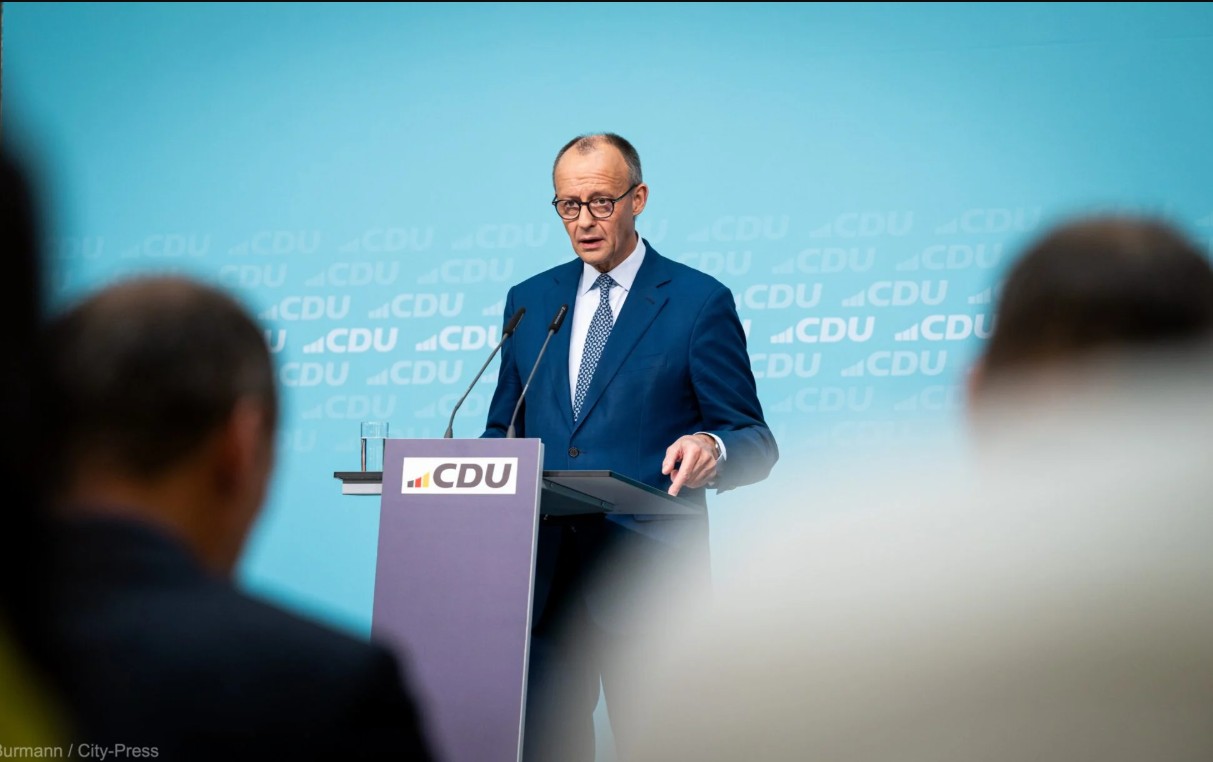
However, I was asked by TVP, the Polish national broadcaster, to come to their Warsaw studios on 8 May, the day after the WSF, for a live-on-air commentary on the recent drama in the German Bundestag (parliament) where the new Chancellor, Fredrich Merz, embarrassingly failed to get the necessary votes on the first ballot. He finally succeeded on second ballot, after intense politicking and consultations within his party, the center-right CDU, in its Bavarian sister party, the CSU, and in his coalition-partner party, the center-left SPD.
So, first; I was asked to explain this surprising electoral fiasco for the new chancellor, Merz, and his party, and how it may have weakened his new government.
Secondly, Merz immediately, after being sworn in, undertook a one-day whirlwind trip to Paris and then Warsaw, to visit his prospective main partners in the European Union, President Macron of France and Prime Minister Tusk of Poland. (Continued ….)
Above: Audio of my comments to (various) press on 22 April 25, on the impact of falling oil prices on Russia’s capacity to war on Ukraine. Also, a scenario I have discussed for over a year, first privately and then publicly, of how the USA could shut down the great majority of Russia’s seaborne oil exports, to devastating consequences for its oil sector and capacity to continue the war. In the present market situation of oversupply and anticipated continued weak demand, this could be done in a way that does not spike global oil prices.
This will only be done if Trump decides he needs to use harsh coercion to force Putin into an acceptable peace deal with Ukraine, AND if Trump were willing to impose lasting harm on the older Russian oil fields.
Xi Jinping has still not built China’s domestic market to escape its trade-war vulnerabilities from over-dependence on exports, a weakness he openly discussed back in February 2012 on his USA tour before becoming premier.
For the USA, Trump had apparently planned to have resolved the Ukraine war and in some way undermined the Russia-China alliance, inducing Russia to move closer to the USA before going after China. But, ending the war has proven far more difficult than he anticipated. His lack of success with Russia will weigh on his ability to negotiate from a position of strength with all the countries he is competing to win away from China’s geoeconomics orbit such as India, Viet Nam, Cambodia, Philippines, Thailand and etc. — the states that Treasury Secretary would say are in the “yellow zone” as opposed to the USA#s closest allies such as Japan, South Korea, Taiwan, in the so-called “green zone.” For details – see this post on my blog,
I felt greatly honored to speak in Ireland, the home of my ancestors, at a high-level Irish-Polish event, invited by the Polish embassy as part of Poland’s Presidency of the European Council. [Spoiler alert: my assessment of the Green Deal’s impact on EU energy security and competitiveness was highly critical. And, I called for a radical reform, modeled on the 1970-80’s French Messmer nuclear program, the response to a similarly dire European energy and competitiveness crisis.]
For Ireland we had Secretary General Oonagh Buckley and Wind Energy Ireland CEO Noel Cunniffee; for Poland, Daniel Piekarsky, Head of Energy Security Unit in the Foreign Ministry, and myself, Global Fellow of the Wilson Center, Washington (external) working in Europe, from Berlin.
Our moderator, from the Polish Embassy, Dublin, was the Polish diplomat and patriot, Dr. Jacek Rosa — a good friend, with whom I had the great pleasure of closely collaborating, for several years, in opposition to the Russian-German Nord Stream 2 gas-pipeline partnership, before the 2022 full-scale invasion of Ukraine. Below is the lineup, the initial invitation and some pictures. The event was off-the-record, so I show here only my own, slightly redacted talk.
Opening of Nord Stream1 pipeline, 2011. Gazprom via PAP
Below are links to 12 articles that appeared in the Polish press in the last few months, interviewing or quoting me on four topics I feel are important. The topics are listed in the title above.
The links are below, sorted by topic. The first or left column has English translations of the titles, and the second or right column has the original Polish — which unfortunately I don’t speak! If you follow the links, Google Translate or Deepl will translated the Polish articles pretty well into English. My special thanks to the intrepid Polish journalist, Artur Ciechanowicz at BiznesAlert in Warsaw for his interviews in the list. (I also had about 33 quotes or interviews in several other languages since December [1]).
ENGLISH titles and links:
On German (far-right) & USA (Trump) each plotting a Russian gas return to Germany
A former Stasi agent lobbies for the resumption of Nord Stream. Expert: One of the gas pipeline lines ready to be launched,, By,:Artur Ciechanowicz, March 3, 2025, biznesAlert.pl
Some EU countries believed that Gazprom gas would be in Europe forever BiznesAlert.pl
“Like a Drug Addict Returning to Heroin.” Analyst on the Idea of Unblocking Gas Imports from Russia to Europe, Author: Artur Ciechanowicz, February 1, 2025, 07:21
Failures of EU Green Deal on technology and energy security.
American expert: recommendation to reduce emissions by 90 percent by 2040 is “fantasy” | Energetyka24
Expert: EC recommendation to reduce gas emissions is fantasy wpolityce.pl
Unrealistic EU climate plan. Expert opinion crushes – Super Business
“Rearranging deckchairs on the sinking Titanic”. Expert slams the eco-target dictates of Brussels Eurocrats – PCH24.pl
Trump, EU & Poland: Ukraine War crisis.
First talk with Putin. Trump has visions of ending the war in Ukraine | Newsweek Jan 21
How Trump Can Bring Down the Russian Economy: Analysts: He Has an Arsenal of Means to Do It, By Artur Ciechanowicz, Jan 24, 2025 | Biznes Alert
Trump may use [oil] sanctions to finish off Moscow, which is running out of money for the National Welfare Fund. – 16 January 2026 UBN
Expert: Washington, London, Warsaw should work quickly. Kiev can’t afford to be patient – Dziennik.pl
German deindustrialization: Energy & economic crisis
Major shoe retailer goes bankrupt A sharp increase in bankruptcies in Germany
Polish titles and links:
First topic.
Agent Stasi lobbuje za wznowieniem Nord Stream. Ekspert: Jedna z nitek gazociągu gotowa do uruchomienia biznesalert.pl
Część krajów Unii uwierzyła, że gaz z Gazpromu będzie w Europie na zawsze BiznesAlert.pl
“Jak powrót narkomana do heroiny”. Analityk o pomyśle odblokowania importu gazu z Rosji do Europy | BizNes Alert
2nd Topic
Amerykański ekspert: zalecenie redukcji emisji o 90 proc. do 2040 r. to „fantastyka” | Energetyka24
Ekspert: Zalecenie KE redukcji emisji gazów to fantastyka wpolityce.pl
Nierealny plan klimatyczny UE. Opinia eksperta miażdży – Super Business
“Przestawianie leżaków na tonącym Titanicu”. Ekspert nie zostawia suchej nitki na eko-dyktaturze brukselskich eurokratów – PCH24.pl
Third topic
Donald Trump chce uchronić świat przed III wojną światową | Newsweek
Jak Trump może złamać rosyjską gospodarkę?
Trump may use [oil] sanctions to finish off Moscow, which is running out of money for the National Welfare Fund. – UBN
Ekspert: Waszyngton, Londyn, Warszawa powinny szybko działać. Kijowa nie stać na cierpliwość – Dziennik.pl
[1] Other than being cited/interviewed in Poland, I was also quoted elsewhere about 33 times so far in 2025, mainly in the USA, with many then translated to languages of Europe, Asia and Latin America. I never know what to do with all these print interviews. Here at GlobalBarrel.com, I often publish videos of some of my live-on-air expert commentary, usually accompanied by a detailed blog post. So, my idea is I will make a new tab at the top of the GlobalBarrel.com site, next to the “About Me” tab, where I can simply list link to my recent press citations or Op-Eds. [Back to text]
TRT asked me to be ready to comment, live, on the Oval Office meeting just before it blew up. I said Vance acted “infantile”. What I should have stressed, however, is that understanding Vance’s decision to blow up the meeting is key to understanding Trump’s strategy towards Russia, Ukraine, and Europe. (So, in this post the written analysis is the main thing, not the video.)
My TRT quick take, 28 Feb. See my later analysis, in the blog post.
There is plenty of facile analyses of this clash. Many say the blowup reflected “chaos” in Trump’s policy on Ukraine and Russia, or that Trump has an “impulsive” strategy, that he “dislikes Ukraine”, he’s “pro-Russian,” or that the blowup was a “prearranged ambush” to “humiliate” Zelensky, or similar.
Too few consider the possibility that the rebuke is consistent with a well-defined USA strategy. What quickly becomes clear from listening, at face value, to multiple statements by Trump himself and his team is that they have a consistent strategy. This is clearly not the first Trump administration. This second administration is different in its unity and consistency on its Ukraine, Russia, and Europe policies.
What was the purpose of the “minerals” deal that Zelensky came to sign?
The weeks-long USA-Ukrainian clash over this deal has reflected their geostrategic differences on a peace deal with Russia. After heated exchanges and compromises, clearly the Ukrainian side was not pleased with the issues it had had to give up in the minerals deal. Nevertheless, Zelensky’s Council of Ministers voted to endorse the deal, and Zelensky went to DC explicitly to sign it.
Interestingly, just before he went to the White House, President Zelensky met with a group of Republican and Democratic senators, who had “… all told him sign the deal and don’t get into an argument.” (War on the Rocks, timestamp 7:58-8:19, 06.03.25). Alas, if one watches Zelensky’s public argumentation, from the start of the press conference, and his telling Trump that a deal without a US security guarantee won’t work, all of which is in contradiction to the deal he is about to sign, it is clear that he precipitated the breakdown. In my reading of the event, he seemed to not be able to restrain himself, seemingly out of an understandable deep anguish at being about to sign an accord contrary to his better judgment.
What did each side want in the “minerals” deal, and who got what?
Everything I found to have been said by the actors on the USA and Ukrainian sides as to what each wanted in the document is quite consistent.
On the Ukrainian side, the big one was a USA security guarantee for any deal Trump makes with Putin. The Ukrainians certainly welcome the willingness of European allies to extend security guarantees for any deal, especially the public commitments made by both the UK and France to contribute troops, but they were clear that they did not think this can substitute for a USA guarantee standing behind theirs. Related to this, the Ukrainians opposed taking NATO membership for them off the table. Another was a seat at the table for Ukraine and the Europeans during negotiations with Russia (Trump wants something more like a shuttle diplomacy between the two.) Related to this, is that the USA should not negotiate a cease fire deal without them. Still another was refusing to agree beforehand to give up any Ukrainian territory that has been occupied by Russia.
Obviously the USA disagreed and de facto or openly refused all these conditions. However, the disagreement over the security guarantee seemed to be the most hot-button issue between them. Trump flatly refused. His reasoning, as explained to the press was interesting, revealing a lot about his philosophy or method for negotiating a peace deal. He said that the two sides obviously hated one another and he had to go between the two to negotiate anything. (Read Trump’s own words, in the transcript below.)
The Trump concept of economic interests and security interests
He also said that they had to trust him, saying that it just would not work if he first gave a security guarantee, taking Ukraine’s side so clearly beforehand. He also said that the ultimate security guarantee “is the easy part” and getting the deal “is the hard part.” He said the guarantees can “come later.” It became clear that, in his approach, this minerals deal was to be the signal to Putin that the USA would have long-term economic interests in Ukraine and would, of course, in Trump’s view of how the world works, defend against any threats to those economic interests.
This approach is clearly seen as highly risky by Ukraine, which has been abandoned once before under what was an explicit security guarantee, the Bucharest Memorandum, extended in return for giving up its nuclear weapons in the 1990’s. As Zelensky recounted for Trump, no signatories of the Minsk Accords extended security guarantees after Russia’s 2014 aggression, and Putin broke them constantly
The text of the final document, the one the Ukrainian ministers approved, is known; it was published in Kyiv two days before the Oval Office meeting. (The full text of the Ukraine-US Minerals Agreement, European Pravda, Kyiv, 26.02.25). So, it is easy to see that Kyiv didn’t get its main demands, although the USA did compromise, in a sense, on one of them, agreeing to an explicit mention of a “security guarantee.” However, the USA did not extend one as a quid-pro-quo for the minerals deal, rather in Section 10. the wording is:
The Government of the United States of America supports Ukraine’s efforts to obtain security guarantees needed to establish lasting peace. Participants will seek to identify any necessary steps to protect mutual investments, as defined in the Fund Agreement.
So, the USA vision of security, to “protect mutual investments,” is asserted in association..
This is in English, after Eugene Romer of Układ Sił media introduces me in Polish. This was at the “3 Seas -1 Opportunity Forum” in Gdansk, last June 4-5, 2024. I have been wanting to post it ever since, as the questions remain relevant. My thanks to Eugene and his team, and to his Opportunity Think Tank colleagues.
My panel at the forum was on problems of relying on energy security that arrives via the sea. So, think Poland and Lithuania’s LNG terminals, of the many sub-sea pipelines, power and communications cables between Baltic and Nordic states. And, since June, all the incidents where ships leaving Russian ports “accidentally” dragged their anchors, cutting such vital links. So, this conference was rather prescient. My sincere thanks to our hosts The Opportunity Institute for Foreign Affairs.
I explain EU/German motives for seeking “green H2” import pipes, then (at time 11:30) questions I raised moderating at NAPEC re. EU-Algerian pipeline MOU.
Here’s my video from Oran, Algeria, after a very informative “Africa and Mediterranean Energy & Hydrogen Exhibition & Conference,” NAPEC 2024 (video highlights here). Two parts to my analysis:
First, (up to time 11:30) I explain the rationale and impetus for the EU drive for massive green hydrogen gas imports. This is primarily driven by Germany’s increasing desperation at being locked into over-reliance on weather-variable renewables, whose high prices are sparking its “deindustrialization,” especially after losing Russian gas pipeline imports due to Putin’s war on Ukraine, plus due to the own-goal shutting down of their zero-carbon, amortized (paid for) nuclear plants during the European energy crisis. (Note: I misspoke: “Grey” hydrogen would NOT have the CO2 stored, “Blue” would. Both are derived from natural gas.)
I also explain how this massive green hydrogen “fix” to “renewables fundamentalist” policy is a techno-panacea that simply cannot work. Then ..
Recorded Thurs AM, 03Oct24. Warsaw Old Town, Castle Square.
Will Israel hit Iranian oil infrastructure? And, what part of it? To what effect on markets, and geopolitics, (i.e., Mideast, OPEC, Russia and Ukraine war)? A video report.
MAIN POINTS (see transcript):
1. What if Israel hits Iran oil infrastructure in retaliation for missile strikes on Tel Aviv on Tuesday night? 1.a. The difference effects of hitting Iranian refineries vs oil export terminals In itself, neither target would make big difference in the market. The market would immediately jump, of course, but in principle the effect would be small. 1b OPEC+ and Western Hemisphere have plenty of spare capacity.
2. Consider Saudi market tactics … reportedly they want to now go for share over price support, as price support is failing after well over a year of output cuts (about 6 mb/d). Note: Shortly after this recording the Saudis repudiated the WSJ that reported the switch in tactics to defending share. Likely they’ll now want to wait and see what happens to Iranian exports, or if this Israel-Iran tit-for-tat gets out of hand.
My assessment of how threats posed to the 3-Seas-Region Member States executing a pragmatic energy transition incorporating nuclear energy emanate both from the role of Russia’s Rosneft, and equally from the activities of seven anti-nuclear Member States led by Germany, and
Detailed research on Russia’s nuclear energy dangers contributed by colleagues in Poland and Ukraine. Their research includes:
Appendix A: Some facts and policy recommendations on Rosatom activities, based on research by Warsaw colleagues at The Polish Economic Institute (PEI), Dr. Adam Juszczak, and Mr. Kamil Lipiński (p. 6);
Appendix B. Rosatom may be assisting in circumventing sanctions., from research by colleagues at DiXiE Group, Kyiv, Ukraine, especially Mr. Roman Nitsovych, and Ms. Olena Pavlenko (p. 7);
Appendix C. Why sanction Rosatom: Link between “peaceful” Rosatom energy & Russian nuclear weapons, based on research by CGS Strategy XXI , Kyiv, Ukraine, in particular Mykhailo M. Gonchar, Founder and President, and Chief Editor of the Black Sea Security Journal (p. 11.)
I highly recommend their three Appendices.
I should note that what I wrote in the main body was likely unexpected. I wrote that, for accomplishing a pragmatic, nuclear-power-inclusive energy transition in the 3-Seas Region (i.e., the EU’s Central and Eastern Europe, Baltic, and Balkan Member States), the continued dependencies on Russia’s Rosatom are not the only threats. The threat from the Group of Seven anti-nuclear states, led by Germany, is clearly equally or more disruptive to the Region accomplishing a pragmatic energy security-and-transition policy. I’ll quote a bit of the report on this point:
In an Easter Sunday interview in 20+ Polish papers [POLISH & ENGLISH below], I said White House reasons for Ukraine not to hit Russian refineries don’t make sense. The “elephant in the room” alarming DC is that Ukraine can now disrupt Primorsk, UST-Luga and Novorossiskya oil ports, needed for 60% of Russian exports.
This would not only deny Moscow vital oil revenues needed to wage war, it would also spark a spectacular global oil market shock. I explain that the USA and allies can urgently prepare for this, while the Ukrainians are still maintaining strategic patience.
Berlin Energy Roudtable. L to R: Ben Aris, Tom O’Donnell, Morten Frisch & Andriy Kobolyev (video link from Kyiv) 24 October 2023, Haus der Bunderpresskonferenz – PHOTO GALLERY BELOW(Divan staff)
On 24 October, I was honored to moderate a great roundtable in Berlin with three European energy experts, sponsored by Der Divan Kulturehaus. SUGGESTION: While listening, open up that speaker’s file below. You’ll find Ben Aris’ data-slides on Russian price-cap failings, Andriy Kobolyev’s proposal to tax Moscow’s oil & Morten Frisch’s slides on EU renewable shortcomings & continued oil and gas needs.
Al Jazeera asked for an online commentary within an hour of Putin’s announcement. These were my initial thoughts.
I also spoke to AJ Arabic, and a couple hours later, on Germany’s Deutsche Welle’s English language service elaborated on these points (see video, next blog post).
The question is where will the EU-USA-g7 western alliance go from here. If they stepwise lower the cap, and also work hard to get new oil online (from OPEC and the USA), they can gradually keep lowering Russia’s market share. However, as I indicated, the coming recession – esp. in Europe – and the uncertainties of Chinese demand as it exits COVID shutdowns in early 2023, complicate calculations of whether the globala oil market will be short or long on supplies and if the price will spike or not. I said this will be “a chess game.”