Credit: Vėjo jėgainė | J. Stacevičiaus / LRT nuotr.
My gratitude to LRT.lt journalist Vaida Kalinkaitė-Matuliauskienė for this in-depth print interview. We spoke just after Baltic states had disconnected from the Russian-Belarus electrical grid, BRELL, and had connected with the European grid. This was a complex and costly project, executed rapidly and flawlessly. [My comment continue below, after the English (first link) and Lithuanian (second link) versions:]
The Baltic states’ impetus was obvious: a deep mistrust of Russia after its 2022 cutoff of half of all European gas imports intended to pressure EU states to abandon solidarity with Ukraine as Russia invaded it. So, switching to the European grid is a great relief. However, the dangers haven’t ended.
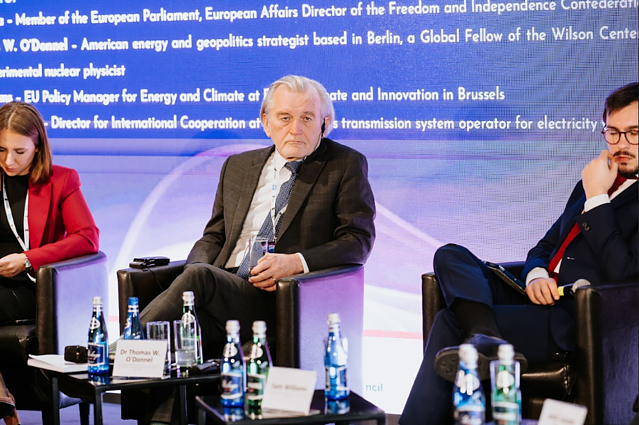
I felt greatly honored to speak in Ireland, the home of my ancestors, at a high-level Irish-Polish event, invited by the Polish embassy as part of Poland’s Presidency of the European Council. [Spoiler alert: my assessment of the Green Deal’s impact on EU energy security and competitiveness was highly critical. And, I called for a radical reform, modeled on the 1970-80’s French Messmer nuclear program, the response to a similarly dire European energy and competitiveness crisis.]
For Ireland we had Secretary General Oonagh Buckley and Wind Energy Ireland CEO Noel Cunniffee; for Poland, Daniel Piekarsky, Head of Energy Security Unit in the Foreign Ministry, and myself, Global Fellow of the Wilson Center, Washington (external) working in Europe, from Berlin.
Our moderator, from the Polish Embassy, Dublin, was the Polish diplomat and patriot, Dr. Jacek Rosa — a good friend, with whom I had the great pleasure of closely collaborating, for several years, in opposition to the Russian-German Nord Stream 2 gas-pipeline partnership, before the 2022 full-scale invasion of Ukraine. Below is the lineup, the initial invitation and some pictures. The event was off-the-record, so I show here only my own, slightly redacted talk.
My long print interview at Lithuania’s LRT [Lithuanian PDF | English PDF] with Aleksandra Ketlerienė, deputy editor-in-chief of Lithuania’s LRT.lt, published 7January. We spoke in Warsaw, 19 November. My thanks to Aleksandra for her insightful questioning and editorial care. We discussed:
The EU’s systemic energy-policy “own goals” since its initial energy-crisis win after Moscow began cutting gas exports early in 2021.
Reforming failed/ineffective Russian price-cap sanctions for real sanctions, and how the global oil market is now favorable for “maximum pressure.”
Historical perspectives on oil, gas, renewables, and nuclear sectors, essential for realistic policy formation.
An historical overview of China’s decades-long effort to overcome its energy security, learning lessons of Japan’s WW2 weaknesses.
I appeared alongside Dr. Hashem Aqel, Oil and Energy Expert, Associate Fellow at Oxford Institute for Energy Studies, who contributed several insights. Asharq News is the Mideast Bloomberg partner. My further analysis follows:
Arabic, original broadcast version.
The recent rise in EU gas prices and the rapid depletion of what had been a significant surplus in EU storage, is principally a two-sided story.
One side is indeed about the impending cutoff of Russian gas, still flowing across Ukraine. This has been expected for months, and so is already largely priced in. Expectations of new transit across Ukraine of Russian-origin gas re-labelled as Azerbaijani was being negotiated. However, this deal fell apart, with the final nail in its coffin being when Ukraine’s President Zelensky asserted that Ukraine would not transit any further Russian-origin gas after 31 December unless payments to Russia are withheld until after the war ends. This seems a very reasonable demand for a country fighting for its survival against a Russian invasion. [See “Ukraine will not allow transit of Russian gas with Azeri label, Zelenskyy says, dashing Slovak hopes,” EuroNews, Jorge Liboreir 19 Dec. 2024.] This marks the end of the five-year contract, which was only agreed to at the last moment before New Year 2020, when the US Senate finally forced then-President Trump to agree to sanctions on Nord Stream 2 construction (I was in Kyiv, for Naftogaz, and on Ukrainian television, analyzing Washington sanctions, Kyiv-Moscow negotiations, and the pro-Nord Stream position of Berlin.)
The other side is a story of yet another European energy own-goal, a consequence of its over-reliance on weather-dependent renewable energy generation. This overreliance has made its electricity supply increasingly volatile, in sync with the weather. In November and early December, especially north and western Europe experienced what the Germans call “Dunkelflaute“, a protracted wind and solar drought. Batteries can only substitute for perhaps 40 minutes, or at best an hour. So, the de facto long-term, grid-scale “storage” backing up Europe’s plethora of wind and sun generation is really just natural-gas turbine electrical generation plants. The reality of increased generation (and hence, electricity market) volatility and dependence on gas backup generation was analyzed this week in a data-driven manner by the Oxford Institute for Energy Studies. [See: “Dunkelflaute: Driving Europe Gas Demand Volatility” Energy Insight: 161, by Anouk Honoré and Jack Sharples, Senior Research Fellows, OIES, 2024/12.]
This is a continuation of my remarks in Warsaw, on 18 November.Part 1, which posted on 19 December, reviewed failures to develop critical tech elements required by the EU Green Deal, a program modeled on the German Energiewende. I argued that, after decades of R&D efforts, these technology failures indicate the systemic failure of heavily renewable models, pointing to a need for “radical reform” of the Green Deal. I advocated for the historically proven Messmer model, which succeeded, some 40 years ago, in decarbonizing French electrical generation using nuclear power, without any need for new grids or long-term grid-scale storage tech.
Below, Part 2 (edited for clarity) focuses on the political intransigence of the new Von der Leyen commission, which is doubling down on the Green Deal’s renewable model. I argue this is not “reindustrializing” Europe or making it “more competitive” as claimed, but rather driving it into deindustrialization. This mirrors the process underway in Germany via its continuing push for new “green tech,” on the theory this should spark a broad new European industrial competitiveness. From an historical perspective, this is theoretical and practical nonsense – or so I argue. Critiques are welcomed. (PS, Happy holidays!)
Leon (moderator): So, I’m going to turn to Thomas again. You argued that that some form of radical overhaul is necessary, you know, with regards to the EU Green Deal, if I understand it correctly, and you’ve cited one of the issues is the complexity of the fact that there are certain technologies that haven’t emerged over the last 30 years that have just been growing incrementally rather than rapidly to meet our needs. But at the same time there’s seems to be some sort of political rationale for why this sort of revolutionary approach. How would you respond to that?
Tom: Yes, politically, I do think the new Commission presents a big problem for European competitiveness, for energy policy and security.
The new commission is anti-energy-policy reform
Firstly this is because Ms. Teresa Ribera, from Spain, is President Von der Leyen’s new chief executive vice-president. She is in charge of attaining both the Green Deal and has also been given responsibility for “industrialization of Europe,” for making it competitive again.
The problem is, Ms. Ribera is a true believer in all-renewable energy systems, I would say a career-long renewable fundamentalist.
For example, she’s said to be so good at negotiating that she managed to get the Spanish nuclear industry and civil society to agree on a timetable to close all the Spanish nuclear power plants, and she’s very proud of this. This is politically and ideologically identical to what Mr. Robert Habeck, the German Green Party leader, who is energy and economics minister, carried out with the approval of Chancellor Scholz of the SPD-party. Habeck closed Germany’s last three nuclear power plants during a wartime, Russian-instigated, European energy crisis.
The fact that Von der Leyen fought hard to appoint Ribera and then put her in charge of the Green Deal and of European industrialization, and made her the most powerful commissioner, the executive vice president of the commission, shows that Von der Leyen, a member of the German conservatives, the CDU, has no interest in reform of the renewables model despite its suffering technological failures on several key aspects.
The problem is not that Europe has not had an industrial policy. Europe has had an industrial policy, one that has failed
ENGLISH Interview | Al Watan, Cairo. Thurs 10Oct24. 15 minutes
ARABIC Interview
At first, we focused on IEA warnings of a possible EU winder gas shortage due to supply-and-demand mismatches. I agree and expand on the IEA points.
Second, I explained that if Israel retaliates against Iran so strongly that it threatens the regimes survival, or is seen as intending to provoke regime change, then the Iranian leadership will have “nothing to lose” by in-turn escalating to the maximum. Aside from unleashing the maximum response of its proxies surrounding Israel, Tehran’s most potent weapon would be to spark a global oil and gas crisis.
Consider oil: Iran can either shut down the Straights of Hormuz (or simply make them unsafe for tankers) and/or, it can use missiles and drones to destroy significant parts of Saudi, UAE and other Gulf oil facilities, including perhaps even Azerbaijan’s as some Iranian propagandists have threatened.
Consider natural gas: Shutting the Straights or directly hitting Qatar’s massive LNG exports infrastructure would immediately stop Qatari LNG exports. As the world’s second largest LNG exporter, this would immediately cause a separate global natural gas crisis.
Below, I am quoted repeatedly (marked in bold -TO’D), by Newsweek’s intrepid Brendan Cole, reporting from London on Russia and Ukraine. I was on the Berlin-Warsaw express, heading to the Warsaw Security Forum. At the end are links to several other-language versions. Read on …
Putin’s Arctic Project Suffers Blow From Top Trade Ally
India has refused to buy liquefied natural gas (LNG) from Vladimir Putin‘s flagship Arctic energy project delivering a “major blow” to Moscow’s fuel exports, an energy analyst has told Newsweek.
India’s oil secretary, Pankaj Jain, has said that New Delhi is “not touching” any commodity from the Arctic LNG 2 project due to sanctions that followed Putin’s full-scale invasion of Ukraine aimed at stifling Russian energy revenues, which the United States stepped up this month.
Putin had high hopes for the seaborne resource after losing the lucrative European market for pipeline gas due to sanctions and the president’s move to weaponize the fuel, which only spurred countries to find other suppliers.
Following huge losses, Gazprom cut its fuel production while a proposed Power of Siberia 2 pipeline to transport increasingly stranded Russian gas resources to China remains delayed amid haggling over price.
However, attempts by state firm Novatek to get Russia’s gas to market through the Arctic LNG 2 project have so far failed after Jain said last Friday, “We are not buying any sanctioned commodity.”
Newsweek reached out to Novatek for comment.
Berlin-based energy analyst Tom O’Donnell said Russia’s switch to boosting LNG exports has been fraught with difficulties due to sanctions.
“They have had to considerably cut back because they can’t get either the equipment to build it or the ships to transport it,” he told Newsweek.
“LNG from the new Arctic LNG 2 project was very important for Putin to be able to ship it to India and to China,” he said. “With India dropping out, this will be a major blow.”
Russia plans to triple its LNG exports by 2030 to 100 million tons. The country is expected to play a key role in India’s energy strategy, which has built terminals to receive the fuel.
Al Qahera, news TV in Cairo, asked me questions on Germany’s VW crisis. VW announced yesterday it will close at least two facilities and move to break the long-term agreement with its workers’ union for no layoffs till 2029. This is serious in that 1) VW, since its founding in 1937, has never shut any plants, and 2) it’s not just VW. and it’s not just the German auto sector.
I told Al Qahera that the same story can be told about Germany’s steel industry (i.e., Thyssen-Krupp), or its chemical industry (i.e., BASF).
German energy intensive industries are facing not merely the creeping uncompetitiveness long decried in the country, but outright deindustrialization.
I described to Al Qahera how this decline of German industry reminds me of USA deindustrialization (the “rust belt” collapse) during my years working in the USA auto industry in the mid-1970’s to early 1980’s (both at Chrysler and Ford, in Detroit) and USA Railways (I worked on the Michigan Central when it was consolidated with other railways, by the federal government, to form Conrail). I remarked how it took the USA some 15 or more years to restructure and again become a modern, digitalized manufacturer. There is no guarantee Germany could pull this restructuring off, and there was no guarantee the USA would either, but that was a special case of a mammoth economy,
NOTE: Last call to Sign Up Here for our 2ndBerlin Energy Forum, on “Germany’s Quest for Green Hydrogen: from Ukraine to Mauritania & back,”4:00 – 5:30 PM (CET), Berlin Capital Club, followed by networking and drinks. The Capital Club is atop the Hilton Hotel, adjacent to Gendarme Market in Berlin’s Mitte district. Looks like we’ll have a full house again. There is also a delayed-video sign-up option. -o-o-o-o-o- Speakers: I’ll be joined by Dr. Dawud Ansari of SWP think tank where he leads H2 research, and Ms. Olena Pavlenko, President Kyiv’s Dixie Group via video link. Moderation: Ben Aris, Editor-in-chief & founder of bneIntelliNews, & our forum co-organizer.
German Green Hydrogen Import Strategy is Unworkable & Ignores Mauritania’s needs
Referring to the green hydrogen MOU signed with Mauritania in 2023, Conjuncta CEO Stefan Liebing said, “(This project) will have a strong link to Germany both as a technology provider and a potential offtaker of green energy.” (“Consortium signs $34 billion MoU for hydrogen project in Mauritania,” Reuters, 8 Mar 23.)
German public broadcaster Deutsche Welle seemed quite impressed: “It has a planned capacity of 10 gigawatts – the output of roughly five to six standard nuclear power plants. The first phase of the project is set to be completed by 2028” (“Mauritania set to export green hydrogen to Germany,” DW Business, 09Mar23 archived at YouTube.)
Indeed, the MOU aims for “10 gigawatts” of electrolyzers outputting “8 million tonnes/year” (Mt/y) of green hydrogen (H2) and other products, such as ammonia. However, according to the press announcement, in 2028 the facility will have a 400 MW capacity, or one-twenty-fifth of 10 gigawatts envisioned .
The German coalition government faces a formidable energy dilemma.
On one hand, it must urgently develop enough natural gas generation capacity at a reasonable cost to halt deindustrialization, and shut coal plants it brought back online when it closed the last nuclear plants To this end, Minister Habeck (Greens) urgently won approval for installation of 25 GW capacity of new natural gas turbine generation by 2030. In addition, this new natural gas capacity is needed to back up Germany’s growing, renewable-electricity dependence, as it simply has no feasible grid storage tech to offset its weather-variability.
So too, in response to Russia cutting off gas deliveries to Germany, as part of its full scale invasion of Ukraine, Germany urgently moved to install up to seven offshore LNG floating regasification ships (FRSOs). These aimed for a new natural gas import capacity of 25 bcm/year as LNG in 2023,
In January 2024, the Bundesnetzagentur (BNetzA) reported that, “According to preliminary figures, the total volume of natural gas imported into Germany in 2023 was 968 T”Wh (2022: 1,437 TWh).” of which 7% or almost 70 TWh was LNG. The reduction from 2022 largely reflects the fall in industrial production it is now suffering.
On the other hand, Germany urgently seeks enough future “green energy” import projects to eventually replace all this natural gas if it is to meet its decarbonization targets. The government published its “National Hydrogen Strategy” in summer 2023. (Also, “Gremany’s National Hydrogen Strategy,” Factsheet, 26 Jul 2023, by Sören Amelang and Julian Wettengela, Clean Energy Wire, is very useful.)
The (IMHO) dogmatic insistence on refusing to re-open several still-operable nuclear plants and to develop new German nuclear capacity means that the only low-carbon way the government coalition and many other political and business actors can imagine to replace all this natural gas is with green hydrogen produced from renewables in distant African, Mideast, Latin American and other states, or from developing new renewable-generated electricity it can import from nearby European countries.
This self-induced straitjacketing of the German energy system is, as I have described it, a sort of “renewable fundamentalism” — a maximalist insistence to fuel everything with 100% renewables and absolutely no nuclear.
How much of Germany’s new LNG-supplied energy could the Mauritania project replace in 2028?
My assessment of how threats posed to the 3-Seas-Region Member States executing a pragmatic energy transition incorporating nuclear energy emanate both from the role of Russia’s Rosneft, and equally from the activities of seven anti-nuclear Member States led by Germany, and
Detailed research on Russia’s nuclear energy dangers contributed by colleagues in Poland and Ukraine. Their research includes:
Appendix A: Some facts and policy recommendations on Rosatom activities, based on research by Warsaw colleagues at The Polish Economic Institute (PEI), Dr. Adam Juszczak, and Mr. Kamil Lipiński (p. 6);
Appendix B. Rosatom may be assisting in circumventing sanctions., from research by colleagues at DiXiE Group, Kyiv, Ukraine, especially Mr. Roman Nitsovych, and Ms. Olena Pavlenko (p. 7);
Appendix C. Why sanction Rosatom: Link between “peaceful” Rosatom energy & Russian nuclear weapons, based on research by CGS Strategy XXI , Kyiv, Ukraine, in particular Mykhailo M. Gonchar, Founder and President, and Chief Editor of the Black Sea Security Journal (p. 11.)
I highly recommend their three Appendices.
I should note that what I wrote in the main body was likely unexpected. I wrote that, for accomplishing a pragmatic, nuclear-power-inclusive energy transition in the 3-Seas Region (i.e., the EU’s Central and Eastern Europe, Baltic, and Balkan Member States), the continued dependencies on Russia’s Rosatom are not the only threats. The threat from the Group of Seven anti-nuclear states, led by Germany, is clearly equally or more disruptive to the Region accomplishing a pragmatic energy security-and-transition policy. I’ll quote a bit of the report on this point:
First, a personal note: As some of you know, this is an idea I’ve been floating in Berlin since well before Corona. Then, last October, I had an experimental test run, a one-off, sponsored by the Qatari embassy’s Divan – and it went very well.
However, the biggest success from that event was that Ben Aris, co-founder and editor-in-chief of bne IntelliNews enthusiastically joined me to found the Berlin Energy Forum as a regular monthly sort of membership club. Amongst the longest serving foreign correspondents in Eastern Europe, Ben has been covering Russia since 1993, with stints in the Baltics and Central Asia. He is a former Moscow bureau chief for the Daily Telegraph and was a contributing editor at The Banker and Euromoney for a decade amongst writing for many other publications. He is also a professional photographer, and nowadays based in Berlin.
Ben is one of those rare people who relishes doing analysis and data-driven writing (non-stop!), AND who knows how to do business – and thoroughly enjoys doing it. Just the partner for this endeavor.
My model and inspiration for this forum was always the New York Energy Forum, which has run for over 40 years now. I happily attended while teaching in NYC. My experience with that forum, plus familiarity with a few top DC think tanks, and various foreign diplomats (esp. in NYC/UN), is how, as an academic, I got to know a broad spectrum of USA oil and gas executives, journalists, financial-institution analysts and government officials. Those personal connections have, over the years, anchored my assessments of USA, of OPEC MENA-and-Latin American members’, and of Russian and Chinese strategy. This sort of community doesn’t exist in Europe in such a focused manner, save perhaps in London. Perhaps we can now bring a bit of that world to Berlin with our new BEF.
In an Easter Sunday interview in 20+ Polish papers [POLISH & ENGLISH below], I said White House reasons for Ukraine not to hit Russian refineries don’t make sense. The “elephant in the room” alarming DC is that Ukraine can now disrupt Primorsk, UST-Luga and Novorossiskya oil ports, needed for 60% of Russian exports.
This would not only deny Moscow vital oil revenues needed to wage war, it would also spark a spectacular global oil market shock. I explain that the USA and allies can urgently prepare for this, while the Ukrainians are still maintaining strategic patience.
“O’Donnell told Newsweek that that if Ukrainians really wanted to hit oil exports, they would go after Novorossiysk Fuel Oil Terminal in the [eastern] Black Sea and Primorsk Oil Terminal at the end of the Baltic Pipeline System.
“‘These are the two major exports sites for Russian oil and they are demonstrated to be within range of aerial drones and perhaps, in the case the Black Sea, their seaborne drones,’ he said. ‘If they really want to cut Russia’s oil income, they would go after those ports and they haven’t—that might be in deference to Americans concerns.’“ (Russia Faces Major Gas Headache After Ukraine Strikes, Newsweek, article by Brendan Cole, Mar 25, 2024.)
Last week, Newsweek (USA) twice cited my analysis of Ukrainian drone strikes. In one instance, I had the honor of following an interview with General Ben Hodges, former Commander of US Army, Europe, with whom I concur in regretting the USA opposition.
(Aside: I hope to have an Op-Ed, perhaps tomorrow, in Europe, assessing that (i) the USA’s stated reasons versus Ukraine’s drone strikes to date do not make sense, and (ii) the “elephant in the room,” which must really have alarmed the White House, is that Ukraine’s strikes on refineries ipso facto demonstrate they COULD, if they so chose, disrupt anywhere up to 60% of Russian oil exports. Lastly,(iii) if the USA, EU and allies do not rapidly prepare non-Russian oil-sector producers for this eventuality, a global oil price shock could result.)
Here are the links to last week’s two new interviews/citations by Newsweek:
According to energy and geopolitics expert Tom O’Donnell, Ukrainian allies’ oil price cap, in conjunction with Ukrainian drones’ physical damage could be a significant hit to Russian revenues.
Tom O’Donnell, PhD, an expert on energy and geopolitics, sat down with Kyiv Post to explain what Ukraine’s attacks on Russia’s energy sector will mean for the larger Russian energy sector.
It sounds like a huge number. But how much do you think losing 12 percent of production, in a day, will affect Russia?
First off, although these refineries hit by Ukrainian drones yesterday represent about 12 percent of Russian production, experience shows that they might not each be totally impaired from production. Nevertheless, there are two particularly significant implications for Russia.
First, whatever percentage of Russian refined oil products this impairs, the damage will both deprive the war economy of needed export revenues and/or of much-needed fuels to keep the domestic war economy running.
Already, Russia had announced it will ban the export of gasoline from March 1 in order to tame prices for consumers in the runup to the presidential elections mid-month. In 2023 about 17 percent of Russian gasoline was exported.
What is the origin of the current price pressure?
The present price pressure is both a result of the demands of the war economy as well as previously successful Ukrainian hits on other refineries that began in January.
This gets to my second point – the successful refinery strikes of yesterday, involving a reported launch of 58 drones, as well as recent hits on a Russian domestic gas transmission pipeline, all demonstrate that the January successes were not one-off special operations, but rather the beginning of what will be a sustained Ukraine armed forces campaign capable of, over time, significantly disrupting Russia’s all-important oil and gas import revenues and internal refined-product supplies.
Kyiv has launched some of its largest air attacks on Russia this week ahead of the vote, which is set to hand President Vladimir Putin another six-year term in the Kremlin.
If Russia continues to lose refineries, which appears likely, what new complications will it create for Russia?
First, from a strategic point of view, it is important to see these physical strikes against Russian oil and gas infrastructure in conjunction with the sanctions efforts of the USA, EU and other allies aimed at reducing Russian oil profits. These drone strikes should be seen as a “force multiplier” to allied oil sanctions.
How so?
Consider that, with Russia no longer having the Druzba oil pipeline flowing into Central Europe due to EU sanctions, this has forced it to shift its Urals-region oil exports to seaports on the Baltic coast of Russia and to a new western-Arctic port. Hence, hitting any refining or export facilities inside Russia along this general Urals-oil export corridor has a significant effect on Russia sustaining export revenues. This oil mainly flows to Turkey, India and China, with Russian oil tankers representing the main users of the Suez and then the Red Sea. Due to sanctions, most of these ships are now either directly or indirectly Russian-controlled, to avoid the sanctions oil-price cap.
There has been a discussion in US-EU security-and-sanctions circles that these ships could be stopped for inspection by Sweden and/or Denmark in the Baltic, in the straights between their countries, and many might be refused passage due to having sketchy insurance and/or being unsafe, old vessels.
Advertisement
What do you think of the oil price cap? Is it a good idea?
From the point of view of strategic impact, the allies’ choice of an oil-price cap has been, in my view, a weak and overly complex-to-enforce instrument. However, in conjunction with Ukrainian drones’ physical damage, the overall hit to Russian revenues might become significant.
Secondly, Ukraine has also hit refineries in Russia just east of its own territory, which will mainly undermine the region’s war economy and complicate supplying the massive demand from Russia’s invasion forces. This region already has chronic fuel-supply problems, with farmers last year protesting against a lack of diesel for harvests, causing Russia to ban diesel exports during that season.
Dr. Tom O’Donnell is Berlin-based and is a Global Fellow of the Wilson Center.
Jason Jay Smart, Ph.D., is a political adviser who has lived and worked in Ukraine, Moldova, Kyrgyzstan, Kazakhstan, Russia, and Latin America. Due to his work with the democratic opposition to Pres. Vladimir Putin, Smart was persona non grata, for life, by Russia in 2010. His websites can be found at http://www.JasonJaySmart.com / http://www.AmericanPoliticalServices.com / fb.com/jasonjaysmart / Twitter: @OfficeJJSmart
Related references for assertions I made in my interview – Tom O’D.
Berlin Energy Roudtable. L to R: Ben Aris, Tom O’Donnell, Morten Frisch & Andriy Kobolyev (video link from Kyiv) 24 October 2023, Haus der Bunderpresskonferenz – PHOTO GALLERY BELOW(Divan staff)
On 24 October, I was honored to moderate a great roundtable in Berlin with three European energy experts, sponsored by Der Divan Kulturehaus. SUGGESTION: While listening, open up that speaker’s file below. You’ll find Ben Aris’ data-slides on Russian price-cap failings, Andriy Kobolyev’s proposal to tax Moscow’s oil & Morten Frisch’s slides on EU renewable shortcomings & continued oil and gas needs.


 If you had stayed in BRELL, it would have been much easier for Russia



 The Global Barrel