I was a bit insistent that the spike during the day today, to over $100 at some point, was overblown.
As I mentioned, Fatih Birol at IEA (I forgot to mention also Chris Wright, USA Secretary of Energy),who had said the same thing, insisting last Friday that there is plenty of oil in the market. (See Wright and Bloomberg’s Steven Stapczynski elaborate here). That is NOT a problem now.
And, in the interview, I detailed some facts about this (e.g., before the war started nine days ago, there were about 1.4 billion(!) barrels floating on the water, an unprecedented amount, and the Russians had nowhere to put their unsellable oil).
So, It turns out that late Monday evening news (EST USA time), the news coming from the USA vindicates my suspicions. For now, there is no plan by the administration to release SPR reserves into the market.
Notice what I explained about this likely being a short-lived boost for Russian oil That is, after the Venezuelan campaign, if the Trump admin. Iran campaign works, both China and Russia will be in a very restricted position in the now-USA tightly controlled international oil market supply chain.
Here is the WSJ saying the prices of oil dropped quite a bit, and the stock market rebounded as well by the end of the day. Following that is a Bloomberg take too.
This is a longish, ca. 30 minute video. Host Nataly Lutsenko kindly told me she wanted to make a long interview.
(During time of crisis like this, I have so many TV and press interviews that I don’t have time to put most of them online. So, I will refrain from writing long posts to accompany videos to get more online, if I think they are useful interviews. – Tom O’D)
I discussed with Artur Ciechanowicz (BizNesAlert.pl) how Chancellor Merz and Energy Minister Reiche refuse the one reform that can really boost German energy security: focusing on nuclear energy as France has, and Poland has begun to do. (Read below in English or in Polish) — Twice last week, Merz indicated willingness to work with Russia when the Ukraine war ends. For two decades before the war, working with Russia meant more Russian gas imports, building Nord Stream 1 & 2. Now Merz worries about dependence on USA LNG. However, the German model he continues, one of installing BOTH a full-scale, wildly complex renewables system, plus a full-scale natural-gas backup system, guarantees high-cost energy, deindustrialization and foreign energy dependence.(Polish at BizNesAlert.pl)
Amerykański ekspert: Niemcy znów myślą o gazie z Rosji
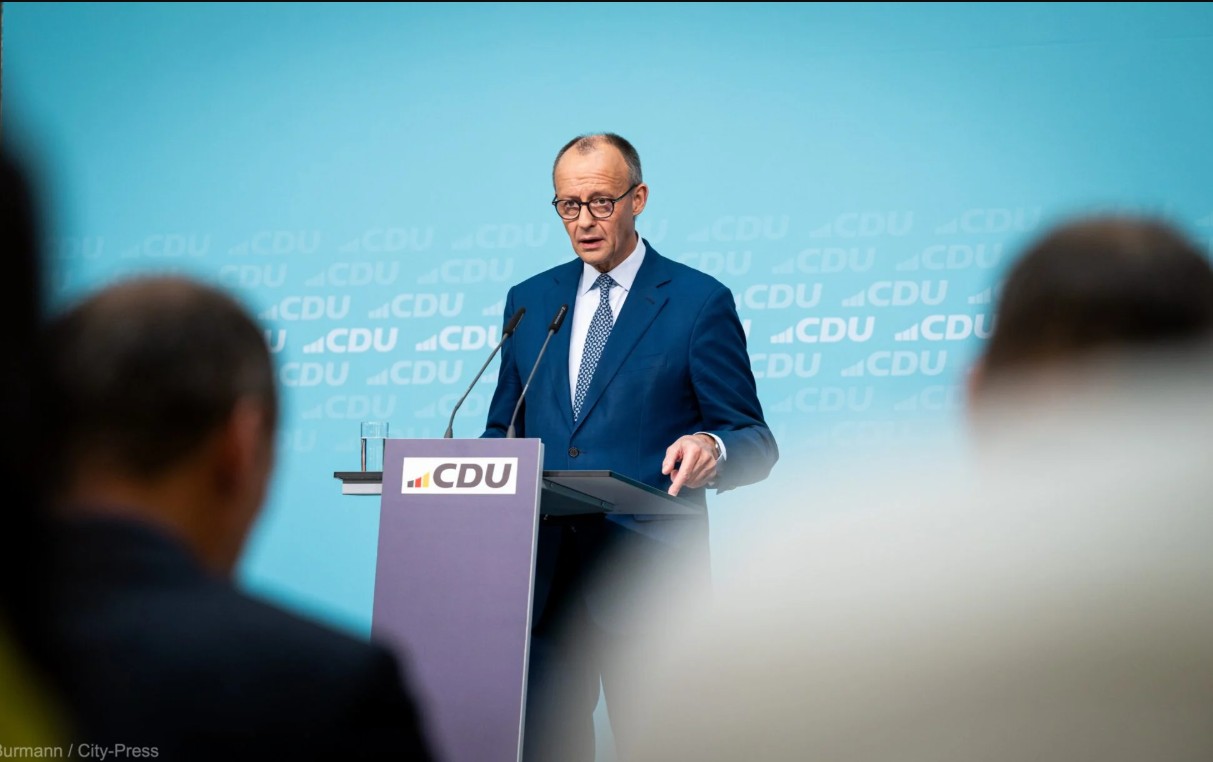
Wcześniej czy później Niemcy ponownie będą racjonalizować podporządkowanie się Gazpromowi Putina w imię +dywersyfikacji+ dostaw – ocenia Thomas O’Donnell, ekspert ds. energii i geopolityki z amerykańskiego think-tanku Wilson Center. Na zdjęciu kanclerz Niemiec Friedrich Merz.FOTO: x.com/_FriedrichMerz
Berlin zaczyna zmieniać kurs wobec Rosji i znów będzie racjonalizować współpracę z Putinem w imię „dywersyfikacji” dostaw gazu. Stanie się tak, bo Niemcy nadal opierają swoją strategię energetyczną na OZE wspierane gazem, zamiast postawić na atom jako priorytet – ocenia w rozmowie z Biznes Alert amerykański ekspert Thomas O’Donnell.
Wypowiedzi kanclerza Niemiec Friedricha Merza o potrzebie „pojednania” z Rosją, wygłoszone dwukrotnie nie da się traktować, jako wyrwanych z kontekstu i przypadkowych. To sygnał polityczny. Najbogatsze państwo Europy i przemysłowy motor Unii Europejskiej zaczyna rewidować swoją linię wobec Moskwy.
Merz z ufnością o Rosji
– Jeśli uda nam się przywrócić pokój i wolność w Europie, jeśli ponownie odnajdziemy równowagę w relacjach z naszym największym europejskim sąsiadem, czyli z Rosją, jeśli zapanuje pokój i zostanie zapewniona wolność – jeśli to wszystko nam się powiedzie, wtedy Unia Europejska, a wraz z nią my w Niemczech, przejdziemy kolejny test i będziemy mogli z ufnością patrzeć w przyszłość także po 2026 roku – powiedział szef niemieckiego rządu na spotkaniu noworocznym z przedstawicielami przemysłu i handlu 14 stycznia w Halle, dodając potem: „(…) jeśli w dłuższej perspektywie uda nam się na nowo przywrócić równowagę w relacjach z Rosją, gdy zapanuje pokój i gdy wolność będzie zagwarantowana”.
Niemiecki przemysł od 2023 roku zmaga się z wysokimi cenami energii, spadkiem konkurencyjności, rosnącą presją chińskich producentów oraz stagnacją wzrostu gospodarczego. W 2024 roku niemiecka gospodarka formalnie weszła w recesję techniczną, a prognozy wzrostu na 2025 rok były jednymi z najsłabszych w UE.
Wypowiedzi Merza nie oznaczają natychmiastowego zwrotu w polityce wobec Moskwy ani propozycji zniesienia sankcji. Nie są ofertą pokoju ani jednostronnym gestem. Wskazują jednak na rosnące przekonanie w niemieckich elitach politycznych i gospodarczych, że obecny stan konfrontacji – bez realistycznej strategii wyjścia – osiągnął dla nich próg bólu.
„Powrót do „mafijnego bossa od gazu”
Thomas O’Donnell, ekspert ds. energii i geopolityki z amerykańskiego think-tanku Wilson Center wyjaśnia w rozmowie z Biznes Alertem intencje Merza: „Niemieckiemu kanclerzowi chodzi przede wszystkim o uniezależnienie się od pełnego sojuszu z USA, od zależności od Stanów Zjednoczonych. Jednak powrót do starego +mafijnego bossa od gazu+, Władimira Putina, trudno nazwać niezależną strategią”.
Z analizowanych przez O’Donnella wypowiedzi i komentarzy, a także z poufnych rozmów wynika, że niemieccy urzędnicy rządowi traktują amerykańską energię, jako potencjalnie równie zawodną jak tę z Rosji.
– Merz zlecił w związku z tym swoim ludziom znalezienie rozwiązań. Oczywiście, metody Donalda Trumpa w relacjach z sojusznikami nie są konstruktywne. Mimo że Niemcy są teraz ogromnym odbiorcą LNG z USA, to amerykański prezydent traktuje te biznesowe więzi również jako instrument nacisku – zaznacza ekspert.
– Jednak źródło problemu leży w nierealistycznej polityce energetycznej ostatnich czterech kanclerzy. Merz dostrzega problem silnie subsydiowanych odnawialnych źródeł energii oraz nadmiernej zależności od rosyjskiego gazu. Ale wciąż nie widzi, że Niemcy nie mogą zapewnić sobie bezpieczeństwa energetycznego ani przystępnych cen, opierając się na zależnych od pogody OZE wspieranych gazem. Postawienie na nową energetykę jądrową jako priorytet to jedyna droga — co Francja jasno udowodniła – dodaje.
Niemcy znowu pomyślą o gazie z Rosji
O’Donnell zwraca uwagę, że Merz i jego rząd popierają kontynuację budowy tych samych dwóch równoległych systemów, które tworzyli poprzedni dwaj kanclerze: jednego opartego wyłącznie na OZE i drugiego — gazowego — jako zaplecza na dni bez wiatru lub słońca.
– W praktyce tak zwana reforma polityki energetycznej Merza polega na tym, że dalsza rozbudowa OZE i sieci ma być teraz w większym zakresie finansowana z prywatnych środków, a planowane ogromne instalacje turbin gazowych również mają powstać — tyle że zasilane LNG z USA, a nie rosyjskim gazem – podkreśla Thomas O’Donnell i ocenia, że nie jest to radykalna, strukturalna reforma energetyczno‑przemysłowa, której Niemcy potrzebują, a jedynie kosmetyczna zmiana.
– W sposób konieczny wcześniej czy później doprowadzi to do tego, że Niemcy ponownie będą racjonalizować podporządkowanie się Gazpromowi Putina w imię +dywersyfikacji+ dostaw. Czy to z powodu ideologiczno‑technologiczno‑politycznego zamieszania, czy oportunizmu — niemieccy przywódcy nie dostrzegają, że już istniejące OZE i każda nowa generacja gazowa powinny być traktowane jedynie jako rozwiązania pomostowe, podczas gdy rozwój energetyki jądrowej powinien być priorytetem – jako jedyna realna droga – podsumowuje amerykański ekspert.
Artur Ciechanowicz
American expert: Germany is considering gas from Russia again
Sooner or later, Germany will once again rationalize its subordination to Putin’s Gazprom in the name of “diversification” of supplies, says Thomas O’Donnell, an energy and geopolitics expert at the American think tank Wilson Center. Pictured is German Chancellor Friedrich Merz. PHOTO: x.com/_FriedrichMerz
Berlin is beginning to change course towards Russia and will once again rationalize cooperation with Putin in the name of “diversifying” gas supplies. This will happen because Germany continues to base its energy strategy on renewable energy supported by gas, instead of prioritizing nuclear power, American expert Thomas O’Donnell told Biznes Alert.
German Chancellor Friedrich Merz’s statements about the need for “reconciliation” with Russia, made twice, cannot be dismissed as out of context or coincidental. They are a political signal. Europe’s richest country and the industrial engine of the European Union is beginning to reconsider its stance towards Moscow.
Merz with confidence about Russia
– If we manage to restore peace and freedom in Europe, if we manage to find balance again in relations with our largest European neighbor, Russia, if peace prevails and freedom is guaranteed – if all this succeeds, then the European Union, and with it we in Germany, will have passed another test and will be able to look to the future with confidence even after 2026 – said the head of the German government at a New Year’s meeting with representatives of industry and trade on January 14 in Halle, later adding: “(…) if in the long term we manage to restore balance again in relations with Russia, when peace prevails and freedom is guaranteed.”
German industry has been struggling with high energy prices, declining competitiveness, increasing pressure from Chinese manufacturers, and stagnant economic growth since 2023. In 2024, the German economy formally entered a technical recession, and growth forecasts for 2025 were among the weakest in the EU.
Merz’s statements do not signal an immediate shift in policy toward Moscow or a proposal to lift sanctions . They are not an offer of peace or a unilateral gesture. However, they indicate a growing conviction among German political and economic elites that the current state of confrontation—without a realistic exit strategy—has reached their pain threshold.
“Return to the ‘Mafia Gas Boss'”
Thomas O’Donnell, an energy and geopolitics expert from the American think-tank Wilson Center, explains Merz’s intentions in an interview with Biznes Alert: “The German chancellor is primarily concerned with becoming independent from a full alliance with the United States, from dependence on the United States. However, returning to the old ‘mafia gas boss’, Vladimir Putin, is hardly an independent strategy.”
Statements and comments analyzed by O’Donnell, as well as confidential conversations, indicate that German government officials view American energy as potentially as unreliable as that from Russia.
“Merz has therefore tasked his people with finding solutions. Of course, Donald Trump’s methods in relations with allies are not constructive. Even though Germany is now a huge recipient of LNG from the US, the American president also uses these business ties as a tool for pressure,” the expert notes.
“However, the root of the problem lies in the unrealistic energy policies of the last four chancellors. Merz recognizes the problem of heavily subsidized renewable energy sources and excessive dependence on Russian gas. But he still fails to see that Germany cannot ensure energy security and affordable prices by relying on weather-dependent renewable energy sources supported by gas. Prioritizing new nuclear energy is the only way forward—as France has clearly demonstrated,” he adds.
Germany will think about gas from Russia again
O’Donnell points out that Merz and his government support the continuation of the construction of the same two parallel systems that the previous two chancellors created: one based solely on renewable energy and the other – gas – as a backup for days without wind or sun.
– In practice, the so-called Merz energy policy reform means that further expansion of renewable energy sources and the grid is now to be financed to a greater extent from private funds, and the planned huge gas turbine installations are also to be built – but powered by LNG from the USA, not Russian gas – emphasizes Thomas O’Donnell, assessing that this is not the radical, structural energy and industrial reform that Germany needs, but merely a cosmetic change.
“Sooner or later, this will inevitably lead to Germany once again rationalizing its subordination to Putin’s Gazprom in the name of ‘diversification’ of supplies. Whether due to ideological, technological, and political confusion or opportunism, German leaders fail to recognize that existing renewable energy sources and any new gas-fired generation should be treated merely as bridge solutions, while the development of nuclear energy should be a priority—the only viable path,” the American expert concludes.
7 January 2026, Al Jazeera English. On Venezuelan oil, and Trump’s new leverage over China’s oil-loans..
See especially (i) my second response re. China’s big risk regarding repayment of its $100b loans, collateralized with a promised flow of Venezuelan oil, and equally (ii) Janiv Shah’s first comment, on the more immediate China impact. It was a pleasure to be on with the well known oil expert Janiv Shah, VP RystadEnergy.
Nataly Lutsenko at Kanal24 TV in Kyiv, invited me again to an interview. We discussed, in detail, what I see as “the oil war” jointly waged by Ukraine and the USA against Russia. Each has its role:
(i) Ukraine is waging an air campaign with drones and missiles against Russian refineries, oil export terminal ports, and oil tankers. This is an audacious and expanding campaign seriously impeding Russian capacity to handle export of the oil its fields produce.
It is important to note, politically, that these attacks are assisted by USA intelligence, as reported in October by the FT. Ukraine’s intelligence chief also spoke of Ukraine’s crucial dependence on US intelligence assets on 20 December, and later on the depth. Unlike the former “oil price cap” strategy of the Biden administration and the early months of the second-Trump administration, the present, much expanded air war on Russian oil is now clearly embraced by the USA.
(ii) For its part, the USA’s role in this oil-war – along with NATO, UK, EU and G7 allies – involves increasingly harsh tariffs and sanctions against Russian oil exports.
Here is the video of our 10 Nov. event, organized by EIES (European Institute for Energy Security). Our topic was the turn in US Trump administration policy on ending Russia’s war against Ukraine and the Russian oil sector.
My sincere thanks to EIES, and especially Executive Director Albéric Mongrenier, for inviting me along with distinguished energy and geopolitics experts. (Note: EIES is affiliated with, but policy-independent of, SAFE in Washington).
Our distinguished expert panel included:
Dr. Jaak Aviksoo, Former Minister of Defence of Estonia, EIES Energy Security Leadership Council
Christof Rühl, Senior Research Scholar at Columbia University’s Center on Global Energy Policy, former BP Chief Economist
Dr. Thomas O’Donnell, Energy and Geopolitical Strategist and Founder of GlobalBarrel.com
Moderated by Rosemary Griffin, OPEC+ Lead Reporter, S&P Global Commodity Insights
Opened by Peter Flory, Senior Fellow, EIES, Former NATO Assistant Secretary General
A central question we addressed was the turn in the Trump administration policy to apply significant coercive measures against the Russian oil sector to undermine the ability of the Putin government to continue its was in Ukraine. We discussed how effective the new sanctions on Rosneft and Lukoil might be and what is the synergistic effect of the Ukrainian drone and missile campaign against Russian domestic refineries and oil export terminal ports.
For an update on expanded attacks on Russian Black Sea oil ports and their meaning, see the written comments accompanying my Kanal24 video interview, posted on Monday, 17 Nov. “The US & Ukraine pound Russian oil | my Kanal24, Kyiv“).
On 5 November, I told Kanal24, Kyiv that a US-Ukraine campaign to disable the Russian petrostate’s oil sector is underway. I stressed that this is a multi-spectral campaign combining (i) severe USA sanctions and secondary tariffs on Russian oil exports in parallel with (ii) Ukrainian military action on oil refineries and export-terminal ports. These attacks are known to be conducted and planned in close cooperation with USA military intelligence (FT,12 Oct.).
This means that an assessment of either aspect of this campaign on its own is inadequate. The synergy of sanctions plus military hits is the issue.
Secondary Sanctions. It has been widely recognized that the USA would need to, as promised, vigorously impose secondary tariffs on any entities that violated its recent tariff announcement. Indeed, on Sunday, President Trump lent support to a bill being drafted in Congress to hit any entity “doing business with Russia.”, not only buying its oil (i.e., “Trump says Republicans drafting bill to sanction countries that trade with Russia, Reuters. November 17). This sounds similar to the Senators Lindsey Graham (R, SC) and Richard Blumenthal’s (D Conn) so-called “bone-crushing sanctions” bill (Politico, 7 June) endorsed by 83 senators on 3 June.
The apparent aim of the port drone and missile attacks is to slash oil exports from Russia’s three or four biggest westward facing terminals. The focus thus far is on Black Sea terminals:
The thesis of this video analysis (above) is that the USA, in coordination with its allies, has prepared an unprecedented “Oil War,” as I term it, against the Russian Federation to force either an end to Putin’s war on Ukraine, or the ruin of Russia’s oil sector, the main foundation of its war economy.
It is difficult to consider this to be anything less than an oil war, not merely a new sanctions or tariffs policy. Its aims to “permanently” destroy Russia’s capacity to export oil, should Putin not relent, an objective that the American Secretary of the Interior has persistently lobbied for inside the Trump cabinet.
This oil war has been in preparation, together with allies of NATO, the EU, the Saudis and various OPEC states, for several months, as I explain in detail in the video. In particular, as I endeavor to explain, the objective market balances of the past two or more years — of abundant surplus production capacity being held offline by OPEC and OPEC+, which far exceeds the total seaborn exports of the Russian Federation, taken together with the preeminent position of the USA plus its ally, Saudi Arabia — means that this objective should be very taken seriously.
In my view, media and expert commentary have simply not seen the full sweep of what has been in preparation since perhaps January, and certainly since April.
The media and both geostrategic and oil-sector commentators have been too focused on week-by-week, or even daily perspectives, and fail to consider the Trump administration’s longer term, consistent policy objectives in which these events are situated.
For some perspective, we should recall clearly that Putin, for his part, has twice weaponized the oil or gas prowess of the Russian Federation attempting to impose energy-sector and thereby geostrategic defeats on the USA — and on its European Union/G7 and NATO, Saudis and various OPEC-member allies. Consider:
— First, there was the oil price war of March 2020 – overtly aimed to “destroy” USA shale and, with it, the capacity of the USA to sanction Russian oil and gas. (See my analyses during those events.)
— Second, there was the weaponization of Europe’s over-dependence on Russian gas-pipeline exports in parallel to Putin’s full-scale invasion of Ukraine in 2022. This energy war aimed to force Ukraine’s European allies to abandon their solidarity with Ukraine under threat of severe energy shortages and high prices aimed at ruining the European economy. (See my many analyses during those events.)
Both these Russian-initiated energy wars, one in 2020 using oil, the other in 2022 using gas, failed. However, the consequences of the gas war persist in Europe and are still a major contributing factor in its de-industrialization and uncompetitiveness – indeed, the EU victory of 2022 over the Russian gas war may yet prove to be pyrrhic if Europe doesn’t drastically reform its energy policies in a coherent, scientific manner.
So, it is not so surprising that the USA should now lead a counter onslaught, an “oil war” against Russia with the geostrategic goal of forcing Putin to make an acceptable deal to end the Ukraine war.
Should Putin not relent to Trump’s demands to end the war, this USA-led oil-sector policy could, in my estimation (see the video), severely restrict the capacity of the Russian Federation to produce and export oil, and to continue its historical role as one of the three biggest players in the global oil market. This in turn, would ruin the Russian economy and capacity to maintain the current war production.
Putin’s pre-2022 European gas-market dominance (e.g., 40% of all imports were from Russia, and Gazprom owned much of European gas infrastructure) meant that he could weaponize this position to launch a second, energy front against Europe in support of his February 2022 full-scale military invasion of Ukraine.
Many have spoken of USA “energy dominance.” The economic benefits for the USA from the oil and gas fracking revolution have been seen. And, oil remains the world’s most geostrategic resource.
This reality should be taken as seriously, not simply as a trope. As I endeavor to explain in the video, the current particulars of the global oil market (the tech, finance,, resource base, production and spare capacities, and security arrangements of the market-centered, one “global barrel” energy security system, mean that, If the Trump administration and Congress proceed as threatened, the Russian oil sector will face an existential threat to its continuation.
Appendix: Some comments I made on LnkedIn on related issues.
Some argue that the recent EU lowering of the Russian oil price cap is a “big deal.” However, it is not. Here I explain/argue that “the Russian oil-price cap is all a waste of effort.” and that “a devastating, fundamental shift in approach has been prepared.” To wit:
The cap hasn’t failed because it is too high. It is a fundamentally ineffective policy. Russia’s shadow fleet is effective as a backdoor to evade the cap, exactly as most people in the oil sector – including me – predicated it would.
Russian oil has to be simply taken offline and this enforced via harsh secondary sanctions and/or tariffs. This *should* begin within a week, led by the USA.
There has long been plenty of withheld spare supply in OPEC, OPEC+, USA and elsewhere. It was a fundamental fallacy in 2022 that Russian oil needed to be kept online for market stability, and this fallacy/timidness led to the USA’s “novel” price cap fiasco.
Only “bone crushing” [Senators Graham (R, SC) & Blumenthal (D, Conn)] oil and gas sanctions can REALLY undermine Russia’s war mchine.
This has been Trump’s, his cabinet’s and Congress’ Plan B since January for Putin.
I would argue the Saudis et al (Gulf Opec) have been prepping/shaping the global oil market since then for the possibility of an epic, anti-Russian US-led oil-sanctions war.
(I suggest looking at how easily the Saudis crushed Putin-Sechin’s oil-price war of March 2020, at GlobalBarrel(dot)com)
NOTE Secretary of Interior Burgum has long advocated “destruction” of Russia’s oil sector, Energy Secretary C. Wright speaks positively of scenarios wherein Russian oil exports are replaced by others, including the USA.
We’ll know very shortly if Trump sticks to this Plan B for the war in Ukraine.
A huge confrontation will result. Russia may retaliate, somehow, in desperation. Infrastructure (Baltic? Atlantic?) and cyber attacks? Battlefield escalations, etc.? Spreading the war? What will China do? Will Putin consider a real “deal”?
Trump will again offer Putin, undoubtedly, at some point, inducements to end the war and move away from China towards Western investments, such as a return to oil & gas markets, etc.
The Trumpian “grand strategy” is to pull Russia away from China, isolating China but, if not possible, then devastate it’s ally, Russia.
This might fail, deepening their alliance. A devestating failure is if a greatly weakened Russia allowed China, which has 1/3 of global manufacturing, to arm Russia as it’s “cats paw.” Xi speaks tough till now on all this, rhetorically backing Russia vs. USA oil & gas sanctions & tariffs.
I should add that Ukraine has long been capable of smashing the oil-export infrastructure of Russia’s three big west-facing oil ports. Perhaps it will soon be allowed to do so?
Appendix: Some comments I make on the recent USA-EU tariffs deal (also form LinkedIn):
A key, analytically, is to see that Trump’s numbers should (obviously?) be taken qualitatively, not quantitatively. This implies, then, one should also take them, seriously.
The qualitative aspect here is that Trump has now gotten his ‘ducks’ (I.e., European NATO, EU trade and especially energy, and similarly Japan – “all in a row. This now allows him to transition to his “Plan B” vs. Putin -which will entail a severe energy shock to Russian oil & gas exports, and require an as-smooth-as-possible global oil-market reworking…. while maximally squeezing India & China. Von der Leyen et al are in on all this.
One should take as ominous his immediately cutting Putin’s days before the Western energy sanctions onslaught begins.
This required getting the NATO meeting and the EU & Japan deals done.
PS There is also a sig. Mideast angle here, re. presumed Trump/USA coordination with the Saudis/Gulf on OPEC/OPEC+ pre-shaping of the oil market for the oil-confrontation vs Russia.
In the last two weeks, I was in Warsaw twice. First, for the Three Seas One Opportunity conference (3S1O) on 27 April, organized by the Opportunity Think Tank, where I co-chaired a session. This was an official side event of the Three Seas Summit (a ministerial conference). Second, for the Warsaw Security Forum’s Public Dialogue. (WSF) 7 May. I will soon post here about both these very interesting events.
However, I was asked by TVP, the Polish national broadcaster, to come to their Warsaw studios on 8 May, the day after the WSF, for a live-on-air commentary on the recent drama in the German Bundestag (parliament) where the new Chancellor, Fredrich Merz, embarrassingly failed to get the necessary votes on the first ballot. He finally succeeded on second ballot, after intense politicking and consultations within his party, the center-right CDU, in its Bavarian sister party, the CSU, and in his coalition-partner party, the center-left SPD.
So, first; I was asked to explain this surprising electoral fiasco for the new chancellor, Merz, and his party, and how it may have weakened his new government.
Secondly, Merz immediately, after being sworn in, undertook a one-day whirlwind trip to Paris and then Warsaw, to visit his prospective main partners in the European Union, President Macron of France and Prime Minister Tusk of Poland. (Continued ….)
El día de Pascua, 20.04, me entrevistaron en directo por radio, en muchas ciudades de Europa y del hemisferio occidental. On Easter Sunday, April 20, 2025, I was interviewed live in several cities of Europe and the Western Hemisphere.The interview was in Spanish. An English Google translation is below (RHS column). The topic was the negotiations of the Trump USA administration between Russia and Ukraine to end the war. Tom OD.)
Mi agradecimiento por la invitación de María Eugenia Plano, productora del programa radial Corresponsales en Línea, realizado por las corresponsales de los diarios Clarín y La Nación en París y Londres (María Laura Avignolo), París (Danielle Raymond), Madrid (Silvia Pisani), Berlin (Araceli Viceconte), Washington ( Paula Lugones) y San Pablo (Cristina Veiga) con la conducción de Silvia Naishtat (Editora de Economía de Clarín). en vivo y en directo para Radio Ciudad en Buenos Aires, los días domingos de 10 a 12 AM Hora Argentina. My thanks for the invitation from María Eugenia Plano, producer of the radio program Corresponsales en Línea, made by the correspondents of the newspapers Clarín and La Nación in Paris and London (María Laura Avignolo), Paris (Danielle Raymond), Madrid (Silvia Pisani), Berlin (Araceli Viceconte), Washington (Paula Lugones) and Sao Paulo (Cristina Veiga) hosted by Silvia Naishtat (Economics Editor of Clarín). live and direct for Radio Ciudad in Buenos Aires, Sundays from 10 to 12 AM Argentine time.
ENGLISH Interview | Al Watan, Cairo. Thurs 10Oct24. 15 minutes
ARABIC Interview
At first, we focused on IEA warnings of a possible EU winder gas shortage due to supply-and-demand mismatches. I agree and expand on the IEA points.
Second, I explained that if Israel retaliates against Iran so strongly that it threatens the regimes survival, or is seen as intending to provoke regime change, then the Iranian leadership will have “nothing to lose” by in-turn escalating to the maximum. Aside from unleashing the maximum response of its proxies surrounding Israel, Tehran’s most potent weapon would be to spark a global oil and gas crisis.
Consider oil: Iran can either shut down the Straights of Hormuz (or simply make them unsafe for tankers) and/or, it can use missiles and drones to destroy significant parts of Saudi, UAE and other Gulf oil facilities, including perhaps even Azerbaijan’s as some Iranian propagandists have threatened.
Consider natural gas: Shutting the Straights or directly hitting Qatar’s massive LNG exports infrastructure would immediately stop Qatari LNG exports. As the world’s second largest LNG exporter, this would immediately cause a separate global natural gas crisis.
Below, I am quoted repeatedly (marked in bold -TO’D), by Newsweek’s intrepid Brendan Cole, reporting from London on Russia and Ukraine. I was on the Berlin-Warsaw express, heading to the Warsaw Security Forum. At the end are links to several other-language versions. Read on …
Putin’s Arctic Project Suffers Blow From Top Trade Ally
India has refused to buy liquefied natural gas (LNG) from Vladimir Putin‘s flagship Arctic energy project delivering a “major blow” to Moscow’s fuel exports, an energy analyst has told Newsweek.
India’s oil secretary, Pankaj Jain, has said that New Delhi is “not touching” any commodity from the Arctic LNG 2 project due to sanctions that followed Putin’s full-scale invasion of Ukraine aimed at stifling Russian energy revenues, which the United States stepped up this month.
Putin had high hopes for the seaborne resource after losing the lucrative European market for pipeline gas due to sanctions and the president’s move to weaponize the fuel, which only spurred countries to find other suppliers.
Following huge losses, Gazprom cut its fuel production while a proposed Power of Siberia 2 pipeline to transport increasingly stranded Russian gas resources to China remains delayed amid haggling over price.
However, attempts by state firm Novatek to get Russia’s gas to market through the Arctic LNG 2 project have so far failed after Jain said last Friday, “We are not buying any sanctioned commodity.”
Newsweek reached out to Novatek for comment.
Berlin-based energy analyst Tom O’Donnell said Russia’s switch to boosting LNG exports has been fraught with difficulties due to sanctions.
“They have had to considerably cut back because they can’t get either the equipment to build it or the ships to transport it,” he told Newsweek.
“LNG from the new Arctic LNG 2 project was very important for Putin to be able to ship it to India and to China,” he said. “With India dropping out, this will be a major blow.”
Russia plans to triple its LNG exports by 2030 to 100 million tons. The country is expected to play a key role in India’s energy strategy, which has built terminals to receive the fuel.
I was asked by Debbie Mohblatt for the Jerusalem Post on Thursday: Why can’t Israel make unilateral decisions [i.e., as to whether and how to attack Iran]? Two other geopolitical experts interviewed were Jack Kennedy, head of Middle East and North Africa Country Risk at S&P Global Market Intelligence, and Noa Meir, founder of the Gideon Meir Diplomacy Center. My quoted remarks follow, the full article is here, and farther below I put today’s performative Israeli response in perspective..
Israel dependent on American decisions
Dr. Thomas O’Donnell, a global fellow of the Woodrow Wilson Center in Washington who teaches in Berlin, told The Media Line that Israel was very dependent on American decisions. He added that in this case, Israel could carry out some small-scale symbolic response that would not necessarily draw an additional Iranian attack leading to escalation.
“Israel has always gotten huge amounts of support from the United States—military and otherwise. It’s quite clear that it [Israel] can’t sustain a protracted war, especially a protracted war of the nature it would be against Iran, without the United States’ support, and there’s no other country that is capable or willing to give that support,” he said.
O’Donnell added that very few of the world’s countries can make these kinds of decisions without considering their allies. “A small country can go to war with another small country. But if this is going to bring in larger powers, they have to be very careful,” he continued.
… O’Donnell explained that ever since President George W. Bush’s administration, which came before Presidents Barack Obama and Donald Trump, the United States has been very clear that it made a mistake by putting too many boots on the ground in the Middle East and that it must get out of the region. “It has to focus on great power competition against Russia and China. And this is becoming more urgent by the day,” he continued, explaining part of the rationale behind the US not wanting a major escalation between Israel and Iran. (Read the entire article for the others’ comments.)
Berlin Energy Roudtable. L to R: Ben Aris, Tom O’Donnell, Morten Frisch & Andriy Kobolyev (video link from Kyiv) 24 October 2023, Haus der Bunderpresskonferenz – PHOTO GALLERY BELOW(Divan staff)
On 24 October, I was honored to moderate a great roundtable in Berlin with three European energy experts, sponsored by Der Divan Kulturehaus. SUGGESTION: While listening, open up that speaker’s file below. You’ll find Ben Aris’ data-slides on Russian price-cap failings, Andriy Kobolyev’s proposal to tax Moscow’s oil & Morten Frisch’s slides on EU renewable shortcomings & continued oil and gas needs.
This interview (Arabic video; English audio above) was recorded the evening of 29nov22 as the EU struggled over how low to set the price cap.
Soon, it will be agreed, and will gradually become devastating for Russia.
As new non-Russian oil resources are developed (e.g., in Guyana, Suriname, UAE, Iraqi and other fields) and/or oil fields come back online (e.g., Venezuela, Libya, …), the EU and G7 will feel confident to further lower the price further and further below the price of Brent and WTI crude.



 The Global Barrel