Dear colleagues and friends — there are two key energy aspects in this detailed interview with Nataliia Lutsenko of Channel 24, an all-news TV channel from Kyiv: (1) Ukraine’s attritional war on Russia’s domestic oil sector and (2) whether Ukrainian long-range drone capacities will be called upon (viz., permitted by the USA) to accomplish what the new US policy of ending Russian oil exports seeks to accomplish through secondary tariffs. Elaborating:
(1) Domestic Russian oil refining capacities: I explained that, If Ukraine can sustain these new drone attacks at a faster rate than Russia can repair them, this will be a major blow to the supply of diesel fuel required by the Russian war economy, especially to war industries, railways (i.e., to locomotive fuel), for harvesting of crops this fall, and to supply the war front and occupied Ukraine. The last time this was tried on a large scale, roughly two years ago, Ukraine caused significant hardships to Russian refining, but ultimately it did not achieve sustained damage at a rate necessary to collapse Russia’s immense national refining capacity. However, as I pointed out to Nataliia, Ukraine’s drone production and sophistication is now greater, and chances of success therefore better. We should know in some weeks or perhaps a few months if Ukraine can now overwhelm Russia’s repair capacities.
Already, fuel prices have spiked in Russia, with Moscow deciding to insure refiners receive a special subsidy they would otherwise not get due to high prices they are charging for fuel, to address difficulties with the renewed drone war. (Russian Refiners Hit Rough Patch, Hope for State Support, E.I., 20August25, [paywall].)
(2) Russian oil export capacities: Why does Ukraine’s war on the Russian oil sector not include destruction of Russia’s three westward facing oil ports, the terminals it uses to export the overwhelming bulk of its oil exports? These are Ust-Luga and Primorsk in the Baltic, and Novorossiya on the Black Sea. Why has the oil export capacities of these ports essentially never been hit?
In the last two weeks, I was in Warsaw twice. First, for the Three Seas One Opportunity conference (3S1O) on 27 April, organized by the Opportunity Think Tank, where I co-chaired a session. This was an official side event of the Three Seas Summit (a ministerial conference). Second, for the Warsaw Security Forum’s Public Dialogue. (WSF) 7 May. I will soon post here about both these very interesting events.
However, I was asked by TVP, the Polish national broadcaster, to come to their Warsaw studios on 8 May, the day after the WSF, for a live-on-air commentary on the recent drama in the German Bundestag (parliament) where the new Chancellor, Fredrich Merz, embarrassingly failed to get the necessary votes on the first ballot. He finally succeeded on second ballot, after intense politicking and consultations within his party, the center-right CDU, in its Bavarian sister party, the CSU, and in his coalition-partner party, the center-left SPD.
So, first; I was asked to explain this surprising electoral fiasco for the new chancellor, Merz, and his party, and how it may have weakened his new government.
Secondly, Merz immediately, after being sworn in, undertook a one-day whirlwind trip to Paris and then Warsaw, to visit his prospective main partners in the European Union, President Macron of France and Prime Minister Tusk of Poland. (Continued ….)
My long print interview at Lithuania’s LRT [Lithuanian PDF | English PDF] with Aleksandra Ketlerienė, deputy editor-in-chief of Lithuania’s LRT.lt, published 7January. We spoke in Warsaw, 19 November. My thanks to Aleksandra for her insightful questioning and editorial care. We discussed:
The EU’s systemic energy-policy “own goals” since its initial energy-crisis win after Moscow began cutting gas exports early in 2021.
Reforming failed/ineffective Russian price-cap sanctions for real sanctions, and how the global oil market is now favorable for “maximum pressure.”
Historical perspectives on oil, gas, renewables, and nuclear sectors, essential for realistic policy formation.
An historical overview of China’s decades-long effort to overcome its energy security, learning lessons of Japan’s WW2 weaknesses.
[Warsaw, 21 Nov] Here’s my interview with BiznesAlert’s Artur Ciechanowicz (in EN & Pl)on Germany’s energy, industrial and political crises. I spoke here in Warsaw Monday at the CEE Energy Security Conference, attended Wednesday’s 25 Years of NATO Membership conference, and was invited yesterday evening, by a leader of the Sejm (parliament) for a long talk in his offices, joined by Mark Voyger (American University Kyiv and former-NATO). More soon. Tom O’D.
I’ve been thinking about what to say on Monday in Warsaw: at the “Energy Security in Central & Eastern Europe” conference. As soon as I saw the title of my panel: “Does EU Climate Policy Need Evolution or Revolution? What Should We Change in the European Green Deal?” I accepted! This question goes beyond politics – left, right or center – it is a pressing matter for European energy security
Then, I recalled my syndicated interview with Polish AP’s Arthur Ciechanowicz (Brussels) this February. It’s exactly what I should say in Warsaw (see below: LHS in EN, RHS in PL), especially given President Von der Leyen’s choices of long-time anti-nuclear politicians to be her top commissioners for climate and (re)industrialization (Teresa Ribera), and for energy (Dan Jørgensen). (**Details in footnotes). See what you think.
ENGLISH Interview | Al Watan, Cairo. Thurs 10Oct24. 15 minutes
ARABIC Interview
At first, we focused on IEA warnings of a possible EU winder gas shortage due to supply-and-demand mismatches. I agree and expand on the IEA points.
Second, I explained that if Israel retaliates against Iran so strongly that it threatens the regimes survival, or is seen as intending to provoke regime change, then the Iranian leadership will have “nothing to lose” by in-turn escalating to the maximum. Aside from unleashing the maximum response of its proxies surrounding Israel, Tehran’s most potent weapon would be to spark a global oil and gas crisis.
Consider oil: Iran can either shut down the Straights of Hormuz (or simply make them unsafe for tankers) and/or, it can use missiles and drones to destroy significant parts of Saudi, UAE and other Gulf oil facilities, including perhaps even Azerbaijan’s as some Iranian propagandists have threatened.
Consider natural gas: Shutting the Straights or directly hitting Qatar’s massive LNG exports infrastructure would immediately stop Qatari LNG exports. As the world’s second largest LNG exporter, this would immediately cause a separate global natural gas crisis.
I was interviewed along with Dr. Michael Amoah (LSE), by TRT, Türkiye’s national broadcaster, on the Istanbul show “Straight Talk,” on 23 July 2024. Topic: Turkey’s new energy and mineral deals with Niger and Somalia. The TRT blurb:
What Is Türkiye’s Energy Strategy in Africa? It was a busy week for Türkiye’s energy diplomacy with Africa. Over just two days, Ankara secured two key agreements, one with uranium and mineral-rich Niger, and the other with Somalia. Turkish Energy and Natural Resources Minister Alparslan Bayraktar, who attended both meetings, said significant progress had been made and that for Somalia, the search for hydrocarbons off the horn of Africa will begin this year. The Turkish seismic vessel Oruc Reis is expected to set sail for the Somali coast by the end of this year as part of the agreement. In March, Turkiye and Somalia signed a deal on offshore oil and natural gas cooperation, which followed a defense agreement in February. And last week, a high-level delegation from Türkiye visited Niger’s capital Niamey to cover everything from energy, defense, intelligence sharing and mining. The visit came after the West African nation severed mining contracts with key Western countries, including France, and called for French and US troops to leave the country.
Guests:
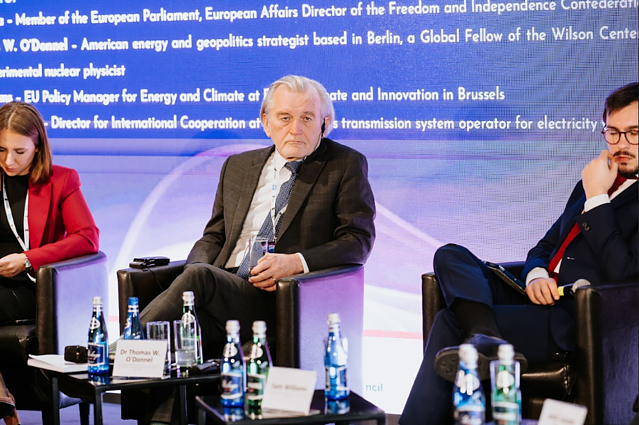
— Dr. Thomas O’Donnell Global Fellow at Wilson Center
On 4 April, in Warsaw, the first meeting of our new CEE Nuclear Expert Network (a policy network) was held to consult with Polish officials and experts. The network organizers include:
Attending were representatives of the Ministry of Climate and Environment, the Ministry of Technology and Development, the Prime Minister’s office, National Development Bank of Poland (BGK), Industrial Development Agency (ARP), Polskie Sieci Elektroenergetyczne S.A. (PSE – the national electric grid operator or TSO), a consultancy advising the ministry, and others. (See also Kamil Lipinski’s LinkedIn Post’s list below.),
This version has my voice in English. Translations of interview question are in the blog pos
[Right: Video in English. Below: Arabic version]
The US administration asserts that Kyiv’s drone strikes on Russian refineries threaten to cause higher oil prices. However, as I have argued since early-mid-March (Kyiv Post, USA press, USA press, Polish press), this is not logical (to first order). What undoubtedly alarms DC is that Kyiv has demonstrated that – if it chose to – it could also disrupt the three big Russian westward-facing oil-ports that handle 60% of Russian exports to the global oil market, undoubtedly causing a global oil-price shock. But, fear of such a shock might be overblown. [1]
In an Easter Sunday interview in 20+ Polish papers [POLISH & ENGLISH below], I said White House reasons for Ukraine not to hit Russian refineries don’t make sense. The “elephant in the room” alarming DC is that Ukraine can now disrupt Primorsk, UST-Luga and Novorossiskya oil ports, needed for 60% of Russian exports.
This would not only deny Moscow vital oil revenues needed to wage war, it would also spark a spectacular global oil market shock. I explain that the USA and allies can urgently prepare for this, while the Ukrainians are still maintaining strategic patience.
According to energy and geopolitics expert Tom O’Donnell, Ukrainian allies’ oil price cap, in conjunction with Ukrainian drones’ physical damage could be a significant hit to Russian revenues.
Tom O’Donnell, PhD, an expert on energy and geopolitics, sat down with Kyiv Post to explain what Ukraine’s attacks on Russia’s energy sector will mean for the larger Russian energy sector.
It sounds like a huge number. But how much do you think losing 12 percent of production, in a day, will affect Russia?
First off, although these refineries hit by Ukrainian drones yesterday represent about 12 percent of Russian production, experience shows that they might not each be totally impaired from production. Nevertheless, there are two particularly significant implications for Russia.
First, whatever percentage of Russian refined oil products this impairs, the damage will both deprive the war economy of needed export revenues and/or of much-needed fuels to keep the domestic war economy running.
Already, Russia had announced it will ban the export of gasoline from March 1 in order to tame prices for consumers in the runup to the presidential elections mid-month. In 2023 about 17 percent of Russian gasoline was exported.
What is the origin of the current price pressure?
The present price pressure is both a result of the demands of the war economy as well as previously successful Ukrainian hits on other refineries that began in January.
This gets to my second point – the successful refinery strikes of yesterday, involving a reported launch of 58 drones, as well as recent hits on a Russian domestic gas transmission pipeline, all demonstrate that the January successes were not one-off special operations, but rather the beginning of what will be a sustained Ukraine armed forces campaign capable of, over time, significantly disrupting Russia’s all-important oil and gas import revenues and internal refined-product supplies.
Kyiv has launched some of its largest air attacks on Russia this week ahead of the vote, which is set to hand President Vladimir Putin another six-year term in the Kremlin.
If Russia continues to lose refineries, which appears likely, what new complications will it create for Russia?
First, from a strategic point of view, it is important to see these physical strikes against Russian oil and gas infrastructure in conjunction with the sanctions efforts of the USA, EU and other allies aimed at reducing Russian oil profits. These drone strikes should be seen as a “force multiplier” to allied oil sanctions.
How so?
Consider that, with Russia no longer having the Druzba oil pipeline flowing into Central Europe due to EU sanctions, this has forced it to shift its Urals-region oil exports to seaports on the Baltic coast of Russia and to a new western-Arctic port. Hence, hitting any refining or export facilities inside Russia along this general Urals-oil export corridor has a significant effect on Russia sustaining export revenues. This oil mainly flows to Turkey, India and China, with Russian oil tankers representing the main users of the Suez and then the Red Sea. Due to sanctions, most of these ships are now either directly or indirectly Russian-controlled, to avoid the sanctions oil-price cap.
There has been a discussion in US-EU security-and-sanctions circles that these ships could be stopped for inspection by Sweden and/or Denmark in the Baltic, in the straights between their countries, and many might be refused passage due to having sketchy insurance and/or being unsafe, old vessels.
Advertisement
What do you think of the oil price cap? Is it a good idea?
From the point of view of strategic impact, the allies’ choice of an oil-price cap has been, in my view, a weak and overly complex-to-enforce instrument. However, in conjunction with Ukrainian drones’ physical damage, the overall hit to Russian revenues might become significant.
Secondly, Ukraine has also hit refineries in Russia just east of its own territory, which will mainly undermine the region’s war economy and complicate supplying the massive demand from Russia’s invasion forces. This region already has chronic fuel-supply problems, with farmers last year protesting against a lack of diesel for harvests, causing Russia to ban diesel exports during that season.
Dr. Tom O’Donnell is Berlin-based and is a Global Fellow of the Wilson Center.
Jason Jay Smart, Ph.D., is a political adviser who has lived and worked in Ukraine, Moldova, Kyrgyzstan, Kazakhstan, Russia, and Latin America. Due to his work with the democratic opposition to Pres. Vladimir Putin, Smart was persona non grata, for life, by Russia in 2010. His websites can be found at http://www.JasonJaySmart.com / http://www.AmericanPoliticalServices.com / fb.com/jasonjaysmart / Twitter: @OfficeJJSmart
Related references for assertions I made in my interview – Tom O’D.
Jun 17, 2022 Today, Gazprom announced a further cut in exports of gas via Nord Stream 1 to Germany and on into Europe. Earlier this week, they had cut 40%, now it is 60% of the 55 billion cubic meters per year (bcm) that normally flows in this pipe.
I explained that the Gazprom excuse – -that it could not re-import some compressor parts it had sent to Siemens to repair in Canada due to sanctions — appears as a convenient, manufactured excuse.
I pointed out that a one-off sanctions waiver from the USA, EU and/or Canada for the reimportation of these very specific parts could likely be easily arranged – and if the gas did not again flow fully, Gazprom’s ruse would be clearly exposed.
However, as I said, this is more accurately understood as simply another step in the weaponization of the over-dependence of the European Union (and esp. of Germany, Austria and Italy) on Russian gas imports, a game which Mr. Putin began in earnest in August of 2021.
We discussed the EU’s repeated failures to impose an embargo in Russian oil. Now, (after Monday 30 May) they are considering a sea-borne-oil-only embargo.
Kostaka.Media (Kyiv) independent journalists continue informing the Ukranian people on energy affairs. I was interviewed from afar by YAROSLAV MARKIN, TETIANA HUZENKO. We focused on gas issues – would Putin cut Europe’s gas? What have the Americans been organizing, now with the Europeans? How would this affect Europe, Ukraine and Putin’s income?
Below are links to the article in Kostaka’s three languages (EN, RU, UA). I pasted in the English one below, in case you have access problems. This interview had to be written, not audio/video, due to wartime difficulties. [Also, here’s my previous (in-person Kyiv) interview with Kostaka.Media.]
Biden’s Gas Air Lift and the impact on Kremlin revenue: Thomas W. O’Donnell on the russian gas embargo 28 April 2022 — Author YAROSLAV MARKIN, TETIANA HUZENKO Europe is going to cut the consumption of gas by a ⅔ in 2022, that is obviously will affect the Kremlin’s revenue. However, an embargo is highly possible as well. Both the Kremlin and the EU, in response to Russia’s new war crimes in Ukraine, could stop the gas flows. In such a case, LNG supplies are to help weather the crisis of 2022-2023 via Biden Air Lift. The last mentioned is being set up by the US and EU diplomats and is patterned on the Berlin Air Lift of 1949. Berlin Air Lift was a system of food and coal supply during the times when the USSR had been blocking land routes. This would be the end of Russian gas supplies to Europe forever, an international expert and senior energy and geopolitics analyst at GlobalBarrel.com, Dr Thomas W. O’Donnell believes. He told Kosatka.Media how quickly Europe would be able to abandon Russian gas, what alternative supply routes could be used, and whether Hungary and Austria, obsessed with Russian gas, could prevent this.
The analogue of Putin’s army in the energy sector • How much gas does Europe import from Russia per year? Who are the major consumers?
There are two different market processes whereby Russian gas is purchased by Europe. If we speak about only gas delivered by pipeline, these are: І. Via long-term contracts, agreements which are for natural gas to be delivered for several years, perhaps from five to as much as 20 years.
ІІ. Via the “spot” market. These are short-term contracts for gas to be delivered the following month. It is also possible to buy gas day-by-day, where traders agree to a price for gas delivered the next day. Here, gas traders consult the future’s market, which has set the price for gas delivered the next day, or the next month, or some number of months in the future.






 The Global Barrel