Both Christof Rühl (bio) and Jack Kemp (bio) had great, data-driven media this past week. I too addressed these issues (spoiler: I assess Trump is not bluffing on Iran talks, and oil supply remains adequate.) My conflict-trajectory take differs a bit from Chrisof, perhaps closer to Jack K here.. My Al Jazeera was just after Trump announced talks.
Dear readers, This paper, which I wrote in 2008-09, analyzed the evolution of interests underlying the US-Iran crisis till then, interests which persist in the 2026 US-Iran war.
That is, Trump’s “USA Energy Dominance” strategy does not seek to fundamentally alter the structure or logic of the post-1973 global, market-centered, USA-led-and-protected oil order. However, to preserve it, the USA now feels the necessity of removing the Iranian mullahs as custodians of Iran’s oil for persistently insisting on projecting power and seeking hegemony in the energy-critical Gulf Region.
What is new from 2008, is the bipartisan urgency felt in Washington to renovate the existing oil market-and-security order, reconsolidating the USA as primary arbiter of energy flows via Hormuz to both China and US allied and friendly states of the Indo-Pacific region. In addition, to be capable of significantly blocking Russian oil exports and thereby its petrostate-fueled aggression elsewhere.
In particular, it mush achieve these aims, vis-a-vis Russia and China, without causing global oil shocks. (continued in full-column below …)
Mar 12, 2026. Is the Iran war about the US containing China? For my part, I explained how control of Hormuz would give the US two key levers:
The USA will control half of China’s oil imports, 5.4 million barrels per day (mbd), which flow through Hormuz.
The USA will insure that during any Pacific war China might start that Iran, acting in solidarity with China, could not block oil flows to US Asian allies such as Japan, S. Korea, Australia, Philippines, or flows to others whose supplies it would also want to guarantee, such as Viet Nam, Indonesia, Malaysia, Singapore, etc..
This is a longish, ca. 30 minute video. Host Nataly Lutsenko kindly told me she wanted to make a long interview.
(During time of crisis like this, I have so many TV and press interviews that I don’t have time to put most of them online. So, I will refrain from writing long posts to accompany videos to get more online, if I think they are useful interviews. – Tom O’D)
Last night on TRT World Global News (London), I emphasized that despite the modest spike in oil prices from about $70 to $78 per barrel as of yesterday, Trump has an historically unprecedented advantage for exercising “US Energy Dominance.”
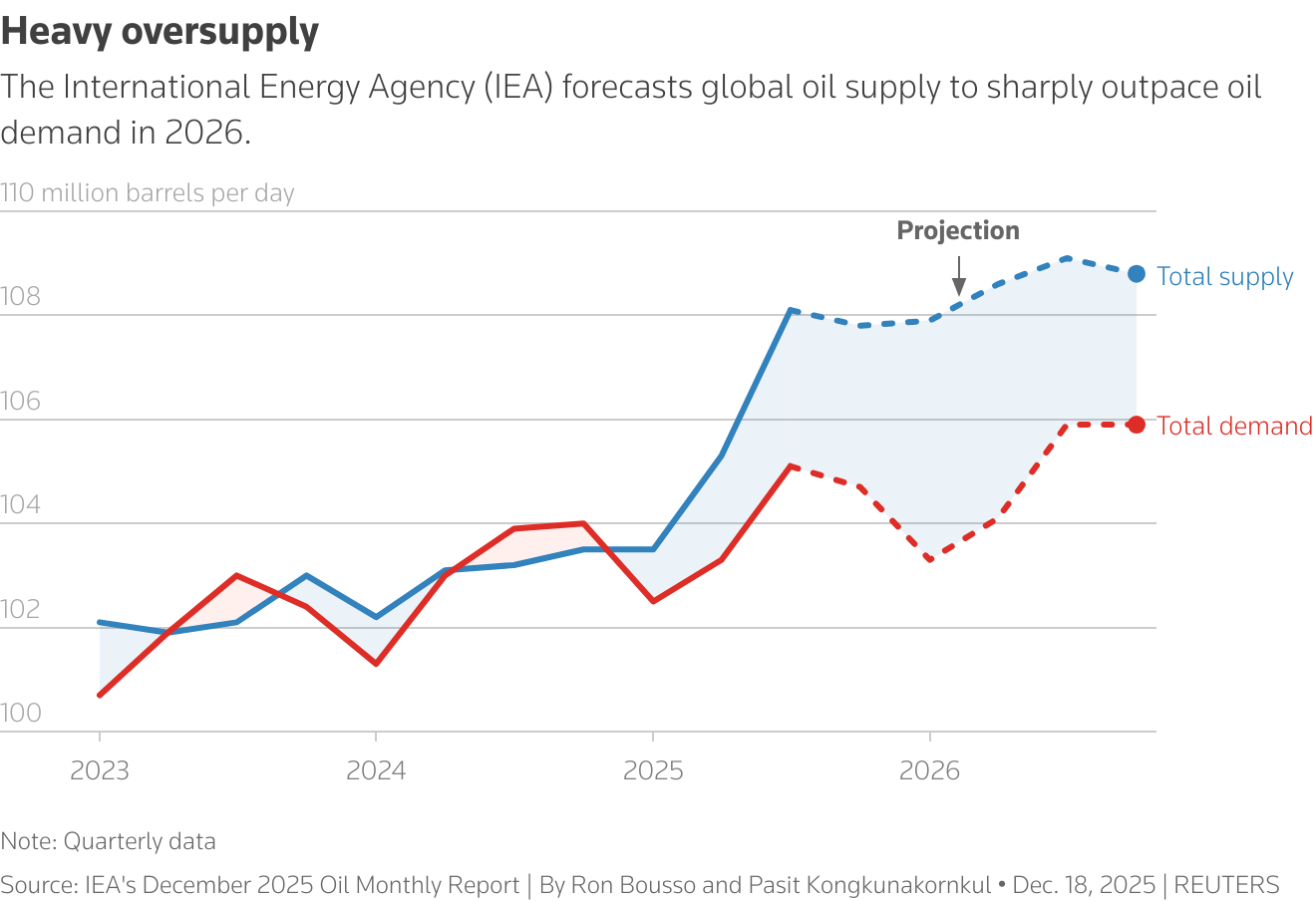
Fig. 1. IEA projects global oil glut throughout 202
The campaigns against Venezuela and Iran, plus the turning of the Indian oil-consuming behemoth towards USA and Western interests vs Russian oil, are examples of the geopolitical leverage the USA’s now-dominant role in global oil affairs has afforded the Trump administration.
This oil-market advantage comes mainly from of two things:
MY COMMENTS: 1) USA long-planned surprise strategy 2) Iran leaders’ 20-year nukes brinkmanship strategy aimed for USA ssecurity-guarantee deal
ALL GUESTS – TRT-London, USA bombing
I was invited on TRT-World, London, 24 June, for a panel after US strikes on Iranian nuclear sites (see the panelist lineup below. I answered two questions at some length – see the 2nd video.)
In summary: Trump claims USA Operation Midnight Hammer “obliterated” the country’s nuclear capacity, but how much have they really been degraded?
My analysis is that it does not matter. If the USA decides to bomb again at will, without Iran having air defenses the USA and Israel can destroy or disrupt most any renewed Iranian work on its nuclear or conventional missile program. If, as he stated, repeat bombings as needed are Trump’s intention, then this should be the case. This now leaves Iran very little negotiating leverage. The regional proxies it always intended to use for retaliation in just such a scenario have been decimated by Israel.
Therefore, there is a high likelihood Iran will be forced by Trump to negotiate from a now much weaker position. If Tehran resists, it could fall back to rely on state-sponsored terrorist methods, which are of limited usefulness for maintaining a modern functioning state and economy.
Overall, I emphasize that this “12 Day War” has been especially motivated, by Trump, to assure USA Gulf allies that they can now safely enter into the Abraham Accords with Israel and the USA, establishing a new regional security structure. Trump will be constrained to do whatever is necessary, militarily and in negotiations, to insure the Iranian threat these allies have felt acutely remains under control. In turn, if these accords, which Trump’s chief negotiator, Steve Witkoff, was reportedly already working on among the USA’s Gulf Arab allies immediately after the USA bombing is intended to allow the USA to move on, focusing more squarely on Great Power competition elsewhere.
This is my general assessment. There are many details and some possible derailments here, of course. – Tom O’D.
The ceasefire Trump brokered will hopefully end this “12-Day War.” I want to discuss here why this war did not trigger a global energy crisis. [Here’s what I said about this to Al Jazeera last week, in the last five paragraphs. A PDF is also embedded below. I’ll also post a TRT-London show on Iran’s nuclear strategy, recorded Tuesday, soon.]
To assess the risk to energy supplies, understanding the aims of the combatants is key. Throughout this war, it was the USA-Israel side setting the agenda, and there were two strategic aims they could pursue. One was to “only” destroy Iran’s nuclear program and its existing conventional regional power-projection capacities. The second was to go beyond this to undermine the viability of the Islamic Republic, up to forcing a regime change. Why do I say this?
ENGLISH Interview | Al Watan, Cairo. Thurs 10Oct24. 15 minutes
ARABIC Interview
At first, we focused on IEA warnings of a possible EU winder gas shortage due to supply-and-demand mismatches. I agree and expand on the IEA points.
Second, I explained that if Israel retaliates against Iran so strongly that it threatens the regimes survival, or is seen as intending to provoke regime change, then the Iranian leadership will have “nothing to lose” by in-turn escalating to the maximum. Aside from unleashing the maximum response of its proxies surrounding Israel, Tehran’s most potent weapon would be to spark a global oil and gas crisis.
Consider oil: Iran can either shut down the Straights of Hormuz (or simply make them unsafe for tankers) and/or, it can use missiles and drones to destroy significant parts of Saudi, UAE and other Gulf oil facilities, including perhaps even Azerbaijan’s as some Iranian propagandists have threatened.
Consider natural gas: Shutting the Straights or directly hitting Qatar’s massive LNG exports infrastructure would immediately stop Qatari LNG exports. As the world’s second largest LNG exporter, this would immediately cause a separate global natural gas crisis.
Again, oil security is determined by both global-market balances and geostrategic realities – at present the Mideast war and Russia’s War on Ukraine. My analyses this weekend were featured in: (a)an AlHurra video (LHS English, RHS Arabic), and below these (b)a detailed BBC-Cairo print interview (LHS English Google Translate, RHS Arabic original). where I make similar points as my Friday video in Warsaw.
Alhurra ENGLISH. My comments at 2:45 & 8:20. Date: 5 Oct 2024, with co-guest GPI President Paolo von Schirach, Washington.
Alhurra ARABIC, 5 October 2024
My BBC (CAIRO) print interview in Arabic and English (Google Translate):
Recorded Thurs AM, 03Oct24. Warsaw Old Town, Castle Square.
Will Israel hit Iranian oil infrastructure? And, what part of it? To what effect on markets, and geopolitics, (i.e., Mideast, OPEC, Russia and Ukraine war)? A video report.
MAIN POINTS (see transcript):
1. What if Israel hits Iran oil infrastructure in retaliation for missile strikes on Tel Aviv on Tuesday night? 1.a. The difference effects of hitting Iranian refineries vs oil export terminals In itself, neither target would make big difference in the market. The market would immediately jump, of course, but in principle the effect would be small. 1b OPEC+ and Western Hemisphere have plenty of spare capacity.
2. Consider Saudi market tactics … reportedly they want to now go for share over price support, as price support is failing after well over a year of output cuts (about 6 mb/d). Note: Shortly after this recording the Saudis repudiated the WSJ that reported the switch in tactics to defending share. Likely they’ll now want to wait and see what happens to Iranian exports, or if this Israel-Iran tit-for-tat gets out of hand.
See my pre-interview research reference & notes below this post. Tom O’D.
This epitomizes today’s LNG-geostrategic nexus.
One way to look at the Turkey-Shell LNG deal is that Mr. Erdogan wants Turkey to avoid Germany’s blunder in relying heavily on Putin’s Russia for its imported natural gas. He obviously wants Turkey to diversify its natural gas imports. In this regard, the opening comment by Tom Marzec-Manser, head of Gas Analytics at ICIS, London, that “this is a big deal” for Turkey – is correct.
Turkey uses about 50 bcm (billion cubic meters) of natural gas per year. This is currently supplied almost entirely via pipelines, mainly from Russia, also from Iran and from Azerbaijan. As I pointed out, Mr. Erdogan is well aware how Putin cut off German and EU Russian gas supplies as a geostrategic weapon in preparation for his full-scale invasion of Ukraine. This plunged Germany and the entire EU into the acute 2022-2023 European energy crisis. Germany, especially, still has not fully recovered.
I was asked by Debbie Mohblatt for the Jerusalem Post on Thursday: Why can’t Israel make unilateral decisions [i.e., as to whether and how to attack Iran]? Two other geopolitical experts interviewed were Jack Kennedy, head of Middle East and North Africa Country Risk at S&P Global Market Intelligence, and Noa Meir, founder of the Gideon Meir Diplomacy Center. My quoted remarks follow, the full article is here, and farther below I put today’s performative Israeli response in perspective..
Israel dependent on American decisions
Dr. Thomas O’Donnell, a global fellow of the Woodrow Wilson Center in Washington who teaches in Berlin, told The Media Line that Israel was very dependent on American decisions. He added that in this case, Israel could carry out some small-scale symbolic response that would not necessarily draw an additional Iranian attack leading to escalation.
“Israel has always gotten huge amounts of support from the United States—military and otherwise. It’s quite clear that it [Israel] can’t sustain a protracted war, especially a protracted war of the nature it would be against Iran, without the United States’ support, and there’s no other country that is capable or willing to give that support,” he said.
O’Donnell added that very few of the world’s countries can make these kinds of decisions without considering their allies. “A small country can go to war with another small country. But if this is going to bring in larger powers, they have to be very careful,” he continued.
… O’Donnell explained that ever since President George W. Bush’s administration, which came before Presidents Barack Obama and Donald Trump, the United States has been very clear that it made a mistake by putting too many boots on the ground in the Middle East and that it must get out of the region. “It has to focus on great power competition against Russia and China. And this is becoming more urgent by the day,” he continued, explaining part of the rationale behind the US not wanting a major escalation between Israel and Iran. (Read the entire article for the others’ comments.)
It was my pleasure to be with Thierry Bros of Sciences Po University, Paris, and Peter Zalmayev, Ukrainian security analyst and executive director of Eurasian Democracy Initative on David Foster’s Roundtable on TRT World, London, broadcast 9 June 2021.
I discussed Biden’s apparent reasoning for waiving Nord Stream 2 sanctions:
First off, the German government of Angela Merkel simply would not cooperate otherwise. Allowing her pet energy project to go forward was the price she had demanded for trans-Atlantic “unity” before Biden’s summit with Putin.
(Aside: My research in Berlin and elsewhere has convinced me that, at no point from the late-Trump administration through Biden’s six months in office, did the German side actually engage in any meaningful “negotiation” or discussions with the US side to seek to find some compromise or to initiate a moratorium on construction. Not until Biden waived sanctions on Nord Stream 2 AG, and decided not to sanction any German firms inolved in construction did Merkel show any real interest in discussions. She emphasized her change of attitude on negotiating with Biden about: “what now are also the necessary commonalities in the relationship with Russia” in comments during a German national broadcast interview immediately following Biden’s sanctions waiver. Until this waiver, she had held up any real discussion of the pressing issues of trans-Atlantic unity-in-general, whcih urgently needed attention.
Secondly, as the EU and NATO allies all realize, Biden has to have this summit with Putin for a number of reasons. As I indicated on the show, the summit is needed to discuss:
Last week, Gillian Rich at Investor’s Business Daily (Washington), asked me (Berlin) and others about the OPEC’s 20-21 June meeting. Below here, I give my views in more detail, including the tie-in to the Trump project to isolate Iran and my comment about Putin likely betraying the Iranians again. The IBD piece is here: Trump Could Make OPEC’s Next Meeting As Dysfunctional As G-7 Summit. 15 June ’18.
We spoke about market and geopolitical aspects. On the latter, I emphasized both the Trump Administration’s evolving plan to sanction and isolate Iran, and Russia’s new role as a central player with OPEC ever since the 2016 joint Russian-OPEC decision to raise production.
That’s when Putin played a new role for any Russian leader. Not only did he coordinate Russian oil policy with OPEC’s, he got personally involved in heated discussions, getting on the phone late in the last night with Iranian and Saudi leaders to get the deal sealed. Continue reading →
Mr. Trump promises he’d use the USA’s shale-oil revolution to deliver “complete” independence from foreign oil, telling voters in May: “Imagine a world in which our foes and the oil cartels (sic) can no longer use energy as a weapon. Wouldn’t that be nice?” But, he is confusing two quite distinct things:
“Energy independence” – in the sense of the USA producing more oil than the country consumes – is indeed possible, even “tantalizingly close” as this CNNMoney article (Aug. 9, 2016, by Matt Egan) makes clear, citing myself and other experts. For clarity, I’ll call this “net oil-exporter status.”
However, Donald Trump asks us to “imagine” he can use this net oil exporter status, to make the US independent of the global oil market and oil in geopolitics where our “foes” and “cartels” have leverage. Continue reading →



 The Global Barrel