Category Archives: The USA

I’m quoted by the FT | “Germany warns new US sanctions endanger Nord Stream 2 pipeline. (As) serious interference in European sovereignty”

BD74709B-4105-41E6-AB80-97377F9D6ADE_w1200_r1

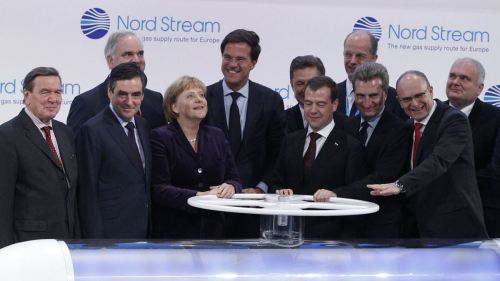
Chancellor Merkel, x-Chancellor Schroeder, Gazprom and Russian officials et al open valve for earlier Nord Stream 1 pipeline, 11 Nov. 2011. (Radio Free Europe)

Here is the link to the Financial Times article of 2 July 2020. (pay wall likely). However, a plain-text version is also below, at the end of this post (for which I beg the FT’s indulgence).

Comment on deteriorating US-German relations over the Nord Stream 2 project

As my brief FT quote indicates, the new PEESA Clarification Act sanctions now before Congress are intended to be so severe as to convince German officials to abandon any further attempts to complete the pipeline with Russia, killing it permanently.

This is essentially an ultimatum, which, as such, will of course be taken badly by the German side. However, German leaders’ and experts’ widely held perceptions that these sanctions are motivated primarily from the mercantilist and transactional approach to US-German relations touted by Trump — such as demands to purchase US LNG — are sorely missing the message emanating from Congress, and not least because US opposition to these projects long predates its shale gas revolution and emergence as an LNG-exporting country.

These sanctions are not flowing from Trump’s complaints against Germany.  In fact, this will be the third time Congress, on a bipartisan basis, has imposed sanctions on Russian interests contrary to Trump’s wishes.

The first instance was the codification into law of President Obama’s executive sanctions on Russia, which Obama had imposed after the Russian invasion of Ukraine in 2014.  These were made into a law in June 2017 which passed with so many votes that Trump could not veto the bill.  This was done precisely because Trump was not trusted to keep in place Obama’s sanctions, considering Trump’s demonstrated affinity for Putin.

These 2017 measures also gave Trump presidential authority to sanction Nord Stream 2; however he refused to do so.  Therefore, Congress imposed mandatory sanctions on Nord Stream 2 in December 2019, known as the PEESA act, as part of the National Defense Authorization Act (NDAA) of 2019. These were the sanctions which had the effect of immediately halting construction of the pipeline.

However, in response, both the Russian and German governments have repeatedly made clear their resolve to complete construction regardless of these 2019 sanctions.  And, once again, since Trump refuses to take further action to stop the pipeline’s construction, Congress is expect to soon enact the very severe PEESA Clarifications Act presently under consideration.

In short, US congressional sanctioning of Nord Stream 2 construction cannot be seen as simply a product of Trump’s presidency, of his nationalist-mercantalist bombast against Chancellor Merkel et al. Although various members have a range of motivations, overall these sanctions reflect a long-evolving bipartisan resolve within Congress that this pipeline project, contrary to the objections of  the German government, is harmful to the energy security of Europe. Russia’s unrelenting cyber, military, assassination, election-interference and propaganda outrages only increases the sense of urgency in Congress.

It should be noted that this is a position supported by many other European allies, who also disagree with Berlin on this matter, and have actively fought to block or, with some successes, hinder the project via legal and political channels within the European Union.
Continue reading

My interview: on US troops redeployed in Germany & Poland | O’Donnell: Żołnierze u granic Rosji to sygnał dla Kremla [Wywiad]

2853601-olnierz-wojsko-armia-657-323

Soldiers deployed in Poland are a kind of warning to the Kremlin. –  Source: GazetaPrawna.pl

My interview on Trump’s announced US troop draw downs from Germany and partial reassignment to Poland appeared in the Polish economic press Gazeta Prawna on 25 June 2020 by the Polish journalist Artur Ciechanowicz.  You can read it (a) in ENGLISH below (via Google Translate, with minor fixes) or (b) in the POLISH original at this link.

O’Donnell: Soldiers at the borders of Russia are a signal to the Kremlin [INTERVIEW]

From a military point of view, deploying too many troops too close to the border with a potential enemy is dangerous because there is a risk that they can be overrun rapidly – says Dr. Thomas O’Donnell, energy and international affairs analyst, and adjunct faculty at Hertie School of Governance in Berlin.

Question: US President Donald Trump has decided to increase the US military presence in Poland, while also reducing the contingent in Germany. Where do these decisions come from?

On the one hand, they logically result from the American National Security Strategy (NSS) of December 2017. Work on it began during Barack Obama’s term of office and was completed by the Donald Trump administration. According to the NSS, the US priority is no longer the war on terror and the situation in the Middle East, but competition with China and Russia. It is therefore quite natural that the United States moves its troops and increases its military presence in countries closer to Russia – the Baltic States, Poland and Romania. The second factor that led to these decisions was the personal involvement of Donald Trump, who is running his election campaign.
Poland’s security will increase?

As a rule, increasing the US military presence in Poland is of course good news. The Pentagon’s activities have been moving in this direction for some time, although the US military is of the opinion that this should be done a little slower and not at the expense of Germany. From a military point of view, deploying too much of the army too close to the border with a potential enemy is dangerous because there is a risk that it will be overrun too soon. There is therefore a tactical reason to keep some of the army a little further from the Russian border. Therefore, the rapid relocation of a significant number of soldiers to Poland is viewed skeptically by some American commanders. Remember, soldiers deployed in Poland are a kind of warning against the Kremlin. There are enough of them for Vladimir Putin to think twice before doing anything. However, not enough – even after increasing the quota – to stop the first strike. The rule is simple here: if Russia decided to attack Poland and American soldiers would die, it would mean a war with all the power of the US. Neither any president nor Congress would hesitate a single moment.

Some American commanders are opposed to the permanent presence of US troops in Poland. Why? Continue reading

Europe’s Gas Crunch:  The Pending Crisis Around Nordstream 2 & Ukraine Transit

My public talk in Washington, 12 June:

pic_my_12jun_kennan_talk_european_gas_crisis

Despite Berlin and Moscow’s rush to make the Nordstream 2 (NS2) pipeline construction through the Baltic Sea a fait accompli, opposition from several EU states has stalled its completion. Meanwhile, Gazprom’s transit contract with Ukraine will expire in January and Moscow has put unacceptable preconditions on negotiating a new one. Once again, Europe must brace itself for a Russian gas-supply crisis. Professor Thomas O’Donnell will discuss European states’ various interests and heightened energy anxieties, the prospects for the NS2 pipeline, and Russia’s strategy.

Speaker:  Thomas O’Donnell, 

Instructor, Hertie School of Governance, Berlin;  Title VIII Short-term Scholar, Kennan Institute — Scholar’s Research-Project Page at Kennan

RSVP Now

Wednesday, June 12, 2019
2:00pm-3:00pm  –   5th Floor Conference Room

Directions

Wilson Center
Ronald Reagan Building and
International Trade Center
One Woodrow Wilson Plaza
1300 Pennsylvania, Ave., NW
Washington, D.C. 20004   Phone: 202.691.4000    kennan@wilsoncenter.org

Washington interviews: Energy Relations of Russia, Germany, Poland & Ukraine (Kennan Fellow)

g7-trump-merkel-round-9jun18-jezco_denzel_ger_gov_photo.jpgWhat are US experts’ and officials’ views on the increasingly conflictive energy and geostrategic relations between Russia, Germany, Poland and Ukraine? 

Greetings. I’m in Washington as a “Title VIII” fellow of the Kennan Institute in the Woodrow Wilson Center, interviewing people in think tanks and government (legislative and executive) on these topics. I’ll also give a public talk on this at Wilson on 12 June, at 2 PM (more info soon). putin_wink-round-hnewkremlinstooge-wordpress

I’m interested to hear anything readers think should be asked and of whom.  Don’t hesitate to write me at twod(at)umich.edu or my (temp) Wilson email: thomas.odonnell(at) wilsoncenter.org

A central issue: why is Germany so adamantly for Nordstream 2 despite the negative security consequences for Ukraine and despite the tremendous hit this project is causing to German soft-power not only with Poland, but with most Central and Eastern European (CEE) and Nordic states?  (Here’s my own analysis.)  How do US experts see this? Continue reading

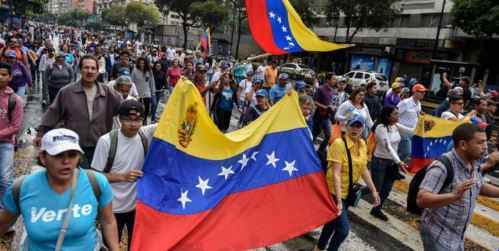
Venezuelan transition? My analysis on Germany’s DW TV | Videos: español & English

venezuela_protest_dw.de_31jan19

Here are two videos from the Quadriga show on Germany’s international network DW.de —  Aquí hay dos vídeos del programa Cuadriga de la red internacional alemana DW.de

Espanol, 28 febrero 2019:  https://p.dw.com/p/3EHYo  (… luego desplácese hasta el video)

English 31 January 2019 : https://p.dw.com/p/3CVxR (… then scroll down to the video)

Continue reading

Germany backs small-scale LNG import terminals despite opposition [my King’s College/EUCERS paper]

Here is my detailed analysis of the decision by Angela Merkel’s government to begin “small-scale” Liquid Natural Gas (LNG) imports to address greenhouse gas emissions and competitiveness issues in Germany’s heavy-road transport and maritime-shipping sectors.  Read it below (via Scribid) or go directly to EUCERS.  [This peer-reviewed paper appears in the King’s College-London, Newsletter of the European Centre for Energy and Resource Security (EUCERS), Issue 77, July 2018.] – Tom O’D.

Germany’s Real LNG Policy [My BPJ analysis]

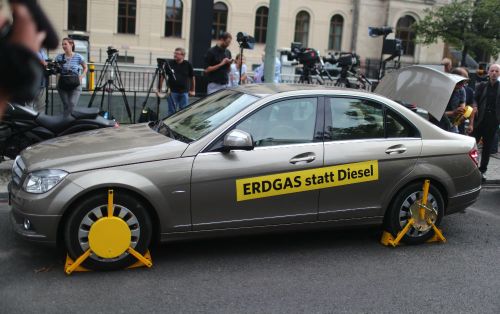
bpj_erdgas_statt_diesel_c-reuters_28jun18

“Natural gas instead of Diesel” © REUTERS/Hannibal Hanschke

My latest at: Berlin Policy Journal (German Council on Foreign Relations), June 28, 2018:

Germany’s Real LNG Policy
Germany’s government has endorsed imports of liquid natural gas for the first time—but not because of Russia and Nord Stream 2. 

The German federal government has decided in favor of building liquid natural gas (LNG) import terminals and infrastructure. In March, Chancellor Angela Merkel’s CDU/CSU-SPD government, in its “coalition contract,” pledged to “Make Germany the site for LNG infrastructure.” This is a notable policy change, because in Germany the opposition to LNG imports and use has been so much stronger than anywhere else in Europe.

The aim of this new endorsement is to reduce maritime and roadway heavy-transport emissions. However, many in Germany argue that using “small-scale” LNG in this way, as a “bridging” fossil fuel, is “wasted investment”. They contend that Energiewende-mandated electric vehicles can and will rapidly de-carbonize heavy transport. Still others oppose LNG imports on the grounds that they would unnecessarily diversify Germany’s gas suppliers with the aim of offsetting increasing reliance on Russian pipeline gas. They insist that Russian pipeline gas has been “historically reliable” and is cheaper for Germany than building large-scale import terminals for LNG.
Continue reading

A Comment on: “A Trans-Atlantic Manifesto in Times of Trump – A German Perspective,” by foreign policy experts

I sent this today to European and American contacts – apologies for duplications.

Dear Colleagues and Friends,

I read with interest the declaration: “In spite of it all, America: A Trans-Atlantic Manifesto in Times of Donald Trump – A German Perspective,” signed by a number of leading German foreign policy experts today in Die Zeit and translated in the NYTimes.
Point 10 is of particular interest and much welcomed as – at long last – a frank characterization in Germany of the Nord Stream 2 project for what it plainly is: “a geopolitical project:”  Quoting:
10. Energy security policy — giving up Nord Stream 2 is in Germany’s interest
There is one more policy area in which the German government should reconsider its position to open the door for productive cooperation: energy security policy. The United States has identified Nord Stream 2, the planned pipeline running through the Baltic Sea to Russia, as a geostrategic project. They are correct. More important: This pipeline project is not in the joint European interest. Nord Stream 2 contradicts a policy of greater energy independence and undermines the envisaged European Energy Union. We should try to identify a joint approach with our European partners and the United States. (emphasis added – T.O’D.)

Continue reading

“Neue Neue Ostpolitik” My BPJ piece on German fury at Senate NS2 sanctions

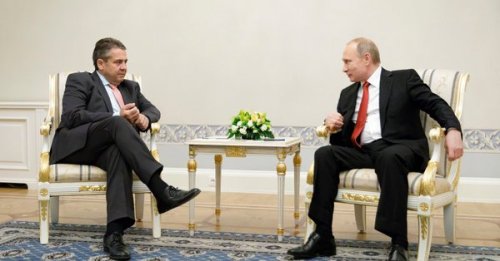
putin_gabriel_schroeder_dinner with an old acquaintance-der_spiegel_07jun17_U637TtLQ

The US Senate’s decision to expand sanctions against Russia triggered indignation in Berlin, throwing Germany’s geopolitical ambitions over the Nord Stream 2 project into sharp relief.  Read below or get the App.   My other articles at Berlin Policy Journal  

“Neue Neue Ostpolitik”  

Berlin – July 21, 2017    By: Thomas O’Donnell —  On June 15, the US Senate approved an act to sharply expand sanctions imposed on Russia in retaliation for its intervention in eastern Ukraine and annexation of Crimea in 2014. The broadly bi-partisan move that enshrined Barack Obama’s earlier executive orders – intended as a response to Moscow’s alleged cyber interference in US elections – was a stunning rebuke to US President Donald Trump’s Russia policy, essentially taking a broad swath of foreign policy out of his hands. Continue reading

Trump’s promise to “stay totally independent” of OPEC is populist hype [My IBD interview]

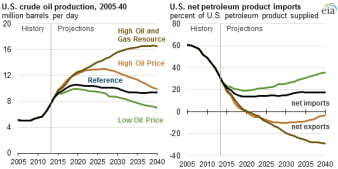
eia_apr15_us_oil_prod-importsContrary to his campaign hype (see article below), Trump-as-president will not do anything to interfere with the free flow of oil or gas to or from the USA.  As I pointed out in the Investors Business Daily interview (Gillian Rich’s story is below), people central to Trump’s administration – such as Rex Tillerson, his designated secretary of state and former CEO of Exxon, and Harold Hamm, Trump’s fracking billionaire friend he wanted for secretary of energy – are global-market-oriented businessmen who would never agree to disconnect the USA from global energy markets.

The free flow of petroleum through the unified global market traded in US dollars – what I call the “Global Barrel” – is central to the business model of every private as well as every national oil company.  Today there is essentially one, global oil price. If you break up the global market by limiting imports or exports, you get national markets with national prices.  Then what?

If the US price went higher than the global price due to keeping out cheap foreign oil, Trump’s popular approval would dive. And, if the U.S. price went lower due to a domestic production glut of fracked oil, then his support among business would tank.

Moreover, the unified global market serves as the key element in the world’s collective energy-security system by guaranteeing equal access and prices to all suppliers and consumers.   Continue reading

My CNNMoney quote & 3 points: OPEC v shale, Russia’s new role & Trump-buddy Hamm is pro Saudi price band


160928163540-opec-algeria-384x216I was interviewed by Matt Egan of CNNMoney. Three points, if I may:

  1. This story echoes my message in Berlin Policy Journal earlier this week and my RTRadio interview: OPEC now has to live with a new oil-market paradigm where shale  won’t disappear (for now its in the US, but soon elsewhere too).  It is a technology more akin to manufacturing than traditional oil extraction and so more amenable to technological and operating innovation in a low-price regime (or in a price war such as the Saudis et al have just given up on waging against it). And, being much smaller-in-scale means it can ramp up at much lower initial costs and more rapidly than traditional oil fields. The CNNMoney story is below here, or here’s the CNN ink .
  2. Another totally new phenomena seen in this OPEC deal was that a Russian leader was deeply involved in the tense OPEC negotiations, specifically between Iran and Saudi Arabia. Russia has never done this before. Historically, it has also never carried through on previous promises to support an OPEC cut, instead free-riding on higher prices effected by OPEC/Saudi cuts.  In this case, Putin was instrumental in getting the Saudi’s to agree, as they always have before, to swallow most of the cuts. But, Putin has agreed to cut too (in ambiguous language, but repeatedly). We shall now see if he and Igor Sechin (CEO of Rosneft, that produces 40% of Russian oil, and who is, by the way, a great friend of Venezuela’s miserably failing chavista leadership, where his company is now the biggest foreign oil producer) … do as they have promised OPEC and the Saudis. If they do not, the fallout with Saudis and their allies will be significant.
  3. Now, also, we shall see how US shale responds. Of course, IEA head, Fatih Birol, has understandably predicted that US shale and other producers, will likely hike production if oil reaches $60/barrel and simply eat up the present OPEC cuts in about nine months or so. (Aside: of course, the present output cuts, even if they ‘fail’ in the long run to sustain higher prices, would still have had been a significant cash-boosting relief to all OPEC states and to Russia while they lasted.)  However, take a look at the Bloomberg video link at the end of my Berlin Policy Journal piece – an interview with Howard Hamm, Trump’s billionaire fracking close-ally (who has just turned down an offer to run the Department of Energy). He had told Bloomberg he expects OPEC to make a deal because “it makes sense” and, further, that he expects/hopes his US fracking colleagues will show ‘discipline’ after the price rise, i.e., not expanding too fast so as to keep prices up.  An interesting, de facto recognition that price wars, in the end (in the long run), do not benefit either side, and goes on to approvingly say that the Saudi’s want to once again maintain prices “in a band” as they used to do. It is clear from Hamm that this would all be very welcomed from the US side. (Note, Hamm’s Continental Energy company made $3 billion in just three hours after the OPEC deal boosted prices! ) Indeed, in light of such everlasting market realities, it is difficult to imagine Trump’s attitude to the Saudi’s will be much different than other US president’s over the years. Which has geopolitical implications for Iran, of course, as the Saudi-Iranian geopolitical competition for regional influence and their parallel oil-market competition both continue to heat up.

Here’s the CNNMoney piece by M. Egan of 1 December 2016 (with my quote highlighted): Continue reading

An Oil-Price War´s Surprise Ending -My BPJ article on OPEC, Shale, Trump, Market & Geopolitics

bpj-oil-price-war-end-29nov16Here`s my latest at Berlin Policy Journal:  about  OPEC`s 30 Novermber meeting, US shale and the geopolitics from the  Trump Administration towards Iran and the Saudis. – Tom O`D.

An Oil-Price War’s Surprise Ending

No one expected shale producers to survive extended low oil prices.
, NOVEMBER 29, 2016 
The oil market’s oversupply – and the low prices that followed – was supposed to drive shale producers out of business. Instead, the economies of several large national producers have been upended, and the next act could prove even more destabilizing.

OPEC’s 171st meeting in Vienna on November 30 reflects the new paradigm of the global oil market. After two years, the Saudi-led price war to drive American shale and other “high cost” producers from the market has ended. However, to the surprise of many – not least the Saudis – shale has survived. What now?

The United States Energy Information Agency (EIA) expects persistent market oversupply to have been quenched by the second half of 2017. The Saudis view the diminishing oversupply as an opportunity to cut production by 600,000 or more barrels per day – although about twice this amount would be optimal – boosting prices from under $50 per barrel to $60 or more. The Saudis have worked intensely to reach an agreement at the OPEC summit to coordinate this production cut with Russia; any failure to achieve this highly anticipated deal would sink market confidence, pushing prices into the $30s.

The key obstacle to the Saudi plan is that Iran has refused to participate in any cut, insisting it should first be allowed to re-establish production it lost under years of sanctions. In response, the Saudis have threatened to boost their own production, punishing Iran by collapsing prices and by denying them market share. The Financial Times’ Nick Butler correctly characterizes this as “playing with fire,” and not only because of the severe pain this would impose on weaker OPEC states, but also for the geopolitical retaliation it might provoke from the new US administration as the Saudis would also bankrupt numerous shale producers in the US.

However, even if Russia, Iran, and the rest of OPEC agree to the Saudis’ cuts, US shale is widely expected to expand into the void, re-depressing prices by later next year. In all these scenarios, the future remains extremely difficult for OPEC, for Russia, and for other oil-dependent states.

A Price War Backfires

The prolonged high price of oil, starting to rise in 2002 and then dipping during the financial crisis before rising again till mid-2014, encouraged the emergence of new unconventional shale production. Driven by technical innovations in hydraulic fracturing plus abundant venture capital, by 2014 the US had added more new oil to the global market than what was lost in the Arab Spring and subsequent wars in Libya, Iraq, and Syria. By mid-2014, some two million excess barrels-per-day (bpd) were flowing into storage, and the price collapsed. Continue reading

Saudi & Russia seek oil deal as OPEC fight v US shale fails [My RTRadio Interview]

economonitor-com-putin_and_prince_g20_sept16

RT Radio-Edinburgh’s Jack Foster interviewed me on the upcoming 30 November OPEC summit where the Saudis hope to set a cap on OPEC and Russian production. Here’s the interview:   Listen from time-stamp 9:00-to-17:30 (Streaming MP3) 

This would  mark the first-ever Russian cooperation with OPEC. However, market realities look bleak for OPEC and Russia whether they reach an agreement or not. The reason is the unprecedented continuing challenge from US shale, which has dramatically cut its costs via tech and operational innovations to stay profitable at low prices. Continue reading

“Energy independence” won’t free the USA from global oil market & geopolitics [I’m cited: CNNMoney]

160809121848-us-oil-imports-shrink-780x439

Credit: CNNMoney, 9 August 2016

Mr. Trump promises he’d use the USA’s shale-oil revolution to deliver “complete” independence from foreign oil, telling voters in May: “Imagine a world in which our foes and the oil cartels (sic) can no longer use energy as a weapon. Wouldn’t that be nice?” But, he is confusing two quite distinct things:

“Energy independence” – in the sense of the USA producing more oil than the country consumes – is indeed possible, even “tantalizingly close” as this CNNMoney article (Aug. 9, 2016, by Matt Egan) makes clear, citing myself and other experts.  For clarity, I’ll call this “net oil-exporter status.”

However, Donald Trump asks us to “imagine” he can use this net oil exporter status, to make the US independent of the global oil market and oil in geopolitics where our “foes” and “cartels” have leverage. Continue reading

New US tech squeezing oilfields & rivals [IBD quotes me]

U.S. oil companies are developing new technologies and techniques to produce oil cheaper and faster.Gillian Rich at Investors’ Business Daily News (17 June 2016) writes a quite informative survey of the many new technological methods pushing the cost of US shale production ever downward. Here’s Gillian’s article. She asked me about the impact on OPEC producers and my central point (my quotes are below) was that it will be the high-tech, most-efficient producers (such as US shale) and NOT necessarily those with the largest and easiest-to-access proven reserves (e.g., countries such as Venezuela and much of OPEC, many corrupt Russian and Chinese state-dominated firms, etc.)  that will set the pace in the new oil order

If the latter actors can’t find ways to innovate in technology and operational methods they will be at a disadvantage because shale production looks more like manufacturing than  traditional oil extraction.  Many OPEC and other state-owned firms never had to think like a combination of Henry Ford and Silicon Valley, but could instead count on huge, low-cost reserves, inefficient exploration and production and cheap local labor.

Eventually, the new shale methods will of course spread to promising shale fields in Argentina, China, Eastern/Central Europe and elsewhere; but this will require big advances in local infrastructure, training and government regulatory capacity. Again, things those countries must think about very seriously. Here are my quotes (from near the end of her long article).

New Oil Order

…. OPEC countries like Nigeria and Venezuela that haven’t invested in newer technology will be hurt by advances in the U.S., said Thomas O’Donnell, a senior energy analyst at the consulting firm Wikistrat. Russia also can’t exploit shale and Arctic assets because of economic sanctions that limit Westerners from helping develop the new fields.

Meanwhile, Saudi Arabia has low-cost production fields, and state-run oil company Saudi Aramco can bring in foreign experts knowledgeable about fracking and new technologies, he added.

Still, OPEC must now grapple with U.S. shale producers on the rebound, which could lead to volatility, O’Donnell said. “The oil order has changed. It’s conventional oil on one side, and new shale oil on the other.”