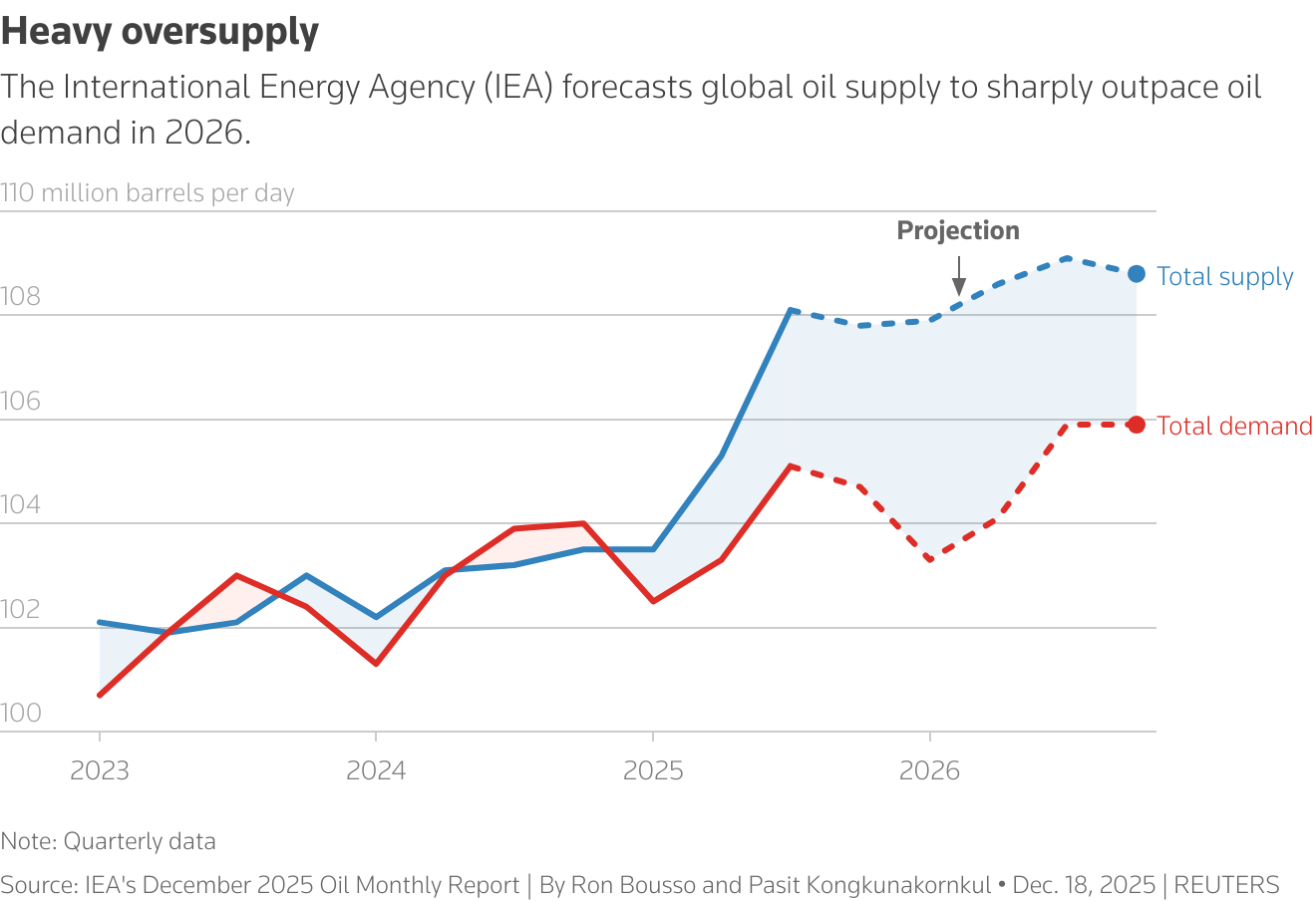
Last night on TRT World Global News (London), I emphasized that despite the modest spike in oil prices from about $70 to $78 per barrel as of yesterday, Trump has an historically unprecedented advantage for exercising “US Energy Dominance.”
Fig. 1. IEA projects global oil glut throughout 202
The campaigns against Venezuela and Iran, plus the turning of the Indian oil-consuming behemoth towards USA and Western interests vs Russian oil, are examples of the geopolitical leverage the USA’s now-dominant role in global oil affairs has afforded the Trump administration.
This oil-market advantage comes mainly from of two things:
My thanks to Tor Klaveness at Kapital, Norway’s oldest and leading, business magazine. Below is an English translation, then the Norwegian original. – Tom O’D.
“Bone-crushing” and “draconian”: The law that could choke Putin’s oil revenues
If peace talks between Ukraine and Russia break down, the US Senate is ready to pass a sanctions package that could strangle Russia’s oil exports. In that case, it could significantly strengthen the oil market.
Energy Published 29 Nov. | Paywall removed, Updated 9 Dec.
“President Trump said this weekend, ‘Send me the bill.’ So we have to send him the bill to help end this war.”
Dr. Thomas O’Donnell, energy and geopolitical strategist
This was stated by Republican Senator Lindsey Graham in a panel debate on November 19 with Democratic Senator Richard Blumenthal. The debate was moderated by Clayton Seigle, a senior fellow at the think tank Center for Strategic and International Studies (CSIS), which also organized the debate.
The bill Graham referred to is the Sanctioning Russia Act , which he is co-sponsoring with Blumenthal. The bill already has the support of 85 of the 100 US senators and would give US authorities the right to impose punitive tariffs of no less than 500 percent on countries importing Russian energy.
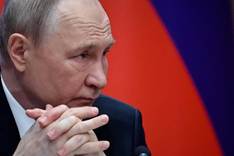
PHOTO: Alexander Kazakov, Sputnik, Kremlin Pool Photo via AP/NTB
With a stick and a carrot
Dr. Thomas O’Donnell is an energy and geopolitical strategist, founder of GlobalBarrel.com and former global fellow at the Wilson Center in Washington, D.C. He believes Congress is now poised to give President Trump an extremely potent weapon.
The proposal is being described as “bone-crushing” and “draconian,” and is set to be voted through almost unanimously in the Senate.
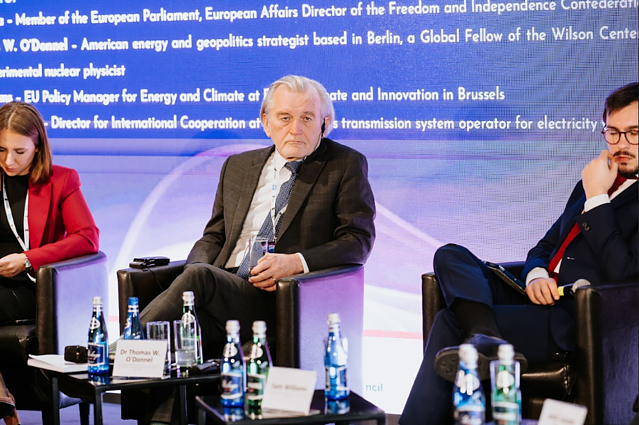
Here is the video of our 10 Nov. event, organized by EIES (European Institute for Energy Security). Our topic was the turn in US Trump administration policy on ending Russia’s war against Ukraine and the Russian oil sector.
My sincere thanks to EIES, and especially Executive Director Albéric Mongrenier, for inviting me along with distinguished energy and geopolitics experts. (Note: EIES is affiliated with, but policy-independent of, SAFE in Washington).
Our distinguished expert panel included:
Dr. Jaak Aviksoo, Former Minister of Defence of Estonia, EIES Energy Security Leadership Council
Christof Rühl, Senior Research Scholar at Columbia University’s Center on Global Energy Policy, former BP Chief Economist
Dr. Thomas O’Donnell, Energy and Geopolitical Strategist and Founder of GlobalBarrel.com
Moderated by Rosemary Griffin, OPEC+ Lead Reporter, S&P Global Commodity Insights
Opened by Peter Flory, Senior Fellow, EIES, Former NATO Assistant Secretary General
A central question we addressed was the turn in the Trump administration policy to apply significant coercive measures against the Russian oil sector to undermine the ability of the Putin government to continue its was in Ukraine. We discussed how effective the new sanctions on Rosneft and Lukoil might be and what is the synergistic effect of the Ukrainian drone and missile campaign against Russian domestic refineries and oil export terminal ports.
For an update on expanded attacks on Russian Black Sea oil ports and their meaning, see the written comments accompanying my Kanal24 video interview, posted on Monday, 17 Nov. “The US & Ukraine pound Russian oil | my Kanal24, Kyiv“).
You are invited to register now for Monday, 10 Nov. at 14:00 UK || 15:00 CET || 9:00 ET, an EIES Webinar. [My view: the USA, Ukraine & allies can dismantle the Russian petrostate. My posts on this are linked at the end]. I’m honored to join experts:
Dr. Jaak Aviksoo, Former Minister of Defence of Estonia, EIES Energy Security Leadership Council
Christof Rühl, Senior Research Scholar at Columbia University’s Center on Global Energy Policy, former BP Chief Economist
Dr. Thomas O’Donnell, Energy and Geopolitical Strategist and Founder of GlobalBarrel.com
Moderated by Rosemary Griffin, OPEC+ Lead Reporter, S&P Global Commodity Insights
Opened by Peter Flory, Senior Fellow, EIES, Former NATO Assistant Secretary General
Dismantling the Petrostate: Moment of Truth for Russian Oil? – Webinar: Monday 10 Nov.
Register Now – Allies have so far failed to break Putin’s war machine. The EU recently agreed on a 19th round of sanctions and plans to further ramp down Russian energy supplies. But EU sanctions have shown their limits, political leaders have not been able to use Russia’s frozen assets to aid Ukraine, and Moscow’s hydrocarbons still flow into the Union and other major markets.
Washington’s and London’s most recent sanctions may change the game. As we enter another winter of war, can Europe and the United States build on hard-won Transatlantic convergence to strike a decisive blow to the engine of the Kremlin’s aggression: Russia’s oil exports? Can the EU agree to and successfully manage the phaseout of Russian oil and gas?
The ceasefire Trump brokered will hopefully end this “12-Day War.” I want to discuss here why this war did not trigger a global energy crisis. [Here’s what I said about this to Al Jazeera last week, in the last five paragraphs. A PDF is also embedded below. I’ll also post a TRT-London show on Iran’s nuclear strategy, recorded Tuesday, soon.]
To assess the risk to energy supplies, understanding the aims of the combatants is key. Throughout this war, it was the USA-Israel side setting the agenda, and there were two strategic aims they could pursue. One was to “only” destroy Iran’s nuclear program and its existing conventional regional power-projection capacities. The second was to go beyond this to undermine the viability of the Islamic Republic, up to forcing a regime change. Why do I say this?
My comments are linked here:: -1- 02:21, -2- 06:52 -3- 14:30 -4- 20:50, but hear Aura & Oktay too!
I was happy to address Türkiye’s push to become a gas hub: both for its own domestic security of supply, and to become an indispensable supplier to the European market. I was on with esteemed gas-sector analysts Aura Sabadus and Oktay TanriseverI, and host Yusuf Erim. TRT is a state-supported Turkish national broadcaster. The Turkish, East Med, Central Asian, Caspian regions involved are fairly complex, and I will simply let the interview speak for itself. Turkey is making progress but needs to end market-price setting, as Aura Sabadus stressed – and I agreed, as well as further diversification of supplies. I stressed the self-destructive EU lack of interest in long-term new pipeline gas from Azerbaijan and Turkmenistan it could indeed contract for, which would all transit Turkey.
You will see (my 3rd answer) that I raised again my view that Europe will become ever more deeply in need (i.e., dependent) on natural gas imports, but is acting rather “schizophrenic” about this. Brussels et al seems not to be willing to face this reality. Natural gas importance and its geostrategic nature will only increase due, perhaps counter-intuitively, to EU over-dependence on renewables. But, where is the urgency, then, to sign long-term pipeline-gas contracts from neighboring states via a developing Turkish gas-sales hub? Such supplies would generally be cheaper than LNG imports, especially if the LNG is purchased on short-term spot markets. Indeed, even its main pipeline supplies now, from Norway, are reportedly mainly via short-term spot purchases (See Morten Frisch, Norwegian gas-sector veteran). I find this astonishing for both price and security of supply.
Above: Audio of my comments to (various) press on 22 April 25, on the impact of falling oil prices on Russia’s capacity to war on Ukraine. Also, a scenario I have discussed for over a year, first privately and then publicly, of how the USA could shut down the great majority of Russia’s seaborne oil exports, to devastating consequences for its oil sector and capacity to continue the war. In the present market situation of oversupply and anticipated continued weak demand, this could be done in a way that does not spike global oil prices.
This will only be done if Trump decides he needs to use harsh coercion to force Putin into an acceptable peace deal with Ukraine, AND if Trump were willing to impose lasting harm on the older Russian oil fields.
Here’s my interview and a written elaboration – in lieu of a transcript:
Trump’s “tariff shock” on everyone was intended mainly to force negotiations. Especially this is to insure no country:
Functions as a transit state for Chinese exports to get into the USA without paying crippling tariffs, or
Provides a Chinese-owned manufacturing site in their country with the same aim of accessing the USA market without crippling tariffs..
Trump’s Chair of the Council of Economic Advisers Miran and Treasury Secretary Bessent have been fairly clear about this, if one listens in detail.
Trump Tariffs’ impact on Europe – Deindustrialization. German auto sector as an example.
While Trump and his circle militate against “deindustrialization” of the USA accomplished over the past few decades by the growth of Chinese manufacturing capacity and the export of these products into the USA market, Europe has an immediate problem, however, with the current advance of its “deindustrialization” or, as some more optimistically say, its new industrial “evolution”. [Some references from major German economic institutes on deindustrialization: IFO Institute, IW Institute, Kiel Institute, the latter of which has evolved a bit on this].
Taking the German auto industry as an example, it was already suffering from well known, chronic problems of Germany’s own making. These include two decades of low infrastructure investments, poor digitalization, high taxes, and being subjected to arbitrary government mandates to reduce diesel sales and increase battery electric vehicle production, and etc. ON top of this, German industry has also suffered high energy prices due to the countries exceptionally complex all-renewables energy transition model. On top of this came suddenly, from 2021, the Russian energy war, which denied Europe half of the cheap gas that European, and especially German industry was relying on to compensate for the high-cost of the all-renewables transition.
This energy war – and on the heels of the Covid shock – was devastating to German manufacturing and heavy industries, providing the proverbial straw that broke the camel’s back. In my assessment at the time, this was the point at which German industry’s problems of multi-faceted uncompetitiveness morphed into a form of deindustrialization,
Germany is in its third year of recession. However, this is not just a recession. Note that the VW, the German auto firm, for example, in September 2024, began mass layoffs for the first time in 87 years in September 2024. BASF is in a similar conundrum. In my view this is a systemic, secular problem over and above any present economic downturn.
So, the point of painting this detailed picture of the crisis of German automobile manufacturing, as an example, is that one can now really only imagine what a sharp knock-on effect Trump’s auto tariffs and his other tariffs might have on top of all this. This is devastating. Already the CEO of Mercedes has said if the tariffs continue he will move the production of the cheaper models to the USA. Already one of the largest exporters of cats from the USA is a German factory.
My response (critique) of Jeff Sacks‘ dollar-decline predictions
I was asked to listen to a clip from Asharq/Bloomberg’s earlier on-air interview with Nobel Prize economist, Jeffry Sachs, about his prediction that the US dollar would lose its reserve currency status in this decade and be replaced by regional currencies.
My take was that there was little new (or old) factual evidence of this, plus Trump’s tariff shock is not necessarily a long-term tactic. So, I commented that Sachs has had this theory for a long time, an it is nothing new. (I think it is fair to say he is quite sympathetic to China in various interviews, for some years now.) So, I simply said I was not surprised he says this, as he has for a long time.
However, I explained (with a bit more factual detail than Sachs, I hope) that indeed, even Trump’s theorist Miran and Bessent too agree that the tariffs strategy is designed to reduce the value of the dollar (its aims is precisely a weak dollar), and this should normally mean that the dollar loses its reserve currency status, its preferred use in the world, that these Trump theorists have a plan for a “Mar-a-Lago” or similar accord for states that are seen as being key, close allies, who would agree to peg their currencies to the dollar, and that they should be expected to agree as they need to trade into the USA market.. This is based on the observation that the USA market has a special status in the world. If this were to pass, they theorize that this would in fact preserve the special, preferred reserve status of the US dollar. Trump likes this as he has said that if this status is lost, then the destiny of the USA is to be a “third world” economy. **Continued at GlobalBarrel.com ….
Credit: Vėjo jėgainė | J. Stacevičiaus / LRT nuotr.
My gratitude to LRT.lt journalist Vaida Kalinkaitė-Matuliauskienė for this in-depth print interview. We spoke just after Baltic states had disconnected from the Russian-Belarus electrical grid, BRELL, and had connected with the European grid. This was a complex and costly project, executed rapidly and flawlessly. [My comment continue below, after the English (first link) and Lithuanian (second link) versions:]
The Baltic states’ impetus was obvious: a deep mistrust of Russia after its 2022 cutoff of half of all European gas imports intended to pressure EU states to abandon solidarity with Ukraine as Russia invaded it. So, switching to the European grid is a great relief. However, the dangers haven’t ended.
I felt greatly honored to speak in Ireland, the home of my ancestors, at a high-level Irish-Polish event, invited by the Polish embassy as part of Poland’s Presidency of the European Council. [Spoiler alert: my assessment of the Green Deal’s impact on EU energy security and competitiveness was highly critical. And, I called for a radical reform, modeled on the 1970-80’s French Messmer nuclear program, the response to a similarly dire European energy and competitiveness crisis.]
For Ireland we had Secretary General Oonagh Buckley and Wind Energy Ireland CEO Noel Cunniffee; for Poland, Daniel Piekarsky, Head of Energy Security Unit in the Foreign Ministry, and myself, Global Fellow of the Wilson Center, Washington (external) working in Europe, from Berlin.
Our moderator, from the Polish Embassy, Dublin, was the Polish diplomat and patriot, Dr. Jacek Rosa — a good friend, with whom I had the great pleasure of closely collaborating, for several years, in opposition to the Russian-German Nord Stream 2 gas-pipeline partnership, before the 2022 full-scale invasion of Ukraine. Below is the lineup, the initial invitation and some pictures. The event was off-the-record, so I show here only my own, slightly redacted talk.
Opening of Nord Stream1 pipeline, 2011. Gazprom via PAP
Below are links to 12 articles that appeared in the Polish press in the last few months, interviewing or quoting me on four topics I feel are important. The topics are listed in the title above.
The links are below, sorted by topic. The first or left column has English translations of the titles, and the second or right column has the original Polish — which unfortunately I don’t speak! If you follow the links, Google Translate or Deepl will translated the Polish articles pretty well into English. My special thanks to the intrepid Polish journalist, Artur Ciechanowicz at BiznesAlert in Warsaw for his interviews in the list. (I also had about 33 quotes or interviews in several other languages since December [1]).
ENGLISH titles and links:
On German (far-right) & USA (Trump) each plotting a Russian gas return to Germany
A former Stasi agent lobbies for the resumption of Nord Stream. Expert: One of the gas pipeline lines ready to be launched,, By,:Artur Ciechanowicz, March 3, 2025, biznesAlert.pl
Some EU countries believed that Gazprom gas would be in Europe forever BiznesAlert.pl
“Like a Drug Addict Returning to Heroin.” Analyst on the Idea of Unblocking Gas Imports from Russia to Europe, Author: Artur Ciechanowicz, February 1, 2025, 07:21
Failures of EU Green Deal on technology and energy security.
American expert: recommendation to reduce emissions by 90 percent by 2040 is “fantasy” | Energetyka24
Expert: EC recommendation to reduce gas emissions is fantasy wpolityce.pl
Unrealistic EU climate plan. Expert opinion crushes – Super Business
“Rearranging deckchairs on the sinking Titanic”. Expert slams the eco-target dictates of Brussels Eurocrats – PCH24.pl
Trump, EU & Poland: Ukraine War crisis.
First talk with Putin. Trump has visions of ending the war in Ukraine | Newsweek Jan 21
How Trump Can Bring Down the Russian Economy: Analysts: He Has an Arsenal of Means to Do It, By Artur Ciechanowicz, Jan 24, 2025 | Biznes Alert
Trump may use [oil] sanctions to finish off Moscow, which is running out of money for the National Welfare Fund. – 16 January 2026 UBN
Expert: Washington, London, Warsaw should work quickly. Kiev can’t afford to be patient – Dziennik.pl
German deindustrialization: Energy & economic crisis
Major shoe retailer goes bankrupt A sharp increase in bankruptcies in Germany
Polish titles and links:
First topic.
Agent Stasi lobbuje za wznowieniem Nord Stream. Ekspert: Jedna z nitek gazociągu gotowa do uruchomienia biznesalert.pl
Część krajów Unii uwierzyła, że gaz z Gazpromu będzie w Europie na zawsze BiznesAlert.pl
“Jak powrót narkomana do heroiny”. Analityk o pomyśle odblokowania importu gazu z Rosji do Europy | BizNes Alert
2nd Topic
Amerykański ekspert: zalecenie redukcji emisji o 90 proc. do 2040 r. to „fantastyka” | Energetyka24
Ekspert: Zalecenie KE redukcji emisji gazów to fantastyka wpolityce.pl
Nierealny plan klimatyczny UE. Opinia eksperta miażdży – Super Business
“Przestawianie leżaków na tonącym Titanicu”. Ekspert nie zostawia suchej nitki na eko-dyktaturze brukselskich eurokratów – PCH24.pl
Third topic
Donald Trump chce uchronić świat przed III wojną światową | Newsweek
Jak Trump może złamać rosyjską gospodarkę?
Trump may use [oil] sanctions to finish off Moscow, which is running out of money for the National Welfare Fund. – UBN
Ekspert: Waszyngton, Londyn, Warszawa powinny szybko działać. Kijowa nie stać na cierpliwość – Dziennik.pl
[1] Other than being cited/interviewed in Poland, I was also quoted elsewhere about 33 times so far in 2025, mainly in the USA, with many then translated to languages of Europe, Asia and Latin America. I never know what to do with all these print interviews. Here at GlobalBarrel.com, I often publish videos of some of my live-on-air expert commentary, usually accompanied by a detailed blog post. So, my idea is I will make a new tab at the top of the GlobalBarrel.com site, next to the “About Me” tab, where I can simply list link to my recent press citations or Op-Eds. [Back to text]
10-12 February, I was invited to contribute to the NATO Advanced Research Workshop (ARW) on critical European infrastructure, organized in Podgorica by the Atlantic Council of Montenegro, a NATO member, and The International Society for Risk Management (ISRM), Serbia, a non-NATO member. This partnership plus experts from neighboring states made the workshop on risks to regional and West Balkan infrastructure very informative. I felt quite honored, as a regional outsider, an American working on EU energy and geosecurity (based in Berlin), to be invited. Conference FB link
I planned to discuss drivers of EU deindustrialization, but decided to focus on one sharp example: how tech failures in the EU’s energy-infrastructure model, the Green Deal, is causing the unexpected 2025 EU natural gas crisis. This comes while gas prices were still high and supply still problematic from the 2022-23 Energy War – caused by Russia maliciously stopping Nord Stream pipeline flows. This new hit to European competitiveness and security was, however, an eminently avoidable “own goal.” (The workshop discussion is off the record, but I may post my own talk.)
How has the Green Deal model caused another gas crisis?
The EU Green Deal model requires installation of high percentages of wind and solar renewables. However, to supply energy reliably, installation of wind and solar renewable (RE) technology must be paired with installation of sufficient universal, long-term, grid-scale storage (ULTGSS) technology. The idea is excess electricity generated on very sunny, windy and mild days should be stored to compensate supply on dark, calm and cold days. (Let’s put aside, for now, expert debunking of this RE-plus-storage model using weather and tech data.) Over-installation of solar and wind beyond what can be backed up by some other source, is a critical vulnerability to energy infrastructure reliability during periods of cloudy, calm and cold weather. This is called “Dunkelflaute” in German.
However, the reality is that, after some four decades of storage-tech R&D, such a technology still does not exist. There is no lack of studies and data on this. However, EU members remain mandated by the Green Deal and ancillary EU and/or national laws to continue installing ever higher percentages of renewable generation.
As a result, Dunkelflaute conditions in late-November and early December 2024, and again in February 2025 across northern Europe led to prolonged periods of plunging RE generation. Without the aforementioned ULTGSS backup (my acronym), the “de facto ULTGSS” has primarily been natural-gas-fueled generation, plus importing of nuclear, hydro and coal generation from neighboring countries having excess capacity in these.
My talk was an analysis the root cause for another EU natural gas crisis this winter. I explained that the EU’s initial win in the energy war imposed on it by Putin, overcoming the initial, acute crisis of 2022, is nevertheless evolving dangerously into a Pyrrhic victory – into a defeat. This is because EU energy policy, the Green Deal, has critical technological failings, and the present EU Commission leadership refuses to reform it, rejects any serious criticism of the model, and is instead doubling down on an all-renewables system ASAP. In fact, it is assumed that Van der Leyen will announce, late in February, adoption of a new, more “ambitious” target of 90% net-zero emissions by 2040 relative to 1990. (GlobalBarrel.com readers might recall I termed this as “fantasy” in Op-Eds last year in the Polish daily press and elsewhere.)
A Green Deal reform, based on science, is not inherently “right”, “center” or “left”
I explained why a radical reform of this Green Deal model should not be a matter of political philosophy, rather ait requires only an honest recognition that the tech simply does not exist for this scale of installations. Refusal to reform is no longer only anti-science Green populism. After ca. 15 years of this Green Model’s hegemony in various member states, then in Brussels, ALL PARTIES are beset with ideological-scientific confusion and need a certain fresh start, a reeducation or green-energy deprogramming. In particular, center-right parties, such as the CDU in Germany, are typically confused in that they tend to see the entire problem as one of the methods of financing the Green Deal (and the German Energiewende, which provided the model the Green Deal is based on). They focus on having less government mandates, less subsidies, more public financing, and a more liberal, interconnected electricity market in Europe. All well and fine. However, if one is talking about alchemy, funding the transmutation of lead into gold, then it matters little how efficiently it is financed, and how liberal is the market model. In this case, the problem is that a highly RE based model (much less the German, Spanish, Austrian, etc. model of 100% renewables), lacking any universally applicable, long-term, grid-scale storage, is simply energy-infrastructure “alchemy”. It is simply impossible without an entire parallel natural gas system on standby awaiting any instance of Dunkelfloute. This is a disaster, an impossibly complex and expensive model that guarantees ever deeper EU deindustrialization.
Even the farthest right and left parties are hesitant to embrace a fundamentally different model of massive large-scale nuclear as the basis, with also extensive electricity-fueled mass transit build-outs as a clearly already-proven model. The alternative is further high energy prices, deindustrialization and undercutting of European security.
This is in English, after Eugene Romer of Układ Sił media introduces me in Polish. This was at the “3 Seas -1 Opportunity Forum” in Gdansk, last June 4-5, 2024. I have been wanting to post it ever since, as the questions remain relevant. My thanks to Eugene and his team, and to his Opportunity Think Tank colleagues.
My panel at the forum was on problems of relying on energy security that arrives via the sea. So, think Poland and Lithuania’s LNG terminals, of the many sub-sea pipelines, power and communications cables between Baltic and Nordic states. And, since June, all the incidents where ships leaving Russian ports “accidentally” dragged their anchors, cutting such vital links. So, this conference was rather prescient. My sincere thanks to our hosts The Opportunity Institute for Foreign Affairs.
My long print interview at Lithuania’s LRT [Lithuanian PDF | English PDF] with Aleksandra Ketlerienė, deputy editor-in-chief of Lithuania’s LRT.lt, published 7January. We spoke in Warsaw, 19 November. My thanks to Aleksandra for her insightful questioning and editorial care. We discussed:
The EU’s systemic energy-policy “own goals” since its initial energy-crisis win after Moscow began cutting gas exports early in 2021.
Reforming failed/ineffective Russian price-cap sanctions for real sanctions, and how the global oil market is now favorable for “maximum pressure.”
Historical perspectives on oil, gas, renewables, and nuclear sectors, essential for realistic policy formation.
An historical overview of China’s decades-long effort to overcome its energy security, learning lessons of Japan’s WW2 weaknesses.







 The Global Barrel