Category Archives: Energy and Geopolitics

My Newsweek: 1) Ukraine could hit Russian oil exports-but hasn’t. 2) Gen. Hodges is right–USA stand regrettable.

Credit: Kyiv Post 13mar24

“O’Donnell told Newsweek that that if Ukrainians really wanted to hit oil exports, they would go after Novorossiysk Fuel Oil Terminal in the [eastern] Black Sea and Primorsk Oil Terminal at the end of the Baltic Pipeline System.

“‘These are the two major exports sites for Russian oil and they are demonstrated to be within range of aerial drones and perhaps, in the case the Black Sea, their seaborne drones,’ he said. ‘If they really want to cut Russia’s oil income, they would go after those ports and they haven’t—that might be in deference to Americans concerns.’ (Russia Faces Major Gas Headache After Ukraine Strikes, Newsweek, article by Brendan Cole, Mar 25, 2024.)

Last week, Newsweek (USA) twice cited my analysis of Ukrainian drone strikes. In one instance, I had the honor of following an interview with General Ben Hodges, former Commander of US Army, Europe, with whom I concur in regretting the USA opposition.

(Aside: I hope to have an Op-Ed, perhaps tomorrow, in Europe, assessing that (i) the USA’s stated reasons versus Ukraine’s drone strikes to date do not make sense, and (ii) the “elephant in the room,” which must really have alarmed the White House, is that Ukraine’s strikes on refineries ipso facto demonstrate they COULD, if they so chose, disrupt anywhere up to 60% of Russian oil exports. Lastly,(iii) if the USA, EU and allies do not rapidly prepare non-Russian oil-sector producers for this eventuality, a global oil price shock could result.)

Here are the links to last week’s two new interviews/citations by Newsweek:

Continue reading

“Is Europe winning the energy war?” Roundtable views: (i) Russian oil-price cap failing; anti-trust tax could help. (ii) Green-energy inflation & subsidies plus low oil & gas development disarm Europe.

Berlin Energy Roudtable. L to R: Ben Aris, Tom O’Donnell, Morten Frisch & Andriy Kobolyev (video link from Kyiv) 24 October 2023, Haus der Bunderpresskonferenz – PHOTO GALLERY BELOW (Divan staff)

On 24 October, I was honored to moderate a great roundtable in Berlin with three European energy experts, sponsored by Der Divan Kulturehaus. SUGGESTION: While listening, open up that speaker’s file below. You’ll find Ben Aris’ data-slides on Russian price-cap failings, Andriy Kobolyev’s proposal to tax Moscow’s oil & Morten Frisch’s slides on EU renewable shortcomings & continued oil and gas needs.

Continue reading

“Is Europe Winning the Energy War?” Berlin Energy Roundtable -24 Oct.- Invitation

Space is limited. Registration is required.

You are invited to attend the 1st Berlin Energy Roundtable, on 24 October. Our three distinguished speakers share decades of Eurasian and Mideast gas-sector experience. I’ll have the pleasure of moderating.

As many of you know, this is a format I long sought to establish in Berlin; but, which during Corona and the energy-crisis after the largescale Russian invasion of Ukraine, was difficult to advance.

The event is made possible with the generous sponsorship of the Divan Culture House in Berlin. Hopefully there will be several more in the coming year.

My SkyNews: Saudis can & will limit oil price before tanking customers’ economies. Russian cap has had impact; but it’s lessening.

This has English audio.
This is the on-air ARABIC version – T.O’D.

Two key, of several, points I made:

[02.10.23 Note: Some typos/syntax corrected. Somehow could not edit w/ my phone yesterday.]

–1– The Saudis have no intention to spike oil price over $100/barrel, at least not for long – that’s my read.

Their customers’ economies are troubled, especially China, but Europe too – where too-high-an-oil-price could re-boost inflation, even push them into recession(s) killing oil demand.

Over the last year, the Saudi’s were newly proactive (their traditional mode was always to react after-the-fact). And their economists’ market calls were correct.

For several months, OPEC+ cumulative production cuts barely held prices stable. Only in recent months, along with new (though tepid) demand, did prices climb, form high-$80s to now mid $90s.

The Saudi minister professes to be unsure whether demand will rise in Q4. The IEA and the futures market (in backwardian now) see tightness. The Saudi minister answers that, if that happens, he has plenty of oil ready to put back into markets.

But – Nota Bene – despite present drawdowns in USA oil stocks and apparent tightness elsewhere, suddenly many oil analysts are saying that the present price rally could be short lived, and that OPEC-plus may have to keep or even deepen its cuts to maintain prices as they are.

Here are three very useful reports to this effect:

Continue reading

My Asharq: Russian oil to India, 40% of imports, ousting traditional suppliers. Borell wanted resale into EU stopped. OPEC: Investments must surge before Q3/Q4 Asian demand-&-price rise.

Asharq, Dubai (Bloomberg, Dubai) in Arabic, with Jordanian expert and myself. 22May23

I was interviewed (from Berlin) by Asharq (Bloomberg affiliate, Dubai) along with Jordanian oil and energy expert, Dr. Amer Al-Shobaki (from Amman) about OPEC leaders’ assertions that oil investment is urgently needed to meet an expected demand rebound, especially in Asia, in Q3-Q4 2023.

Investments have been precariously low for a long time, throughout COVID and even after 24 February 2022, with Russia’s full-on aggression against Ukraine. Now, OPEC warns later-2023 can bring big price spikes and deep economic problems.

I should note, this demand-and-price boost would be a boon to Russian oil prospects, complicating Ukrainian’s allies’ attempts to reduce Russian profits and limit the resale of Russian oil refined in India into the EU market. The G7/EU adoption of the USA-proposed price caps on Russian exports (enforced via constraints on oil-shipping insurance and banks financing of sales) instead of an “old fashioned” sanctions regime (such as specifically restricting Russian oil sales step-by-step via direct and secondary sanctions) has finally begun to significantly restrict the normally expected flow of oil-export-sales cash back into Moscow’s coffers, after a 2022 of high oil prices and big Russian profits.

EU foreign minister, EU Commission foreign relations chief, Josep Borell, has rightly asserted that the EU must do something to stop this resale, by adjusting present sanctions. However, unfortunately, the EU has now backed down substantially on this ambition.

On air, I referred to a report by Marianna Pàrrage, at Reuters, whose research has found that from January to April 2023, 1.69 million barrels per day (mbd), and 1.89 in May, went to India, now accounting for about 40% of India’s total. This has displaced India’s former Venezuelan, Middle East, African and USA suppliers.

Interestingly, Moscow has sold its oil, banned in the EU, USA and UK, in a very focused manner to India, China and Turkey, not Asia broadly, which could have market advantages for Moscow.

Continue reading

My Sky News: Germany-Mauritania green hydrogen plan is complex, costly & slow. Not mentioned: Mauritania & Senegal to soon export LNG.

Note: The Arab-to-English interpreter’s voice has been inserted over the interviewers. T.O’D.’s is direct.

Sky News Arabia asked me to assess the memorandum Mauritania signed on 8 March with German project developer Conjuncta, UAE firm Masdar and Egypt’s Infinity to produce “green hydrogen.”  I tried to give Sky News a data-driven assessment of this project.

According to Conjuncta CEO Stefan Liebing, “(This project) will have a strong link to Germany both as a technology provider and a potential offtaker of green energy.” (“Consortium signs $34 billion MoU for hydrogen project in Mauritania,” Reuters, 8 Mar 23.)

The German public broadcaster, Deutsche Welle, seemed impressed: “It has a planned capacity of 10 gigawatts – the output of roughly five to six standard nuclear power plants. The first phase of the project is set to be completed by 2028” (“Mauritania set to export green hydrogen to Germany,” DW Business, 09Mar23 archived at YouTube.)

While indeed, this MOU was advertised as aiming for “10 gigawatts” of electrolyzers, the initial goal is actually 400 MW (i.e., 0.4 GW) by 2028. That’s one-twenty-fifth the total  According to the announcement, this means 8 million tonnes/year of green hydrogen by 2028.

How significant is this?

Continue reading

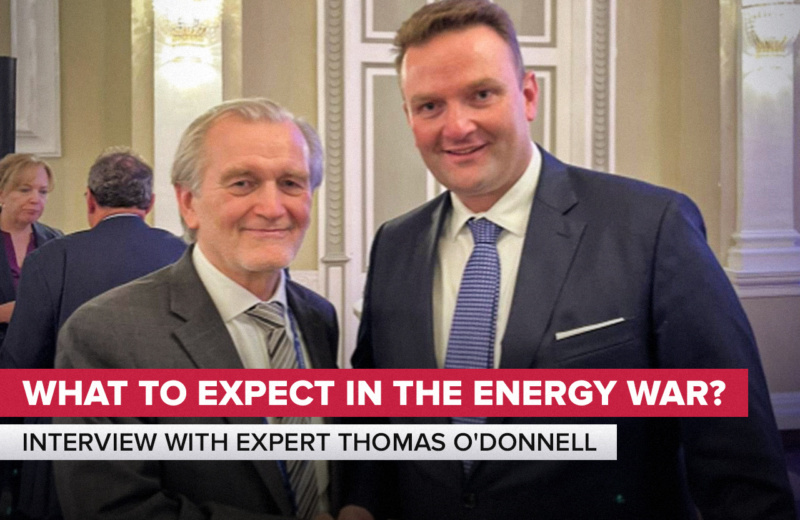
Kyiv Post: “What to Expect in the Energy War? Interview with Expert Thomas O’Donnell”

Dr. Thomas O’Donnell with the former Director of Montenegro’s National Security Agency Savo Kentera. Photo credit: Jason Jay Smart, Kyiv Post. [Note: At a reception hosted by Montenegro’s Defense Minister during the 2BS Forum in Budva, a few hours after the Prime Minister had fired Kantera, who had expelled Russian spies without the PM’s permission. The following interview took place the same day, at the 2BS conference. T. O’D.]

To read the interview at Kyiv Post, which I recommend, go to this link. My thanks to Jason Smart for the interview. – If the link is down, here is the interview:

By Jason Jay Smart

Dr. Thomas O’Donnell is an American energy and geopolitics expert, based for the last decade in Berlin. He has been deeply engaged in analysis and critique of the German-Russian gas partnership and continues to undertake work on geopolitics surrounding global oil markets and OPEC/OPEC+ states.

A nuclear physicist by training, O’Donnell is a proponent of a European nuclear renaissance over the perceived dangerous illusions of “100 percent renewables and no nuclear” policies. He blogs at GlobalBarrel.com and his Twitter handle is @twodtwod.

He spoke to Kyiv Post’s Jason Jay Smart about Russia’s weaponizing of energy supplies, how long that can go on, and the outlook for winters to come in Europe.

What do you make of the bombing of the underwater Nord Stream pipelines?

 We must be clear when we talk about the bombing of Nord Stream 1 and Nord Stream 2 pipelines – Europe is being subjected to an energy war by Russia, which is part of the larger Russian war against Ukraine. We see that the battlefield war isn’t going well for Russia, so Russia is betting on its energy policies being able to cause enough economic pain for Europeans to divide Europe, with hopes that Europe will then abandon its solidarity with Ukraine.

Which is more strategically valuable to Russia and why: Gas or oil? Continue reading

My Al Jazeera: Washington picked a pointless, populist fight with the Saudis over OPEC+ cuts

I explain further in the blog post, way below. English audio is above. Arabic video just below.
To defeat Russia’s energy war, OPEC should invest in CAPACITY to produce more oil. So should USA shale.

The title above says much more succinctly what I was hoping to get into in this interview. Below are the beginning of an article I was writing for this blog post. However, a USA organization is interested in using it for an Op-Ed. So, only the initial part is below. I hope to post on this fully very soon (i.e., a published article). – Tom O’D.

In my view, the Biden Administration has unwisely gotten into an exaggerated public clash with the Saudis and OPEC/OPEC+ over their 2 mbd quota cut.

The key here is the need for more investment rapidly into both the OPEC states (which have plenty of oil reserves that can be developed) and into USA shale resources (that are also abundant and need to be more rapidly expanded).

The looming global recession discourages investors in both instances, of course. And, the Biden administration has reason to worry, both if a global recession soon begins, slashing oil demand, and especially if it doesn’t (but, it will).

I agree with Ed Morse (video interview on CNN here), veteran oil-market analyst, head of Citibank’s Global Commodities: Regardless of the OPEC quota cut, given the strong trend towards a global recession, which is proceeding relatively slower in the USA than elsewhere, it’s likely oil prices will be “in the $70’s at the end of the year.”

… to be continued.

My Sky News: Are EU Measures vs the Russian Oil- & Gas-War Enough?

English audio track is above for Arabic video below.
Sky News Arabia interviews me last night on the fight vs. the Kremlin’s energy war against Europe, a second front to its war against Ukraine.

Dear GlobalBarrel.com readers,

Some upcoming events I’ll attend and post here:

1. I’m invited to speak at the “12th 2BS Forum, one of the leading politico-security conferences in Southeast Europe, organized by the Atlantic Council of Montenegro.” So I’ll be in Budva from 6-9 October. Ukrainian President Zelensky will deliver a keynote video speech from Kyiv. My Panel is 8 August 2022, 14.45 – 15.15:

The Climate-Energy Security Nexus, with speakers:

  • Thomas W. O’DONNELL, Energy & Geopolitical Expert
  • Alan RILEY, Nonresident Senior Fellow, Professor, City Law School, Global Energy Center, Atlantic Council ONLINE SPEAKER TBC
  • Moderator: Jasmina KOS, Presenter and Reporter, Al Jazeera Balkans

2. I’m also invited to speak at

  • The 9th Annual Gulf & Arabian Peninsula Studies Forum, for which I will be in Doha, Qatar from 21-24 October. The conference title is: “Implications of the Ukraine crisis and regional and international competition for the future of security and energy in the Gulf region.”
  • The My topic will be the transformation of the German (and EU) relationship with the GCC states in energy and security matters since the Russian aggression against Ukraine and the parallel Kremlin energy war against Europe.

I plan to post on the content of these conferences and my contributions, and to try to post more of my media interviews – when they may be of use.

Continue reading

My Al Jazeera: I was asked to assess Pres. Von der Leyen’s proposals on the energy crisis | Sharing hardships fairly is the key to unity.

Just as President Von der Leyen finished her speech, I was asked for an analysis of her proposals to cope with the energy crisis – which Member States’ will meet to approve or reject on 30 September.

EU Commission President Ursula Von der Leyen presented the commission’s plan to address the growing energy crisis before and during the coming winter. Now there will be two weeks of discussions among Member states until their energy ministers gather on 30 September to decide which to endorse.
There will undoubtedly be no price caps on Russian or other natural gas.
There will be liquidity for those energy companies struggling to purchase high-priced gas.
There are measures to decouple the effects, at least, of the coupling of the electricity prices to high natural gas prices in the wake of Putin’s regime cutting its pipeline flows to Europe. The idea here, as I explained, is a sort of “windfall profits taxes” on low-cost energy producers, such as renewables and nuclear, to capture their rents and redistribute them to those citizens and firms struggling to pay energy bills during the crisis.
I explain that this is a wholly appropriate measure during wartime, which is what this is – an economic and energy war vs. Russia to support the Ukrainian people’s fight against Russian aggression.
I was asked, again, as on other networks recently, whether the EU is “divided” on these measures.
I explained how there are absolutely no proposals that the EU (or USA) back down on its sanctions program vs. Russia and esp. vs. Russian energy.
I explained how, despite Orban of Hungary and some similar examples, these have been pretty well handled by the majority of Member states and the Commission and in fact the sanctions and emergency measures have gone forward.
I noted that in two or so years, Russia will be relegated to a second-level energy exporter, and the EU will certainly be able to be independent of Putin’s regime in the energy sector.

Al Jazeera’s video on my view: “What does Russia’s gas cut mean for Europe?”

My thanks to Al Jazeera’s Katya Bohdan, producer, and the digital team in Doha (English) for this well done “documentary” featuring my point of view on: “What does Russia’s gaas cur mean for Europe?” I think it is self-explanatory (and its short). Watch it below or directly at the AJ link here. Tom OD.

My AlJazeera: Russia cuts exports via Nord Stream 1 by 60%, further weaponizing EU over-dependence, as part of its war against Ukraine. EU winter gas rationing is possible.

Jun 17, 2022 Today, Gazprom announced a further cut in exports of gas via Nord Stream 1 to Germany and on into Europe. Earlier this week, they had cut 40%, now it is 60% of the 55 billion cubic meters per year (bcm) that normally flows in this pipe.

I explained that the Gazprom excuse – -that it could not re-import some compressor parts it had sent to Siemens to repair in Canada due to sanctions — appears as a convenient, manufactured excuse.

I pointed out that a one-off sanctions waiver from the USA, EU and/or Canada for the reimportation of these very specific parts could likely be easily arranged – and if the gas did not again flow fully, Gazprom’s ruse would be clearly exposed.

However, as I said, this is more accurately understood as simply another step in the weaponization of the over-dependence of the European Union (and esp. of Germany, Austria and Italy) on Russian gas imports, a game which Mr. Putin began in earnest in August of 2021.

Continue reading

My DW live: Gazprom Germania bailout: German policy made EU hostage to Russian energy, enabled Moscow’s Ukraine war | German strategy 1980-2022 was “strategic balancing” of Russia vs USA to carve out a space for its freedom of action within sphere of USA predominance.

My DW Live, 14 June 2022: Gazprom Germania baili out; What was the logic of German elites to partner with Russia on energy?

My live discussion with DW (Deutsche Welle, the German national broadcaster; in English) on 14 Jun 2022 on Gazprom Germania’s Euro 10 b loan from the German state. I stressed that German Energy policy has made the EU hostage to Russian energy, and enabled Moscow’s Ukraine war. Why did Germany do this?

From 1980-to-2022 German elites depended on their Russian oil-and-gas partnership as a means to carve out a space for German capital despite general USA predominance, while still remaining inside the USA-protected Western alliance and global trade system. Their geostrategic gamble — a “strategic balancing” of Russia for perogatives vis-a-vis USA predominance — has led to disaster..

We discussed the reasons the German government is offering up to Euro10 billion to bail out Gazprom Germania, which was a daughter of Russian state gas export monopoly, Gazprom, in St. Petersburg.

Continue reading

Asharq live: No EU embargo agreed vs. Russian oil. Some too cautious (Germany), others pro-Putin (Hungary). Yet, EU has months of oil in storage. [EN audio, AR video]

Above: ENGLISH Audio }} Below: ARABIC video
I was on with the expert, Sona Muzikarova,a chief economist at GLOBSEC in Bratislava, Slovakia.

We discussed the EU’s repeated failures to impose an embargo in Russian oil. Now, (after Monday 30 May) they are considering a sea-borne-oil-only embargo.

My Al Jazeera: Finland, the Baltics & Poland prepared well for Gazprom’s cutoff. Germany & Austria did the opposite, putting EU at risk.

ABOVE is English audio — BELOW is Arabic video. Recorded live; Al Jazeera, 21 May 2022.

I told Al Jazeera that Finland is well prepared, having worked since 2017 with Estonia, Latvia and Lithuania – the Baltic states – and with Poland to connect them all together with new pipelines, also to access LNG, storage and soon, new supplies from Norway.

Finland has also rented a regasification ship, from a US firm, to receive 5 billion cubic meters per year of LNG, whch will be plenty to supply both itself and Estonia in the wake of Putin cutting off Gazprom supplies of natural gas. Finland refuses, as did Poland too, to pay Moscow in rubles and so are being punished by Putin.

Continue reading