Category Archives: Economic Crisis

My Asharq-Bloomberg: (1)Trump is following Miran’s tariff strategy (2)My reply to Jeff Sachs on US dollar role (3)Tariffs boost EU deindustrialization & (4)turbocharge German auto-crisis (5)Trump’s EU energy-purchase demands

Here’s my interview and a written elaboration – in lieu of a transcript:

  1. Trump’s “tariff shock” on everyone was intended mainly to force negotiations. Especially this is to insure no country:
    • Functions as a transit state for Chinese exports to get into the USA without paying crippling tariffs, or
    • Provides a Chinese-owned manufacturing site in their country with the same aim of accessing the USA market without crippling tariffs..
      • Trump’s Chair of the Council of Economic Advisers Miran and Treasury Secretary Bessent have been fairly clear about this, if one listens in detail.
  2. Trump Tariffs’ impact on Europe – Deindustrialization. German auto sector as an example.
    • While Trump and his circle militate against “deindustrialization” of the USA accomplished over the past few decades by the growth of Chinese manufacturing capacity and the export of these products into the USA market, Europe has an immediate problem, however, with the current advance of its “deindustrialization” or, as some more optimistically say, its new industrial “evolution”. [Some references from major German economic institutes on deindustrialization: IFO Institute, IW Institute, Kiel Institute, the latter of which has evolved a bit on this].
    • Taking the German auto industry as an example, it was already suffering from well known, chronic problems of Germany’s own making. These include two decades of low infrastructure investments, poor digitalization, high taxes, and being subjected to arbitrary government mandates to reduce diesel sales and increase battery electric vehicle production, and etc. ON top of this, German industry has also suffered high energy prices due to the countries exceptionally complex all-renewables energy transition model. On top of this came suddenly, from 2021, the Russian energy war, which denied Europe half of the cheap gas that European, and especially German industry was relying on to compensate for the high-cost of the all-renewables transition.
    • This energy war – and on the heels of the Covid shock – was devastating to German manufacturing and heavy industries, providing the proverbial straw that broke the camel’s back. In my assessment at the time, this was the point at which German industry’s problems of multi-faceted uncompetitiveness morphed into a form of deindustrialization,
    • Germany is in its third year of recession. However, this is not just a recession. Note that the VW, the German auto firm, for example, in September 2024, began mass layoffs for the first time in 87 years in September 2024. BASF is in a similar conundrum. In my view this is a systemic, secular problem over and above any present economic downturn.
    • So, the point of painting this detailed picture of the crisis of German automobile manufacturing, as an example, is that one can now really only imagine what a sharp knock-on effect Trump’s auto tariffs and his other tariffs might have on top of all this.  This is devastating. Already the CEO of Mercedes has said if the tariffs continue he will move the production of the cheaper models to the USA. Already one of the largest exporters of cats from the USA is a German factory.
  3. My response (critique) of Jeff Sacks‘ dollar-decline predictions
    • I was asked to listen to a clip from Asharq/Bloomberg’s earlier on-air interview with Nobel Prize economist, Jeffry Sachs, about his prediction that the US dollar would lose its reserve currency status in this decade and be replaced by regional currencies.
    • My take was that there was little new (or old) factual evidence of this, plus Trump’s tariff shock is not necessarily a long-term tactic. So, I commented that Sachs has had this theory for a long time, an it is nothing new. (I think it is fair to say he is quite sympathetic to China in various interviews, for some years now.) So, I simply said I was not surprised he says this, as he has for a long time.
    • However, I explained (with a bit more factual detail than Sachs, I hope) that indeed, even Trump’s theorist Miran and Bessent too agree that the tariffs strategy is designed to reduce the value of the dollar (its aims is precisely a weak dollar), and this should normally mean that the dollar loses its reserve currency status, its preferred use in the world, that these Trump theorists have a plan for a “Mar-a-Lago” or similar accord for states that are seen as being key, close allies, who would agree to peg their currencies to the dollar, and that they should be expected to agree as they need to trade into the USA market.. This is based on the observation that the USA market has a special status in the world. If this were to pass, they theorize that this would in fact preserve the special, preferred reserve status of the US dollar.  Trump likes this as he has said that if this status is lost, then the destiny of the USA is to be a “third world” economy. **Continued at GlobalBarrel.com ….
Continue reading

My Al Jazeera: The EU will retaliate against Trump’s arbitrary tariffs | Attacking allies, Trump dilutes fight vs. real threats from highly subsidized Chinese exports.

Last night, I was live on Al Jazeera’s evening news to give an “EU perspective” on Trump’s sweeping tariffs on the EU and have a bit of a debate with Hon. Robert Arlett, Sussex County Council, Delaware, USA – a MAGA supporter. I was happy to do so.

I think I made several decent points of criticism about how the entire premise for “retaliation” against the EU on trade was “made up” under an “arbitrary” formula that “makes no sense.” I allowed that, as is often the case with Trump, much of this, the “retaliatory” portion, might be a pressure tactic for some other, still-to-be-revealed concession Trump is aiming for from Europe.

Of course, this is the geo-economic side to Trump’s geostrategic undermining of a unified USA-EU approach to facing Russia over its invasion of Ukraine. (However exactly how that new geostrategic relationship with Europe and NATO might all fit into Trump’s larger, global security strategy is still mostly up in the air, a matter still taking shape.)

However, as for these massive tariffs on Europe and Asian allies, these are a systematic attempt to dismantle globalization as we have known it and instead to focus on the subordination of European and Asian allies to a system where hegemon is unwilling to pay certain costs of maintaining its allies within its system.

Trump envisions a system where the USA makes no sacrifices or pays no communal costs, but must profit at every step from each and every ally. Indeed, the USA has powerful tools afforded it from its geo-economic dominance, tools which Trump seeks to exploit to unilaterally shape international economic and geopolitical relations, while forcing its allies to pay for the privilege and advantages of belonging to the USA-hegemon-maintained system.

Continue reading

My Dublin talk: “The role of renewables in securing Europe’s energy” [at EU Commission Representation, Polish Presidency event]

I felt greatly honored to speak in Ireland, the home of my ancestors, at a high-level Irish-Polish event, invited by the Polish embassy as part of Poland’s Presidency of the European Council. [Spoiler alert: my assessment of the Green Deal’s impact on EU energy security and competitiveness was highly critical. And, I called for a radical reform, modeled on the 1970-80’s French Messmer nuclear program, the response to a similarly dire European energy and competitiveness crisis.]

For Ireland we had Secretary General Oonagh Buckley and Wind Energy Ireland CEO Noel Cunniffee; for Poland, Daniel Piekarsky, Head of Energy Security Unit in the Foreign Ministry, and myself, Global Fellow of the Wilson Center, Washington (external) working in Europe, from Berlin.

Our moderator, from the Polish Embassy, Dublin, was the Polish diplomat and patriot, Dr. Jacek Rosa — a good friend, with whom I had the great pleasure of closely collaborating, for several years, in opposition to the Russian-German Nord Stream 2 gas-pipeline partnership, before the 2022 full-scale invasion of Ukraine. Below is the lineup, the initial invitation and some pictures. The event was off-the-record, so I show here only my own, slightly redacted talk.

Continue reading

My Asharq/Bloomberg: European gas surplus slashed as (1) Russian gas via Ukraine ends, (2) low wind & sun starve renewables. Yet the EU rejects new long-term gas import deals, betting on green-hydrogen. [EN/AR]

English voice-over version.

I appeared alongside Dr. Hashem Aqel, Oil and Energy Expert, Associate Fellow at Oxford Institute for Energy Studies, who contributed several insights. Asharq News is the Mideast Bloomberg partner. My further analysis follows:

Arabic, original broadcast version.

The recent rise in EU gas prices and the rapid depletion of what had been a significant surplus in EU storage, is principally a two-sided story.

  1. One side is indeed about the impending cutoff of Russian gas, still flowing across Ukraine. This has been expected for months, and so is already largely priced in. Expectations of new transit across Ukraine of Russian-origin gas re-labelled as Azerbaijani was being negotiated. However, this deal fell apart, with the final nail in its coffin being when Ukraine’s President Zelensky asserted that Ukraine would not transit any further Russian-origin gas after 31 December unless payments to Russia are withheld until after the war ends. This seems a very reasonable demand for a country fighting for its survival against a Russian invasion. [See “Ukraine will not allow transit of Russian gas with Azeri label, Zelenskyy says, dashing Slovak hopes,” EuroNews, Jorge Liboreir 19 Dec. 2024.] This marks the end of the five-year contract, which was only agreed to at the last moment before New Year 2020, when the US Senate finally forced then-President Trump to agree to sanctions on Nord Stream 2 construction (I was in Kyiv, for Naftogaz, and on Ukrainian television, analyzing Washington sanctions, Kyiv-Moscow negotiations, and the pro-Nord Stream position of Berlin.)
  2. The other side is a story of yet another European energy own-goal, a consequence of its over-reliance on weather-dependent renewable energy generation. This overreliance has made its electricity supply increasingly volatile, in sync with the weather. In November and early December, especially north and western Europe experienced what the Germans call “Dunkelflaute“, a protracted wind and solar drought. Batteries can only substitute for perhaps 40 minutes, or at best an hour. So, the de facto long-term, grid-scale “storage” backing up Europe’s plethora of wind and sun generation is really just natural-gas turbine electrical generation plants. The reality of increased generation (and hence, electricity market) volatility and dependence on gas backup generation was analyzed this week in a data-driven manner by the Oxford Institute for Energy Studies. [See: “Dunkelflaute: Driving Europe Gas Demand Volatility” Energy Insight: 161, by Anouk Honoré and Jack Sharples, Senior Research Fellows, OIES, 2024/12.]
Continue reading

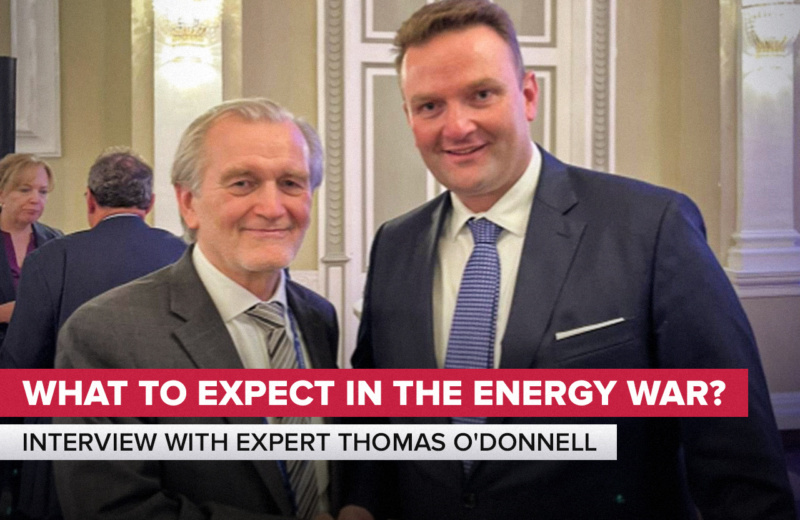
Kyiv Post: “What to Expect in the Energy War? Interview with Expert Thomas O’Donnell”

Dr. Thomas O’Donnell with the former Director of Montenegro’s National Security Agency Savo Kentera. Photo credit: Jason Jay Smart, Kyiv Post. [Note: At a reception hosted by Montenegro’s Defense Minister during the 2BS Forum in Budva, a few hours after the Prime Minister had fired Kantera, who had expelled Russian spies without the PM’s permission. The following interview took place the same day, at the 2BS conference. T. O’D.]

To read the interview at Kyiv Post, which I recommend, go to this link. My thanks to Jason Smart for the interview. – If the link is down, here is the interview:

By Jason Jay Smart

Dr. Thomas O’Donnell is an American energy and geopolitics expert, based for the last decade in Berlin. He has been deeply engaged in analysis and critique of the German-Russian gas partnership and continues to undertake work on geopolitics surrounding global oil markets and OPEC/OPEC+ states.

A nuclear physicist by training, O’Donnell is a proponent of a European nuclear renaissance over the perceived dangerous illusions of “100 percent renewables and no nuclear” policies. He blogs at GlobalBarrel.com and his Twitter handle is @twodtwod.

He spoke to Kyiv Post’s Jason Jay Smart about Russia’s weaponizing of energy supplies, how long that can go on, and the outlook for winters to come in Europe.

What do you make of the bombing of the underwater Nord Stream pipelines?

 We must be clear when we talk about the bombing of Nord Stream 1 and Nord Stream 2 pipelines – Europe is being subjected to an energy war by Russia, which is part of the larger Russian war against Ukraine. We see that the battlefield war isn’t going well for Russia, so Russia is betting on its energy policies being able to cause enough economic pain for Europeans to divide Europe, with hopes that Europe will then abandon its solidarity with Ukraine.

Which is more strategically valuable to Russia and why: Gas or oil? Continue reading

My Al Jazeera: Washington picked a pointless, populist fight with the Saudis over OPEC+ cuts

I explain further in the blog post, way below. English audio is above. Arabic video just below.
To defeat Russia’s energy war, OPEC should invest in CAPACITY to produce more oil. So should USA shale.

The title above says much more succinctly what I was hoping to get into in this interview. Below are the beginning of an article I was writing for this blog post. However, a USA organization is interested in using it for an Op-Ed. So, only the initial part is below. I hope to post on this fully very soon (i.e., a published article). – Tom O’D.

In my view, the Biden Administration has unwisely gotten into an exaggerated public clash with the Saudis and OPEC/OPEC+ over their 2 mbd quota cut.

The key here is the need for more investment rapidly into both the OPEC states (which have plenty of oil reserves that can be developed) and into USA shale resources (that are also abundant and need to be more rapidly expanded).

The looming global recession discourages investors in both instances, of course. And, the Biden administration has reason to worry, both if a global recession soon begins, slashing oil demand, and especially if it doesn’t (but, it will).

I agree with Ed Morse (video interview on CNN here), veteran oil-market analyst, head of Citibank’s Global Commodities: Regardless of the OPEC quota cut, given the strong trend towards a global recession, which is proceeding relatively slower in the USA than elsewhere, it’s likely oil prices will be “in the $70’s at the end of the year.”

… to be continued.

Al Jazeera’s video on my view: “What does Russia’s gas cut mean for Europe?”

My thanks to Al Jazeera’s Katya Bohdan, producer, and the digital team in Doha (English) for this well done “documentary” featuring my point of view on: “What does Russia’s gaas cur mean for Europe?” I think it is self-explanatory (and its short). Watch it below or directly at the AJ link here. Tom OD.

My Al Jazeera Live: EU Gas Crisis 2021: Too many windmills w/o wind, a cold winter & hot summer drained EU & Russian storage. While Putin fills his, EU goes back to coal & prices soar. [Arabic & English]

ENGLISH AUDIO: At 0:30 are the interpreter’s questions & my answers.

Video In Arabic – Audio above has English interpreter’s and my voice in English.

Decoding the Oil Price War 2: My Wikistrat webinar “Oil Price War & COVID Crisis” transcript

covid-oil_war_2bd-cropped-graphic_wikistrat_12apr20_captureMy Wikistrat webinar transcript “Oil Price War & COVID” from a couple weeks ago is now available on their website as a PDF.  Issues discussed include:

  • Why did Moscow declare the “war”? [Note: Putin & Sechin’s initial boasts Russia would hold out for “years”, kill shale & end sanctions all stopped in only a couple days!]
  • The Saudi response was sharply focused against Russian oil-pipeline markets in W Europe (Druzhba) & Asia.  [I believe this focused Mr. Putin’s attention on economic realities as opposed to Mr. Sechin’s anger-driven desire for revenge against US sanctions that had inflated his (self-)image of Rosneft and Russian oil-market prowess when up against a concerted Saudi counter-war, and the prospects of various US responses.  Reports are that Putin spend three days on the phone to undo this fiasco and, in the end, had to accept significant cuts to Russian output.  See my GlobalBarrel.com post of last week explaining the initial, flawed Russian strategy.]
  • The options Trump had to choose from undermine his long antipathy to OPEC. (Did he secretly offer Putin any Nord Stream 2, Ukraine or Venezuela sanctions relief? If so, Congress won’t approve.) Also: Big Oil (American Petroleum Institute) and W. Texas/other independent producers are pulling at Trump in two very different policy directions re. OPEC, tariffs, production controls, etc
  • And more (esp. in the Q&A): probable impact on carbon mitigation policies, the China market for LNG, US shale’s financial and production future, etc.

Continue reading

Bolivarian Venezuela in crisis: An oil-rich nation collapses? Berlin, 10 October

8oz7x3svenezuela_food_line

Bolivarian Venezuela in crisis: An oil-rich nation collapses? – Panel Discussion (bios follow):

  • Ms. Rita Bitar Deeb  PhD student in Political Science at the Otto-Suhr-Institut of Freie Universität Berlin
  • Dr. Ivo Hernandez  Lecturer in International Relations at the Political Science Institute of Universität Münster
  • Dr. Manuel Silva-Ferrer  John Boulton Foundation Fellow and Lecturer at the Latin-American Institute of Freie Universität Berlin
  • Dr. Thomas W. O’Donnell -Moderator  Guest Lecturer at Hertie School of Governance and the European Studies Program, FU/BEST at Freie Universität Berlin

WHEN: 10 October, 6-7:30 pm. LOCATION:  Hertie School of Governance,  Friedrichstrasse 180 – 10117 Berlin, Germany.  [To attend, please register online.] – Venezuela is currently unable to adequately feed its people, or to provide basic services such as medical care, education, and electricity. Polls indicate about 90% of the population would vote to remove its Chavista president, Nicolas Maduro, if his government allowed a recall referenda to take place this year, which is widely demanded. What will happen in Venezuela: Collapse? Chaos? Democratic renewal?  And, moreover, why is this occurring now?

Since the mid-20th Century, fueled by oil riches, Venezuela has veered from being the leading example of ‘democratic development’ within a continent rife with right-wing dictatorships, to a nation mired in its own economic and political crises. A ‘neo-liberal shock’ in the late-1980’s failed and was roundly rejected by citizens. At the end of the 1990‘s, Hugo Chavez broadly excited the hopes for development of not only Venezuelans but elicited significant sympathy worldwide with Chavismo’s ‘new resource nationalism’ and ’21st Century Bolivarian Socialism’. However, this leftward turn is also demonstrably failing, with the nation again on the brink of disaster. What comes next? Our panel of Venezuelan experts weighs in and will address attendees’ questions.


Rita Bitar Deeb is a PhD student in Political Science at the Otto-Suhr-Institut of the Freie Universität Berlin. She received her Master in Public Policy and Management from the University of Pittsburgh and Graduate Certificate in Latin American Studies. Her research interests are democratization process, social development and gender policy. She has worked for the Inter-American Development Bank (IADB), and several local NGOs as project coordinator in Venezuela (Atenea, Súmate, Red de Apoyo-HHRR). Bitar has taught at the University of Kassel in Germany, and at the Catholic University in Caracas.


Ivo Hernandez is lecturer in International Relations at the Political Science Institute of Universität Münster.  He studied at Universidad Central de Venezuela (UCV) in Caracas, the London School of Economics (LSE), the University of Heidelberg and University of Tübingen in Germany and The National Defense University in Washington D.C. His research interests include oil politics, national oil companies, the logics of terrorism, and Latin American politics and political economy.


Manuel Silva-Ferrer is John Boulton Foundation Fellow – exploring oil, society and culture in 20th-Century Latin America – as well as Lecturer at the Latin-American Institute of Freie Universität Berlin.  Born in Caracas, he is a graduate of the Institute of Communication Studies at Universidad Central de Venezuela (UCV) and earned his PhD from Freie Universität Berlin.  He was Director of the state film foundation Cinemateca Nacional de Venezuela and Head of Cinema and Media at the Ministry of Culture where his work included developing the National Academy of Film and Audiovisual.  Silva-Ferrer led ExtraCámara, a magazine for Latin-American photography, and was co-responsible for the creation of the Centro Nacional de la Fotografía, a public foundation for the promotion of photographic art. During his studies, Silva-Ferrer was Fellow of the Fundación Gran Mariscal de Ayacucho, and awarded a PhD full scholarship from the German Academic Exchange Service (DAAD).


Moderation & comments:

Thomas W. O’Donnell is Guest Lecturer at Hertie School of Governance and the European Studies Program (FU/BEST) at Freie Universität Berlin.  An academic, analyst and consultant in the global energy system and international relations, his work has encompassed especially the role of oil and gas in the EU, Russia, Latin America, Middle East, China and the USA.  His PhD is from the University of Michigan at Ann Arbor in experimental nuclear physics, and he previously studied Political Science and China Studies at the State University of New York and Canisius College.  In 2008-09, he was US Fulbright Scholar and Visiting Professor at the Center for the Study of Development (CENDES) at the Central University of Venezuela (UCV) and in 2015 AICGS (American Institute of Contemporary German Studies) & DAAD Fellow in Washington D.C. O’Donnell has taught post-graduate seminars on energy in international relations and development at The University of Michigan, The Ohio State University, The New School University’s JJ Studley Graduate Program in International Affairs (NYC),and Freie Universität, JFK Institute (Berlin). He is Senior Analyst at Wikistrat and consults with other geopolitical and business-intelligence firms. Before his PhD, O’Donnell gained broad tech experience in U.S. automobile-manufacturing, railway-operations and power-generation industries.  He is author of some 40 peer-reviewed scientific physics papers.


If you wish to attend, please register online.

Latin American Oil: Beijing Still Lending, But for How Long? – I’m quoted by Energy Compass

energy_intelligence_tom_od2_13may16

Last week, Energy Intelligence (EI) quoted me on China’s continued appetite for oil and gas investments in Latin America even with its own  economic slowdown and LatAm’s many political upheavals. (Sincere thanks to EI for a PDF of their proprietary Energy Compass to share on my blog. You can access it below here.)

Some thoughts on China’s strategy: In the case of Venezuela, as the price of oil fell, Beijing quickly eased up on PDVSA’s repayment terms for its huge outstanding loans which are repayable in oil. This shows some willingness to help Venezuela cope with the falling market value of oil. Why? Because, mainly, it is the oil that China has always been laser-focused on – not making interest on these loans.

Generally, it is clear that new Chinese investments or loans are still possible in Latin America. In Venezuela however, Continue reading

A Strange “No!” Alignment: Greeks, IMF and Washington v. Berlin and Brussels

What a strange rebellion against the international financial order.  On Sunday 5 July, Greece voted “No!” by a resounding 61% to the bailout conditions insisted upon by Berlin, Brussels and “the creditors.”  But, what is truly unique here is the alignment of international forces for renegotiation of Greek debt.

Throughout the post-War era, whenever it came down to imposing “discipline” on other small, debt-defaulting states, the most intrepid champions of the norms of the international financial order have consistently been Washington and the IMF (just ask Argentina’s Mrs. Kirchner, she’ll tell you).

Yet, look who agrees with the Greeks that their debts–in their present magnitude and structure–are impossible and potentially disastrous for the country: Continue reading

My DGAP article | Energiewende vs. USA Shale Gas: Can German industry compete?

ImageIn Germany, the impact of the country’s renewable energy transition on the economy is a very hot topic.  Tuesday, Mrs. Merkel’s  new Minister of Economy & Environment (and chair of the Social Democratic Party), Mr. Sigmar Gabriel, declared: “We need to keep in mind that the whole economic future of our country is riding on this,” (NYT, 21Jan14).

Here’ is my article in the DGAP’s (German Council on Foreign Affairs’) IP Journal of 30Dec13  (submitted 24Nov13):

Germany’s Energiewende (renewable-energy transition) is under intense pressure both from consumers facing soaring electric bills and from German manufacturers fretting about their falling energy competitiveness vís-a-vís the US, where manufacturers are benefiting from the boom in cheap natural gas production. What should be done to address these concerns has become a major topic of the CDU-SPD negotiations forming Chancellor Merkel’s new coalition government.  

From the viewpoint of German manufacturers, there are two ways the US shale gas revolution implies a worrisome competitive challenge. First, cheaper natural gas in the US is lowering electricity and other energy costs for American manufacturers, while Germany’s continue to rise. This is especially of concern to energy-intensive industries, where the EU now has 36 percent of world capacity and the US only 10 percent. Secondly, as the US begins to build facilities for export of liquefied gas (LNG), this capacity could have a significant effect on the price of electricity and gas in Asia. … Continue reading at DGAP’s (Deutsche Gesellschaft für Auswärtige Politik e.V.) IP Journal.

Competing with China in Latin America: Is Germany losing its high-tech advantage?

Wilfredo R. Rodriguez H., CC BYAn article I wrote for the IP Journal of the German Council on Foreign Relations is online today. It examines data on China, the EU and Germany’s trade with Latin America and the Caribbean, including in energy. Here’s a quote from near the end:

…  China’s exports to Latin America in the low-, medium-, and  high-tech categories were below those of Germany and the EU in 2003; but in 2012 [China’s exports] exceeded the combined totals of the EU15 in the medium-tech and even in the high-tech categories. The only place the EU15 surpasses China is, rather oddly, in the low-tech manufactured goods …

-> READ THE ARTICLE at GCFP’s IP Journal or Research Gate.

My talk: JFK Institute, Berlin: How “The Global Barrel” shapes Washington-EU relations

You’re invited to my lecture at The JFK Institute of North American Studies at Freie Universität in Berlin, Germany, Tuesday 6 PM. Here is the flyer, then the Abstract.  Tschüß!

ABSTRACT:

“The Global Barrel”

Today’s globalized market-centered energy system defines Washington’s relations with the EU, Japan and OPEC states Continue reading