Tag Archives: Middle East

My TRT-London | With air defenses & proxies decimated, USA-Israel can bomb Iran at will, killing nuclear & missile programs, and its negotiating hand | Trump, Gulf eye Abraham Accords era

MY COMMENTS: 1) USA long-planned surprise strategy 2) Iran leaders’ 20-year nukes brinkmanship strategy aimed for USA ssecurity-guarantee deal
ALL GUESTS – TRT-London, USA bombing

I was invited on TRT-World, London, 24 June, for a panel after US strikes on Iranian nuclear sites (see the panelist lineup below. I answered two questions at some length – see the 2nd video.)

In summary: Trump claims USA Operation Midnight Hammer “obliterated” the country’s nuclear capacity, but how much have they really been degraded?

My analysis is that it does not matter. If the USA decides to bomb again at will, without Iran having air defenses the USA and Israel can destroy or disrupt most any renewed Iranian work on its nuclear or conventional missile program. If, as he stated, repeat bombings as needed are Trump’s intention, then this should be the case. This now leaves Iran very little negotiating leverage. The regional proxies it always intended to use for retaliation in just such a scenario have been decimated by Israel.

Therefore, there is a high likelihood Iran will be forced by Trump to negotiate from a now much weaker position. If Tehran resists, it could fall back to rely on state-sponsored terrorist methods, which are of limited usefulness for maintaining a modern functioning state and economy.

Overall, I emphasize that this “12 Day War” has been especially motivated, by Trump, to assure USA Gulf allies that they can now safely enter into the Abraham Accords with Israel and the USA, establishing a new regional security structure. Trump will be constrained to do whatever is necessary, militarily and in negotiations, to insure the Iranian threat these allies have felt acutely remains under control. In turn, if these accords, which Trump’s chief negotiator, Steve Witkoff, was reportedly already working on among the USA’s Gulf Arab allies immediately after the USA bombing is intended to allow the USA to move on, focusing more squarely on Great Power competition elsewhere.

This is my general assessment. There are many details and some possible derailments here, of course. – Tom O’D.

Continue reading

“12-Day War”: Why no energy crisis? Iran regime was cornered. Seeing USA’s limited aims, it dared not escalate, gave up. | My Al Jazeera comments

The ceasefire Trump brokered will hopefully end this “12-Day War.” I want to discuss here why this war did not trigger a global energy crisis. [Here’s what I said about this to Al Jazeera last week, in the last five paragraphs. A PDF is also embedded below. I’ll also post a TRT-London show on Iran’s nuclear strategy, recorded Tuesday, soon.]

To assess the risk to energy supplies, understanding the aims of the combatants is key. Throughout this war, it was the USA-Israel side setting the agenda, and there were two strategic aims they could pursue. One was to “only” destroy Iran’s nuclear program and its existing conventional regional power-projection capacities. The second was to go beyond this to undermine the viability of the Islamic Republic, up to forcing a regime change. Why do I say this?

Continue reading

My Al Watan(Cairo): Iran would seek global energy crisis if an Israeli/USA strike threatened regime survival | IEA warns on EU winter gas

ENGLISH Interview | Al Watan, Cairo.  Thurs 10Oct24. 15 minutes
ARABIC Interview

At first, we focused on IEA warnings of a possible EU winder gas shortage due to supply-and-demand mismatches. I agree and expand on the IEA points.

Second, I explained that if Israel retaliates against Iran so strongly that it threatens the regimes survival, or is seen as intending to provoke regime change, then the Iranian leadership will have “nothing to lose” by in-turn escalating to the maximum. Aside from unleashing the maximum response of its proxies surrounding Israel, Tehran’s most potent weapon would be to spark a global oil and gas crisis.

Consider oil: Iran can either shut down the Straights of Hormuz (or simply make them unsafe for tankers) and/or, it can use missiles and drones to destroy significant parts of Saudi, UAE and other Gulf oil facilities, including perhaps even Azerbaijan’s as some Iranian propagandists have threatened.

Consider natural gas: Shutting the Straights or directly hitting Qatar’s massive LNG exports infrastructure would immediately stop Qatari LNG exports. As the world’s second largest LNG exporter, this would immediately cause a separate global natural gas crisis.

Continue reading

My BBC(Cairo)+Alhurra(Wash DC): What if Israel bombs Iran’s oil? Does Israel have an end strategy? “Smite enemies, repeat in 10 years”?

Again, oil security is determined by both global-market balances and geostrategic realities – at present the Mideast war and Russia’s War on Ukraine. My analyses this weekend were featured in: (a) an AlHurra video (LHS English, RHS Arabic), and below these (b) a detailed BBC-Cairo print interview (LHS English Google Translate, RHS Arabic original). where I make similar points as my Friday video in Warsaw.

Alhurra ENGLISH. My comments at 2:45 & 8:20. Date: 5 Oct 2024, with co-guest GPI President Paolo von Schirach, Washington.
Alhurra ARABIC, 5 October 2024

My BBC (CAIRO) print interview in Arabic and English (Google Translate):

Continue reading

What if Israel bombs Iran’s oil? Four points on market & geopolitics. Video-Warsaw 03oct24

Recorded Thurs AM, 03Oct24. Warsaw Old Town, Castle Square.

Will Israel hit Iranian oil infrastructure? And, what part of it? To what effect on markets, and geopolitics, (i.e., Mideast, OPEC, Russia and Ukraine war)? A video report.

MAIN POINTS (see transcript):

1. What if Israel hits Iran oil infrastructure in retaliation for missile strikes on Tel Aviv on Tuesday night? 1.a. The difference effects of hitting Iranian refineries vs oil export terminals In itself, neither target would make big difference in the market. The market would immediately jump, of course, but in principle the effect would be small. 1b OPEC+ and Western Hemisphere have plenty of spare capacity.

2. Consider Saudi market tactics … reportedly they want to now go for share over price support, as price support is failing after well over a year of output cuts (about 6 mb/d). Note: Shortly after this recording the Saudis repudiated the WSJ that reported the switch in tactics to defending share. Likely they’ll now want to wait and see what happens to Iranian exports, or if this Israel-Iran tit-for-tat gets out of hand.

Continue reading

“Energy independence” won’t free the USA from global oil market & geopolitics [I’m cited: CNNMoney]

160809121848-us-oil-imports-shrink-780x439

Credit: CNNMoney, 9 August 2016

Mr. Trump promises he’d use the USA’s shale-oil revolution to deliver “complete” independence from foreign oil, telling voters in May: “Imagine a world in which our foes and the oil cartels (sic) can no longer use energy as a weapon. Wouldn’t that be nice?” But, he is confusing two quite distinct things:

“Energy independence” – in the sense of the USA producing more oil than the country consumes – is indeed possible, even “tantalizingly close” as this CNNMoney article (Aug. 9, 2016, by Matt Egan) makes clear, citing myself and other experts.  For clarity, I’ll call this “net oil-exporter status.”

However, Donald Trump asks us to “imagine” he can use this net oil exporter status, to make the US independent of the global oil market and oil in geopolitics where our “foes” and “cartels” have leverage. Continue reading

How fast can Libyan oil recover? (I’m quoted by CNN)

160719181131-chart-libya-oil-production-780x439

CNN 20 July 2016

The oil market remains glutted, with price in the mid-$40’s.  Despite furtive hopes over recent weeks  by the business press about “imminent re-balancing” of global supply v. demand and about “draw downs” of record-high global storage inventories, data reveal only incremental re-balancing has occurred since fall of 2014 when this all began. (And, from November 2014,  the Saudi’s responded by fighting for their market-share rather than for boosting price, which would have been impossible for OPEC to do on its own given the huge supply glut.)

Continue reading

The EU-US “Oil Weapon”: Putin’s overtures to OPEC, China & Iran reveal desperation

Foto: Presidents Rouhani of Iran and Putin of Russia holding discussions Presidents Rouhani of Iran and Putin of Russia holding discussions

(AICGS Analysis, by Tom O’Donnell)  Since Russia’s president, Vladimir Putin, decided to annex Crimea and back east Ukrainian separatists with troops, many have worried he might use his “energy weapon” to counter U.S.-EU sanctions, as Russia supplies around a third of the EU’s natural gas imports.  But what about Russian retaliation in the oil sector?

That’s hard to imagine. While gas is marketed in bi-lateral, pipeline-mediated relationships, oil is not. It’s liquid, fungible, and marketed in a unified open market—“the global barrel” [and name of this blog, T.O’D.]—which means there are no bi-lateral oil dependencies.

So, when EU leaders were cajoled by Germany’s Angela Merkel into joining the United States in applying sanctions, Russia could do little to retaliate from within the oil sector.  In reality, it is the EU and the U.S., not Russia, that have an “oil weapon” in hand.  And, the flurry of Russian oil diplomacy with OPEC, Iran and China over the past couple of weeks has a distinct whiff of desperation to it. Continue reading

Oil Price Collaterals: Saudi strategy shakes Russia, Iran & Venezuela, but they’re not targets

Obama and Saudi King in Saudi Arabia after the death of previous king

Falling oil prices are not a US-EU-Saudi plot against Russia, Iran and Venezuela… though their effect is certainly not unwelcomed..Foto: REUTERS/Jim Bourg


[Printed in IP Journal, German Council on Foreign Affairs] Pin-pointing the reason for the dramatic – and continuing – fall in the price of oil is relatively easy: OPEC held its 166th conference in late-November 2014 to decide on a strategy to address oil prices, which had been falling at five to ten percent per month since July. Rather than pursue a production cut

Continue reading

“Oil & the US-Iran Crisis” – My talk at American University, Washington DC:

If you are in Washington, DC, this historical overview of the US-Iran Crisis and the role of oil might be of interest:
american_u_iran_talk_01oct14JPG

My talk on Iran, NYC | After an Iran-USA deal: A Mideast without democracy, run by Iran & Saudi Arabia?

Figure 1.  Ayatollah Hashemi Rafsanjani (R) exchanges greetings with the new Saudi Arabian ambassador to Iran, Abdulrahman Bin Groman Shahri in Tehran, April 22, 2014. (photo by Twitter/ISNA)    Read more: http://www.al-monitor.com/pulse/originals/2014/04/rafsanjani-saudi-ambassador-kiss-controversy.html#ixzz32ktJuoKR

Kiss between Rafsanjani and Saudi ambassador stirs controversy   Former Iranian President, Ayatollah Hashemi Rafsanjani (R) exchanges greetings with the new Saudi Arabian ambassador to Iran, Abdulrahman Bin Groman Shahri in Tehran, Al Monitor, April 22, 2014. (photo by Twitter/ISNA)

Appreciation: I am honored to again be invited by my Iranian colleagues in New York, Professors Reza Ghorashi, Hamidah Zangeneh and Hamid Sedghi, to join this panel and discuss the geopolitics of US-Iranian relations.  And, my thanks to Prof. Sedghi for reading my paper as I am teaching in Berlin and cannot be with you today. I only ask that those who dislike my message, kindly refrain from shooting the messenger.

Introduction

The US-Iran nuclear confrontation finally appears close to resolution.  This is because both Presidents Obama and Rouhani desire a diplomatic solution, and both countries need to move on. With such an agreement, it is possible that relations will slowly become normalized.

Of particular note—as a direct consequence—are the recent secret negotiations between Iran and Saudi Arabia towards a rapprochement.  These were initially facilitated by Oman (e.g. see reports here, here, and here). Until very recently the Saudis had remained fiercely opposed to any US deal with Iran.  However, the Saudi’s are realists, and know when it is time to adapt.  Figure 1. is a photo of kisses exchanged on 22 April between ex-President Rafsanjani of Iran and King Abdullah’s ambassador to Iran, which caused quite a stir in the region. Agreements reached in these recently revealed negotiations have already significantly affected the presidential-succession crisis in Lebanon, sectarian conflicts in Iraq, and the conflict in Yemen. Next the two sides are expected to negotiate regarding their interests in the Syrian conflict.

In addition, the nature of the US-Saudi relationship is changing, transferring much more responsibility on the Kingdom and its Gulf partners for their own defense–albeit strongly supported with US weapons and logistics. This is part of the US disengagement from direct regional interventions, which will be significantly furthered by a successful US-Iran agreement (e.g., see here and here, and this report on Saudi defense buildup from Balfour at Harvard).

How are these new developments to be understood? Continue reading

USA Oil Seminar 5.0 | USA as Rising Energy Superpower?

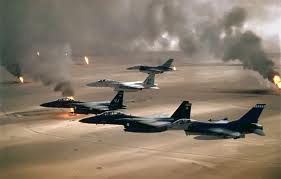
us_air_force_jets_oil_buring_iraqNote: These “USA Oil Seminar” posts are extra readings for my students to better understand how US energy policy is developed and to hear the views of US experts.  The seminar is: “The Global Oil System & US Policy” at JFK Institute of FU-Berlin. 

RECOMMENDATIONS:

  1. This Friday, watch live (or the recording later on): Is the U.S. a Rising Energy Superpower? Implications for Global Markets and Asia, the Middle East, Russia, and Europe.  CSIS upcoming talk by Fereidun Fesharaki.  FRIDAY, MAY 16, 2014 | 10:00 AM – 11:30 AM .  Moderated by David Pumphrey.
  2. Read the paper: Fueling a New Order? The New Geopolitical and Security Consequences of Energy |April 15, 2014. By: Bruce Jones, David Steven and Emily O’Brien.  Brookings Institute; Washington, DC.

BACKGROUND:  This week, the class reading assignments are a couple conference papers I wrote a few years ago on the history and structure of today’s global oil system, and how it grew to replace the neo-colonial oil system. Continue reading

USA Oil 3.0 | US energy experts on Europe, Russia & Ukraine

Note: I’m teaching a post-graduate course “The Global Oil System & US Policy” at JFK Institute of Freie U. in Berlin. In order to give students a feel for how US energy policy is developed–and to see the views of important US actors–I’m sending them frequent e-mails with supplemental readings and videos  from US think tanks, US government offices and from the US media on energy topics.

These are not my own in-depth analysis like I usually post on GlobalBarrel.com.  However I think they are worthwhile sharing with especially non-USA followers of my blog.  I’ll title these posts “USA OIL” plus a number to label them).  I hope these are useful.  Here’s today’s ‘optional material’ I sent to my students:

How is US energy policy developed? You might find this video of interest.

Some background: The CSIS (Center for Study of International Security) is a non-partisan (i.e., not Democratic or Republican) think tank in Washington, DC. It performs an important role in US foreign policy. Continue reading

A new syllabus: The USA & the global oil system: The formation of American energy policy

global_barrel_graphic_twodDuring Spring 2014, I’m teaching a post-graduate seminar in Berlin  on the USA and  the global market-centered oil system (a.k.a.”The Global Barrel”)–the syllabus sketch is below here.

While I’ve often taught seminars on “the Geopolitics of Global Oil,” the JFK Institute at Berlin’s Freie Universität had a special request: they would like their students to learn “how these policies are decided in the USA.”

For an American energy “expert”, the how of the USA’s policy-decision process is fairly familiar. However, not only for German students, but also for most US citizens, this process–whose outcome has such a profound impact on the entire world– indeed seems at best rather opaque, and, at worst, like an unseemly, vested-interest-driven and hopelessly partisan process. Continue reading

Can Obama & Rouhani End Iranian Nukes+Oil Crisis? – My Beijing press interviews in “Sanlian Lifeweek”

August 3, Iran's Supreme Leader Ayatollah Ali Khamenei (third left) gives letter of appointment to new president Rohani (third right). by: Sanlian Life, Beijing

August 3, Iran’s Supreme Leader Ayatollah Ali Khamenei (third left) gives letter of appointment to new president Rohani (third right). by: Sanlian Life, Beijing

What does H. Rouhani’s  election mean for the Iran nuclear crisis?  What separates the US and Iran in negotiations? What’s the role of oil?

The Beijing-based weekly, SanLian Lifeweek, interviewed me several times in recent months on the US-Iran crisis (also on Iranian-Egyptian relations, the South China Sea disputes, and Russia’s trade surge in Latin America).   Below are their three articles on US-Iran relations quoting me and other experts.  Since these are in Chinese (my name O’Donnell appears as “奥唐奈”), I’m including my written English answers to their questions.

(1a) Chinese:  “Iran’s new president: US-Iran talks turnaround and challenges” P20-21观察 3 August 2013

(1b) My English answers (full text):

Q (Sanlian Lifeweek): When election has just ended, many assumed that Rohani’s win will possibly bring a breakthrough in Iran-U.S. relations. Recently, with him showing the intention of appointing Mohammed Javad Zarif, who many of us know well from his days in New York as the Iranian ambassador to the United Nations, as the new foreign minister, some believe that US-Iranian negotiation is now realistic for the first time in many years.

Do you agree with this comment? If not, what kind of difficulties do you think Rohani will be facing domestically in seeking moderate U.S. policies? Continue reading