Tag Archives: China

New US tech squeezing oilfields & rivals [IBD quotes me]

U.S. oil companies are developing new technologies and techniques to produce oil cheaper and faster.Gillian Rich at Investors’ Business Daily News (17 June 2016) writes a quite informative survey of the many new technological methods pushing the cost of US shale production ever downward. Here’s Gillian’s article. She asked me about the impact on OPEC producers and my central point (my quotes are below) was that it will be the high-tech, most-efficient producers (such as US shale) and NOT necessarily those with the largest and easiest-to-access proven reserves (e.g., countries such as Venezuela and much of OPEC, many corrupt Russian and Chinese state-dominated firms, etc.)  that will set the pace in the new oil order

If the latter actors can’t find ways to innovate in technology and operational methods they will be at a disadvantage because shale production looks more like manufacturing than  traditional oil extraction.  Many OPEC and other state-owned firms never had to think like a combination of Henry Ford and Silicon Valley, but could instead count on huge, low-cost reserves, inefficient exploration and production and cheap local labor.

Eventually, the new shale methods will of course spread to promising shale fields in Argentina, China, Eastern/Central Europe and elsewhere; but this will require big advances in local infrastructure, training and government regulatory capacity. Again, things those countries must think about very seriously. Here are my quotes (from near the end of her long article).

New Oil Order

…. OPEC countries like Nigeria and Venezuela that haven’t invested in newer technology will be hurt by advances in the U.S., said Thomas O’Donnell, a senior energy analyst at the consulting firm Wikistrat. Russia also can’t exploit shale and Arctic assets because of economic sanctions that limit Westerners from helping develop the new fields.

Meanwhile, Saudi Arabia has low-cost production fields, and state-run oil company Saudi Aramco can bring in foreign experts knowledgeable about fracking and new technologies, he added.

Still, OPEC must now grapple with U.S. shale producers on the rebound, which could lead to volatility, O’Donnell said. “The oil order has changed. It’s conventional oil on one side, and new shale oil on the other.”

Latin American Oil: Beijing Still Lending, But for How Long? – I’m quoted by Energy Compass

energy_intelligence_tom_od2_13may16

Last week, Energy Intelligence (EI) quoted me on China’s continued appetite for oil and gas investments in Latin America even with its own  economic slowdown and LatAm’s many political upheavals. (Sincere thanks to EI for a PDF of their proprietary Energy Compass to share on my blog. You can access it below here.)

Some thoughts on China’s strategy: In the case of Venezuela, as the price of oil fell, Beijing quickly eased up on PDVSA’s repayment terms for its huge outstanding loans which are repayable in oil. This shows some willingness to help Venezuela cope with the falling market value of oil. Why? Because, mainly, it is the oil that China has always been laser-focused on – not making interest on these loans.

Generally, it is clear that new Chinese investments or loans are still possible in Latin America. In Venezuela however, Continue reading →

My AQ piece: “Russia Is Beating China to Venezuela’s Oil Fields”

map_aq_russia-pdvsa_oil_a

Russian Production & Stakes in Venezuelan Oil Projects (40% stake is limit)

Last October & November I succeeded in interviewing several people in the Venezuelan private sector directly knowledgeable of Russian oil projects with PDVSA. Many Venezuelans wonder what all the Russians-known for their secrecy-are up to there.  Some of my key findings are in Americas Quarterly‘s Winter 2016 edition. Read on … 

Russia Is Beating China to Venezuela’s Oil Fields – By THOMAS W. O’DONNELL

The profits, politics and luck behind Russia’s growing footprint.

Russian companies produce more oil in joint projects with PDVSA than their Chinese counterparts This article is adapted from our 1st print issue of 2016. 

The late Venezuelan President Hugo Chávez, had long envisioned China becoming Venezuela’s biggest oil-sector production partner. So when Rafael Ramírez, then president of Petróleos de Venezuela, S.A. (PDVSA), announced in January 2013 that Russia would produce enough oil with PDVSA by 2021 to become “the biggest petroleum partner of our country,” very few people believed him. It sounded like empty hype.

Yet it turns out that Ramírez was serious. Three years later, Russian companies are already producing more oil in joint projects with PDVSA than their Chinese counterparts. Official figures are either unreliable or unavailable, but according to field data provided by Global Business Consultants (GBC), a Caracas-based energy consulting firm, Russia-Venezuela production as of late 2015 was 209,000 barrels per day (bpd), compared to China-Venezuela’s at a bit over 171,000 bpd.

Continue reading →

US Experts on German & EU Energy Vulnerabilities (My D.C. seminar)

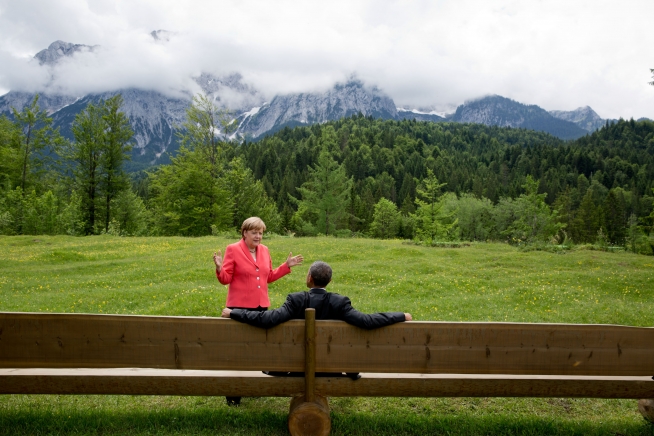
Merkel and Obama at G7 - the main topic was Russia and Ukraine

Merkel and Obama at G7. Main topic was Russian threats to EU and Ukraine

An AICGS workshop with Dr. Thomas O’Donnell was held on May 27 in Washington, DC with a lively full-room attendance.

O’Donnell presented preliminary results of interviews he conducted in Washington during April and May to hear candid views of US energy-and-geopolitical experts on German and the EU energy policies.  The main topics were (1) European natural-gas vulnerabilities in light of the Ukraine crisis and dependence on Russian supplies and (2) implications of Germany’s commitment to a transition to renewable energy called the Energiewende.   Continue for Workshop PowerPoint & written Summary –>  Continue reading →

The EU-US “Oil Weapon”: Putin’s overtures to OPEC, China & Iran reveal desperation

Foto: Presidents Rouhani of Iran and Putin of Russia holding discussions Presidents Rouhani of Iran and Putin of Russia holding discussions
(AICGS Analysis, by Tom O’Donnell)  Since Russia’s president, Vladimir Putin, decided to annex Crimea and back east Ukrainian separatists with troops, many have worried he might use his “energy weapon” to counter U.S.-EU sanctions, as Russia supplies around a third of the EU’s natural gas imports.  But what about Russian retaliation in the oil sector?

That’s hard to imagine. While gas is marketed in bi-lateral, pipeline-mediated relationships, oil is not. It’s liquid, fungible, and marketed in a unified open market—“the global barrel” [and name of this blog, T.O’D.]—which means there are no bi-lateral oil dependencies.

So, when EU leaders were cajoled by Germany’s Angela Merkel into joining the United States in applying sanctions, Russia could do little to retaliate from within the oil sector.  In reality, it is the EU and the U.S., not Russia, that have an “oil weapon” in hand.  And, the flurry of Russian oil diplomacy with OPEC, Iran and China over the past couple of weeks has a distinct whiff of desperation to it. Continue reading →

[Spanish] Mi opinión en Petroquía: China se involucra en los principales proyectos de América Latina

Here’s my piece [in Spanish] in Petroguía 2015, the oil-&-gas sector catalog for Latin America  Note: Hemispheric integration (e.g., energy infrastructure) was endlessly promoted by Hugo Chavez.  In the end, he built none. The region’s resources continue going mainly to develop other regions, such as China. Continue reading →

USA Oil Seminar 5.0 | USA as Rising Energy Superpower?

us_air_force_jets_oil_buring_iraqNote: These “USA Oil Seminar” posts are extra readings for my students to better understand how US energy policy is developed and to hear the views of US experts.  The seminar is: “The Global Oil System & US Policy” at JFK Institute of FU-Berlin. 

RECOMMENDATIONS:

  1. This Friday, watch live (or the recording later on): Is the U.S. a Rising Energy Superpower? Implications for Global Markets and Asia, the Middle East, Russia, and Europe.  CSIS upcoming talk by Fereidun Fesharaki.  FRIDAY, MAY 16, 2014 | 10:00 AM – 11:30 AM .  Moderated by David Pumphrey.
  2. Read the paper: Fueling a New Order? The New Geopolitical and Security Consequences of Energy |April 15, 2014. By: Bruce Jones, David Steven and Emily O’Brien.  Brookings Institute; Washington, DC.

BACKGROUND:  This week, the class reading assignments are a couple conference papers I wrote a few years ago on the history and structure of today’s global oil system, and how it grew to replace the neo-colonial oil system. Continue reading →

USA Oil 3.0 | US energy experts on Europe, Russia & Ukraine

Note: I’m teaching a post-graduate course “The Global Oil System & US Policy” at JFK Institute of Freie U. in Berlin. In order to give students a feel for how US energy policy is developed–and to see the views of important US actors–I’m sending them frequent e-mails with supplemental readings and videos  from US think tanks, US government offices and from the US media on energy topics.

These are not my own in-depth analysis like I usually post on GlobalBarrel.com.  However I think they are worthwhile sharing with especially non-USA followers of my blog.  I’ll title these posts “USA OIL” plus a number to label them).  I hope these are useful.  Here’s today’s ‘optional material’ I sent to my students:

How is US energy policy developed? You might find this video of interest.

Some background: The CSIS (Center for Study of International Security) is a non-partisan (i.e., not Democratic or Republican) think tank in Washington, DC. It performs an important role in US foreign policy. Continue reading →

Venezuelan state’s economic response to protests: Rationing plus Chinese and Russian loans to float a liberal dollar market

The anti-government protest in eastern Caracas 13 March ended in clashes with Venezuelan police BBC
The anti-government protest in eastern Caracas 13 March ended in clashes with Venezuelan police. Three more died in widespread protests. BBC

As protests continue against Venezuela’s faltering “oil revolution,” the political strategy of the chavista administration is striking for its intransigence. President Maduro has refused to recognize any grievances by students or other protesters. He calls protesters “fascists” and blames them for all the ills of the economy.  Protests are attacked by the national guard and often by state-organized paramilitary gangs on motorcycles who are praised by the president.

The administration’s strategy so far appears to be that protests will burn themselves out if they can be delegitimized and contained within middle-class areas.  Accordingly, the president’s rhetoric aims at inciting poorer citizens against protesters.  All in all, this is a risky strategy.  Protests have constantly intensified, with perhaps 25 persons dead now.
After a month of protests, the administration has taken urgent economic measures it hopes will undermine the protests and prevent their spread to poor and working-class barrios.
1. Ramirez announces Chinese and Russian loans and the launch of a very liberal Sicad 2

A new syllabus: The USA & the global oil system: The formation of American energy policy

global_barrel_graphic_twodDuring Spring 2014, I’m teaching a post-graduate seminar in Berlin  on the USA and  the global market-centered oil system (a.k.a.”The Global Barrel”)–the syllabus sketch is below here.

While I’ve often taught seminars on “the Geopolitics of Global Oil,” the JFK Institute at Berlin’s Freie Universität had a special request: they would like their students to learn “how these policies are decided in the USA.”

For an American energy “expert”, the how of the USA’s policy-decision process is fairly familiar. However, not only for German students, but also for most US citizens, this process–whose outcome has such a profound impact on the entire world– indeed seems at best rather opaque, and, at worst, like an unseemly, vested-interest-driven and hopelessly partisan process. Continue reading →

China y América Latina: ¿Quién gana y quién pierde? – Petroguía 2014 (Spanish)

Inversiones energéticos de  China en Latino américa.  Nota que Venezuela está en tercer lugar, en contra de las intenciones iniciales de Beijing en 2007-08.

Inversiones energéticos de China en Latino américa. Nota que Venezuela está en cuatro lugar, en contra de las intenciones iniciales de Beijíng en 2007-08. HAZ CLICK para magnificar. (Grafico por T.O’D.)

[English readers: This post is an analysis I did in Spanish for Petroguía 2014 – the annual hard-copy guide for the LatAm petroleum sector – of China’s oil and gas investments in LatAm and the Carribean.  For Beijing’s other investments, or a presentation, etc. drop me a line. ]

NOTA: La siguiente es mi análisis publicado en Petroguía 2014, la guía anual para el sector petrolífero latinoamericano.  Soy agradecido a los directores del Petroguía por haberme permitido publicar el artículo aquí.  El artículo es una resumen de una investigación que hizo sobre todas las inversiones de China en Latino américa. Si tienen interés en una reportaje o presentación detallada, por favor contactarme.

China y América Latina: ¿Quién gana y quién pierde?

Sumario. El mercado de hidrocarburos ya no está en el norte de América sino hacia el este,  y la mejor estrategia de intercambio con esa plaza la lleva Brasil, mientras que Venezuela y Argentina están a la zaga.

Por Thomas W. O’Donnell

El petróleo y el gas que exportará América Latina en las décadas venideras irán mayormente a China y otras partes de Asia. Y eso es por el efecto combinado de menores necesidades de energía importada en Estados Unidos, gracias a la utilización de los nuevos métodos de fractura hidráulica (fracking) que produce cada vez más petróleo liviano, y por el tope que ha alcanzado su demanda doméstica. Continue reading →

Beijing ups Venezuelan oil investments, but refuses Chavista leaders’ plea for a cash bailout

folha_header_08apr13folha_quote of the day_venez-and-china_08apr13Back in April, Brazil’s Folha de SaoPaulo ran an article entitled: “The Future of Venezuela Depends on China“ and highlighted this quote:  Translation: “If Maduzo wins, he’ll have to regain the confidence of the Chinese.”  TOM O’DONNELL, petroleum consultant

Indeed, it is now clear that the short-term strategy of the post-Chavez Maduro-Cabello administration was to escape the country’s severe dollar crisis: convincing Beijing to extend it a $5 billion cash loan alleviating food-import shortages before 8 December elections.  In particular, the cash was to fund a new dollar exchange system (see El Nacional,25 Sept 2013). Continue reading →

My AS/COA piece: PDVSA Post-Chavez: Will Partnerships with the Private Sector and Chinese Experts Boost PDVSA Oil Production?

PDVSA oil rigs in Venezuela (TalCual)

PDVSA oil rigs in Venezuela (TalCual)

Throughout 2012, and especially after President Hugo Chávez’ death in early March 2013, Venezuela’s national oil firm, Petróleos de Venezuela S.A. (PDVSA), has taken measures beyond anything done in the past decade to raise its lagging production. While the likely impact merits cautious analysis, the drivers of the Bolivarian Republic’s scramble for increased oil revenues are clear.  … Continue reading →

Competing with China in Latin America: Is Germany losing its high-tech advantage?

Wilfredo R. Rodriguez H., CC BYAn article I wrote for the IP Journal of the German Council on Foreign Relations is online today. It examines data on China, the EU and Germany’s trade with Latin America and the Caribbean, including in energy. Here’s a quote from near the end:

…  China’s exports to Latin America in the low-, medium-, and  high-tech categories were below those of Germany and the EU in 2003; but in 2012 [China’s exports] exceeded the combined totals of the EU15 in the medium-tech and even in the high-tech categories. The only place the EU15 surpasses China is, rather oddly, in the low-tech manufactured goods …

-> READ THE ARTICLE at GCFP’s IP Journal or Research Gate.

My talk: JFK Institute, Berlin: How “The Global Barrel” shapes Washington-EU relations

You’re invited to my lecture at The JFK Institute of North American Studies at Freie Universität in Berlin, Germany, Tuesday 6 PM. Here is the flyer, then the Abstract.  Tschüß!

ABSTRACT:

“The Global Barrel”

Today’s globalized market-centered energy system defines Washington’s relations with the EU, Japan and OPEC states Continue reading →