Category Archives: Nord Stream

My Dublin talk: “The role of renewables in securing Europe’s energy” [at EU Commission Representation, Polish Presidency event]

I felt greatly honored to speak in Ireland, the home of my ancestors, at a high-level Irish-Polish event, invited by the Polish embassy as part of Poland’s Presidency of the European Council. [Spoiler alert: my assessment of the Green Deal’s impact on EU energy security and competitiveness was highly critical. And, I called for a radical reform, modeled on the 1970-80’s French Messmer nuclear program, the response to a similarly dire European energy and competitiveness crisis.]

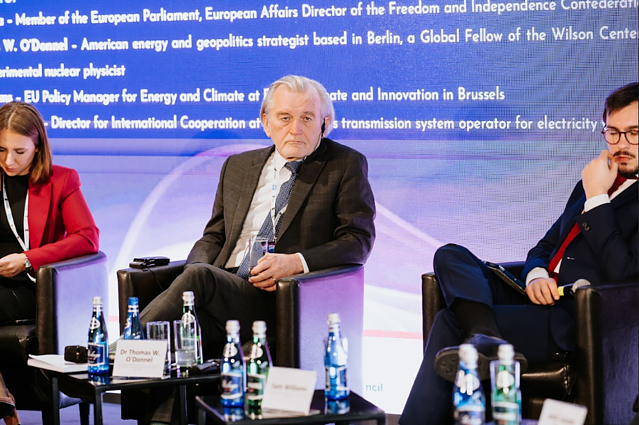
For Ireland we had Secretary General Oonagh Buckley and Wind Energy Ireland CEO Noel Cunniffee; for Poland, Daniel Piekarsky, Head of Energy Security Unit in the Foreign Ministry, and myself, Global Fellow of the Wilson Center, Washington (external) working in Europe, from Berlin.

Our moderator, from the Polish Embassy, Dublin, was the Polish diplomat and patriot, Dr. Jacek Rosa — a good friend, with whom I had the great pleasure of closely collaborating, for several years, in opposition to the Russian-German Nord Stream 2 gas-pipeline partnership, before the 2022 full-scale invasion of Ukraine. Below is the lineup, the initial invitation and some pictures. The event was off-the-record, so I show here only my own, slightly redacted talk.

Continue reading

My Q1 Polish press: |1|Does Germany want Russian gas back? |2|Green Deal model has a tech problem. |3|German deindustrialization: bankruptcies up. |4|Warsaw, Paris & London must act fast for Ukraine!

Opening of Nord Stream1 pipeline, 2011. Gazprom via PAP

Below are links to 12 articles that appeared in the Polish press in the last few months, interviewing or quoting me on four topics I feel are important. The topics are listed in the title above.

The links are below, sorted by topic. The first or left column has English translations of the titles, and the second or right column has the original Polish — which unfortunately I don’t speak! If you follow the links, Google Translate or Deepl will translated the Polish articles pretty well into English. My special thanks to the intrepid Polish journalist, Artur Ciechanowicz at BiznesAlert in Warsaw for his interviews in the list. (I also had about 33 quotes or interviews in several other languages since December [1]).

ENGLISH titles and links:

  1. On German (far-right) & USA (Trump) each plotting a Russian gas return to Germany
    • A former Stasi agent lobbies for the resumption of Nord Stream. Expert: One of the gas pipeline lines ready to be launched,, By,: Artur Ciechanowicz, March 3, 2025, biznesAlert.pl
    • Some EU countries believed that Gazprom gas would be in Europe forever BiznesAlert.pl
    • “Like a Drug Addict Returning to Heroin.” Analyst on the Idea of ​​Unblocking Gas Imports from Russia to Europe, Author: Artur Ciechanowicz, February 1, 2025, 07:21
  2. Failures of EU Green Deal on technology and energy security.
    • American expert: recommendation to reduce emissions by 90 percent by 2040 is “fantasy” | Energetyka24
    • Expert: EC recommendation to reduce gas emissions is fantasy wpolityce.pl
    • Unrealistic EU climate plan. Expert opinion crushes – Super Business
    • “Rearranging deckchairs on the sinking Titanic”. Expert slams the eco-target dictates of Brussels Eurocrats PCH24.pl
  3. Trump, EU & Poland: Ukraine War crisis.
    • First talk with Putin. Trump has visions of ending the war in Ukraine | Newsweek Jan 21
    • How Trump Can Bring Down the Russian Economy: Analysts: He Has an Arsenal of Means to Do It, By Artur Ciechanowicz, Jan 24, 2025 | Biznes Alert
    • Trump may use [oil] sanctions to finish off Moscow, which is running out of money for the National Welfare Fund. – 16 January 2026 UBN
    • Expert: Washington, London, Warsaw should work quickly. Kiev can’t afford to be patient – Dziennik.pl
  4. German deindustrialization: Energy & economic crisis
    • Major shoe retailer goes bankrupt A sharp increase in bankruptcies in Germany

Polish titles and links:

  1. First topic.
    • Agent Stasi lobbuje za wznowieniem Nord Stream. Ekspert: Jedna z nitek gazociągu gotowa do uruchomienia biznesalert.pl
    • Część krajów Unii uwierzyła, że gaz z Gazpromu będzie w Europie na zawsze BiznesAlert.pl
    • “Jak powrót narkomana do heroiny”. Analityk o pomyśle odblokowania importu gazu z Rosji do Europy | BizNes Alert
  2. 2nd Topic
    • Amerykański ekspert: zalecenie redukcji emisji o 90 proc. do 2040 r. to „fantastyka” | Energetyka24
    • Ekspert: Zalecenie KE redukcji emisji gazów to fantastyka wpolityce.pl
    • Nierealny plan klimatyczny UE. Opinia eksperta miażdży – Super Business
    • “Przestawianie leżaków na tonącym Titanicu”. Ekspert nie zostawia suchej nitki na eko-dyktaturze brukselskich eurokratów – PCH24.pl
  3. Third topic
    • Donald Trump chce uchronić świat przed III wojną światową | Newsweek
    • Jak Trump może złamać rosyjską gospodarkę?
    • Trump may use [oil] sanctions to finish off Moscow, which is running out of money for the National Welfare Fund. – UBN
    • Ekspert: Waszyngton, Londyn, Warszawa powinny szybko działać. Kijowa nie stać na cierpliwość – Dziennik.pl
  4. Fourth topic

Notes:

  • [1] Other than being cited/interviewed in Poland, I was also quoted elsewhere about 33 times so far in 2025, mainly in the USA, with many then translated to languages of Europe, Asia and Latin America. I never know what to do with all these print interviews. Here at GlobalBarrel.com, I often publish videos of some of my live-on-air expert commentary, usually accompanied by a detailed blog post. So, my idea is I will make a new tab at the top of the GlobalBarrel.com site, next to the “About Me” tab, where I can simply list link to my recent press citations or Op-Eds. [Back to text]

My interview at Lithuania’s LRT: Trump could seriously harm Russia if he wants to | Trumpas, jeigu tik norėtų, galėtų stipriai pakenkti Rusijai

My long print interview at Lithuania’s LRT [Lithuanian PDF | English PDF​] with Aleksandra ​Ketlerienė, deputy editor-in-chief of Lithuania’s LRT.lt, published 7January. We spoke in Warsaw, 19 November. My thanks to Aleksandra for her insightful questioning and editorial care. We discussed:

  • The EU’s systemic energy​-policy “own goals” ​since its initial energy-crisis win ​after Moscow began cutting gas exports early in 2021​.
  • Reforming failed/ineffective Russian price-cap sanctions for real sanctions, and how the global oil market is now favorable for “maximum pressure.”
  • Historical perspectives on oil, gas, renewables, and nuclear sectors, essential for realistic policy formation.
  • An historical overview of China’s decades-long effort to overcome its energy security, learning lessons of Japan’s WW2 weaknesses.
  • (​See topics summary))
Continue reading

Part 2: “Does EU Climate Policy Need Evolution or Revolution? What Should We Change in the Green Deal?” My critical remarks at “Energy Security in CEE Conference,” Warsaw

This is a continuation of my remarks in Warsaw, on 18 November. Part 1, which posted on 19 December, reviewed failures to develop critical tech elements required by the EU Green Deal, a program modeled on the German Energiewende. I argued that, after decades of R&D efforts, these technology failures indicate the systemic failure of heavily renewable models, pointing to a need for “radical reform” of the Green Deal. I advocated for the historically proven Messmer model, which succeeded, some 40 years ago, in decarbonizing French electrical generation using nuclear power, without any need for new grids or long-term grid-scale storage tech.

Below, Part 2 (edited for clarity) focuses on the political intransigence of the new Von der Leyen commission, which is doubling down on the Green Deal’s renewable model. I argue this is not “reindustrializing” Europe or making it “more competitive” as claimed, but rather driving it into deindustrialization. This mirrors the process underway in Germany via its continuing push for new “green tech,” on the theory this should spark a broad new European industrial competitiveness. From an historical perspective, this is theoretical and practical nonsense – or so I argue. Critiques are welcomed. (PS, Happy holidays!)

Leon (moderator): So, I’m going to turn to Thomas again. You argued that that some form of radical overhaul is necessary, you know, with regards to the EU Green Deal, if I understand it correctly, and you’ve cited one of the issues is the complexity of the fact that there are certain technologies that haven’t emerged over the last 30 years that have just been growing incrementally rather than rapidly to meet our needs. But at the same time there’s seems to be some sort of political rationale for why this sort of revolutionary approach. How would you respond to that?

Tom: Yes, politically, I do think the new Commission presents a big problem for European competitiveness, for energy policy and security.

The new commission is anti-energy-policy reform

Firstly this is because Ms. Teresa Ribera, from Spain, is President Von der Leyen’s new chief executive vice-president.  She is in charge of attaining both the Green Deal and has also been given responsibility for “industrialization of Europe,” for making it competitive again.

The problem is, Ms. Ribera is a true believer in all-renewable energy systems, I would say a career-long renewable fundamentalist.

For example, she’s said to be so good at negotiating that she managed to get the Spanish nuclear industry and civil society to agree on a timetable to close all the Spanish nuclear power plants, and she’s very proud of this. This is politically and ideologically identical to what Mr. Robert Habeck, the German Green Party leader, who is energy and economics minister, carried out with the approval of Chancellor Scholz of the SPD-party. Habeck closed Germany’s last three nuclear power plants during a wartime, Russian-instigated, European energy crisis.

The fact that Von der Leyen fought hard to appoint Ribera and then put her in charge of the Green Deal and of European industrialization, and made her the most powerful commissioner, the executive vice president of the commission, shows that Von der Leyen, a member of the German conservatives, the CDU, has no interest in reform of the renewables model despite its suffering technological failures on several key aspects.

The problem is not that Europe has not had an industrial policy. Europe has had an industrial policy, one that has failed

Continue reading

Our TRT/Istanbul: Will Turkey be Russia’s new gas hub to Europe? Can Putin save his gas sector? What’s Erdogan’s game?

We began at timestamp 1:00 minute, after TRT’s lead-in story.

With guests:

  • Dr. Thomas O’Donnell: Energy Analyst, in Berlin
  • Eser Özdil of Glocal Group Consulting; and Former President of The Turkish Petroleum and Natural Gas Platform Association. He is also an external fellow of the Atlantic Council in Washington, DC.

and Host Ayse Suberker of TRT TV’s Straight Talk from Istanbul.

We analyzed what Putin aims to achieve, and why President Erdogan of Turkey has so rapidly accepted this proposal. This is obviously, I said, a scheme by Putin to try to save his natural gas business to Europe.

Continue reading

Al Ghad/Cairo: Putin tempts Erdogan, “Take Nord Stream gas at a Turkish hub. Sell EU my gas. Forget NATO.” Putin’s ‘Gas Godfather’ games become pathetic.

English: Audio above || Arabic: Video below

Is this even a real proposal? Nowadays, after becoming so unreliable a supplier of gas to Europe, in fact having weaponized Russian gas deliveries, it is difficult for anyone to take this proposal seriously. Erdogan may have many significant problems; however he and Turkey are not so naieve as to do what Germany and Austria forced the European Union to do, i.e., become overdependent on Russian gas, especially given the deep energy crisis Europe is currently going through.

But, also consider this (as I explained towards the end): This proposal of sending Nord Stream gas, originating in Northern Urengoy province, above the Artic Circle, would also require a big, new pipeline laying project, running at least from perhaps near the Ukrainian border south towards the Black Sea and then onto Turkey. This would have a significant cost. And, by the time this could be finished – in perhaps five or more years – the world will have moved on. By that time, new LNG and natural gas production potential in the USA, Qatar, Australia, Algeria, Norway, Israel (sent to Egypt for liquification) and likely many others’, will have been developed and be on the global market. On this time horizon, there would be plenty of diverse sources of gas fully able to replace Russian export capacities.

I also explained the history of the South Stream Pipeline …

Continue reading

My AlJazeera: Russia cuts exports via Nord Stream 1 by 60%, further weaponizing EU over-dependence, as part of its war against Ukraine. EU winter gas rationing is possible.

Jun 17, 2022 Today, Gazprom announced a further cut in exports of gas via Nord Stream 1 to Germany and on into Europe. Earlier this week, they had cut 40%, now it is 60% of the 55 billion cubic meters per year (bcm) that normally flows in this pipe.

I explained that the Gazprom excuse – -that it could not re-import some compressor parts it had sent to Siemens to repair in Canada due to sanctions — appears as a convenient, manufactured excuse.

I pointed out that a one-off sanctions waiver from the USA, EU and/or Canada for the reimportation of these very specific parts could likely be easily arranged – and if the gas did not again flow fully, Gazprom’s ruse would be clearly exposed.

However, as I said, this is more accurately understood as simply another step in the weaponization of the over-dependence of the European Union (and esp. of Germany, Austria and Italy) on Russian gas imports, a game which Mr. Putin began in earnest in August of 2021.

Continue reading

My Al Jazeera: Finland, the Baltics & Poland prepared well for Gazprom’s cutoff. Germany & Austria did the opposite, putting EU at risk.

ABOVE is English audio — BELOW is Arabic video. Recorded live; Al Jazeera, 21 May 2022.

I told Al Jazeera that Finland is well prepared, having worked since 2017 with Estonia, Latvia and Lithuania – the Baltic states – and with Poland to connect them all together with new pipelines, also to access LNG, storage and soon, new supplies from Norway.

Finland has also rented a regasification ship, from a US firm, to receive 5 billion cubic meters per year of LNG, whch will be plenty to supply both itself and Estonia in the wake of Putin cutting off Gazprom supplies of natural gas. Finland refuses, as did Poland too, to pay Moscow in rubles and so are being punished by Putin.

Continue reading

Le dije a Radio Clarín Buenos Aires: Putin amenaza con cortarle el gas a la UE/Alemania, pero no tiene otra fuente de dinero. Si lo hace, Biden y la UE organizarán un “Gas-Lift” … [Spanish]

Lo sentimos, la calidad de la comunicación celular desde Alemania no es buena. Por lo tanto, he escrito mi respuesta larga a la primera pregunta a continuación. Las otras preguntas también están abajo. Muchas gracias a los periodistas de Radio Clarín y La Nacion en Argentina (y en París).

Re: Urgente Pedido de Entrevista Periodística – Corresponsales Clarín y La Nación – Argentina

De Maria E… … Fri, Apr 29, 11:50 PM

Dr. O ´Donnell, … Estas son las preguntas para la entrevista del domingo:

1¿Alemania tiene otra posibilidad que no sea seguir comprando el gas ruso? ¿Cuáles serían sus otras opciones?

Repuesta: Antes que nada, muchas gracias por esta oportunidad de hablar con su audiencia argentina.

Pues, debo señalar que hay dos problemas diferentes: el suministro de petróleo ruso a Alemania y Europa y el suministro de gas ruso a Alemania y Europa. Me preguntas por el gas. El gas es mucho más difícil para Europa y para Alemania que el petróleo Hay dos casos: una reducción gradual o parcial de gas o un corte inmediato.

Un corte gradual se puede manejar bastante bien. Ahora Putin está tratando de dividir y conquistar Europa cortando el suministro de gas a Polonia y Bulgaria.

Un recorte inmediato, ya sea por parte de Putin o debido a las sanciones de la UE, crearía una gran crisis energética en Europa. Sin embargo, es importante entender que, al final, Putin está en una posición mucho más débil.

Si Putin corta todos los suministros de gas a Europa, ahora no hay suficiente gas en el mercado mundial para compensar. Pero Occidente, y especialmente EE. UU., la administración Biden, se ha estado preparando para esto al menos dos meses antes de que Putin invadiera Ucrania, incluso antes de que Europa creyera las advertencias de EE. UU. de que Putin atacaría Ucrania.

Continue reading

EU Energy Crisis: Germany & EU long ignored US warnings that Putin can weaponize gas, attack Ukraine – On David Foster’s Roundtable, London

26.01.2022. Experts Wahid Machram, market analyst in Dubai; Samuel Ramadi at Oxford University, UK. and TRT Roundtable host David Foster in London made important points. Here’s a key assessment I made.:

There is a new and growing asymmetry between the European Union and Russia in energy supplies – one increasingly favoring Moscow.

Europe has opened itself to energy blackmail. The present winter 2021-22 gas shortage and skyrocketing prices are only one part. There is also the real possibility of Putin cutting off the pipeline gas he is still supplying in the event that Europe, esp. Germany, opposes any Russian invasion of Ukraine.

About the new EU-Russia growing energy asymmetry:

  • On the demand side, Germany and Europe generally increasingly need natural gas, and are growing more dependent on Russian supplies, contrary to the promises of rapid progress to a carbon-free future of the German Green Party and others. The EU, and especially Berlin, have adopted ideologically-determind, technologically unrealistic and expensive energy-transition policies, with little concern for energy-supply security. This has made Europe increasingly dependent on Russian gas imports – 40% at present of total gas imports,
  • Meanwhile, on the supply side, Russia, the major European supplier, is increasingly finding ways to diversify its gas customer base away from Europe, to the Far East, especially to China, and to Eurasia generally. It also has new outlets for its vast Arctic gas resources by converting it to LNG that can go by ship to anywhere in the world.
Continue reading

EU Commission openness to nuclear as green, betrays falling confidence in the German 100%-renewables model [English & Polish]

Dr. Thomas W. O’Donnell, Berlin 27.01.22 (Polish original 22.09.22)

Printed in Polish by Banker.pl as Komisja Europejska może uznać energetykę jądrową za “zieloną” 2021-09-22, from a written interview with Artur Chierskiwsky (PAP, Brussels) Here’s the unpublished English.-Tom O’D. [Edit:: Headline word “betrays” was initially miswritten “belays”].

Reportedly, the EU Commission plans to soon include nuclear power in its green finance taxonomy, finally making it eligible for favorable financing and carbon credits on a par with wind and solar.[1]

This could be spun two ways: as a victory for science over populist capture of climate policies, or as a tipping point in Brussels angst at the growing complexities and costs of the “100% renewables and no nuclear” model.

In reality, it’s some and some.

On the one hand, in March, the Commission received reports solicited from the Joint Research Centre (JRC), its scientific expert arm, finding that nuclear waste is “manageable”, posing no “significant” harm to the environment, and that nuclear energy has been demonstrated to be eminently safe.[2]

However, these assessments are not surprising. Had the Commission requested these years ago, they undoubtedly would have concluded similarly. Nuclear, public-health, risk-assessment and other expert bodies have been saying these things for years (full disclosure: my PhD is in experimental nuclear physics [3]).  

The question then is, why is this scientific consensus only now becoming actionable for the Commission?

Continue reading

My Kyiv interview: PUTIN WAS BLUFFING HE COULD “SAVE” EUROPE: Dr. Tom O’Donnell on Nord Stream 2, hydrogen & nuclear energy [Kosatka.Media]

Dr. Thomas W. O’Donnell, at 1st Ukraine Gas Investment Congress, Kyiv. 21.10.21.[Kosatka Media]

Here’s my extended interview in Kyiv with two great Kosatka.Media journalists [Read in UA, RU]

18 NOVEMBER 2021 — AUTHOR YAROSLAV MARKIN, TETIANA HUZENKO In 2021, the energy sector of Ukraine faced myriad threats related to the completion of Nord Stream 2, increasing gas prices and coal shortage just before the heating season. At the same time, green trends require decarbonizing the industry and developing the hydrogen direction.

Kosatka.Media discussed what direction is better for Ukraine, whether it should wait for the protection against Nord Stream 2, and where global green trends could take us, with Dr. Thomas W. O’Donnell, international expert and senior energy and geopolitics analyst at GlobalBarrel.com, who participated in the Ukraine Gas Investment Congress held in late October in Kyiv.

  • One of the key messages at the congress is that whatever the ‘green’ trends are, gas is a transition fuel and we will use it for a long time. Are there any other case scenarios? How should Ukraine act in this situation?

In the long run, we want to have a world that’s not dependent on hydrocarbons. The worst hydrocarbon is lignite and brown coal. And that’s what people s\should concentrate on eliminating. Natural gas in fact is a great way to eliminate coal.

It’s actually an improvement for Ukraine, not only because of global warming, because of CO2, but also for the health of the people since natural gas does not produce environmental pollution. So, increasing the use of natural gas (or also nuclear energy) in a country like Ukraine is to the benefit of the environment and to the people’s health.

However, Ukraine is not a typical European country, it is a country that unfortunately is at war. In such a situation, it has found an intelligent way to access natural gas, which is virtual reverse flow.

Continue reading

My TRT StraightTalk: Nord Stream 2: Europe’s Energy crisis, Putin’s lever, Ukraine’s plight, & Berlin’s complicity

StraitTalk, 8 October. My comments (from Berlin) begin at 2:30, with Aura Sabadus of ICIS (in London) and TRT’s Ause Suberker interviewing (in Stockholm).

On Friday, 8 October, I was interviewed, with Aura Sabadus (@ASabadus) of ICIS-London, about Nord Stream 2’s impact on European energy politics on”Strait Talk” with TRT host Ayse Suberker.  We discussed the geopolitical aims of Russian and German leaders for partnering on this pipeline. 

I stressed, the issue is not whether Europe is dependent on Russian gas – it is and it will remain so for the foreseeable future for up to 40% of its imports. The issue is what route this gas takes to arrive from Russia into Europe

Consider: Russia historically exported 80% of the gas it sends to Europe using massive Soviet-era pipelines transiting Ukraine, the remainder via a Belarus-Poland-Germany pipeline. However, for 20 years Continue reading

My TRT TV-London: Cold War espionage in Berlin? Plus Russia’s “unique influence & penetration” of German society

Watch the Roundtable discussion

Is this a revival of Cold War espionage?

Aug 24, 2021 Roundtable (20.9K subscribers)
Following the arrest of a British employee at its Berlin embassy as a Russian spy, it’s been suggested that Russia has tried to infiltrate Germany in particular because of its role at the centre of Europe and because of its ties to Moscow. A former MI5 agent-recruiter, Annie Machon, plus UK academic expert Dr. Jenny Mathers at Aberystwyth University, and Dr. Tom O’Donnell, at Hertie School of Governance in Berlin are here to tell us if we’re witnessing a return to the Cold War ways of spying.

Some comments on the show: First off, my fellow panelists are experts on human espionage and Russian spy craft – which I am not – and were extremely informative In this discussion on David Foster’s Roundtable.

An overview and elaboration of my points: I stressed, besides a Cold-War-like level of Russian espionage in Berlin, there is a general openness in Germany to economic and political interpenetration and integration with Russia. In plain sight one sees everyday what I called the “unique influence and penetration” of German society as compared to any other EU or NATO ally.

I stressed energy-sector examples – most especially Nord Stream 1 and, now, Nord Stream 2 pipelines, built by German partnerships with Putin’s Russia, aiming to avoid Russian gas having to transit Ukraine to arrive in Germany and beyond. The degree of this open integration with Russia is unique in the EU. Consider: the Germany’s pre-Merkel chancellor, Schröder, heads the boards of both Gazprom and Rosneft; that an x-German Stazi secret-police officer is the CEO of Gazprom-owned Nord Stream 2 AG, and that overwhelming numbers of German experts “consult’ for Gazprom, including even the 2005-06 German Federal State Secretary for Defense(!) – who is a member of Merkel’s CDU/CSU party.

David Foster’s Roundtable, TRT-London
Continue reading

My Warsaw Op-Ed: Nord Stream 2 deal marks a German win in setting allied strategy on Russia & Ukraine | Niemcy nie boją się Rosji. Boją się ryzyka płynącego z Ukrainy.

My Op-Ed on German motives for Nord Stream 2 appeared in the Dziennik Gazeta Pravwna 4 Aug. 2021 (no. 149 dziennik.pl, forsal.pl), derived from an English interview (below here) with Artur Ciechanowiicz (PAP, Brussels). [Polish Op-Ed link]

Read the Polish Op-Ed (PDF) “Germany is not afraid of Russia. It fears risks coming from Ukraine”

Here is my full English interview, expanded for clarity:

1) [AC] What are the consequences of the Nord Stream 2 deal between Washington and Berlin?

[T O’D] Stepping back a bit: this deal marks a victory by Berlin in its long and intensifying contest with its ally, the USA, over which of these two biggest transatlantic powers will decide the alliance’s strategy with respect to Russia and China. The two allies deeply disagree on this matter.

In the USA, both Democrats and Republicans have agreed since the Obama administration that “Great Power Competition” must be the strategy for the alliance versus Russia and China. The Americans strongly feel it is necessary to “decouple” from globalism’s deep trade and tech integration with China and Russia, that these states must either change their disrespect for global trade rules and moderate their increasingly aggressive geopolitical activities, or be isolated and forcibly contained.

Germany, with almost 50% of its GDP from global trade, deeply disagrees with this US strategy [i.e., German exports provide 46.9% of GDP, the USA’s only 11.7%]. Berlin likes global rules; but its unbalanced economy cannot afford trade decoupling and it broadly opposes forceful military containment of China and Russia. Instead, it wants only negotiations and occasional sanctions.

So, Nord Stream 2 is an iconic example of this clash, this “leadership fight” between the USA and Germany over the transatlantic alliance’s strategy towards Russia. Berlin wants to maintain energy ties at all costs, while the USA has long advocated maximum European energy independence from Russia, and to constrain Russia (and defend Ukraine) by forcing Putin to continue having to send gas across Ukraine to reach his European customers.

Russia, for its part, wants to re-incorporate former-Soviet Ukraine [plus Belarus, Moldova and Georgia, and minimally keep them outside of the EU and NATO], and has wanted to avoid having to send its gas to Europe via Ukraine. Moscow’s transit dependence on Ukraine not only provided income for Ukraine, this constrained Russian subversion and military aggression there, for fear that the transit pipelines could be interrupted by either Ukrainian state or non-state actors.

For Germany, the “insecurity” of having to import Russian gas through Ukraine deeply alarmed Berlin. And so it made a strategic decision over 20 years ago to partner with Russia, to build new pipelines to bring gas directly from Russia to Germany [via Nord Stream 1 and Nord Stream 2] and on to European customers long supplied with the same Russian gas but via Ukraine. The aim was to make Germany the new hub for distribution of Russian gas in Europe.

Given Berlin’s logic, the 2014 Russian war on Ukraine and its annexation of Crimea only made it more sure than ever of the dangers of relying on Russian gas imports that have to transit Ukraine, and it redoubled its efforts to complete NS2, notwithstanding this would undermine German relations with three consecutive US administrations and with many of its EU allies, esp. Poland and East-Central Europe – a region where its much-prized soft power has been sacrificed.

Continue reading