
Here is my 21 July 2021 live interview on Germany’s Deutsche Welle about the new US-German deal, a “bad deal” on the Nord Stream 2 pipeline.
I told DW that the key reason the US has always opposed Nord Stream 2 (NS2) was that it undermines Ukraine’s security – as well as Poland’s and other eastern European and Baltic states’ security.
I told DW that one can argue with the Biden-Blinken assessment (as I have) that they “had to” waive sanctions on the Russian-owned NS2 company, insisting that the pipeline was going to be completed anyway. Indeed, German and Dutch regulators had already allowed work to proceed even when the insurance firm and commissioning firm had left due to sanction threats, and Berlin had promised it would be completed no matter the sanctions.
However, the additional factor, which US spokesmen cite only obliquely, is that Merkel’s government was evidently willing to deny Biden a show of transatlantic unity from which to confront Putin. This shows the extreme lengths Merkel’s government had gone to to insure success in her partnership with Putin to finish NS2..
For Moscow, the essential aim of this partnership has been to avoid the “risk” (as Russian officials have put it) of having to export its gas across Ukraine, a country Putin wants to annex and is now at war with.
For Berlin, the most essential aim of this partnership is to avoid the “risk” (as I have been told repeatedly) of having to import Russian gas via what has long been seen by German political and economic elites as an “insecure” Ukraine (although it is obviously Moscow responsible for this “insecurity”), and as an “unreliable” Ukraine (i.e., German elites had lost confidence in Ukraine to reform itself, or at least the willingness to risk the process).
This German pipeline partnership with Putin,, in other words, is a decision to pursue narrow-national interests. It elevates protection of Germany’s Russian gas supplies for its troubled domestic energy system, and protection of Russian gas supplies for its principal EU trading partners, above the interests of Ukraine’s security and independence as Putin pushes to reincorporate Ukraine into the Russian Federation.
Rather than showing solidarity by forcing Putin to continue shipping his gas to Germany and to other EU sates via Ukraine, the gas will now come directly to Germany. Germany will become the principal hub for distribution of Russian gas to Europe, and Berlin will “handle” any difficulties with Moscow and Putin. Of course, Berlin never consulted with the other EU Member states, much less Kyiv, on what amounts to its narrow-nationalist energy-security plan for Europe.
Continue reading



 What are US experts’ and officials’ views on the increasingly conflictive energy and geostrategic relations between Russia, Germany, Poland and Ukraine?


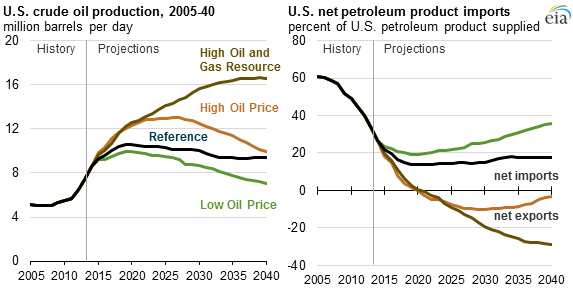 Contrary to his campaign hype (see article below), Trump-as-president will not do anything to interfere with the free flow of oil or gas to or from the USA. As I pointed out in the Investors Business Daily interview (Gillian Rich’s story is below), people central to Trump’s administration – such as Rex Tillerson, his designated secretary of state and former CEO of Exxon, and Harold Hamm, Trump’s fracking billionaire friend he wanted for secretary of energy – are global-market-oriented businessmen who would never agree to disconnect the USA from global energy markets.

