This is a longish, ca. 30 minute video. Host Nataly Lutsenko kindly told me she wanted to make a long interview.
(During time of crisis like this, I have so many TV and press interviews that I don’t have time to put most of them online. So, I will refrain from writing long posts to accompany videos to get more online, if I think they are useful interviews. – Tom O’D)
I discussed with Artur Ciechanowicz (BizNesAlert.pl) how Chancellor Merz and Energy Minister Reiche refuse the one reform that can really boost German energy security: focusing on nuclear energy as France has, and Poland has begun to do. (Read below in English or in Polish) — Twice last week, Merz indicated willingness to work with Russia when the Ukraine war ends. For two decades before the war, working with Russia meant more Russian gas imports, building Nord Stream 1 & 2. Now Merz worries about dependence on USA LNG. However, the German model he continues, one of installing BOTH a full-scale, wildly complex renewables system, plus a full-scale natural-gas backup system, guarantees high-cost energy, deindustrialization and foreign energy dependence.(Polish at BizNesAlert.pl)
Amerykański ekspert: Niemcy znów myślą o gazie z Rosji
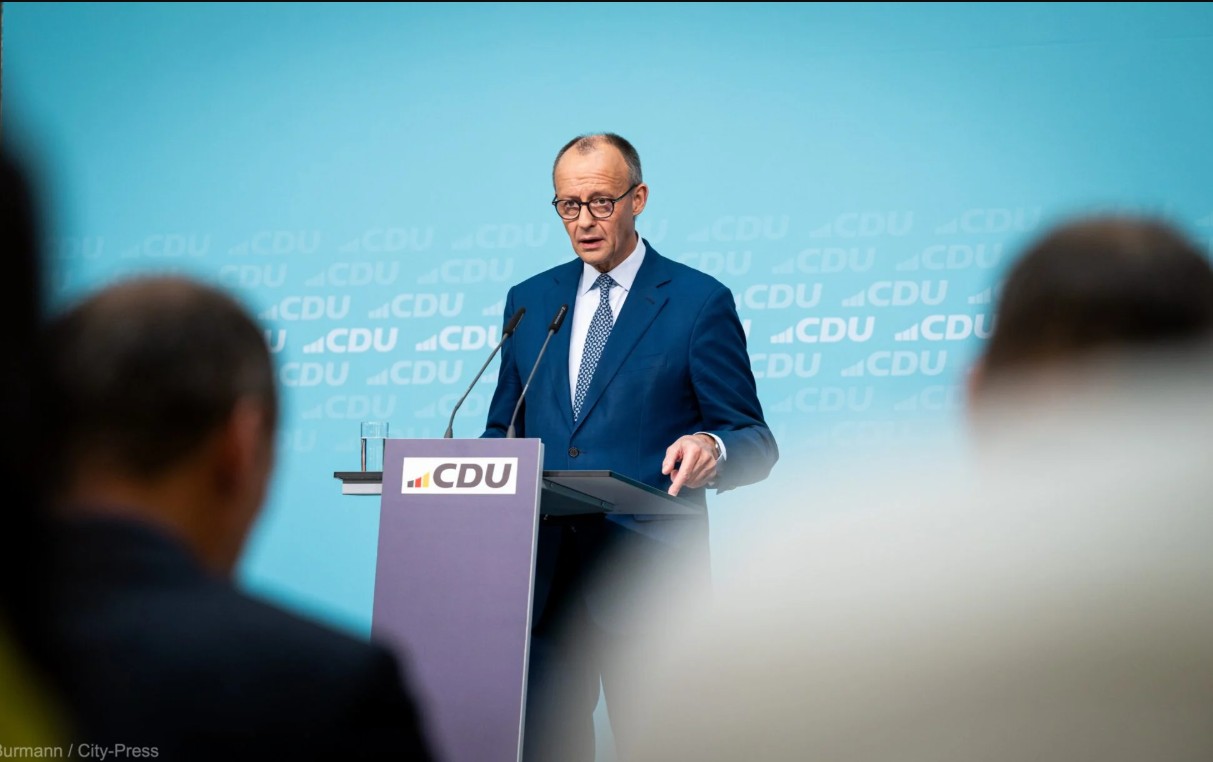
Wcześniej czy później Niemcy ponownie będą racjonalizować podporządkowanie się Gazpromowi Putina w imię +dywersyfikacji+ dostaw – ocenia Thomas O’Donnell, ekspert ds. energii i geopolityki z amerykańskiego think-tanku Wilson Center. Na zdjęciu kanclerz Niemiec Friedrich Merz.FOTO: x.com/_FriedrichMerz
Berlin zaczyna zmieniać kurs wobec Rosji i znów będzie racjonalizować współpracę z Putinem w imię „dywersyfikacji” dostaw gazu. Stanie się tak, bo Niemcy nadal opierają swoją strategię energetyczną na OZE wspierane gazem, zamiast postawić na atom jako priorytet – ocenia w rozmowie z Biznes Alert amerykański ekspert Thomas O’Donnell.
Wypowiedzi kanclerza Niemiec Friedricha Merza o potrzebie „pojednania” z Rosją, wygłoszone dwukrotnie nie da się traktować, jako wyrwanych z kontekstu i przypadkowych. To sygnał polityczny. Najbogatsze państwo Europy i przemysłowy motor Unii Europejskiej zaczyna rewidować swoją linię wobec Moskwy.
Merz z ufnością o Rosji
– Jeśli uda nam się przywrócić pokój i wolność w Europie, jeśli ponownie odnajdziemy równowagę w relacjach z naszym największym europejskim sąsiadem, czyli z Rosją, jeśli zapanuje pokój i zostanie zapewniona wolność – jeśli to wszystko nam się powiedzie, wtedy Unia Europejska, a wraz z nią my w Niemczech, przejdziemy kolejny test i będziemy mogli z ufnością patrzeć w przyszłość także po 2026 roku – powiedział szef niemieckiego rządu na spotkaniu noworocznym z przedstawicielami przemysłu i handlu 14 stycznia w Halle, dodając potem: „(…) jeśli w dłuższej perspektywie uda nam się na nowo przywrócić równowagę w relacjach z Rosją, gdy zapanuje pokój i gdy wolność będzie zagwarantowana”.
Niemiecki przemysł od 2023 roku zmaga się z wysokimi cenami energii, spadkiem konkurencyjności, rosnącą presją chińskich producentów oraz stagnacją wzrostu gospodarczego. W 2024 roku niemiecka gospodarka formalnie weszła w recesję techniczną, a prognozy wzrostu na 2025 rok były jednymi z najsłabszych w UE.
Wypowiedzi Merza nie oznaczają natychmiastowego zwrotu w polityce wobec Moskwy ani propozycji zniesienia sankcji. Nie są ofertą pokoju ani jednostronnym gestem. Wskazują jednak na rosnące przekonanie w niemieckich elitach politycznych i gospodarczych, że obecny stan konfrontacji – bez realistycznej strategii wyjścia – osiągnął dla nich próg bólu.
„Powrót do „mafijnego bossa od gazu”
Thomas O’Donnell, ekspert ds. energii i geopolityki z amerykańskiego think-tanku Wilson Center wyjaśnia w rozmowie z Biznes Alertem intencje Merza: „Niemieckiemu kanclerzowi chodzi przede wszystkim o uniezależnienie się od pełnego sojuszu z USA, od zależności od Stanów Zjednoczonych. Jednak powrót do starego +mafijnego bossa od gazu+, Władimira Putina, trudno nazwać niezależną strategią”.
Z analizowanych przez O’Donnella wypowiedzi i komentarzy, a także z poufnych rozmów wynika, że niemieccy urzędnicy rządowi traktują amerykańską energię, jako potencjalnie równie zawodną jak tę z Rosji.
– Merz zlecił w związku z tym swoim ludziom znalezienie rozwiązań. Oczywiście, metody Donalda Trumpa w relacjach z sojusznikami nie są konstruktywne. Mimo że Niemcy są teraz ogromnym odbiorcą LNG z USA, to amerykański prezydent traktuje te biznesowe więzi również jako instrument nacisku – zaznacza ekspert.
– Jednak źródło problemu leży w nierealistycznej polityce energetycznej ostatnich czterech kanclerzy. Merz dostrzega problem silnie subsydiowanych odnawialnych źródeł energii oraz nadmiernej zależności od rosyjskiego gazu. Ale wciąż nie widzi, że Niemcy nie mogą zapewnić sobie bezpieczeństwa energetycznego ani przystępnych cen, opierając się na zależnych od pogody OZE wspieranych gazem. Postawienie na nową energetykę jądrową jako priorytet to jedyna droga — co Francja jasno udowodniła – dodaje.
Niemcy znowu pomyślą o gazie z Rosji
O’Donnell zwraca uwagę, że Merz i jego rząd popierają kontynuację budowy tych samych dwóch równoległych systemów, które tworzyli poprzedni dwaj kanclerze: jednego opartego wyłącznie na OZE i drugiego — gazowego — jako zaplecza na dni bez wiatru lub słońca.
– W praktyce tak zwana reforma polityki energetycznej Merza polega na tym, że dalsza rozbudowa OZE i sieci ma być teraz w większym zakresie finansowana z prywatnych środków, a planowane ogromne instalacje turbin gazowych również mają powstać — tyle że zasilane LNG z USA, a nie rosyjskim gazem – podkreśla Thomas O’Donnell i ocenia, że nie jest to radykalna, strukturalna reforma energetyczno‑przemysłowa, której Niemcy potrzebują, a jedynie kosmetyczna zmiana.
– W sposób konieczny wcześniej czy później doprowadzi to do tego, że Niemcy ponownie będą racjonalizować podporządkowanie się Gazpromowi Putina w imię +dywersyfikacji+ dostaw. Czy to z powodu ideologiczno‑technologiczno‑politycznego zamieszania, czy oportunizmu — niemieccy przywódcy nie dostrzegają, że już istniejące OZE i każda nowa generacja gazowa powinny być traktowane jedynie jako rozwiązania pomostowe, podczas gdy rozwój energetyki jądrowej powinien być priorytetem – jako jedyna realna droga – podsumowuje amerykański ekspert.
Artur Ciechanowicz
American expert: Germany is considering gas from Russia again
Sooner or later, Germany will once again rationalize its subordination to Putin’s Gazprom in the name of “diversification” of supplies, says Thomas O’Donnell, an energy and geopolitics expert at the American think tank Wilson Center. Pictured is German Chancellor Friedrich Merz. PHOTO: x.com/_FriedrichMerz
Berlin is beginning to change course towards Russia and will once again rationalize cooperation with Putin in the name of “diversifying” gas supplies. This will happen because Germany continues to base its energy strategy on renewable energy supported by gas, instead of prioritizing nuclear power, American expert Thomas O’Donnell told Biznes Alert.
German Chancellor Friedrich Merz’s statements about the need for “reconciliation” with Russia, made twice, cannot be dismissed as out of context or coincidental. They are a political signal. Europe’s richest country and the industrial engine of the European Union is beginning to reconsider its stance towards Moscow.
Merz with confidence about Russia
– If we manage to restore peace and freedom in Europe, if we manage to find balance again in relations with our largest European neighbor, Russia, if peace prevails and freedom is guaranteed – if all this succeeds, then the European Union, and with it we in Germany, will have passed another test and will be able to look to the future with confidence even after 2026 – said the head of the German government at a New Year’s meeting with representatives of industry and trade on January 14 in Halle, later adding: “(…) if in the long term we manage to restore balance again in relations with Russia, when peace prevails and freedom is guaranteed.”
German industry has been struggling with high energy prices, declining competitiveness, increasing pressure from Chinese manufacturers, and stagnant economic growth since 2023. In 2024, the German economy formally entered a technical recession, and growth forecasts for 2025 were among the weakest in the EU.
Merz’s statements do not signal an immediate shift in policy toward Moscow or a proposal to lift sanctions . They are not an offer of peace or a unilateral gesture. However, they indicate a growing conviction among German political and economic elites that the current state of confrontation—without a realistic exit strategy—has reached their pain threshold.
“Return to the ‘Mafia Gas Boss'”
Thomas O’Donnell, an energy and geopolitics expert from the American think-tank Wilson Center, explains Merz’s intentions in an interview with Biznes Alert: “The German chancellor is primarily concerned with becoming independent from a full alliance with the United States, from dependence on the United States. However, returning to the old ‘mafia gas boss’, Vladimir Putin, is hardly an independent strategy.”
Statements and comments analyzed by O’Donnell, as well as confidential conversations, indicate that German government officials view American energy as potentially as unreliable as that from Russia.
“Merz has therefore tasked his people with finding solutions. Of course, Donald Trump’s methods in relations with allies are not constructive. Even though Germany is now a huge recipient of LNG from the US, the American president also uses these business ties as a tool for pressure,” the expert notes.
“However, the root of the problem lies in the unrealistic energy policies of the last four chancellors. Merz recognizes the problem of heavily subsidized renewable energy sources and excessive dependence on Russian gas. But he still fails to see that Germany cannot ensure energy security and affordable prices by relying on weather-dependent renewable energy sources supported by gas. Prioritizing new nuclear energy is the only way forward—as France has clearly demonstrated,” he adds.
Germany will think about gas from Russia again
O’Donnell points out that Merz and his government support the continuation of the construction of the same two parallel systems that the previous two chancellors created: one based solely on renewable energy and the other – gas – as a backup for days without wind or sun.
– In practice, the so-called Merz energy policy reform means that further expansion of renewable energy sources and the grid is now to be financed to a greater extent from private funds, and the planned huge gas turbine installations are also to be built – but powered by LNG from the USA, not Russian gas – emphasizes Thomas O’Donnell, assessing that this is not the radical, structural energy and industrial reform that Germany needs, but merely a cosmetic change.
“Sooner or later, this will inevitably lead to Germany once again rationalizing its subordination to Putin’s Gazprom in the name of ‘diversification’ of supplies. Whether due to ideological, technological, and political confusion or opportunism, German leaders fail to recognize that existing renewable energy sources and any new gas-fired generation should be treated merely as bridge solutions, while the development of nuclear energy should be a priority—the only viable path,” the American expert concludes.
My comments are linked here:: -1- 02:21, -2- 06:52 -3- 14:30 -4- 20:50, but hear Aura & Oktay too!
I was happy to address Türkiye’s push to become a gas hub: both for its own domestic security of supply, and to become an indispensable supplier to the European market. I was on with esteemed gas-sector analysts Aura Sabadus and Oktay TanriseverI, and host Yusuf Erim. TRT is a state-supported Turkish national broadcaster. The Turkish, East Med, Central Asian, Caspian regions involved are fairly complex, and I will simply let the interview speak for itself. Turkey is making progress but needs to end market-price setting, as Aura Sabadus stressed – and I agreed, as well as further diversification of supplies. I stressed the self-destructive EU lack of interest in long-term new pipeline gas from Azerbaijan and Turkmenistan it could indeed contract for, which would all transit Turkey.
You will see (my 3rd answer) that I raised again my view that Europe will become ever more deeply in need (i.e., dependent) on natural gas imports, but is acting rather “schizophrenic” about this. Brussels et al seems not to be willing to face this reality. Natural gas importance and its geostrategic nature will only increase due, perhaps counter-intuitively, to EU over-dependence on renewables. But, where is the urgency, then, to sign long-term pipeline-gas contracts from neighboring states via a developing Turkish gas-sales hub? Such supplies would generally be cheaper than LNG imports, especially if the LNG is purchased on short-term spot markets. Indeed, even its main pipeline supplies now, from Norway, are reportedly mainly via short-term spot purchases (See Morten Frisch, Norwegian gas-sector veteran). I find this astonishing for both price and security of supply.
10-12 February, I was invited to contribute to the NATO Advanced Research Workshop (ARW) on critical European infrastructure, organized in Podgorica by the Atlantic Council of Montenegro, a NATO member, and The International Society for Risk Management (ISRM), Serbia, a non-NATO member. This partnership plus experts from neighboring states made the workshop on risks to regional and West Balkan infrastructure very informative. I felt quite honored, as a regional outsider, an American working on EU energy and geosecurity (based in Berlin), to be invited. Conference FB link
I planned to discuss drivers of EU deindustrialization, but decided to focus on one sharp example: how tech failures in the EU’s energy-infrastructure model, the Green Deal, is causing the unexpected 2025 EU natural gas crisis. This comes while gas prices were still high and supply still problematic from the 2022-23 Energy War – caused by Russia maliciously stopping Nord Stream pipeline flows. This new hit to European competitiveness and security was, however, an eminently avoidable “own goal.” (The workshop discussion is off the record, but I may post my own talk.)
How has the Green Deal model caused another gas crisis?
The EU Green Deal model requires installation of high percentages of wind and solar renewables. However, to supply energy reliably, installation of wind and solar renewable (RE) technology must be paired with installation of sufficient universal, long-term, grid-scale storage (ULTGSS) technology. The idea is excess electricity generated on very sunny, windy and mild days should be stored to compensate supply on dark, calm and cold days. (Let’s put aside, for now, expert debunking of this RE-plus-storage model using weather and tech data.) Over-installation of solar and wind beyond what can be backed up by some other source, is a critical vulnerability to energy infrastructure reliability during periods of cloudy, calm and cold weather. This is called “Dunkelflaute” in German.
However, the reality is that, after some four decades of storage-tech R&D, such a technology still does not exist. There is no lack of studies and data on this. However, EU members remain mandated by the Green Deal and ancillary EU and/or national laws to continue installing ever higher percentages of renewable generation.
As a result, Dunkelflaute conditions in late-November and early December 2024, and again in February 2025 across northern Europe led to prolonged periods of plunging RE generation. Without the aforementioned ULTGSS backup (my acronym), the “de facto ULTGSS” has primarily been natural-gas-fueled generation, plus importing of nuclear, hydro and coal generation from neighboring countries having excess capacity in these.
My talk was an analysis the root cause for another EU natural gas crisis this winter. I explained that the EU’s initial win in the energy war imposed on it by Putin, overcoming the initial, acute crisis of 2022, is nevertheless evolving dangerously into a Pyrrhic victory – into a defeat. This is because EU energy policy, the Green Deal, has critical technological failings, and the present EU Commission leadership refuses to reform it, rejects any serious criticism of the model, and is instead doubling down on an all-renewables system ASAP. In fact, it is assumed that Van der Leyen will announce, late in February, adoption of a new, more “ambitious” target of 90% net-zero emissions by 2040 relative to 1990. (GlobalBarrel.com readers might recall I termed this as “fantasy” in Op-Eds last year in the Polish daily press and elsewhere.)
A Green Deal reform, based on science, is not inherently “right”, “center” or “left”
I explained why a radical reform of this Green Deal model should not be a matter of political philosophy, rather ait requires only an honest recognition that the tech simply does not exist for this scale of installations. Refusal to reform is no longer only anti-science Green populism. After ca. 15 years of this Green Model’s hegemony in various member states, then in Brussels, ALL PARTIES are beset with ideological-scientific confusion and need a certain fresh start, a reeducation or green-energy deprogramming. In particular, center-right parties, such as the CDU in Germany, are typically confused in that they tend to see the entire problem as one of the methods of financing the Green Deal (and the German Energiewende, which provided the model the Green Deal is based on). They focus on having less government mandates, less subsidies, more public financing, and a more liberal, interconnected electricity market in Europe. All well and fine. However, if one is talking about alchemy, funding the transmutation of lead into gold, then it matters little how efficiently it is financed, and how liberal is the market model. In this case, the problem is that a highly RE based model (much less the German, Spanish, Austrian, etc. model of 100% renewables), lacking any universally applicable, long-term, grid-scale storage, is simply energy-infrastructure “alchemy”. It is simply impossible without an entire parallel natural gas system on standby awaiting any instance of Dunkelfloute. This is a disaster, an impossibly complex and expensive model that guarantees ever deeper EU deindustrialization.
Even the farthest right and left parties are hesitant to embrace a fundamentally different model of massive large-scale nuclear as the basis, with also extensive electricity-fueled mass transit build-outs as a clearly already-proven model. The alternative is further high energy prices, deindustrialization and undercutting of European security.
This is in English, after Eugene Romer of Układ Sił media introduces me in Polish. This was at the “3 Seas -1 Opportunity Forum” in Gdansk, last June 4-5, 2024. I have been wanting to post it ever since, as the questions remain relevant. My thanks to Eugene and his team, and to his Opportunity Think Tank colleagues.
My panel at the forum was on problems of relying on energy security that arrives via the sea. So, think Poland and Lithuania’s LNG terminals, of the many sub-sea pipelines, power and communications cables between Baltic and Nordic states. And, since June, all the incidents where ships leaving Russian ports “accidentally” dragged their anchors, cutting such vital links. So, this conference was rather prescient. My sincere thanks to our hosts The Opportunity Institute for Foreign Affairs.
My long print interview at Lithuania’s LRT [Lithuanian PDF | English PDF] with Aleksandra Ketlerienė, deputy editor-in-chief of Lithuania’s LRT.lt, published 7January. We spoke in Warsaw, 19 November. My thanks to Aleksandra for her insightful questioning and editorial care. We discussed:
The EU’s systemic energy-policy “own goals” since its initial energy-crisis win after Moscow began cutting gas exports early in 2021.
Reforming failed/ineffective Russian price-cap sanctions for real sanctions, and how the global oil market is now favorable for “maximum pressure.”
Historical perspectives on oil, gas, renewables, and nuclear sectors, essential for realistic policy formation.
An historical overview of China’s decades-long effort to overcome its energy security, learning lessons of Japan’s WW2 weaknesses.
I explain EU/German motives for seeking “green H2” import pipes, then (at time 11:30) questions I raised moderating at NAPEC re. EU-Algerian pipeline MOU.
Here’s my video from Oran, Algeria, after a very informative “Africa and Mediterranean Energy & Hydrogen Exhibition & Conference,” NAPEC 2024 (video highlights here). Two parts to my analysis:
First, (up to time 11:30) I explain the rationale and impetus for the EU drive for massive green hydrogen gas imports. This is primarily driven by Germany’s increasing desperation at being locked into over-reliance on weather-variable renewables, whose high prices are sparking its “deindustrialization,” especially after losing Russian gas pipeline imports due to Putin’s war on Ukraine, plus due to the own-goal shutting down of their zero-carbon, amortized (paid for) nuclear plants during the European energy crisis. (Note: I misspoke: “Grey” hydrogen would NOT have the CO2 stored, “Blue” would. Both are derived from natural gas.)
I also explain how this massive green hydrogen “fix” to “renewables fundamentalist” policy is a techno-panacea that simply cannot work. Then ..
Below, I am quoted repeatedly (marked in bold -TO’D), by Newsweek’s intrepid Brendan Cole, reporting from London on Russia and Ukraine. I was on the Berlin-Warsaw express, heading to the Warsaw Security Forum. At the end are links to several other-language versions. Read on …
Putin’s Arctic Project Suffers Blow From Top Trade Ally
India has refused to buy liquefied natural gas (LNG) from Vladimir Putin‘s flagship Arctic energy project delivering a “major blow” to Moscow’s fuel exports, an energy analyst has told Newsweek.
India’s oil secretary, Pankaj Jain, has said that New Delhi is “not touching” any commodity from the Arctic LNG 2 project due to sanctions that followed Putin’s full-scale invasion of Ukraine aimed at stifling Russian energy revenues, which the United States stepped up this month.
Putin had high hopes for the seaborne resource after losing the lucrative European market for pipeline gas due to sanctions and the president’s move to weaponize the fuel, which only spurred countries to find other suppliers.
Following huge losses, Gazprom cut its fuel production while a proposed Power of Siberia 2 pipeline to transport increasingly stranded Russian gas resources to China remains delayed amid haggling over price.
However, attempts by state firm Novatek to get Russia’s gas to market through the Arctic LNG 2 project have so far failed after Jain said last Friday, “We are not buying any sanctioned commodity.”
Newsweek reached out to Novatek for comment.
Berlin-based energy analyst Tom O’Donnell said Russia’s switch to boosting LNG exports has been fraught with difficulties due to sanctions.
“They have had to considerably cut back because they can’t get either the equipment to build it or the ships to transport it,” he told Newsweek.
“LNG from the new Arctic LNG 2 project was very important for Putin to be able to ship it to India and to China,” he said. “With India dropping out, this will be a major blow.”
Russia plans to triple its LNG exports by 2030 to 100 million tons. The country is expected to play a key role in India’s energy strategy, which has built terminals to receive the fuel.
See my pre-interview research reference & notes below this post. Tom O’D.
This epitomizes today’s LNG-geostrategic nexus.
One way to look at the Turkey-Shell LNG deal is that Mr. Erdogan wants Turkey to avoid Germany’s blunder in relying heavily on Putin’s Russia for its imported natural gas. He obviously wants Turkey to diversify its natural gas imports. In this regard, the opening comment by Tom Marzec-Manser, head of Gas Analytics at ICIS, London, that “this is a big deal” for Turkey – is correct.
Turkey uses about 50 bcm (billion cubic meters) of natural gas per year. This is currently supplied almost entirely via pipelines, mainly from Russia, also from Iran and from Azerbaijan. As I pointed out, Mr. Erdogan is well aware how Putin cut off German and EU Russian gas supplies as a geostrategic weapon in preparation for his full-scale invasion of Ukraine. This plunged Germany and the entire EU into the acute 2022-2023 European energy crisis. Germany, especially, still has not fully recovered.
NOTE: Last call to Sign Up Here for our 2ndBerlin Energy Forum, on “Germany’s Quest for Green Hydrogen: from Ukraine to Mauritania & back,”4:00 – 5:30 PM (CET), Berlin Capital Club, followed by networking and drinks. The Capital Club is atop the Hilton Hotel, adjacent to Gendarme Market in Berlin’s Mitte district. Looks like we’ll have a full house again. There is also a delayed-video sign-up option. -o-o-o-o-o- Speakers: I’ll be joined by Dr. Dawud Ansari of SWP think tank where he leads H2 research, and Ms. Olena Pavlenko, President Kyiv’s Dixie Group via video link. Moderation: Ben Aris, Editor-in-chief & founder of bneIntelliNews, & our forum co-organizer.
German Green Hydrogen Import Strategy is Unworkable & Ignores Mauritania’s needs
Referring to the green hydrogen MOU signed with Mauritania in 2023, Conjuncta CEO Stefan Liebing said, “(This project) will have a strong link to Germany both as a technology provider and a potential offtaker of green energy.” (“Consortium signs $34 billion MoU for hydrogen project in Mauritania,” Reuters, 8 Mar 23.)
German public broadcaster Deutsche Welle seemed quite impressed: “It has a planned capacity of 10 gigawatts – the output of roughly five to six standard nuclear power plants. The first phase of the project is set to be completed by 2028” (“Mauritania set to export green hydrogen to Germany,” DW Business, 09Mar23 archived at YouTube.)
Indeed, the MOU aims for “10 gigawatts” of electrolyzers outputting “8 million tonnes/year” (Mt/y) of green hydrogen (H2) and other products, such as ammonia. However, according to the press announcement, in 2028 the facility will have a 400 MW capacity, or one-twenty-fifth of 10 gigawatts envisioned .
The German coalition government faces a formidable energy dilemma.
On one hand, it must urgently develop enough natural gas generation capacity at a reasonable cost to halt deindustrialization, and shut coal plants it brought back online when it closed the last nuclear plants To this end, Minister Habeck (Greens) urgently won approval for installation of 25 GW capacity of new natural gas turbine generation by 2030. In addition, this new natural gas capacity is needed to back up Germany’s growing, renewable-electricity dependence, as it simply has no feasible grid storage tech to offset its weather-variability.
So too, in response to Russia cutting off gas deliveries to Germany, as part of its full scale invasion of Ukraine, Germany urgently moved to install up to seven offshore LNG floating regasification ships (FRSOs). These aimed for a new natural gas import capacity of 25 bcm/year as LNG in 2023,
In January 2024, the Bundesnetzagentur (BNetzA) reported that, “According to preliminary figures, the total volume of natural gas imported into Germany in 2023 was 968 T”Wh (2022: 1,437 TWh).” of which 7% or almost 70 TWh was LNG. The reduction from 2022 largely reflects the fall in industrial production it is now suffering.
On the other hand, Germany urgently seeks enough future “green energy” import projects to eventually replace all this natural gas if it is to meet its decarbonization targets. The government published its “National Hydrogen Strategy” in summer 2023. (Also, “Gremany’s National Hydrogen Strategy,” Factsheet, 26 Jul 2023, by Sören Amelang and Julian Wettengela, Clean Energy Wire, is very useful.)
The (IMHO) dogmatic insistence on refusing to re-open several still-operable nuclear plants and to develop new German nuclear capacity means that the only low-carbon way the government coalition and many other political and business actors can imagine to replace all this natural gas is with green hydrogen produced from renewables in distant African, Mideast, Latin American and other states, or from developing new renewable-generated electricity it can import from nearby European countries.
This self-induced straitjacketing of the German energy system is, as I have described it, a sort of “renewable fundamentalism” — a maximalist insistence to fuel everything with 100% renewables and absolutely no nuclear.
How much of Germany’s new LNG-supplied energy could the Mauritania project replace in 2028?
Note: The Arab-to-English interpreter’s voice has been inserted over the interviewers. T.O’D.’s is direct.
Sky News Arabia asked me to assess the memorandum Mauritania signed on 8 March with German project developer Conjuncta, UAE firm Masdar and Egypt’s Infinity to produce “green hydrogen.” I tried to give Sky News a data-driven assessment of this project.
According to Conjuncta CEO Stefan Liebing, “(This project) will have a strong link to Germany both as a technology provider and a potential offtaker of green energy.” (“Consortium signs $34 billion MoU for hydrogen project in Mauritania,” Reuters, 8 Mar 23.)
The German public broadcaster, Deutsche Welle, seemed impressed: “It has a planned capacity of 10 gigawatts – the output of roughly five to six standard nuclear power plants. The first phase of the project is set to be completed by 2028” (“Mauritania set to export green hydrogen to Germany,” DW Business, 09Mar23 archived at YouTube.)
While indeed, this MOU was advertised as aiming for “10 gigawatts” of electrolyzers, the initial goal is actually 400 MW (i.e., 0.4 GW) by 2028. That’s one-twenty-fifth the total According to the announcement, this means 8 million tonnes/year of green hydrogen by 2028.
This interview with Artur Ciechanowich (Polish Associated Press-PAP, Brussels) appeared on Sunday, 25 November 2022 in several Polish press, TV and radio outlets (links below this post). Polish & English (via Google Translate) versions follow:
ENGLISH – via Google Translate
Europe without gas and oil from Russia? An expert gives a possible date
If the European Union does not bow to the Russian energy attack, it may completely replace gas and oil imports from this country with raw materials from other sources within four to six years, said Thomas O’Donnell, an energy market analyst and lecturer at a university in Berlin …..
Russia is waging an energy war against Europe, which is part of a larger war between Russia and Ukraine. We see that the war on the battlefield is not going Russia’s way, so the Kremlin is counting on its energy policy to cause enough economic problems for Europeans to divide the EU and withdraw from solidarity with Ukraine, says O’Donnell.
The question of replacing gas and oil imports from Russia
Vladimir Putin has a much greater influence on Europe through the supply of gas than oil. This is because gas is mainly supplied by pipelines. Around 2027, Europe, the United States, Qatar and others will increase the export capacity of liquefied natural gas enough to replace the EU’s dependence on Russian gas and allow gas prices in the EU to fall to levels close to the low prices in the US, the analyst predicts.
However, he does not hide that before this happens, citizens of EU countries will have to go through a more difficult period. “This is an energy war, and in a war both sides suffer – consumers and businesses in the EU will suffer. It will take at least four years to implement huge new LNG export projects from the US and Qatar, he cautions, adding that the EU will also need to receive as much gas as possible from Algeria, Egypt and Norway.
This year Europe filled up its gas storages. It will be harder next year. It should be understood that the storage facilities – under normal conditions – have never been used to provide normal gas supplies to consumers. They’re just too small for that. They were created with the idea of storing the raw material saved in the summer and using it in the winter, when the Russian and Norwegian pipelines could not keep up with the demand, explains Thomas O’Donnell.
He points out that, therefore, Germany has repealed the regulations requiring the maintenance of a minimum temperature in homes, and in some EU countries there are debates about power cuts for citizens. – Europe has become dependent not only on Russian gas, but also on completely unpredictable wind energy. If the wind is weak – as in the 2020-21 season – combined with the lack of appropriate transmission networks and the lack of technical capacity to store electricity on a large scale, it can mean a disaster. These are the facts. In times of war, citizens must know the whole truth, the expert argues.
PAP He emphasizes that Russia is waging an energy war against Europe in order to break its solidarity towards Ukraine. – In the US and Qatar, but also in Norway, Algeria, Azerbaijan, Israel, Egypt and so on, there are plenty of new gas reserves, financing opportunities, technologies and functioning markets. In four to six years, Europe’s dependence on Russia will be completely replaced by imports from other directions. This also applies to crude oil. Russia, meanwhile, will be reduced from an energy superpower to an OPEC second or third tier country, concludes O’Donnell.
TVN24 live – watch on TVN24 GO The material is part of the TVN24 GO website Author:kris/ToL
Source: PAP
Main photo source: Marcin Bielecki/PAP
POLISH – as from PAP
Europa bez gazu i ropy z Rosji? Ekspert podaje możliwy termin
Jeżeli Unia Europejska nie ugnie się przed rosyjskim atakiem energetycznym, to w czasie od 4 do 6 lat może całkowicie zastąpić import gazu i ropy naftowej z tego kraju surowcami z innych kierunków – stwierdził Thomas O’Donnell, analityk rynku energetycznego i wykładowca na prywatnej berlińskiej uczelni ….
Rosja prowadzi przeciwko Europie wojnę energetyczną, która jest częścią większej wojny Rosji z Ukrainą. Widzimy, że wojna na polu bitwy nie idzie po myśli Rosji, więc Kreml liczy na to, że jej polityka energetyczna wywoła u Europejczyków wystarczające problemy ekonomiczne, by podzielić UE i odstąpić od solidarności z Ukrainą – mówi O’Donnell.
Kwestia zastąpienia importu gazu i ropy z Rosji
Władimir Putin ma znacznie większy wpływ na Europę poprzez dostawy gazu niż ropy naftowej. Dzieje się tak, ponieważ gaz dostarczany jest głównie rurociągami. Około 2027 roku Europa, Stany Zjednoczone, Katar i inne kraje zwiększą możliwości eksportowe skroplonego gazu ziemnego na tyle, aby zastąpić zależność UE od rosyjskiego gazu i pozwolić na obniżenie cen gazu w UE do poziomu zbliżonego do niskich cen w USA – przewiduje analityk.
Nie ukrywa jednak, że zanim to się stanie, to obywatele państw Unii będą musieli przejść przez trudniejszy okres. – To wojna energetyczna, a na wojnie obie strony ponoszą ofiary – ucierpią konsumenci i firmy w UE. Co najmniej cztery lata zajmie wdrożenie ogromnych nowych projektów eksportu LNG z USA i Kataru – zastrzega, dodając, że UE będzie musiała otrzymywać jak najwięcej gazu także z Algierii, Egiptu i Norwegii.
W tym roku Europa napełniła swoje magazyny gazu. W przyszłym roku będzie trudniej. Należy rozumieć, że magazyny – w normalnych warunkach – nigdy nie służyły do zapewniania normalnych dostaw gazu konsumentom. Są na to po prostu za małe. Powstawały z myślą przechowania surowca zaoszczędzonego latem i wykorzystania go zimą, kiedy rosyjskie i norweskie rurociągi nie nadążały z zaspokojeniem popytu – tłumaczy Thomas O’Donnell.
Zwraca uwagę, że w związku z tym, Niemcy uchylili przepisy nakazujące utrzymywanie w domach minimalnej temperatury, a w niektórych krajach Unii toczą się debaty na temat przerw w dostawach prądu dla obywateli. – Europa uzależniła się nie tylko od rosyjskiego gazu, ale postawiła też na całkowicie nieprzewidywalną energię wiatrową. Jeśli wiatr będzie słaby – jak w sezonie 2020-21 – to w połączeniu z brakiem odpowiednich sieci przesyłowych i brakiem technicznych możliwości magazynowania prądu na wielką skalę, może to oznaczać katastrofę. Takie są fakty. W czasie wojny obywatele muszą znać całą prawdę – przekonuje ekspert.
PAP Podkreśla, że Rosja prowadzi wojnę energetyczną przeciwko Europie, aby rozbić jej solidarność wobec Ukrainy. – W USA i Katarze, ale też w Norwegii, Algierii, Azerbejdżanie, Izraelu, Egipcie i tak dalej, istnieje mnóstwo nowych rezerw gazu, możliwości finansowania, technologii i funkcjonujących rynków. Za cztery do sześciu zależność Europy od Rosji zostanie całkowicie zastąpiona importem z innych kierunków. Dotyczy to również ropy naftowej. Rosja tymczasem zostanie zredukowana z supermocarstwa energetycznego do drugoligowego lub trzecioligowego kraju OPEC – konkluduje O’Donnell.
TVN24 na żywo – oglądaj w TVN24 GO Materiał jest częścią serwisu TVN24 GO Autor:kris/ToL
Źródło: PAP
Źródło zdjęcia głównego: Marcin Bielecki/PAP
Here are links to some of the Polish media where the PAP interview was published:
1 day ago — … 4 do 6 lat może całkowicie zastąpić import gazu i ropy naftowej z tego kraju surowcami z innych kierunków – stwierdził Thomas O’Donnell, …
21 hours ago — Rosja tymczasem zostanie zredukowana z supermocarstwa energetycznego do drugoligowego lub trzecioligowego kraju OPEC” – konkluduje O’Donnell. Z …
1 day ago — Jeśli Unia Europejska nie ugnie się przed atakiem energetycznym ze strony Rosji, to w ciągu 4-6 lat zastąpi całkowicie import gazu i ropy …
1 day ago — Jeśli Unia Europejska nie ugnie się przed atakiem energetycznym ze strony Rosji, to w ciągu 4-6 lat zastąpi całkowicie import gazu i ropy …
1 day ago — Jeśli Unia Europejska nie ugnie się przed atakiem energetycznym ze strony Rosji, to w ciągu 4-6 lat zastąpi całkowicie import gazu i ropy …
27 Sept 2022 — Czy Europa jest wystarczająco silna, aby poradzić sobie bez ropy i gazu z Rosji? … Polska, podobnie jak pozostałe państwa Unii Europejskiej, …
Ile lat potrzeba UE aby uniezależnić się od importu ropy i gazu z Rosji? Ekspert wyjaśnia. Jeśli Unia Europejska nie ugnie się przed atakiem energetycznym …
Ekspert: Polska jest dobrze przygotowana na odcięcie dostaw gazu z Rosji, … sprawę z takiego niebezpieczeństwa – mówi w rozmowie z PAP Thomas O’Donnell, …Open document settingsOpen publish panel
The abstract is below. However, first, I must say how impressed I was by the respect and support attendees extended to the Ukrainian ambassador,, Mr. Kuzmenko Andrii, who was in attendance, as were other Ukrainian diplomats (photo below)
I was also impressed by the solidarity expressed by the great majority of academic and business participants, mostly from the Gulf and larger MENA Region, for the people of Ukraine in fighting Russian aggression. Many heartfelt analogies were made to Gulf and MENA-Region nations’ who have suffered invasions, especially citing Kuwait, Afghanistan, and Iraq.
My thanks to Al Jazeera’s Katya Bohdan, producer, and the digital team in Doha (English) for this well done “documentary” featuring my point of view on: “What does Russia’s gaas cur mean for Europe?” I think it is self-explanatory (and its short). Watch it below or directly at the AJ link here. Tom OD.






 The Global Barrel