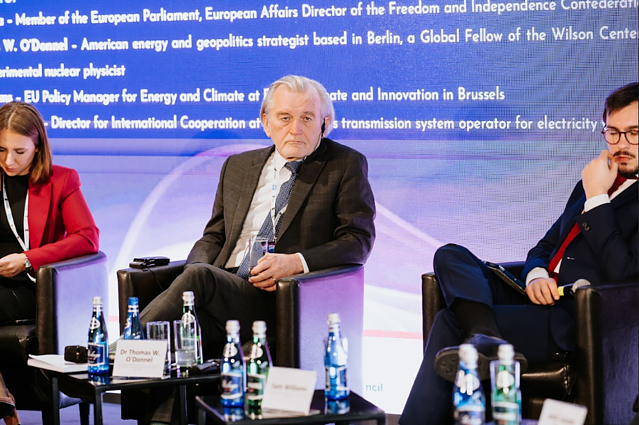
Part 2: “Does EU Climate Policy Need Evolution or Revolution? What Should We Change in the Green Deal?” My critical remarks at “Energy Security in CEE Conference,” Warsaw

This is a continuation of my remarks in Warsaw, on 18 November. Part 1, which posted on 19 December, reviewed failures to develop critical tech elements required by the EU Green Deal, a program modeled on the German Energiewende. I argued that, after decades of R&D efforts, these technology failures indicate the systemic failure of heavily renewable models, pointing to a need for “radical reform” of the Green Deal. I advocated for the historically proven Messmer model, which succeeded, some 40 years ago, in decarbonizing French electrical generation using nuclear power, without any need for new grids or long-term grid-scale storage tech.

Below, Part 2 (edited for clarity) focuses on the political intransigence of the new Von der Leyen commission, which is doubling down on the Green Deal’s renewable model. I argue this is not “reindustrializing” Europe or making it “more competitive” as claimed, but rather driving it into deindustrialization. This mirrors the process underway in Germany via its continuing push for new “green tech,” on the theory this should spark a broad new European industrial competitiveness. From an historical perspective, this is theoretical and practical nonsense – or so I argue. Critiques are welcomed. (PS, Happy holidays!)

Leon (moderator): So, I’m going to turn to Thomas again. You argued that that some form of radical overhaul is necessary, you know, with regards to the EU Green Deal, if I understand it correctly, and you’ve cited one of the issues is the complexity of the fact that there are certain technologies that haven’t emerged over the last 30 years that have just been growing incrementally rather than rapidly to meet our needs. But at the same time there’s seems to be some sort of political rationale for why this sort of revolutionary approach. How would you respond to that?

Tom: Yes, politically, I do think the new Commission presents a big problem for European competitiveness, for energy policy and security.

The new commission is anti-energy-policy reform

Firstly this is because Ms. Teresa Ribera, from Spain, is President Von der Leyen’s new chief executive vice-president.  She is in charge of attaining both the Green Deal and has also been given responsibility for “industrialization of Europe,” for making it competitive again.

The problem is, Ms. Ribera is a true believer in all-renewable energy systems, I would say a career-long renewable fundamentalist.

For example, she’s said to be so good at negotiating that she managed to get the Spanish nuclear industry and civil society to agree on a timetable to close all the Spanish nuclear power plants, and she’s very proud of this. This is politically and ideologically identical to what Mr. Robert Habeck, the German Green Party leader, who is energy and economics minister, carried out with the approval of Chancellor Scholz of the SPD-party. Habeck closed Germany’s last three nuclear power plants during a wartime, Russian-instigated, European energy crisis.

The fact that Von der Leyen fought hard to appoint Ribera and then put her in charge of the Green Deal and of European industrialization, and made her the most powerful commissioner, the executive vice president of the commission, shows that Von der Leyen, a member of the German conservatives, the CDU, has no interest in reform of the renewables model despite its suffering technological failures on several key aspects.

The problem is not that Europe has not had an industrial policy. Europe has had an industrial policy, one that has failed

Continue reading

Part 1: “Does EU Climate Policy Need Evolution or Revolution? What Should We Change in the Green Deal?” My critical remarks at “Energy Security in CEE Conference,” Warsaw

This is long, so posted in two parts. It ended up a sort of manifesto for radical reform of the EU Green Deal model. First, I explain key technological failings of the all-renewables model. Second, I stressed that political intransigence of the new Commission to reforming this model is weakening EU war-time energy security and driving industrial decline.

  • Anna Bryłka – Member of European Parliament, European Affairs Director Freedom & Independence Confederation
  • Dr. Thomas W. O’Donnell – American energy & geopolitics strategist based in Berlin, Global Fellow of Wilson Center, Wash, DC (external) & an experimental nuclear physicist
  • Sam Williams – EU Policy Manager, energy & climate at EPICO Climate & Innovation Brussels
  • prof. Leszek Jesień – Director, International Cooperation at PSE. Poland’s transmission system operator for electricity (TSO)
  • Moderator: Dr. Leon Hartwell – Senior Associate LSE IDEAS, London School of Econ., co-founder Russia-Ukraine Dialogues, & former Sotirov Fellow.

Note: The conference video is unpublished, so I print only my own remarks, unfortunately not my co-panelists’ as well. Starting from an AI transcript I greatly reworked into more like a long article, but with the moderator’s questions unchanged. I also added subtitles.

Dr. Leon Hartwell: Now, I’m going to now turn to you, Thomas, because you’ve written about everything from oil to nuclear energy, and I hope you’ll throw a few spanners in the wheel. So, to give us some food for thought. The title of our panel of course, Evolution or Revolution. What does the Green Deal need and why? What’s your take on this, Tom?

Dr. Tom O’Donnell: Thanks, Leon. Well, first off, I’m not going to say anything I haven’t said for 20 something years, I didn’t just write it for this panel.  I have also taught seminars critiquing the Green Transition Model, the German Model, over many years.

Dr. Tom O’Donnell, CEE Energy Security Conference, Warsaw 18.11.24

So, the question posed is: “Evolution or Revolution in the Green New Deal?” and the other iterations of it, “Fit for 55” and such?  I would say it would be nice to have evolution, but it’s not possible.

It’s a failure, a policy disaster, which is going to require radical action by Europe if you’re not going to deindustrialize, and also for security reasons. There are two aspects here to this failure.

Continue reading

My BiznesAlert: German elites have no idea how to get out of the crisis / Ekspert dla Biznes Alert: niemieckie elity nie mają pomysłu na wyjście zkryzysu

Last night, leaving the Polish Sejm, after a long discussion, invited by a leader.

URL CORRECTIONS: ENGLISH Biznes Interview LINK & POLISH Biznes Interview LINK

[Warsaw, 21 Nov] Here’s my interview with BiznesAlert’s Artur Ciechanowicz (in EN & Pl) on Germany’s energy, industrial and political crises. I spoke here in Warsaw Monday at the CEE Energy Security Conference, attended Wednesday’s 25 Years of NATO Membership conference, and was invited yesterday evening, by a leader of the Sejm (parliament) for a long talk in his offices, joined by Mark Voyger (American University Kyiv and former-NATO). More soon. Tom O’D.

Continue reading

My PAP, Poland: “Expert: EC recommendation to reduce greenhouse gas emissions by 90% by 2040 is fantasy” / “Ekspert: zalecenie KE redukcji emisji gazów cieplarnianych o 90% do 2040 roku to fantastyka”

I’ve been thinking about what to say on Monday in Warsaw: at the “Energy Security in Central & Eastern Europe” conference. As soon as I saw the title of my panel: “Does EU Climate Policy Need Evolution or Revolution? What Should We Change in the European Green Deal?” I accepted! This question goes beyond politics – left, right or center – it is a pressing matter for European energy security

Then, I recalled my syndicated interview with Polish AP’s Arthur Ciechanowicz (Brussels) this February. It’s exactly what I should say in Warsaw (see below: LHS in EN, RHS in PL), especially given President Von der Leyen’s choices of long-time anti-nuclear politicians to be her top commissioners for climate and (re)industrialization (Teresa Ribera), and for energy (Dan Jørgensen). (**Details in footnotes). See what you think.

* Footnotes: References on new EU Commissioners’ anti-nuclear attitudes:

Continue reading

NAPEC ’24, Oran: Why does the EU insist Algeria develop hydrogen & a big pipeline despite Equinor & Shell refusals due to “no customers”?

I explain EU/German motives for seeking “green H2” import pipes, then (at time 11:30) questions I raised moderating at NAPEC re. EU-Algerian pipeline MOU.

Here’s my video from Oran, Algeria, after a very informative “Africa and Mediterranean Energy & Hydrogen Exhibition & Conference,” NAPEC 2024 (video highlights here). Two parts to my analysis:

First, (up to time 11:30) I explain the rationale and impetus for the EU drive for massive green hydrogen gas imports. This is primarily driven by Germany’s increasing desperation at being locked into over-reliance on weather-variable renewables, whose high prices are sparking its “deindustrialization,” especially after losing Russian gas pipeline imports due to Putin’s war on Ukraine, plus due to the own-goal shutting down of their zero-carbon, amortized (paid for) nuclear plants during the European energy crisis. (Note: I misspoke: “Grey” hydrogen would NOT have the CO2 stored, “Blue” would. Both are derived from natural gas.)

I also explain how this massive green hydrogen “fix” to “renewables fundamentalist” policy is a techno-panacea that simply cannot work. Then ..

Continue reading

My Al Watan(Cairo): Iran would seek global energy crisis if an Israeli/USA strike threatened regime survival | IEA warns on EU winter gas

ENGLISH Interview | Al Watan, Cairo.  Thurs 10Oct24. 15 minutes
ARABIC Interview

At first, we focused on IEA warnings of a possible EU winder gas shortage due to supply-and-demand mismatches. I agree and expand on the IEA points.

Second, I explained that if Israel retaliates against Iran so strongly that it threatens the regimes survival, or is seen as intending to provoke regime change, then the Iranian leadership will have “nothing to lose” by in-turn escalating to the maximum. Aside from unleashing the maximum response of its proxies surrounding Israel, Tehran’s most potent weapon would be to spark a global oil and gas crisis.

Consider oil: Iran can either shut down the Straights of Hormuz (or simply make them unsafe for tankers) and/or, it can use missiles and drones to destroy significant parts of Saudi, UAE and other Gulf oil facilities, including perhaps even Azerbaijan’s as some Iranian propagandists have threatened.

Consider natural gas: Shutting the Straights or directly hitting Qatar’s massive LNG exports infrastructure would immediately stop Qatari LNG exports. As the world’s second largest LNG exporter, this would immediately cause a separate global natural gas crisis.

Continue reading

My BBC(Cairo)+Alhurra(Wash DC): What if Israel bombs Iran’s oil? Does Israel have an end strategy? “Smite enemies, repeat in 10 years”?

Again, oil security is determined by both global-market balances and geostrategic realities – at present the Mideast war and Russia’s War on Ukraine. My analyses this weekend were featured in: (a) an AlHurra video (LHS English, RHS Arabic), and below these (b) a detailed BBC-Cairo print interview (LHS English Google Translate, RHS Arabic original). where I make similar points as my Friday video in Warsaw.

Alhurra ENGLISH. My comments at 2:45 & 8:20. Date: 5 Oct 2024, with co-guest GPI President Paolo von Schirach, Washington.
Alhurra ARABIC, 5 October 2024

My BBC (CAIRO) print interview in Arabic and English (Google Translate):

Continue reading

My Newsweek interview (USA): India won’t buy Russia’s USA-sanctioned ‘Arctic LNG2.’ A big blow to Putin.

Below, I am quoted repeatedly (marked in bold -TO’D), by Newsweek’s intrepid Brendan Cole, reporting from London on Russia and Ukraine. I was on the Berlin-Warsaw express, heading to the Warsaw Security Forum. At the end are links to several other-language versions. Read on …

Putin’s Arctic Project Suffers Blow From Top Trade Ally

By Brendan Cole Senior News Reporter FOLLOW

India has refused to buy liquefied natural gas (LNG) from Vladimir Putin‘s flagship Arctic energy project delivering a “major blow” to Moscow’s fuel exports, an energy analyst has told Newsweek.

India’s oil secretary, Pankaj Jain, has said that New Delhi is “not touching” any commodity from the Arctic LNG 2 project due to sanctions that followed Putin’s full-scale invasion of Ukraine aimed at stifling Russian energy revenues, which the United States stepped up this month.

Putin had high hopes for the seaborne resource after losing the lucrative European market for pipeline gas due to sanctions and the president’s move to weaponize the fuel, which only spurred countries to find other suppliers.

Following huge losses, Gazprom cut its fuel production while a proposed Power of Siberia 2 pipeline to transport increasingly stranded Russian gas resources to China remains delayed amid haggling over price.

However, attempts by state firm Novatek to get Russia’s gas to market through the Arctic LNG 2 project have so far failed after Jain said last Friday, “We are not buying any sanctioned commodity.”

Newsweek reached out to Novatek for comment.

Berlin-based energy analyst Tom O’Donnell said Russia’s switch to boosting LNG exports has been fraught with difficulties due to sanctions.

“They have had to considerably cut back because they can’t get either the equipment to build it or the ships to transport it,” he told Newsweek.

“LNG from the new Arctic LNG 2 project was very important for Putin to be able to ship it to India and to China,” he said. “With India dropping out, this will be a major blow.”

Russia plans to triple its LNG exports by 2030 to 100 million tons. The country is expected to play a key role in India’s energy strategy, which has built terminals to receive the fuel.

Continue reading

What if Israel bombs Iran’s oil? Four points on market & geopolitics. Video-Warsaw 03oct24

Recorded Thurs AM, 03Oct24. Warsaw Old Town, Castle Square.

Will Israel hit Iranian oil infrastructure? And, what part of it? To what effect on markets, and geopolitics, (i.e., Mideast, OPEC, Russia and Ukraine war)? A video report.

MAIN POINTS (see transcript):

1. What if Israel hits Iran oil infrastructure in retaliation for missile strikes on Tel Aviv on Tuesday night? 1.a. The difference effects of hitting Iranian refineries vs oil export terminals In itself, neither target would make big difference in the market. The market would immediately jump, of course, but in principle the effect would be small. 1b OPEC+ and Western Hemisphere have plenty of spare capacity.

2. Consider Saudi market tactics … reportedly they want to now go for share over price support, as price support is failing after well over a year of output cuts (about 6 mb/d). Note: Shortly after this recording the Saudis repudiated the WSJ that reported the switch in tactics to defending share. Likely they’ll now want to wait and see what happens to Iranian exports, or if this Israel-Iran tit-for-tat gets out of hand.

Continue reading

My TRT Istanbul: Turkey’s new Shell LNG imports are “a big deal,” with Tom Marzec-Manser, ICIS

See my pre-interview research reference & notes below this post. Tom O’D.

This epitomizes today’s LNG-geostrategic nexus.

One way to look at the Turkey-Shell LNG deal is that Mr. Erdogan wants Turkey to avoid Germany’s blunder in relying heavily on Putin’s Russia for its imported natural gas. He obviously wants Turkey to diversify its natural gas imports. In this regard, the opening comment by Tom Marzec-Manser, head of Gas Analytics at ICIS, London, that “this is a big deal” for Turkey – is correct.

Turkey uses about 50 bcm (billion cubic meters) of natural gas per year. This is currently supplied almost entirely via pipelines, mainly from Russia, also from Iran and from Azerbaijan. As I pointed out, Mr. Erdogan is well aware how Putin cut off German and EU Russian gas supplies as a geostrategic weapon in preparation for his full-scale invasion of Ukraine. This plunged Germany and the entire EU into the acute 2022-2023 European energy crisis. Germany, especially, still has not fully recovered.

Continue reading

My Al Qahera, Cairo: Germany’s VW auto crisis, Green Energy Errors & Deindustrialization (English/Arabic)

English audio here. Arabic video is below.
Arabic video here. English video is above.

Al Qahera, news TV in Cairo, asked me questions on Germany’s VW crisis. VW announced yesterday it will close at least two facilities and move to break the long-term agreement with its workers’ union for no layoffs till 2029. This is serious in that 1) VW, since its founding in 1937, has never shut any plants, and 2) it’s not just VW. and it’s not just the German auto sector.


I told Al Qahera that the same story can be told about Germany’s steel industry (i.e., Thyssen-Krupp), or its chemical industry (i.e., BASF).


German energy intensive industries are facing not merely the creeping uncompetitiveness long decried in the country, but outright deindustrialization.


I described to Al Qahera how this decline of German industry reminds me of USA deindustrialization (the “rust belt” collapse) during my years working in the USA auto industry in the mid-1970’s to early 1980’s (both at Chrysler and Ford, in Detroit) and USA Railways (I worked on the Michigan Central when it was consolidated with other railways, by the federal government, to form Conrail). I remarked how it took the USA some 15 or more years to restructure and again become a modern, digitalized manufacturer. There is no guarantee Germany could pull this restructuring off, and there was no guarantee the USA would either, but that was a special case of a mammoth economy,

Continue reading

At ‘Berlin Energy Forum,’ 2 Sept., I’ll argue: Germany’s green-hydrogen import strategy is unrealistic & ignores African needs

NOTE: Last call to Sign Up Here for our 2nd Berlin Energy Forum, on “Germany’s Quest for Green Hydrogen: from Ukraine to Mauritania & back,” 4:00 – 5:30 PM (CET), Berlin Capital Club, followed by networking and drinks. The Capital Club is atop the Hilton Hotel, adjacent to Gendarme Market in Berlin’s Mitte district. Looks like we’ll have a full house again. There is also a delayed-video sign-up option. -o-o-o-o-o- Speakers: I’ll be joined by Dr. Dawud Ansari of SWP think tank where he leads H2 research, and Ms. Olena Pavlenko, President Kyiv’s Dixie Group via video link. Moderation: Ben Aris, Editor-in-chief & founder of bneIntelliNews, & our forum co-organizer.

Second: While writing my talk, I began rethinking a 2023 post on Germany’s  green-hydrogen import scheme for Mauritania. Below is my update. — Tom O’D.

German Green Hydrogen Import Strategy is Unworkable & Ignores Mauritania’s needs

Referring to the green hydrogen MOU signed with Mauritania in 2023, Conjuncta CEO Stefan Liebing said, “(This project) will have a strong link to Germany both as a technology provider and a potential offtaker of green energy.” (“Consortium signs $34 billion MoU for hydrogen project in Mauritania,” Reuters, 8 Mar 23.)

German public broadcaster Deutsche Welle seemed quite impressed: “It has a planned capacity of 10 gigawatts – the output of roughly five to six standard nuclear power plants. The first phase of the project is set to be completed by 2028” (“Mauritania set to export green hydrogen to Germany,” DW Business, 09Mar23 archived at YouTube.)

Indeed, the MOU aims for “10 gigawatts” of electrolyzers outputting “8 million tonnes/year” (Mt/y) of green hydrogen (H2) and other products, such as ammonia. However, according to the press announcement, in 2028 the facility will have a 400 MW capacity, or one-twenty-fifth of 10 gigawatts envisioned .

The German coalition government faces a formidable energy dilemma.

On one hand, it must urgently develop enough natural gas generation capacity at a reasonable cost to halt deindustrialization, and shut coal plants it brought back online when it closed the last nuclear plants To this end, Minister Habeck (Greens) urgently won approval for installation of 25 GW capacity of new natural gas turbine generation by 2030. In addition, this new natural gas capacity is needed to back up Germany’s growing, renewable-electricity dependence, as it simply has no feasible grid storage tech to offset its weather-variability.

So too, in response to Russia cutting off gas deliveries to Germany, as part of its full scale invasion of Ukraine, Germany urgently moved to install up to seven offshore LNG floating regasification ships (FRSOs). These aimed for a new natural gas import capacity of 25 bcm/year as LNG in 2023,

In January 2024, the Bundesnetzagentur (BNetzA) reported that, “According to preliminary figures, the total volume of natural gas imported into Germany in 2023 was 968 T”Wh (2022: 1,437 TWh).” of which 7% or almost 70 TWh was LNG. The reduction from 2022 largely reflects the fall in industrial production it is now suffering.

On the other hand, Germany urgently seeks enough future “green energy” import projects to eventually replace all this natural gas if it is to meet its decarbonization targets. The government published its “National Hydrogen Strategy” in summer 2023. (Also, “Gremany’s National Hydrogen Strategy,” Factsheet, 26 Jul 2023, by Sören Amelang and Julian Wettengela, Clean Energy Wire, is very useful.)

The (IMHO) dogmatic insistence on refusing to re-open several still-operable nuclear plants and to develop new German nuclear capacity means that the only low-carbon way the government coalition and many other political and business actors can imagine to replace all this natural gas is with green hydrogen produced from renewables in distant African, Mideast, Latin American and other states, or from developing new renewable-generated electricity it can import from nearby European countries.

This self-induced straitjacketing of the German energy system is, as I have described it, a sort of “renewable fundamentalism” — a maximalist insistence to fuel everything with 100% renewables and absolutely no nuclear.

How much of Germany’s new LNG-supplied energy could the Mauritania project replace in 2028?

Continue reading

My TRT Istanbul: Türkiye’s African Energy & Geo Strategies. Somalia & Niger gas & mineral deals.

Note: I haven’t posted TV or print commentary for three months! There’s been too much to do; but now I’ll try to catch up.

ALSO! The next Berlin Energy Forum (BEF), “Germany’s Quest for Green Hydrogen: from Ukraine to Mauritania & back” is 2 Sept 2024. More info & sign up here for in-person or virtual attendance. We have Dawud Ansari, head of SWP-Berlin’s H2 research group, Olena Pavlenko, president of Dixie Group, Ukraine speaking from Kyiv, plus myself, (Wilson Center) and moderated by Ben Aris of bne IntelliNews.

I was interviewed along with Dr. Michael Amoah (LSE), by TRT, Türkiye’s national broadcaster, on the Istanbul show “Straight Talk,” on 23 July 2024. Topic: Turkey’s new energy and mineral deals with Niger and Somalia. The TRT blurb:

What Is Türkiye’s Energy Strategy in Africa? It was a busy week for Türkiye’s energy diplomacy with Africa. Over just two days, Ankara secured two key agreements, one with uranium and mineral-rich Niger, and the other with Somalia. Turkish Energy and Natural Resources Minister Alparslan Bayraktar, who attended both meetings, said significant progress had been made and that for Somalia, the search for hydrocarbons off the horn of Africa will begin this year. The Turkish seismic vessel Oruc Reis is expected to set sail for the Somali coast by the end of this year as part of the agreement. In March, Turkiye and Somalia signed a deal on offshore oil and natural gas cooperation, which followed a defense agreement in February. And last week, a high-level delegation from Türkiye visited Niger’s capital Niamey to cover everything from energy, defense, intelligence sharing and mining. The visit came after the West African nation severed mining contracts with key Western countries, including France, and called for French and US troops to leave the country.

Guests:

— Dr. Thomas O’Donnell Global Fellow at Wilson Center

— Dr. Michael Amoah Visiting Senior Fellow at LSE

Go back

Your message has been sent

Warning
Warning
Warning
Warning.

My Briefing Paper for USA House Foreign Affairs Committee hearing, “… Ending Global Dependence on Putin’s Nuclear Energy Sector.”

—– Click image to open PDF

I was asked to write a Brief for the USA House of Representatives’ Committee on Foreign Affairs (Europe Subcommittee) 12 March hearing: “Going Nuclear on Rosatom: Ending Global Dependence on Putin’s Nuclear Energy Sector,” submitted via Wilson Center in Washington, where I am a Global Fellow (external). There are two aspects to the Brief:

  1. My assessment of how threats posed to the 3-Seas-Region Member States executing a pragmatic energy transition incorporating nuclear energy emanate both from the role of Russia’s Rosneft, and equally from the activities of seven anti-nuclear Member States led by Germany, and
  2. Detailed research on Russia’s nuclear energy dangers contributed by colleagues in Poland and Ukraine.  Their research includes:
  • Appendix A: Some facts and policy recommendations on Rosatom activities, based on research by Warsaw colleagues at The Polish Economic Institute (PEI), Dr. Adam Juszczak, and Mr. Kamil Lipiński (p. 6);
  • Appendix B. Rosatom may be assisting in circumventing sanctions., from research by colleagues at DiXiE Group, Kyiv, Ukraine, especially Mr. Roman Nitsovych, and Ms. Olena Pavlenko (p. 7);
  • Appendix C. Why sanction Rosatom: Link between “peaceful” Rosatom energy & Russian nuclear weapons, based on research by CGS Strategy XXI , Kyiv, Ukraine, in particular Mykhailo M. Gonchar, Founder and President, and Chief Editor of the Black Sea Security Journal (p. 11.)

I highly recommend their three Appendices.

I should note that what I wrote in the main body was likely unexpected. I wrote that, for accomplishing a pragmatic, nuclear-power-inclusive energy transition in the 3-Seas Region (i.e., the EU’s Central and Eastern Europe, Baltic, and Balkan Member States), the continued dependencies on Russia’s Rosatom are not the only threats. The threat from the Group of Seven anti-nuclear states, led by Germany, is clearly equally or more disruptive to the Region accomplishing a pragmatic energy security-and-transition policy. I’ll quote a bit of the report on this point:

Continue reading

1st “Berlin Energy Forum” 21 May | A monthly disruption of the local ‘energy echo chamber.’

Dear Colleagues & friends, Below is an invite to our first Berlin Energy Forum (jump to details | jump to register), but first a personal note.

First, a personal note: As some of you know, this is an idea I’ve been floating in Berlin since well before Corona. Then, last October, I had an experimental test run, a one-off, sponsored by the Qatari embassy’s Divan – and it went very well.

However, the biggest success from that event was that Ben Aris, co-founder and editor-in-chief of bne IntelliNews enthusiastically joined me to found the Berlin Energy Forum as a regular monthly sort of membership club. Amongst the longest serving foreign correspondents in Eastern Europe, Ben has been covering Russia since 1993, with stints in the Baltics and Central Asia. He is a former Moscow bureau chief for the Daily Telegraph and was a contributing editor at The Banker and Euromoney for a decade amongst writing for many other publications. He is also a professional photographer, and nowadays based in Berlin.

Ben is one of those rare people who relishes doing analysis and data-driven writing (non-stop!), AND who knows how to do business – and thoroughly enjoys doing it. Just the partner for this endeavor.

My model and inspiration for this forum was always the New York Energy Forum, which has run for over 40 years now. I happily attended while teaching in NYC. My experience with that forum, plus familiarity with a few top DC think tanks, and various foreign diplomats (esp. in NYC/UN), is how, as an academic, I got to know a broad spectrum of USA oil and gas executives, journalists, financial-institution analysts and government officials. Those personal connections have, over the years, anchored my assessments of USA, of OPEC MENA-and-Latin American members’, and of Russian and Chinese strategy. This sort of community doesn’t exist in Europe in such a focused manner, save perhaps in London. Perhaps we can now bring a bit of that world to Berlin with our new BEF.

Continue reading