El día de Pascua, 20.04, me entrevistaron en directo por radio, en muchas ciudades de Europa y del hemisferio occidental. On Easter Sunday, April 20, 2025, I was interviewed live in several cities of Europe and the Western Hemisphere.The interview was in Spanish. An English Google translation is below (RHS column). The topic was the negotiations of the Trump USA administration between Russia and Ukraine to end the war. Tom OD.)
Mi agradecimiento por la invitación de María Eugenia Plano, productora del programa radial Corresponsales en Línea, realizado por las corresponsales de los diarios Clarín y La Nación en París y Londres (María Laura Avignolo), París (Danielle Raymond), Madrid (Silvia Pisani), Berlin (Araceli Viceconte), Washington ( Paula Lugones) y San Pablo (Cristina Veiga) con la conducción de Silvia Naishtat (Editora de Economía de Clarín). en vivo y en directo para Radio Ciudad en Buenos Aires, los días domingos de 10 a 12 AM Hora Argentina. My thanks for the invitation from María Eugenia Plano, producer of the radio program Corresponsales en Línea, made by the correspondents of the newspapers Clarín and La Nación in Paris and London (María Laura Avignolo), Paris (Danielle Raymond), Madrid (Silvia Pisani), Berlin (Araceli Viceconte), Washington (Paula Lugones) and Sao Paulo (Cristina Veiga) hosted by Silvia Naishtat (Economics Editor of Clarín). live and direct for Radio Ciudad in Buenos Aires, Sundays from 10 to 12 AM Argentine time.
Above: Audio of my comments to (various) press on 22 April 25, on the impact of falling oil prices on Russia’s capacity to war on Ukraine. Also, a scenario I have discussed for over a year, first privately and then publicly, of how the USA could shut down the great majority of Russia’s seaborne oil exports, to devastating consequences for its oil sector and capacity to continue the war. In the present market situation of oversupply and anticipated continued weak demand, this could be done in a way that does not spike global oil prices.
This will only be done if Trump decides he needs to use harsh coercion to force Putin into an acceptable peace deal with Ukraine, AND if Trump were willing to impose lasting harm on the older Russian oil fields.
Xi Jinping has still not built China’s domestic market to escape its trade-war vulnerabilities from over-dependence on exports, a weakness he openly discussed back in February 2012 on his USA tour before becoming premier.
For the USA, Trump had apparently planned to have resolved the Ukraine war and in some way undermined the Russia-China alliance, inducing Russia to move closer to the USA before going after China. But, ending the war has proven far more difficult than he anticipated. His lack of success with Russia will weigh on his ability to negotiate from a position of strength with all the countries he is competing to win away from China’s geoeconomics orbit such as India, Viet Nam, Cambodia, Philippines, Thailand and etc. — the states that Treasury Secretary would say are in the “yellow zone” as opposed to the USA#s closest allies such as Japan, South Korea, Taiwan, in the so-called “green zone.” For details – see this post on my blog,
Last night, I was live on Al Jazeera’s evening news to give an “EU perspective” on Trump’s sweeping tariffs on the EU and have a bit of a debate with Hon. Robert Arlett, Sussex County Council, Delaware, USA – a MAGA supporter. I was happy to do so.
I think I made several decent points of criticism about how the entire premise for “retaliation” against the EU on trade was “made up” under an “arbitrary” formula that “makes no sense.” I allowed that, as is often the case with Trump, much of this, the “retaliatory” portion, might be a pressure tactic for some other, still-to-be-revealed concession Trump is aiming for from Europe.
Of course, this is the geo-economic side to Trump’s geostrategic undermining of a unified USA-EU approach to facing Russia over its invasion of Ukraine. (However exactly how that new geostrategic relationship with Europe and NATO might all fit into Trump’s larger, global security strategy is still mostly up in the air, a matter still taking shape.)
However, as for these massive tariffs on Europe and Asian allies, these are a systematic attempt to dismantle globalization as we have known it and instead to focus on the subordination of European and Asian allies to a system where hegemon is unwilling to pay certain costs of maintaining its allies within its system.
Trump envisions a system where the USA makes no sacrifices or pays no communal costs, but must profit at every step from each and every ally. Indeed, the USA has powerful tools afforded it from its geo-economic dominance, tools which Trump seeks to exploit to unilaterally shape international economic and geopolitical relations, while forcing its allies to pay for the privilege and advantages of belonging to the USA-hegemon-maintained system.
Opening of Nord Stream1 pipeline, 2011. Gazprom via PAP
Below are links to 12 articles that appeared in the Polish press in the last few months, interviewing or quoting me on four topics I feel are important. The topics are listed in the title above.
The links are below, sorted by topic. The first or left column has English translations of the titles, and the second or right column has the original Polish — which unfortunately I don’t speak! If you follow the links, Google Translate or Deepl will translated the Polish articles pretty well into English. My special thanks to the intrepid Polish journalist, Artur Ciechanowicz at BiznesAlert in Warsaw for his interviews in the list. (I also had about 33 quotes or interviews in several other languages since December [1]).
ENGLISH titles and links:
On German (far-right) & USA (Trump) each plotting a Russian gas return to Germany
A former Stasi agent lobbies for the resumption of Nord Stream. Expert: One of the gas pipeline lines ready to be launched,, By,:Artur Ciechanowicz, March 3, 2025, biznesAlert.pl
Some EU countries believed that Gazprom gas would be in Europe forever BiznesAlert.pl
“Like a Drug Addict Returning to Heroin.” Analyst on the Idea of Unblocking Gas Imports from Russia to Europe, Author: Artur Ciechanowicz, February 1, 2025, 07:21
Failures of EU Green Deal on technology and energy security.
American expert: recommendation to reduce emissions by 90 percent by 2040 is “fantasy” | Energetyka24
Expert: EC recommendation to reduce gas emissions is fantasy wpolityce.pl
Unrealistic EU climate plan. Expert opinion crushes – Super Business
“Rearranging deckchairs on the sinking Titanic”. Expert slams the eco-target dictates of Brussels Eurocrats – PCH24.pl
Trump, EU & Poland: Ukraine War crisis.
First talk with Putin. Trump has visions of ending the war in Ukraine | Newsweek Jan 21
How Trump Can Bring Down the Russian Economy: Analysts: He Has an Arsenal of Means to Do It, By Artur Ciechanowicz, Jan 24, 2025 | Biznes Alert
Trump may use [oil] sanctions to finish off Moscow, which is running out of money for the National Welfare Fund. – 16 January 2026 UBN
Expert: Washington, London, Warsaw should work quickly. Kiev can’t afford to be patient – Dziennik.pl
German deindustrialization: Energy & economic crisis
Major shoe retailer goes bankrupt A sharp increase in bankruptcies in Germany
Polish titles and links:
First topic.
Agent Stasi lobbuje za wznowieniem Nord Stream. Ekspert: Jedna z nitek gazociągu gotowa do uruchomienia biznesalert.pl
Część krajów Unii uwierzyła, że gaz z Gazpromu będzie w Europie na zawsze BiznesAlert.pl
“Jak powrót narkomana do heroiny”. Analityk o pomyśle odblokowania importu gazu z Rosji do Europy | BizNes Alert
2nd Topic
Amerykański ekspert: zalecenie redukcji emisji o 90 proc. do 2040 r. to „fantastyka” | Energetyka24
Ekspert: Zalecenie KE redukcji emisji gazów to fantastyka wpolityce.pl
Nierealny plan klimatyczny UE. Opinia eksperta miażdży – Super Business
“Przestawianie leżaków na tonącym Titanicu”. Ekspert nie zostawia suchej nitki na eko-dyktaturze brukselskich eurokratów – PCH24.pl
Third topic
Donald Trump chce uchronić świat przed III wojną światową | Newsweek
Jak Trump może złamać rosyjską gospodarkę?
Trump may use [oil] sanctions to finish off Moscow, which is running out of money for the National Welfare Fund. – UBN
Ekspert: Waszyngton, Londyn, Warszawa powinny szybko działać. Kijowa nie stać na cierpliwość – Dziennik.pl
[1] Other than being cited/interviewed in Poland, I was also quoted elsewhere about 33 times so far in 2025, mainly in the USA, with many then translated to languages of Europe, Asia and Latin America. I never know what to do with all these print interviews. Here at GlobalBarrel.com, I often publish videos of some of my live-on-air expert commentary, usually accompanied by a detailed blog post. So, my idea is I will make a new tab at the top of the GlobalBarrel.com site, next to the “About Me” tab, where I can simply list link to my recent press citations or Op-Eds. [Back to text]
TRT asked me to be ready to comment, live, on the Oval Office meeting just before it blew up. I said Vance acted “infantile”. What I should have stressed, however, is that understanding Vance’s decision to blow up the meeting is key to understanding Trump’s strategy towards Russia, Ukraine, and Europe. (So, in this post the written analysis is the main thing, not the video.)
My TRT quick take, 28 Feb. See my later analysis, in the blog post.
There is plenty of facile analyses of this clash. Many say the blowup reflected “chaos” in Trump’s policy on Ukraine and Russia, or that Trump has an “impulsive” strategy, that he “dislikes Ukraine”, he’s “pro-Russian,” or that the blowup was a “prearranged ambush” to “humiliate” Zelensky, or similar.
Too few consider the possibility that the rebuke is consistent with a well-defined USA strategy. What quickly becomes clear from listening, at face value, to multiple statements by Trump himself and his team is that they have a consistent strategy. This is clearly not the first Trump administration. This second administration is different in its unity and consistency on its Ukraine, Russia, and Europe policies.
What was the purpose of the “minerals” deal that Zelensky came to sign?
The weeks-long USA-Ukrainian clash over this deal has reflected their geostrategic differences on a peace deal with Russia. After heated exchanges and compromises, clearly the Ukrainian side was not pleased with the issues it had had to give up in the minerals deal. Nevertheless, Zelensky’s Council of Ministers voted to endorse the deal, and Zelensky went to DC explicitly to sign it.
Interestingly, just before he went to the White House, President Zelensky met with a group of Republican and Democratic senators, who had “… all told him sign the deal and don’t get into an argument.” (War on the Rocks, timestamp 7:58-8:19, 06.03.25). Alas, if one watches Zelensky’s public argumentation, from the start of the press conference, and his telling Trump that a deal without a US security guarantee won’t work, all of which is in contradiction to the deal he is about to sign, it is clear that he precipitated the breakdown. In my reading of the event, he seemed to not be able to restrain himself, seemingly out of an understandable deep anguish at being about to sign an accord contrary to his better judgment.
What did each side want in the “minerals” deal, and who got what?
Everything I found to have been said by the actors on the USA and Ukrainian sides as to what each wanted in the document is quite consistent.
On the Ukrainian side, the big one was a USA security guarantee for any deal Trump makes with Putin. The Ukrainians certainly welcome the willingness of European allies to extend security guarantees for any deal, especially the public commitments made by both the UK and France to contribute troops, but they were clear that they did not think this can substitute for a USA guarantee standing behind theirs. Related to this, the Ukrainians opposed taking NATO membership for them off the table. Another was a seat at the table for Ukraine and the Europeans during negotiations with Russia (Trump wants something more like a shuttle diplomacy between the two.) Related to this, is that the USA should not negotiate a cease fire deal without them. Still another was refusing to agree beforehand to give up any Ukrainian territory that has been occupied by Russia.
Obviously the USA disagreed and de facto or openly refused all these conditions. However, the disagreement over the security guarantee seemed to be the most hot-button issue between them. Trump flatly refused. His reasoning, as explained to the press was interesting, revealing a lot about his philosophy or method for negotiating a peace deal. He said that the two sides obviously hated one another and he had to go between the two to negotiate anything. (Read Trump’s own words, in the transcript below.)
The Trump concept of economic interests and security interests
He also said that they had to trust him, saying that it just would not work if he first gave a security guarantee, taking Ukraine’s side so clearly beforehand. He also said that the ultimate security guarantee “is the easy part” and getting the deal “is the hard part.” He said the guarantees can “come later.” It became clear that, in his approach, this minerals deal was to be the signal to Putin that the USA would have long-term economic interests in Ukraine and would, of course, in Trump’s view of how the world works, defend against any threats to those economic interests.
This approach is clearly seen as highly risky by Ukraine, which has been abandoned once before under what was an explicit security guarantee, the Bucharest Memorandum, extended in return for giving up its nuclear weapons in the 1990’s. As Zelensky recounted for Trump, no signatories of the Minsk Accords extended security guarantees after Russia’s 2014 aggression, and Putin broke them constantly
The text of the final document, the one the Ukrainian ministers approved, is known; it was published in Kyiv two days before the Oval Office meeting. (The full text of the Ukraine-US Minerals Agreement, European Pravda, Kyiv, 26.02.25). So, it is easy to see that Kyiv didn’t get its main demands, although the USA did compromise, in a sense, on one of them, agreeing to an explicit mention of a “security guarantee.” However, the USA did not extend one as a quid-pro-quo for the minerals deal, rather in Section 10. the wording is:
The Government of the United States of America supports Ukraine’s efforts to obtain security guarantees needed to establish lasting peace. Participants will seek to identify any necessary steps to protect mutual investments, as defined in the Fund Agreement.
So, the USA vision of security, to “protect mutual investments,” is asserted in association..
This is in English, after Eugene Romer of Układ Sił media introduces me in Polish. This was at the “3 Seas -1 Opportunity Forum” in Gdansk, last June 4-5, 2024. I have been wanting to post it ever since, as the questions remain relevant. My thanks to Eugene and his team, and to his Opportunity Think Tank colleagues.
My panel at the forum was on problems of relying on energy security that arrives via the sea. So, think Poland and Lithuania’s LNG terminals, of the many sub-sea pipelines, power and communications cables between Baltic and Nordic states. And, since June, all the incidents where ships leaving Russian ports “accidentally” dragged their anchors, cutting such vital links. So, this conference was rather prescient. My sincere thanks to our hosts The Opportunity Institute for Foreign Affairs.
My long print interview at Lithuania’s LRT [Lithuanian PDF | English PDF] with Aleksandra Ketlerienė, deputy editor-in-chief of Lithuania’s LRT.lt, published 7January. We spoke in Warsaw, 19 November. My thanks to Aleksandra for her insightful questioning and editorial care. We discussed:
The EU’s systemic energy-policy “own goals” since its initial energy-crisis win after Moscow began cutting gas exports early in 2021.
Reforming failed/ineffective Russian price-cap sanctions for real sanctions, and how the global oil market is now favorable for “maximum pressure.”
Historical perspectives on oil, gas, renewables, and nuclear sectors, essential for realistic policy formation.
An historical overview of China’s decades-long effort to overcome its energy security, learning lessons of Japan’s WW2 weaknesses.
My live interview (22 July 2021) on the Nord Stream 2 deal between Germany and USA. with CGTN (London office of Chinese state broadcaster. This was not edited, or I would not post it here.)
I explain the bind which Berlin had put the Biden administration in for agreeing to waive sanctions on Nord Stream 2 (NS2) in return for this bad deal. The German side was playing hardball. Berlin had made clear to Washington (well before Biden arrived in office) that the pipeline would be finished regardless of sanctions.
The German (and the Danish) side had already allowed Gazprom-owned North Stream 2 AG to continue construction in their territorial waters even when reputable insurance companies and the reputable construction-commissioning firms had abandoned the project due to the threat of US sanctions; and Berlin had made it clear to the US side that it would be completed regardless of any further sanctions. Sanctions on German firms could be circumvented by Berlin continuing to allow Russian firms to do any work that German firms were prevented from performing. And, sanctioning German firms, or NS2 AG, would cause outrage in every German political party except for the Greens, the only German party clearly opposed to the project. However, the Greens had made clear they did not think US sanctions on German firms was an appropriate measure for an ally to take.
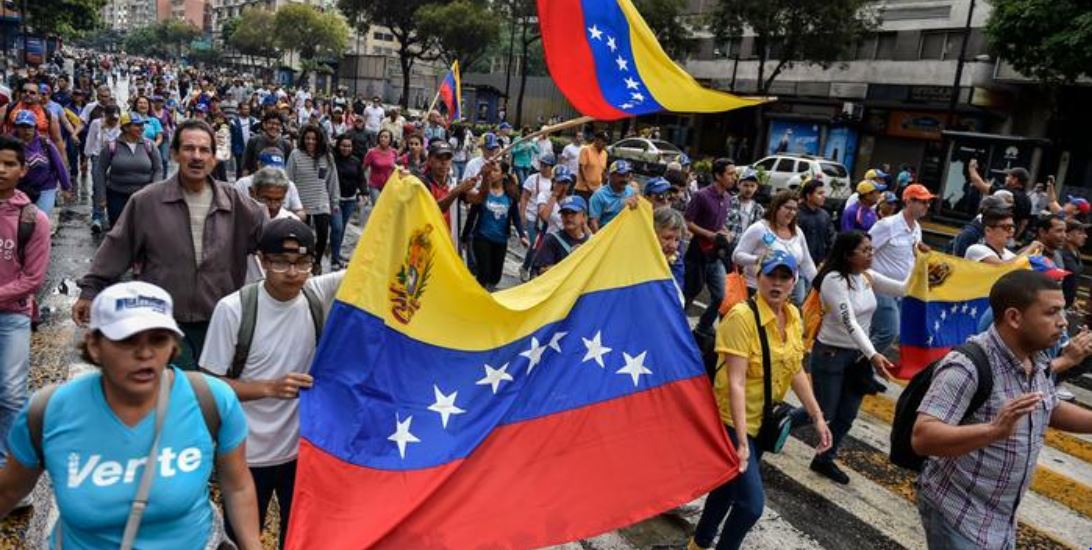
Venezuelan protest, 31 January 2019. Photo credit Deutsche Welle, German public broadcaster.
I was very happy to be interviewed for the Latin American “Energy Analytics Institute” (EAI), a Houston-based consultancy and news service. I’ve followed its work for years.
With Biden in and Trump out, everyone is debating how to deal with Maduro and his chavista regime that’s brought such misery and ruin in Venezuela. It’s not only the USA’s new LatAm team of Biden, Blinken and Nichols, but the EU, Norway, the OAS, the Lima Group, who are all looking for a new strategy. And so has the Venezuelan opposition, plus an increasingly important actor: the growing and doggedly persistent civil society organizations. Increasingly suffering forced-isolation from abroad, this array of social, cultural, media, medical, educational, nutrition, economic and political resistance groups do largely self-sufficient work to replace basic necessities and social-services, which the chavista government and ruined private sector can no longer provide.
However, in this brief Q&A what was addressed was not strategy per se; but a key underlying issue to understand in framing a strategy: the interests of both Moscow and Beijing as key obstacles to removal of the chavista regime. Read at EAI site (free) or Read below – Tom O’D.
China, Russia, Venezuela: Q&A With Thomas O’Donnell
(Energy Analytics Institute, 13.Feb.2021) — China and Russia continue to push around their might in Venezuela. Thomas O’Donnell with the Hertie School of Governance & Freie Universität-Berlin weighs in briefly here.
Energy Analytics Institute: What might China and Russia be willing to do this year to assist Venezuela’s President Nicolas Maduro?
Thomas O’Donnell, PhD: Beijing’s original (and perhaps still) plan for Venezuela was deep vertical integration mirroring PDVSA-Citgo Petroleum: new Faja upgraders, a pipeline to Colombia’s Pacific coast, dedicated ships, dedicated domestic Chinese refineries, etc. All very rational and lucrative for both sides. China became alarmed with Hugo Chavez’ unreliability and incompetence within a few years and with Maduro’s incapacity to reform within a year or so. The entire “oil-for-loans” history was a fallback strategy for Beijing – at least secure an oil stream with minimized risk. I have no doubt the Chinese Communist Party wants a new Caracas regime it can work with.
My analysis of the US-German crisis over Nord Stream 2 and policy towards Russia, published in Washington by the American Institute for Contemporary German Studies (AICGS), 8 October 2020. Read it at AICGS website\. Or, continue here. Comments & Critiques welcomed (below or via email)
Nord Stream 2: Allies’ Crisis
Two decades of Washington-Berlin collisions over the Nord Stream 1 and now the Nord Stream 2 pipelines have come to crisis.
The U.S. Congress stopped Nord Stream 2 construction in December 2019 by enacting sanctions under the Protecting Europe’s Energy Security Act (PEESA), and is poised to enact a much harsher “Clarification” of PEESA, sanctioning any entity that resumes or aids in resuming construction in the Baltic Sea. German officials insist the project will, nonetheless, be completed, denouncing U.S. sanctions as “extraterritorial” interference in “European sovereignty.”
In reality, the project appears dead. Statements by businesses interests, as opposed to political actors, support this.[1] To resume construction, companies, ports, officials, and insurers would require guarantees against ruin, including being personally sanctioned, which is difficult to imagine the German state providing. And there is no evidence of preparations to do so. Nevertheless, Russia’s Gazprom continues preparations to resume work.[2]
Complicating matters, the U.S. Congress, having mandated sanctions against the pipeline, would have to approve any compromise. On the other side, the German Bundestag roundly “savaged” a motion by the Green Party to abandon Nord Stream 2 in response to Navalny’s poisoning, unprecedentedly uniting the CDU/CSU of Chancellor Merkel and her SPD coalition partners with both the far-left Die Linke and far-right Alternative for Deutschland.[3]
Aquí abajo se puedan ver la grabación de la tortulia del 15 de agosto entre dos expertos y yo en el programa “El Fondo” de la red alemana de Deutschewelle (DE.de TV) sobre “la lucha entre aliados” de los EE. UU. y Alemania en la que Washington ha amenazado con fuertes sanciones contra su aliado de la OTAN, Berlín, por su participación en el proyecto del gasoducto ¨Nord Stream 2¨ con Rusia. Gracias a DW y su moderadora venezolana Silvia Cabrera.
Tenga en cuenta que estas no son sanciones del presidente Trump, sino sanciones impuestas por el Congreso en contra de los deseos de Trump y con el amplio apoyo de ambos partidos. Hay mucha ira en el Congreso contra Rusia por sus malas actividades en Europa en materia de suministro de gas natural al continente por parte de Moscú de forma geoestratégica, pero también por su invasión de Ucrania en 2014, y sus extensas actividades contra las democracias del Oeste.
Para Estados Unidos, este proyecto es una peligrosa colaboración de Alemania con Rusia contra los intereses y la independencia energética de la UE y especialmente de Ucrania, un país con partes de su territorio ocupadas por Rusia desde 2014.
De la propaganda del programa El Fondo de DW.de:
“¡Extorsión!” “¡Guerra comercial!” que traería gas de Rusia a Alemania. ¿Se dañará la relación entre Alemania y Estados Unidos? ¿Definirá Estados Unidos la política energética alemana?
Soldiers deployed in Poland are a kind of warning to the Kremlin. – Source: GazetaPrawna.pl
My interview on Trump’s announced US troop draw downs from Germany and partial reassignment to Poland appeared in the Polish economic press Gazeta Prawna on 25 June 2020 by the Polish journalist Artur Ciechanowicz. You can read it (a) in ENGLISH below (via Google Translate, with minor fixes) or (b) in the POLISH original at this link.
O’Donnell: Soldiers at the borders of Russia are a signal to the Kremlin [INTERVIEW]
From a military point of view, deploying too many troops too close to the border with a potential enemy is dangerous because there is a risk that they can be overrun rapidly – says Dr. Thomas O’Donnell, energy and international affairs analyst, and adjunct faculty at Hertie School of Governance in Berlin.
Question: US President Donald Trump has decided to increase the US military presence in Poland, while also reducing the contingent in Germany. Where do these decisions come from?
On the one hand, they logically result from the American National Security Strategy (NSS) of December 2017. Work on it began during Barack Obama’s term of office and was completed by the Donald Trump administration. According to the NSS, the US priority is no longer the war on terror and the situation in the Middle East, but competition with China and Russia. It is therefore quite natural that the United States moves its troops and increases its military presence in countries closer to Russia – the Baltic States, Poland and Romania. The second factor that led to these decisions was the personal involvement of Donald Trump, who is running his election campaign.
Poland’s security will increase?
As a rule, increasing the US military presence in Poland is of course good news. The Pentagon’s activities have been moving in this direction for some time, although the US military is of the opinion that this should be done a little slower and not at the expense of Germany. From a military point of view, deploying too much of the army too close to the border with a potential enemy is dangerous because there is a risk that it will be overrun too soon. There is therefore a tactical reason to keep some of the army a little further from the Russian border. Therefore, the rapid relocation of a significant number of soldiers to Poland is viewed skeptically by some American commanders. Remember, soldiers deployed in Poland are a kind of warning against the Kremlin. There are enough of them for Vladimir Putin to think twice before doing anything. However, not enough – even after increasing the quota – to stop the first strike. The rule is simple here: if Russia decided to attack Poland and American soldiers would die, it would mean a war with all the power of the US. Neither any president nor Congress would hesitate a single moment.
Some American commanders are opposed to the permanent presence of US troops in Poland. Why? Continue reading →
What are US experts’ and officials’ views on the increasingly conflictive energy and geostrategic relations between Russia, Germany, Poland and Ukraine?
Greetings. I’m in Washington as a “Title VIII” fellow of the Kennan Institute in the Woodrow Wilson Center, interviewing people in think tanks and government (legislative and executive) on these topics. I’ll also give a public talk on this at Wilson on 12 June, at 2 PM (more info soon).
I’m interested to hear anything readers think should be asked and of whom. Don’t hesitate to write me at twod(at)umich.edu or my (temp) Wilson email: thomas.odonnell(at) wilsoncenter.org.
A central issue: why is Germany so adamantly for Nordstream 2 despite the negative security consequences for Ukraine and despite the tremendous hit this project is causing to German soft-power not only with Poland, but with most Central and Eastern European (CEE) and Nordic states? (Here’s my own analysis.) How do US experts see this? Continue reading →
Here are two videos from the Quadriga show on Germany’s international network DW.de — Aquí hay dos vídeos del programa Cuadriga de la red internacional alemana DW.de





 Aquí abajo se puedan ver la grabación de la tortulia del 15 de agosto entre dos expertos y yo en el programa “El Fondo” de la red alemana de Deutschewelle (DE.de TV) sobre “la lucha entre aliados” de los EE. UU. y Alemania en la que Washington ha amenazado con fuertes sanciones contra su aliado de la OTAN, Berlín, por su participación en el proyecto del gasoducto ¨Nord Stream 2¨ con Rusia. Gracias a DW y su moderadora venezolana Silvia Cabrera.
 What are US experts’ and officials’ views on the increasingly conflictive energy and geostrategic relations between Russia, Germany, Poland and Ukraine?


