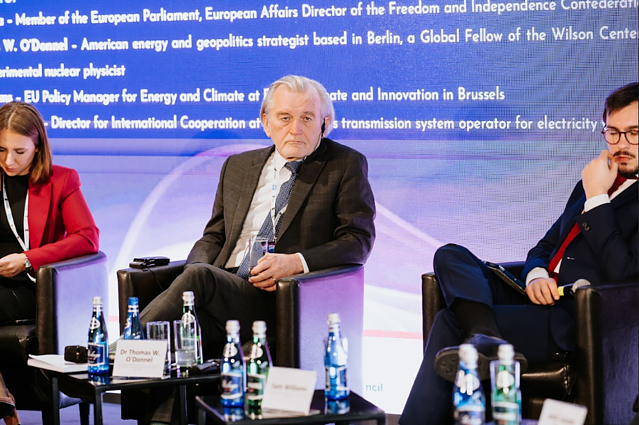
I felt greatly honored to speak in Ireland, the home of my ancestors, at a high-level Irish-Polish event, invited by the Polish embassy as part of Poland’s Presidency of the European Council. [Spoiler alert: my assessment of the Green Deal’s impact on EU energy security and competitiveness was highly critical. And, I called for a radical reform, modeled on the 1970-80’s French Messmer nuclear program, the response to a similarly dire European energy and competitiveness crisis.]
For Ireland we had Secretary General Oonagh Buckley and Wind Energy Ireland CEO Noel Cunniffee; for Poland, Daniel Piekarsky, Head of Energy Security Unit in the Foreign Ministry, and myself, Global Fellow of the Wilson Center, Washington (external) working in Europe, from Berlin.
Our moderator, from the Polish Embassy, Dublin, was the Polish diplomat and patriot, Dr. Jacek Rosa — a good friend, with whom I had the great pleasure of closely collaborating, for several years, in opposition to the Russian-German Nord Stream 2 gas-pipeline partnership, before the 2022 full-scale invasion of Ukraine. Below is the lineup, the initial invitation and some pictures. The event was off-the-record, so I show here only my own, slightly redacted talk.
My long print interview at Lithuania’s LRT [Lithuanian PDF | English PDF] with Aleksandra Ketlerienė, deputy editor-in-chief of Lithuania’s LRT.lt, published 7January. We spoke in Warsaw, 19 November. My thanks to Aleksandra for her insightful questioning and editorial care. We discussed:
The EU’s systemic energy-policy “own goals” since its initial energy-crisis win after Moscow began cutting gas exports early in 2021.
Reforming failed/ineffective Russian price-cap sanctions for real sanctions, and how the global oil market is now favorable for “maximum pressure.”
Historical perspectives on oil, gas, renewables, and nuclear sectors, essential for realistic policy formation.
An historical overview of China’s decades-long effort to overcome its energy security, learning lessons of Japan’s WW2 weaknesses.
I appeared alongside Dr. Hashem Aqel, Oil and Energy Expert, Associate Fellow at Oxford Institute for Energy Studies, who contributed several insights. Asharq News is the Mideast Bloomberg partner. My further analysis follows:
Arabic, original broadcast version.
The recent rise in EU gas prices and the rapid depletion of what had been a significant surplus in EU storage, is principally a two-sided story.
One side is indeed about the impending cutoff of Russian gas, still flowing across Ukraine. This has been expected for months, and so is already largely priced in. Expectations of new transit across Ukraine of Russian-origin gas re-labelled as Azerbaijani was being negotiated. However, this deal fell apart, with the final nail in its coffin being when Ukraine’s President Zelensky asserted that Ukraine would not transit any further Russian-origin gas after 31 December unless payments to Russia are withheld until after the war ends. This seems a very reasonable demand for a country fighting for its survival against a Russian invasion. [See “Ukraine will not allow transit of Russian gas with Azeri label, Zelenskyy says, dashing Slovak hopes,” EuroNews, Jorge Liboreir 19 Dec. 2024.] This marks the end of the five-year contract, which was only agreed to at the last moment before New Year 2020, when the US Senate finally forced then-President Trump to agree to sanctions on Nord Stream 2 construction (I was in Kyiv, for Naftogaz, and on Ukrainian television, analyzing Washington sanctions, Kyiv-Moscow negotiations, and the pro-Nord Stream position of Berlin.)
The other side is a story of yet another European energy own-goal, a consequence of its over-reliance on weather-dependent renewable energy generation. This overreliance has made its electricity supply increasingly volatile, in sync with the weather. In November and early December, especially north and western Europe experienced what the Germans call “Dunkelflaute“, a protracted wind and solar drought. Batteries can only substitute for perhaps 40 minutes, or at best an hour. So, the de facto long-term, grid-scale “storage” backing up Europe’s plethora of wind and sun generation is really just natural-gas turbine electrical generation plants. The reality of increased generation (and hence, electricity market) volatility and dependence on gas backup generation was analyzed this week in a data-driven manner by the Oxford Institute for Energy Studies. [See: “Dunkelflaute: Driving Europe Gas Demand Volatility” Energy Insight: 161, by Anouk Honoré and Jack Sharples, Senior Research Fellows, OIES, 2024/12.]
Is this even a real proposal? Nowadays, after becoming so unreliable a supplier of gas to Europe, in fact having weaponized Russian gas deliveries, it is difficult for anyone to take this proposal seriously. Erdogan may have many significant problems; however he and Turkey are not so naieve as to do what Germany and Austria forced the European Union to do, i.e., become overdependent on Russian gas, especially given the deep energy crisis Europe is currently going through.
But, also consider this (as I explained towards the end): This proposal of sending Nord Stream gas, originating in Northern Urengoy province, above the Artic Circle, would also require a big, new pipeline laying project, running at least from perhaps near the Ukrainian border south towards the Black Sea and then onto Turkey. This would have a significant cost. And, by the time this could be finished – in perhaps five or more years – the world will have moved on. By that time, new LNG and natural gas production potential in the USA, Qatar, Australia, Algeria, Norway, Israel (sent to Egypt for liquification) and likely many others’, will have been developed and be on the global market. On this time horizon, there would be plenty of diverse sources of gas fully able to replace Russian export capacities.
I also explained the history of the South Stream Pipeline …
Jun 17, 2022 Today, Gazprom announced a further cut in exports of gas via Nord Stream 1 to Germany and on into Europe. Earlier this week, they had cut 40%, now it is 60% of the 55 billion cubic meters per year (bcm) that normally flows in this pipe.
I explained that the Gazprom excuse – -that it could not re-import some compressor parts it had sent to Siemens to repair in Canada due to sanctions — appears as a convenient, manufactured excuse.
I pointed out that a one-off sanctions waiver from the USA, EU and/or Canada for the reimportation of these very specific parts could likely be easily arranged – and if the gas did not again flow fully, Gazprom’s ruse would be clearly exposed.
However, as I said, this is more accurately understood as simply another step in the weaponization of the over-dependence of the European Union (and esp. of Germany, Austria and Italy) on Russian gas imports, a game which Mr. Putin began in earnest in August of 2021.
ABOVE is English audio — BELOW is Arabic video. Recorded live; Al Jazeera, 21 May 2022.
I told Al Jazeera that Finland is well prepared, having worked since 2017 with Estonia, Latvia and Lithuania – the Baltic states – and with Poland to connect them all together with new pipelines, also to access LNG, storage and soon, new supplies from Norway.
Finland has also rented a regasification ship, from a US firm, to receive 5 billion cubic meters per year of LNG, whch will be plenty to supply both itself and Estonia in the wake of Putin cutting off Gazprom supplies of natural gas. Finland refuses, as did Poland too, to pay Moscow in rubles and so are being punished by Putin.
Kostaka.Media (Kyiv) independent journalists continue informing the Ukranian people on energy affairs. I was interviewed from afar by YAROSLAV MARKIN, TETIANA HUZENKO. We focused on gas issues – would Putin cut Europe’s gas? What have the Americans been organizing, now with the Europeans? How would this affect Europe, Ukraine and Putin’s income?
Below are links to the article in Kostaka’s three languages (EN, RU, UA). I pasted in the English one below, in case you have access problems. This interview had to be written, not audio/video, due to wartime difficulties. [Also, here’s my previous (in-person Kyiv) interview with Kostaka.Media.]
Biden’s Gas Air Lift and the impact on Kremlin revenue: Thomas W. O’Donnell on the russian gas embargo 28 April 2022 — Author YAROSLAV MARKIN, TETIANA HUZENKO Europe is going to cut the consumption of gas by a ⅔ in 2022, that is obviously will affect the Kremlin’s revenue. However, an embargo is highly possible as well. Both the Kremlin and the EU, in response to Russia’s new war crimes in Ukraine, could stop the gas flows. In such a case, LNG supplies are to help weather the crisis of 2022-2023 via Biden Air Lift. The last mentioned is being set up by the US and EU diplomats and is patterned on the Berlin Air Lift of 1949. Berlin Air Lift was a system of food and coal supply during the times when the USSR had been blocking land routes. This would be the end of Russian gas supplies to Europe forever, an international expert and senior energy and geopolitics analyst at GlobalBarrel.com, Dr Thomas W. O’Donnell believes. He told Kosatka.Media how quickly Europe would be able to abandon Russian gas, what alternative supply routes could be used, and whether Hungary and Austria, obsessed with Russian gas, could prevent this.
The analogue of Putin’s army in the energy sector • How much gas does Europe import from Russia per year? Who are the major consumers?
There are two different market processes whereby Russian gas is purchased by Europe. If we speak about only gas delivered by pipeline, these are: І. Via long-term contracts, agreements which are for natural gas to be delivered for several years, perhaps from five to as much as 20 years.
ІІ. Via the “spot” market. These are short-term contracts for gas to be delivered the following month. It is also possible to buy gas day-by-day, where traders agree to a price for gas delivered the next day. Here, gas traders consult the future’s market, which has set the price for gas delivered the next day, or the next month, or some number of months in the future.
Re: Urgente Pedido de Entrevista Periodística – Corresponsales Clarín y La Nación – Argentina
De Maria E… … Fri, Apr 29, 11:50 PM
Dr. O ´Donnell, … Estas son las preguntas para la entrevista del domingo:
1¿Alemania tiene otra posibilidad que no sea seguir comprando el gas ruso? ¿Cuáles serían sus otras opciones?
Repuesta: Antes que nada, muchas gracias por esta oportunidad de hablar con su audiencia argentina.
Pues, debo señalar que hay dos problemas diferentes: el suministro de petróleo ruso a Alemania y Europa y el suministro de gas ruso a Alemania y Europa. Me preguntas por el gas. El gas es mucho más difícil para Europa y para Alemania que el petróleo Hay dos casos: una reducción gradual o parcial de gas o un corte inmediato.
Un corte gradual se puede manejar bastante bien. Ahora Putin está tratando de dividir y conquistar Europa cortando el suministro de gas a Polonia y Bulgaria.
Un recorte inmediato, ya sea por parte de Putin o debido a las sanciones de la UE, crearía una gran crisis energética en Europa. Sin embargo, es importante entender que, al final, Putin está en una posición mucho más débil.
Si Putin corta todos los suministros de gas a Europa, ahora no hay suficiente gas en el mercado mundial para compensar. Pero Occidente, y especialmente EE. UU., la administración Biden, se ha estado preparando para esto al menos dos meses antes de que Putin invadiera Ucrania, incluso antes de que Europa creyera las advertencias de EE. UU. de que Putin atacaría Ucrania.
Dr. Thomas W. O’Donnell, Berlin 27.01.22 (Polish original 22.09.22)
Photo from interview in Bankers.pl (in Polish-language)
Printed in Polish by Banker.pl as Komisja Europejska może uznać energetykę jądrową za “zieloną”2021-09-22, from a written interview with Artur Chierskiwsky (PAP, Brussels) Here’s the unpublished English.-Tom O’D. [Edit:: Headline word “betrays” was initially miswritten “belays”].
Reportedly, the EU Commission plans to soon include nuclear power in its green finance taxonomy, finally making it eligible for favorable financing and carbon credits on a par with wind and solar.[1]
This could be spun two ways: as a victory for science over populist capture of climate policies, or as a tipping point in Brussels angst at the growing complexities and costs of the “100% renewables and no nuclear” model.
In reality, it’s some and some.
On the one hand, in March, the Commission received reports solicited from the Joint Research Centre (JRC), its scientific expert arm, finding that nuclear waste is “manageable”, posing no “significant” harm to the environment, and that nuclear energy has been demonstrated to be eminently safe.[2]
However, these assessments are not surprising. Had the Commission requested these years ago, they undoubtedly would have concluded similarly. Nuclear, public-health, risk-assessment and other expert bodies have been saying these things for years (full disclosure: my PhD is in experimental nuclear physics [3]).
The question then is, why is this scientific consensus only now becoming actionable for the Commission?
Dr. Thomas W. O’Donnell, at 1st Ukraine Gas Investment Congress, Kyiv. 21.10.21.[Kosatka Media]
Here’s my extended interview in Kyiv with two great Kosatka.Media journalists [Read in UA, RU]
18 NOVEMBER 2021 — AUTHOR YAROSLAV MARKIN, TETIANA HUZENKO In 2021, the energy sector of Ukraine faced myriad threats related to the completion of Nord Stream 2, increasing gas prices and coal shortage just before the heating season. At the same time, green trends require decarbonizing the industry and developing the hydrogen direction.
Kosatka.Media discussed what direction is better for Ukraine, whether it should wait for the protection against Nord Stream 2, and where global green trends could take us, with Dr. Thomas W. O’Donnell, international expert and senior energy and geopolitics analyst at GlobalBarrel.com, who participated in the Ukraine Gas Investment Congress held in late October in Kyiv.
One of the key messages at the congress is that whatever the ‘green’ trends are, gas is a transition fuel and we will use it for a long time. Are there any other case scenarios? How should Ukraine act in this situation?
In the long run, we want to have a world that’s not dependent on hydrocarbons. The worst hydrocarbon is lignite and brown coal. And that’s what people s\should concentrate on eliminating. Natural gas in fact is a great way to eliminate coal.
It’s actually an improvement for Ukraine, not only because of global warming, because of CO2, but also for the health of the people since natural gas does not produce environmental pollution. So, increasing the use of natural gas (or also nuclear energy) in a country like Ukraine is to the benefit of the environment and to the people’s health.
However, Ukraine is not a typical European country, it is a country that unfortunately is at war. In such a situation, it has found an intelligent way to access natural gas, which is virtual reverse flow.
Putin’s recent gas-Godfather-like statements that Nord Stream 2 could alleviate the current European natural gas price and supply crisis is an obvious attempt to pressure the EU to rush Nord Stream 2 approval in ways violating the EU’s own rule of law.
As a Polish expert wrote in 2019,: “The amendment to the [European Union’s] gas directive explicitly confirms that EU law applies in the case of Nord Stream 2 (that is, to the section running through German territorial sea), including the rules on unbundling, third-party access, independent operators et al.: (Agata Łoskot-Strachota, “The gas directive revision: EU law poses problems for Nord Stream 2,” OSW, Warsaw, 21.02.2-19.).
However, Putin’s hubris should be taken with a grain of salt. In reality, his options in this regard are subject to current technical-economic constraints of the Russia gas sector, as my research had indicated in recent weeks.
Russian domestic storage was announced to be at 97% full mid-last-week due to its continuing all-out Gazprom filling campaign, reportedly at the high rate of about 300 million cubic meters/day (mcm/d). The plan had been to finish by 1 November.. Thereafter, this maxed-out production has to immediately be choked off or be sent somewhere else – and indeed there is only one option; but it is not Nord Stream 2…
One caveat: a recently announced 7 November Gazprom export start date did not made sense. Where would the maxed out production flows go from 1 to 7 November? However, an article yesterday by Bloomburg [possible paywall] clarifies “Gazprom said Wednesday that the Russian re-injection campaign would be a week longer than the original Nov. 1 conclusion.” This is quite plausible – it is simply taking an extra six days to top off Russian domestic storage.
So to reiterate points I have stressed over the past few weeks (e.g., at Naftogaz’ Ukraine Gas investment Congress closing panel in Kyiv last Thursday-I’ll put a video of this here soon- and in various interviews):
First, while Putin has relished playing the gas-mafia Godfather (e.g., at the St Petersburg gas conference two weeks ago), asserting that, if Nord Stream 2 is rapidly approved, Gazprom exports could save Europe this winter, he has been merely posturing as the strongman decider. He wanted to appear to be craftily withholding extra, non-contracted gas supplies needed to fill the company’s storage facilities in Germany and throughout the EU, all still now at worryingly low levels long after the traditional filling season ended at the start of October.
StraitTalk, 8 October. My comments (from Berlin) begin at 2:30, with Aura Sabadus of ICIS (in London) and TRT’s Ause Suberker interviewing (in Stockholm).
On Friday, 8 October, I was interviewed, with Aura Sabadus (@ASabadus) of ICIS-London, about Nord Stream 2’s impact on European energy politics on”Strait Talk” with TRT host Ayse Suberker. We discussed the geopolitical aims of Russian and German leaders for partnering on this pipeline.
I stressed, the issue is not whether Europe is dependent on Russian gas – it is and it will remain so for the foreseeable future for up to 40% of its imports. The issue is what route this gas takes to arrive from Russia into Europe.
Consider: Russia historically exported 80% of the gas it sends to Europe using massive Soviet-era pipelines transiting Ukraine, the remainder via a Belarus-Poland-Germany pipeline. However, for 20 years Continue reading →
For explanation of my proposal, go below to bold text on my August Tagesspiegel Op-Ed.
RAJA ME|
EU leaders will discuss the idea of creating a strategic EU gas reserve and decoupling electricity prices from gas prices, said the head of the European Commission, Ursula von der Leyen.
– When it comes to gas, we are dependent on imports – 90 percent. gas is imported. The economies in the world are growing, so is the demand. But the supply is not correspondingly greater. We are very grateful that Norway is increasing production, but it seems that this is not the case in Russia, noted the head of the European Commission, visiting Estonia. In her opinion, the solution to the problem are investments in renewable energy sources, which should make the Community independent of imports and stabilize prices.
– In the short term, we will talk at the European Council, not only this evening (Tuesday), but in two weeks’ time at the formal Council of Europe, how to deal with storage, the strategic reserve and we will look at the overall price structure on the electricity market. Electricity prices are high due to high gas prices and we have to consider the possibility of (them) decoupling because we have much cheaper energy from renewable sources, said von der Leyen
On Tuesday evening, an informal meeting of European leaders will take place in Slovenia ahead of the EU-Western Balkans summit scheduled for Wednesday.
According to unofficial diplomatic sources in Brussels, Poland wants the European Commission to conduct investigations into the manipulation of the natural gas market by the Russian company Gazprom, which are causing the increase in gas prices in the EU. This issue is expected to appear at the EU summit on October 21-22.
Back in April, American energy market analyst Thomas O’Donnell predicted that Russia would use gas supplies to build strategic domination. The EU’s response should be to create a kind of gas ‘central bank’ in Ukrainian warehouses and use this country as a buffer, he proposed.
Ukraine is a key element of the strategic gas reserve
– Shortly after the beginning of the Maidan revolution and the Russian aggression, Ukraine, with the support of the EU, quickly made technical modifications to the export pipelines to Slovakia, Poland, Hungary and Romania in such a way as to enable a reverse. This quickly freed Kiev from having no alternative to buying Russian gas, said the expert.
– Moreover, the Kremlin cannot so easily promote favorable oligarchs – he envisaged adding that the implementation of this idea was only a matter of legislation.
– The EU could designate warehouses in Ukraine, Germany and France as the so-called strategic reserves that must always hold a certain minimum amount of gas. In the event of any aggression by Russia against Ukraine or other countries, these warehouses would be launched by a special EU-US committee or within the OECD, and Russian pipelines would be cut, the analyst suggested.
– Gas belonging to Gazprom, which stores huge amounts of gas in Germany and other EU countries, should in this case be nationalized – the expert believes.
Responding to the objection that such ideas sounded a bit fantastic, he explained that this is almost exactly how the international oil security system has operated for 50 years: in the event of a crisis, 90-day strategic oil reserves are deployed in each member state of the International Energy Agency.
Following the arrest of a British employee at its Berlin embassy as a Russian spy, it’s been suggested that Russia has tried to infiltrate Germany in particular because of its role at the centre of Europe and because of its ties to Moscow. A former MI5 agent-recruiter, Annie Machon, plus UK academic expert Dr. Jenny Mathers at Aberystwyth University, and Dr. Tom O’Donnell, at Hertie School of Governance in Berlin are here to tell us if we’re witnessing a return to the Cold War ways of spying.
Some comments on the show: First off, my fellow panelists are experts on human espionage and Russian spy craft – which I am not – and were extremely informative In this discussion on David Foster’s Roundtable.
An overview and elaboration of my points: I stressed, besides a Cold-War-like level of Russian espionage in Berlin, there is a general openness in Germany to economic and political interpenetration and integration with Russia. In plain sight one sees everyday what I called the “unique influence and penetration” of German society as compared to any other EU or NATO ally.
I stressed energy-sector examples – most especially Nord Stream 1 and, now, Nord Stream 2 pipelines, built by German partnerships with Putin’s Russia, aiming to avoid Russian gas having to transit Ukraine to arrive in Germany and beyond. The degree of this open integration with Russia is unique in the EU. Consider: the Germany’s pre-Merkel chancellor, Schröder, heads the boards of both Gazprom and Rosneft; that an x-German Stazi secret-police officer is the CEO of Gazprom-owned Nord Stream 2 AG, and that overwhelming numbers of German experts “consult’ for Gazprom, including even the 2005-06 German Federal State Secretary for Defense(!) – who is a member of Merkel’s CDU/CSU party.




 Putin’s
 For explanation of my proposal, go below to bold text on my
 The Global Barrel