Category Archives: Renewables

My Dublin talk: “The role of renewables in securing Europe’s energy” [at EU Commission Representation, Polish Presidency event]

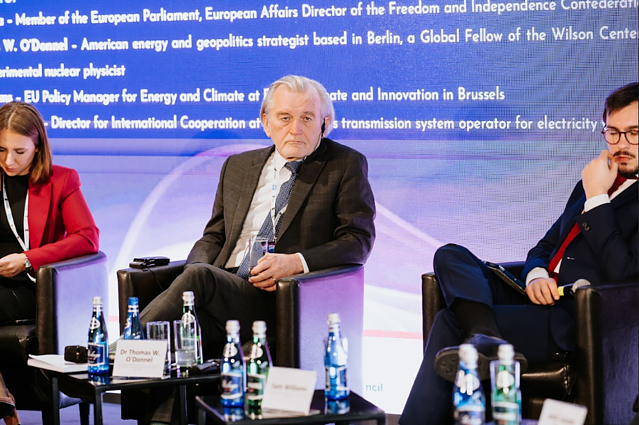
I felt greatly honored to speak in Ireland, the home of my ancestors, at a high-level Irish-Polish event, invited by the Polish embassy as part of Poland’s Presidency of the European Council. [Spoiler alert: my assessment of the Green Deal’s impact on EU energy security and competitiveness was highly critical. And, I called for a radical reform, modeled on the 1970-80’s French Messmer nuclear program, the response to a similarly dire European energy and competitiveness crisis.]

For Ireland we had Secretary General Oonagh Buckley and Wind Energy Ireland CEO Noel Cunniffee; for Poland, Daniel Piekarsky, Head of Energy Security Unit in the Foreign Ministry, and myself, Global Fellow of the Wilson Center, Washington (external) working in Europe, from Berlin.

Our moderator, from the Polish Embassy, Dublin, was the Polish diplomat and patriot, Dr. Jacek Rosa — a good friend, with whom I had the great pleasure of closely collaborating, for several years, in opposition to the Russian-German Nord Stream 2 gas-pipeline partnership, before the 2022 full-scale invasion of Ukraine. Below is the lineup, the initial invitation and some pictures. The event was off-the-record, so I show here only my own, slightly redacted talk.

Continue reading

Our Gdansk chat: Baltic energy risks | USA ousting China from post-war order | “Transition” will be simple: nuclear & mass-transit. “Critical” minerals overblown | EU’s failing model: all-renewables, new grids, grid-storage & EVs | Poland’s risk: China uses Russia

This is in English, after Eugene Romer of Układ Sił media introduces me in Polish. This was at the “3 Seas -1 Opportunity Forum” in Gdansk, last June 4-5, 2024. I have been wanting to post it ever since, as the questions remain relevant. My thanks to Eugene and his team, and to his Opportunity Think Tank colleagues.

My panel at the forum was on problems of relying on energy security that arrives via the sea. So, think Poland and Lithuania’s LNG terminals, of the many sub-sea pipelines, power and communications cables between Baltic and Nordic states. And, since June, all the incidents where ships leaving Russian ports “accidentally” dragged their anchors, cutting such vital links. So, this conference was rather prescient. My sincere thanks to our hosts The Opportunity Institute for Foreign Affairs.

Continue reading

My interview at Lithuania’s LRT: Trump could seriously harm Russia if he wants to | Trumpas, jeigu tik norėtų, galėtų stipriai pakenkti Rusijai

My long print interview at Lithuania’s LRT [Lithuanian PDF | English PDF​] with Aleksandra ​Ketlerienė, deputy editor-in-chief of Lithuania’s LRT.lt, published 7January. We spoke in Warsaw, 19 November. My thanks to Aleksandra for her insightful questioning and editorial care. We discussed:

  • The EU’s systemic energy​-policy “own goals” ​since its initial energy-crisis win ​after Moscow began cutting gas exports early in 2021​.
  • Reforming failed/ineffective Russian price-cap sanctions for real sanctions, and how the global oil market is now favorable for “maximum pressure.”
  • Historical perspectives on oil, gas, renewables, and nuclear sectors, essential for realistic policy formation.
  • An historical overview of China’s decades-long effort to overcome its energy security, learning lessons of Japan’s WW2 weaknesses.
  • (​See topics summary))
Continue reading

My two Sky News: Russian gas via Ukraine not needed: 1) EU has won initial Energy War. 2) But, crisis continues: Volatile EU wind/solar gobbling gas, boosting prices & deindustrialization. Green Deal needs reform. 3) Trump’s demand EU buy more US LNG has seller & buyer risks.

1st row: English (my voice). 2nd row: Arabic (all). EN transcripts below.

EN SkyNews 01.01.25
EN SkyNews 02.01.25
AR SkyNews 01.01.25
AR SkyNews 01.01.25
Continue reading

My Asharq/Bloomberg: European gas surplus slashed as (1) Russian gas via Ukraine ends, (2) low wind & sun starve renewables. Yet the EU rejects new long-term gas import deals, betting on green-hydrogen. [EN/AR]

English voice-over version.

I appeared alongside Dr. Hashem Aqel, Oil and Energy Expert, Associate Fellow at Oxford Institute for Energy Studies, who contributed several insights. Asharq News is the Mideast Bloomberg partner. My further analysis follows:

Arabic, original broadcast version.

The recent rise in EU gas prices and the rapid depletion of what had been a significant surplus in EU storage, is principally a two-sided story.

  1. One side is indeed about the impending cutoff of Russian gas, still flowing across Ukraine. This has been expected for months, and so is already largely priced in. Expectations of new transit across Ukraine of Russian-origin gas re-labelled as Azerbaijani was being negotiated. However, this deal fell apart, with the final nail in its coffin being when Ukraine’s President Zelensky asserted that Ukraine would not transit any further Russian-origin gas after 31 December unless payments to Russia are withheld until after the war ends. This seems a very reasonable demand for a country fighting for its survival against a Russian invasion. [See “Ukraine will not allow transit of Russian gas with Azeri label, Zelenskyy says, dashing Slovak hopes,” EuroNews, Jorge Liboreir 19 Dec. 2024.] This marks the end of the five-year contract, which was only agreed to at the last moment before New Year 2020, when the US Senate finally forced then-President Trump to agree to sanctions on Nord Stream 2 construction (I was in Kyiv, for Naftogaz, and on Ukrainian television, analyzing Washington sanctions, Kyiv-Moscow negotiations, and the pro-Nord Stream position of Berlin.)
  2. The other side is a story of yet another European energy own-goal, a consequence of its over-reliance on weather-dependent renewable energy generation. This overreliance has made its electricity supply increasingly volatile, in sync with the weather. In November and early December, especially north and western Europe experienced what the Germans call “Dunkelflaute“, a protracted wind and solar drought. Batteries can only substitute for perhaps 40 minutes, or at best an hour. So, the de facto long-term, grid-scale “storage” backing up Europe’s plethora of wind and sun generation is really just natural-gas turbine electrical generation plants. The reality of increased generation (and hence, electricity market) volatility and dependence on gas backup generation was analyzed this week in a data-driven manner by the Oxford Institute for Energy Studies. [See: “Dunkelflaute: Driving Europe Gas Demand Volatility” Energy Insight: 161, by Anouk Honoré and Jack Sharples, Senior Research Fellows, OIES, 2024/12.]
Continue reading

Part 2: “Does EU Climate Policy Need Evolution or Revolution? What Should We Change in the Green Deal?” My critical remarks at “Energy Security in CEE Conference,” Warsaw

This is a continuation of my remarks in Warsaw, on 18 November. Part 1, which posted on 19 December, reviewed failures to develop critical tech elements required by the EU Green Deal, a program modeled on the German Energiewende. I argued that, after decades of R&D efforts, these technology failures indicate the systemic failure of heavily renewable models, pointing to a need for “radical reform” of the Green Deal. I advocated for the historically proven Messmer model, which succeeded, some 40 years ago, in decarbonizing French electrical generation using nuclear power, without any need for new grids or long-term grid-scale storage tech.

Below, Part 2 (edited for clarity) focuses on the political intransigence of the new Von der Leyen commission, which is doubling down on the Green Deal’s renewable model. I argue this is not “reindustrializing” Europe or making it “more competitive” as claimed, but rather driving it into deindustrialization. This mirrors the process underway in Germany via its continuing push for new “green tech,” on the theory this should spark a broad new European industrial competitiveness. From an historical perspective, this is theoretical and practical nonsense – or so I argue. Critiques are welcomed. (PS, Happy holidays!)

Leon (moderator): So, I’m going to turn to Thomas again. You argued that that some form of radical overhaul is necessary, you know, with regards to the EU Green Deal, if I understand it correctly, and you’ve cited one of the issues is the complexity of the fact that there are certain technologies that haven’t emerged over the last 30 years that have just been growing incrementally rather than rapidly to meet our needs. But at the same time there’s seems to be some sort of political rationale for why this sort of revolutionary approach. How would you respond to that?

Tom: Yes, politically, I do think the new Commission presents a big problem for European competitiveness, for energy policy and security.

The new commission is anti-energy-policy reform

Firstly this is because Ms. Teresa Ribera, from Spain, is President Von der Leyen’s new chief executive vice-president.  She is in charge of attaining both the Green Deal and has also been given responsibility for “industrialization of Europe,” for making it competitive again.

The problem is, Ms. Ribera is a true believer in all-renewable energy systems, I would say a career-long renewable fundamentalist.

For example, she’s said to be so good at negotiating that she managed to get the Spanish nuclear industry and civil society to agree on a timetable to close all the Spanish nuclear power plants, and she’s very proud of this. This is politically and ideologically identical to what Mr. Robert Habeck, the German Green Party leader, who is energy and economics minister, carried out with the approval of Chancellor Scholz of the SPD-party. Habeck closed Germany’s last three nuclear power plants during a wartime, Russian-instigated, European energy crisis.

The fact that Von der Leyen fought hard to appoint Ribera and then put her in charge of the Green Deal and of European industrialization, and made her the most powerful commissioner, the executive vice president of the commission, shows that Von der Leyen, a member of the German conservatives, the CDU, has no interest in reform of the renewables model despite its suffering technological failures on several key aspects.

The problem is not that Europe has not had an industrial policy. Europe has had an industrial policy, one that has failed

Continue reading

My PAP, Poland: “Expert: EC recommendation to reduce greenhouse gas emissions by 90% by 2040 is fantasy” / “Ekspert: zalecenie KE redukcji emisji gazów cieplarnianych o 90% do 2040 roku to fantastyka”

I’ve been thinking about what to say on Monday in Warsaw: at the “Energy Security in Central & Eastern Europe” conference. As soon as I saw the title of my panel: “Does EU Climate Policy Need Evolution or Revolution? What Should We Change in the European Green Deal?” I accepted! This question goes beyond politics – left, right or center – it is a pressing matter for European energy security

Then, I recalled my syndicated interview with Polish AP’s Arthur Ciechanowicz (Brussels) this February. It’s exactly what I should say in Warsaw (see below: LHS in EN, RHS in PL), especially given President Von der Leyen’s choices of long-time anti-nuclear politicians to be her top commissioners for climate and (re)industrialization (Teresa Ribera), and for energy (Dan Jørgensen). (**Details in footnotes). See what you think.

* Footnotes: References on new EU Commissioners’ anti-nuclear attitudes:

Continue reading

NAPEC ’24, Oran: Why does the EU insist Algeria develop hydrogen & a big pipeline despite Equinor & Shell refusals due to “no customers”?

I explain EU/German motives for seeking “green H2” import pipes, then (at time 11:30) questions I raised moderating at NAPEC re. EU-Algerian pipeline MOU.

Here’s my video from Oran, Algeria, after a very informative “Africa and Mediterranean Energy & Hydrogen Exhibition & Conference,” NAPEC 2024 (video highlights here). Two parts to my analysis:

First, (up to time 11:30) I explain the rationale and impetus for the EU drive for massive green hydrogen gas imports. This is primarily driven by Germany’s increasing desperation at being locked into over-reliance on weather-variable renewables, whose high prices are sparking its “deindustrialization,” especially after losing Russian gas pipeline imports due to Putin’s war on Ukraine, plus due to the own-goal shutting down of their zero-carbon, amortized (paid for) nuclear plants during the European energy crisis. (Note: I misspoke: “Grey” hydrogen would NOT have the CO2 stored, “Blue” would. Both are derived from natural gas.)

I also explain how this massive green hydrogen “fix” to “renewables fundamentalist” policy is a techno-panacea that simply cannot work. Then ..

Continue reading

1st “Berlin Energy Forum” 21 May | A monthly disruption of the local ‘energy echo chamber.’

Dear Colleagues & friends, Below is an invite to our first Berlin Energy Forum (jump to details | jump to register), but first a personal note.

First, a personal note: As some of you know, this is an idea I’ve been floating in Berlin since well before Corona. Then, last October, I had an experimental test run, a one-off, sponsored by the Qatari embassy’s Divan – and it went very well.

However, the biggest success from that event was that Ben Aris, co-founder and editor-in-chief of bne IntelliNews enthusiastically joined me to found the Berlin Energy Forum as a regular monthly sort of membership club. Amongst the longest serving foreign correspondents in Eastern Europe, Ben has been covering Russia since 1993, with stints in the Baltics and Central Asia. He is a former Moscow bureau chief for the Daily Telegraph and was a contributing editor at The Banker and Euromoney for a decade amongst writing for many other publications. He is also a professional photographer, and nowadays based in Berlin.

Ben is one of those rare people who relishes doing analysis and data-driven writing (non-stop!), AND who knows how to do business – and thoroughly enjoys doing it. Just the partner for this endeavor.

My model and inspiration for this forum was always the New York Energy Forum, which has run for over 40 years now. I happily attended while teaching in NYC. My experience with that forum, plus familiarity with a few top DC think tanks, and various foreign diplomats (esp. in NYC/UN), is how, as an academic, I got to know a broad spectrum of USA oil and gas executives, journalists, financial-institution analysts and government officials. Those personal connections have, over the years, anchored my assessments of USA, of OPEC MENA-and-Latin American members’, and of Russian and Chinese strategy. This sort of community doesn’t exist in Europe in such a focused manner, save perhaps in London. Perhaps we can now bring a bit of that world to Berlin with our new BEF.

Continue reading

“Is Europe winning the energy war?” Roundtable views: (i) Russian oil-price cap failing; anti-trust tax could help. (ii) Green-energy inflation & subsidies plus low oil & gas development disarm Europe.

Berlin Energy Roudtable. L to R: Ben Aris, Tom O’Donnell, Morten Frisch & Andriy Kobolyev (video link from Kyiv) 24 October 2023, Haus der Bunderpresskonferenz – PHOTO GALLERY BELOW (Divan staff)

On 24 October, I was honored to moderate a great roundtable in Berlin with three European energy experts, sponsored by Der Divan Kulturehaus. SUGGESTION: While listening, open up that speaker’s file below. You’ll find Ben Aris’ data-slides on Russian price-cap failings, Andriy Kobolyev’s proposal to tax Moscow’s oil & Morten Frisch’s slides on EU renewable shortcomings & continued oil and gas needs.

Continue reading

Our TRT-London: Finland’s new nuclear plant helped slash electricity prices, while EU states going all-renewable face long-term highs.

A lively debate! I defended the Finnish model, as did Finnish expert Rauli Partanen.

Finland, having just completed and put online Europe’s largest nuclear plant, Olkiluoto 3, is considering adding more carbon-free nuclear power plants. Its two older nuclear plants, online since the 1970s and 80s, are operating 24/7 at an impressive 92.8% of full capacity. By comparison, I explained German onshore wind achieved only 19% and offshore only 35% of the installed turbines’ full-rated capacities in 2022 (Calculated from Fraunhofer data – T.O’D.).

Finland also uses its natural endowment of no-carbon hydro wisely, and embraces a limited amount of variable renewables. I explained that this is in contrast to Germany with its (IMHO) over-dependence on renewables and willful destruction of 17 nuclear facilities, which is increasingly requiring installation of expensive new and rebuilt grids, and “grid-scale storage” for when wind and sun are low.

The third guest, the Paris chair of “The Nuclear Consulting Group” was actually anti-nuclear, defending an only-renewables strategy. I found his arguments, generally based on anecdotal expert opinions, as opposed to broad data, unsatisfactory; but consistent with the “100% renewables and no nuclear” school of thought, as I have termed it. (1)

Some facts on Finland’s energy:  According to the International Energy Agency (IEA), Finland has “the world’s most ambitious carbon targets,” planning for neutrality by 2035  (IEA; timestamp 16:35), with 40% of its electricity in 2023 being nuclear (ibid.; timestamp 17:21).  According to the latest (2023) IEA review, “Finland’s nuclear and renewable power strengths provide a solid foundation for reaching its ambitious climate targets.”

  • Here’s the lineup of the show:

TRT London – Round Table. Jun 9, 2023: Electricity bills have spiked across Europe. But, in Finland it’s going in the other direction.

Continue reading

My Asharq with Saudi expert: MENA green hydrogen exports will be inefficient & counter-productive for climate. Renewables still almost “nonexistent”, nuclear is pragmatic.

My Asharq interview, along with Mohammed Al-Dabai, Saudi energy journalist, on 13 April 23. (This post has English interpreter’s audio and my voice over the Arabic. View in Arabic here.)

At about timestamp 5:30, I discuss the difficulties with the Gulf states exporting “green hydrogen” to Germany and the EU.

So little renewable carbon-free energy is produced in MENA and esp. in Gulf states (i.e., almost none), and it would be so inefficient to convert this into “green hydrogen” and then further into “green ammonia” (as many in Germany and the EU now advocate), and then to ship it all the way to Germany or elsewhere in the EU, that it would make little sense, except in so far as Germany and EU states are willing to pay a good price.

However, it would also leave the MENA region with little improvement in their carbon-heavy electricity consumption. Mr. Al-Dabai generally concurred on the “scientific” problems, as he described them, of producing and exporting green hydrogen.

We were discussing a recent Ember consultancy report (London, link below) on the progress of renewable electricity worldwide, and how there is little progress in the Gulf and larger MENA region.

However, I briefly pointed to nuclear developments, the building of new So. Korean Generation 3+ plants in the UAE, and to Saudi plans, as very promising.

However, as with other renewables-focused outfits, Ember doesn’t seem to see any value in this pragmatic approach, not to mention the benefits of coal-to-natural-gas switching as a very reasonable, carbon-emmissions-reduction strategy.

Continue reading

There’s no 2021-22 Nord Stream 2 option: Only way to avert EU gas crisis & for Gazprom not to waste its huge domestic-production-surge investment … is for Moscow to take Kyiv’s offer of 50% cut in transit fees, flooding the EU with gas from 7 November.

voice-of-europe-fire-novy-urongoy-gas-plant-gazprom-5augustPutin’s recent gas-Godfather-like statements that Nord Stream 2 could alleviate  the current European natural gas price and supply crisis is an obvious attempt to pressure the EU to rush Nord Stream 2 approval in ways violating the EU’s own rule of law.
 
As a Polish expert wrote in 2019,: “The amendment to the [European Union’s] gas directive explicitly confirms that EU law applies in the case of Nord Stream 2 (that is, to the section running through German territorial sea), including the rules on unbundling, third-party access, independent operators et al.: (Agata Łoskot-Strachota, “The gas directive revision: EU law poses problems for Nord Stream 2,” OSW, Warsaw, 21.02.2-19.).
 
However, Putin’s hubris should be taken with a grain of salt. In reality, his options in this regard are subject to current technical-economic constraints of the Russia gas sector, as my research had indicated in recent weeks.
 
Russian domestic storage was announced to be at 97% full mid-last-week due to its continuing all-out Gazprom filling campaign, reportedly at the high rate of about 300 million cubic meters/day (mcm/d). The plan had been to finish by 1 November.. Thereafter, this maxed-out production has to immediately be choked off or be sent somewhere else – and indeed there is only one option; but it is not Nord Stream 2…
 
One caveat: a recently announced 7 November Gazprom export start date did not made sense. Where would the maxed out production flows go from 1 to 7 November?  However, an article yesterday by Bloomburg [possible paywall] clarifies “Gazprom said Wednesday that the Russian re-injection campaign would be a week longer than the original Nov. 1 conclusion.”  This is quite plausible – it is simply taking an extra six days to top off Russian domestic storage. 
 
So to reiterate points I have stressed over the past few weeks (e.g., at Naftogaz’ Ukraine Gas investment Congress closing panel in Kyiv last Thursday-I’ll put a video of this here soon- and in various interviews):
 
First, while Putin has relished playing the gas-mafia Godfather (e.g., at the St Petersburg gas conference two weeks ago), asserting that, if  Nord Stream 2 is rapidly approved, Gazprom exports could save Europe this winter, he has been merely posturing as the strongman decider. He wanted to appear to be craftily withholding extra, non-contracted gas supplies needed to fill  the company’s storage facilities in Germany and throughout the EU, all still now at worryingly low levels long after the traditional filling season ended at the start of October.
 

Continue reading

My Kongres590/Warsaw talk: “Building a Joint Three-Seas-Initiative Nuclear Energy R&D-and-Training Center” [Polish & English]

Note: The Polish Interpreter’s voice dominates; however with headphones I could follow the English. Apologies, there’s no separate English audio.

“Cooperation in energy transformation and trade to increase the economic strength of the Three Seas Region …”

Kongres590 – Warsaw – 14 October 2021

  • Moderator: prof. dr. hab. Zbigniew Krysiak, Chairman of the Program Council of the Institute of Schuman Thought
    Panellists:
  • Dr. Thomas W. O’Donnell, (PhD Nuclear Physics; Lecturer in Berlin & Energy & Geopolitical Analyst),
  • Julius Zellah, (President of the Light for Africa Online Foundation)
  • Paweł Kotowski, (Deputy Director of the Department of Economic Cooperation, Ministry of Foreign Affairs)
  • Jarosław Malczewski, (President of the Polish Dairy Group),
  • Dr. Krzysztof Malczewski, (President of the B-2M Company)

Key points of my talk:

1. Poland has no previous experience in nuclear energy; and this is a difficult problem that needs to be tackled starting now. Also, any institute needs a sufficient scale to guarantee both high standards and employment security to those trained for industry, academia, safety, and planning.  It is for this reason that nuclear training in Poland’ should be done jointly, together with all 12 of the Three Seas Initiative members (i.e., the eastern EU member states, and this may soon include also Ukraine – many of which countries already have established nuclear programs). And, as part of the Three Seas Initiative, this means also in conjunction with the USA, in particular its Department of Energy with a vast network of nationl laboratories and obviously decades of nuclear experience to draw on. Continue reading

My Al Jazeera Live: EU Gas Crisis 2021: Too many windmills w/o wind, a cold winter & hot summer drained EU & Russian storage. While Putin fills his, EU goes back to coal & prices soar. [Arabic & English]

ENGLISH AUDIO: At 0:30 are the interpreter’s questions & my answers.

Video In Arabic – Audio above has English interpreter’s and my voice in English.