Category Archives: Energiewende

My BizNesAlert.pl — American expert: Germany is again contemplating Russian gas — Amerykański ekspert: Niemcy znów myślą o gazie z Rosji

x.com/_FriedrichMerz

I discussed with Artur Ciechanowicz  (BizNesAlert.pl) how Chancellor Merz and Energy Minister Reiche refuse the one reform that can really boost German energy security: focusing on nuclear energy as France has, and Poland has begun to do. (Read below in English or in Polish) — Twice last week, Merz indicated willingness to work with Russia when the Ukraine war ends. For two decades before the war, working with Russia meant more Russian gas imports, building Nord Stream 1 & 2. Now Merz worries about dependence on USA LNG. However, the German model he continues, one of installing BOTH a full-scale, wildly complex renewables system, plus a full-scale natural-gas backup system, guarantees high-cost energy, deindustrialization and foreign energy dependence.(Polish at BizNesAlert.pl)

Amerykański ekspert: Niemcy znów myślą o gazie z Rosji

Autor: Artur Ciechanowicz27 stycznia, 2026, 07:05

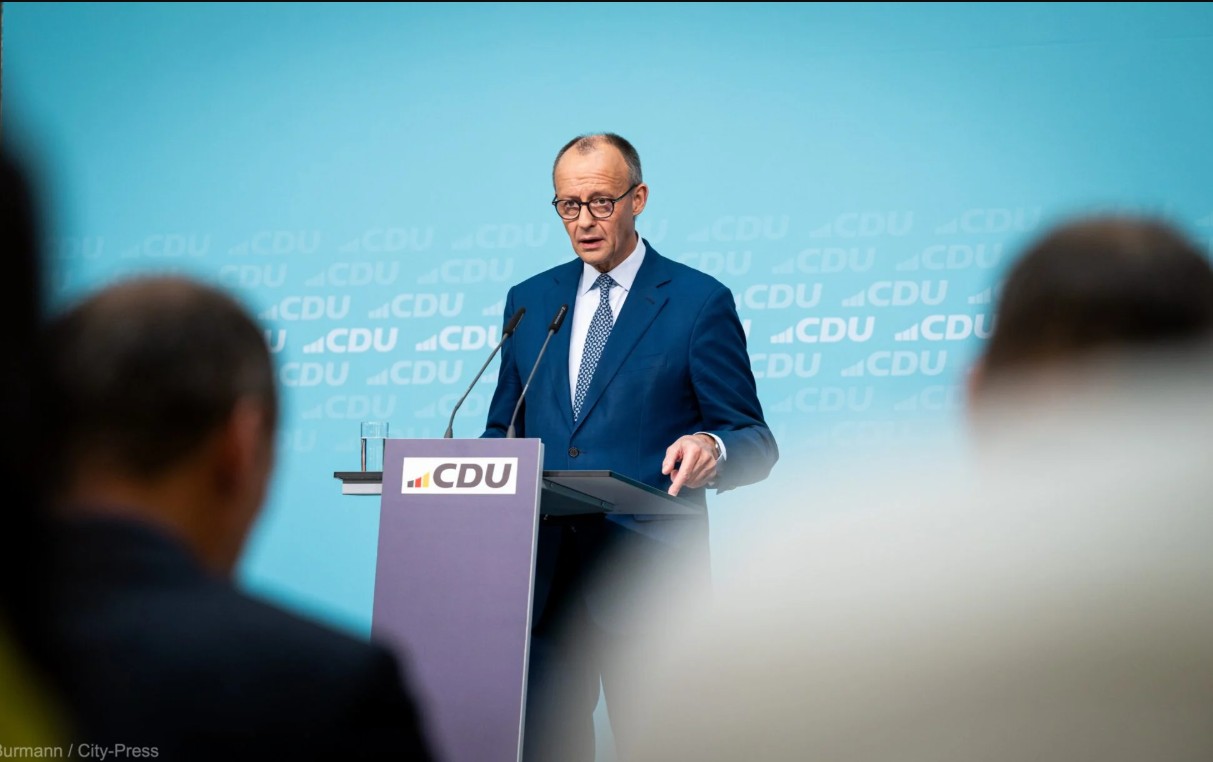
Wcześniej czy później Niemcy ponownie będą racjonalizować podporządkowanie się Gazpromowi Putina w imię +dywersyfikacji+ dostaw – ocenia Thomas O’Donnell, ekspert ds. energii i geopolityki z amerykańskiego think-tanku Wilson Center. Na zdjęciu kanclerz Niemiec Friedrich Merz.FOTO: x.com/_FriedrichMerz

Berlin zaczyna zmieniać kurs wobec Rosji i znów będzie racjonalizować współpracę z Putinem w imię „dywersyfikacji” dostaw gazu. Stanie się tak, bo Niemcy nadal opierają swoją strategię energetyczną na OZE wspierane gazem, zamiast postawić na atom jako priorytet – ocenia w rozmowie z Biznes Alert amerykański ekspert Thomas O’Donnell.

Wypowiedzi kanclerza Niemiec Friedricha Merza o potrzebie „pojednania” z Rosją, wygłoszone dwukrotnie nie da się traktować, jako wyrwanych z kontekstu i przypadkowych. To sygnał polityczny. Najbogatsze państwo Europy i przemysłowy motor Unii Europejskiej zaczyna rewidować swoją linię wobec Moskwy.

Merz z ufnością o Rosji

– Jeśli uda nam się przywrócić pokój i wolność w Europie, jeśli ponownie odnajdziemy równowagę w relacjach z naszym największym europejskim sąsiadem, czyli z Rosją, jeśli zapanuje pokój i zostanie zapewniona wolność –  jeśli to wszystko nam się powiedzie, wtedy Unia Europejska, a wraz z nią my w Niemczech, przejdziemy kolejny test i będziemy mogli z ufnością patrzeć w przyszłość także po 2026 roku – powiedział szef niemieckiego rządu na spotkaniu noworocznym z przedstawicielami przemysłu i handlu 14 stycznia w Halle, dodając potem: „(…) jeśli w dłuższej perspektywie uda nam się na nowo przywrócić równowagę w relacjach z Rosją, gdy zapanuje pokój i gdy wolność będzie zagwarantowana”.

Niemiecki przemysł od 2023 roku zmaga się z wysokimi cenami energii, spadkiem konkurencyjności, rosnącą presją chińskich producentów oraz stagnacją wzrostu gospodarczego. W 2024 roku niemiecka gospodarka formalnie weszła w recesję techniczną, a prognozy wzrostu na 2025 rok były jednymi z najsłabszych w UE.

Wypowiedzi Merza nie oznaczają natychmiastowego zwrotu w polityce wobec Moskwy ani propozycji zniesienia sankcji. Nie są ofertą pokoju ani jednostronnym gestem. Wskazują jednak na rosnące przekonanie w niemieckich elitach politycznych i gospodarczych, że obecny stan konfrontacji – bez realistycznej strategii wyjścia – osiągnął dla nich próg bólu.

„Powrót do „mafijnego bossa od gazu”

Thomas O’Donnell, ekspert ds. energii i geopolityki z amerykańskiego think-tanku Wilson Center wyjaśnia w rozmowie z Biznes Alertem intencje Merza: „Niemieckiemu kanclerzowi chodzi przede wszystkim o uniezależnienie się od pełnego sojuszu z USA, od zależności od Stanów Zjednoczonych. Jednak powrót do starego +mafijnego bossa od gazu+, Władimira Putina, trudno nazwać niezależną strategią”.

Z analizowanych przez O’Donnella wypowiedzi i komentarzy, a także z poufnych rozmów wynika, że niemieccy urzędnicy rządowi traktują amerykańską energię, jako potencjalnie równie zawodną jak tę z Rosji.

– Merz zlecił w związku z tym swoim ludziom znalezienie rozwiązań.  Oczywiście, metody Donalda Trumpa w relacjach z sojusznikami nie są konstruktywne. Mimo że Niemcy są teraz ogromnym odbiorcą LNG z USA, to amerykański prezydent traktuje te biznesowe więzi również jako instrument nacisku – zaznacza ekspert.

– Jednak źródło problemu leży w nierealistycznej polityce energetycznej ostatnich czterech kanclerzy. Merz dostrzega problem silnie subsydiowanych odnawialnych źródeł energii oraz nadmiernej zależności od rosyjskiego gazu. Ale wciąż nie widzi, że Niemcy nie mogą zapewnić sobie bezpieczeństwa energetycznego ani przystępnych cen, opierając się na zależnych od pogody OZE wspieranych gazem. Postawienie na nową energetykę jądrową jako priorytet to jedyna droga — co Francja jasno udowodniła – dodaje.

Niemcy znowu pomyślą o gazie z Rosji

O’Donnell zwraca uwagę, że Merz i jego rząd popierają kontynuację budowy tych samych dwóch równoległych systemów, które tworzyli poprzedni dwaj kanclerze: jednego opartego wyłącznie na OZE i drugiego — gazowego — jako zaplecza na dni bez wiatru lub słońca.

– W praktyce tak zwana reforma polityki energetycznej Merza polega na tym, że dalsza rozbudowa OZE i sieci ma być teraz w większym zakresie finansowana z prywatnych środków, a planowane ogromne instalacje turbin gazowych również mają powstać — tyle że zasilane LNG z USA, a nie rosyjskim gazem – podkreśla Thomas O’Donnell i ocenia, że nie jest to radykalna, strukturalna reforma energetyczno‑przemysłowa, której Niemcy potrzebują, a jedynie kosmetyczna zmiana.

– W sposób konieczny wcześniej czy później doprowadzi to do tego, że Niemcy ponownie będą racjonalizować podporządkowanie się Gazpromowi Putina w imię +dywersyfikacji+ dostaw. Czy to z powodu ideologiczno‑technologiczno‑politycznego zamieszania, czy oportunizmu — niemieccy przywódcy nie dostrzegają, że już istniejące OZE i każda nowa generacja gazowa powinny być traktowane jedynie jako rozwiązania pomostowe, podczas gdy rozwój energetyki jądrowej powinien być priorytetem – jako jedyna realna droga – podsumowuje amerykański ekspert.

Artur Ciechanowicz

American expert: Germany is considering gas from Russia again

Author: Artur Ciechanowicz January 27, 2026, 07:05

Sooner or later, Germany will once again rationalize its subordination to Putin’s Gazprom in the name of “diversification” of supplies, says Thomas O’Donnell, an energy and geopolitics expert at the American think tank Wilson Center. Pictured is German Chancellor Friedrich Merz. PHOTO: x.com/_FriedrichMerz

Berlin is beginning to change course towards Russia and will once again rationalize cooperation with Putin in the name of “diversifying” gas supplies. This will happen because Germany continues to base its energy strategy on renewable energy supported by gas, instead of prioritizing nuclear power, American expert Thomas O’Donnell told Biznes Alert.

German Chancellor Friedrich Merz’s statements about the need for “reconciliation” with Russia, made twice, cannot be dismissed as out of context or coincidental. They are a political signal. Europe’s richest country and the industrial engine of the European Union is beginning to reconsider its stance towards Moscow.

Merz with confidence about Russia

– If we manage to restore peace and freedom in Europe, if we manage to find balance again in relations with our largest European neighbor, Russia, if peace prevails and freedom is guaranteed – if all this succeeds, then the European Union, and with it we in Germany, will have passed another test and will be able to look to the future with confidence even after 2026 – said the head of the German government at a New Year’s meeting with representatives of industry and trade on January 14 in Halle, later adding: “(…) if in the long term we manage to restore balance again in relations with Russia, when peace prevails and freedom is guaranteed.”

German industry has been struggling with high energy prices, declining competitiveness, increasing pressure from Chinese manufacturers, and stagnant economic growth since 2023. In 2024, the German economy formally entered a technical recession, and growth forecasts for 2025 were among the weakest in the EU.

Merz’s statements do not signal an immediate shift in policy toward Moscow or a proposal to lift sanctions . They are not an offer of peace or a unilateral gesture. However, they indicate a growing conviction among German political and economic elites that the current state of confrontation—without a realistic exit strategy—has reached their pain threshold.

“Return to the ‘Mafia Gas Boss'”

Thomas O’Donnell, an energy and geopolitics expert from the American think-tank Wilson Center, explains Merz’s intentions in an interview with Biznes Alert: “The German chancellor is primarily concerned with becoming independent from a full alliance with the United States, from dependence on the United States. However, returning to the old ‘mafia gas boss’, Vladimir Putin, is hardly an independent strategy.”

Statements and comments analyzed by O’Donnell, as well as confidential conversations, indicate that German government officials view American energy as potentially as unreliable as that from Russia.

“Merz has therefore tasked his people with finding solutions. Of course, Donald Trump’s methods in relations with allies are not constructive. Even though Germany is now a huge recipient of LNG from the US, the American president also uses these business ties as a tool for pressure,” the expert notes.

“However, the root of the problem lies in the unrealistic energy policies of the last four chancellors. Merz recognizes the problem of heavily subsidized renewable energy sources and excessive dependence on Russian gas. But he still fails to see that Germany cannot ensure energy security and affordable prices by relying on weather-dependent renewable energy sources supported by gas. Prioritizing new nuclear energy is the only way forward—as France has clearly demonstrated,” he adds.

Germany will think about gas from Russia again

O’Donnell points out that Merz and his government support the continuation of the construction of the same two parallel systems that the previous two chancellors created: one based solely on renewable energy and the other – gas – as a backup for days without wind or sun.

– In practice, the so-called Merz energy policy reform means that further expansion of renewable energy sources and the grid is now to be financed to a greater extent from private funds, and the planned huge gas turbine installations are also to be built – but powered by LNG from the USA, not Russian gas – emphasizes Thomas O’Donnell, assessing that this is not the radical, structural energy and industrial reform that Germany needs, but merely a cosmetic change.

“Sooner or later, this will inevitably lead to Germany once again rationalizing its subordination to Putin’s Gazprom in the name of ‘diversification’ of supplies. Whether due to ideological, technological, and political confusion or opportunism, German leaders fail to recognize that existing renewable energy sources and any new gas-fired generation should be treated merely as bridge solutions, while the development of nuclear energy should be a priority—the only viable path,” the American expert concludes.

Artur Ciechanowicz

My Ukraine Ch24 TV: Seeing Trump can kill his oil sales, Putin asked talks | “Bone-crushing” tariffs on Russian-oil buyers during a market glut can be very effective

This Friday, Trump and Putin will talk in Alaska about the future of Ukraine. Why has Putin asked for this meeting?

The two have spoken repeatedly on the phone …. but, something changed. As I indicated in my previous post (here), Trump has turned from his preferred plan to end the war, to one of confrontation and coercion of Putin (what I have called “Plan B”), aiming to force him into halting his war of aggression and seriously discuss peace proposals.

It was an honor to speak with Natalia Lutsenko of Channel 24 TV in Kyiv, and the Ukrainian national audience on these heavy issues of war and peace. The video interview – about 34 minutes long – goes into some detail of my analysis of the balance of forces.

Continue reading

My BiznesAlert: German elites have no idea how to get out of the crisis / Ekspert dla Biznes Alert: niemieckie elity nie mają pomysłu na wyjście zkryzysu

Last night, leaving the Polish Sejm, after a long discussion, invited by a leader.

URL CORRECTIONS: ENGLISH Biznes Interview LINK & POLISH Biznes Interview LINK

[Warsaw, 21 Nov] Here’s my interview with BiznesAlert’s Artur Ciechanowicz (in EN & Pl) on Germany’s energy, industrial and political crises. I spoke here in Warsaw Monday at the CEE Energy Security Conference, attended Wednesday’s 25 Years of NATO Membership conference, and was invited yesterday evening, by a leader of the Sejm (parliament) for a long talk in his offices, joined by Mark Voyger (American University Kyiv and former-NATO). More soon. Tom O’D.

Continue reading

1st “Berlin Energy Forum” 21 May | A monthly disruption of the local ‘energy echo chamber.’

Dear Colleagues & friends, Below is an invite to our first Berlin Energy Forum (jump to details | jump to register), but first a personal note.

First, a personal note: As some of you know, this is an idea I’ve been floating in Berlin since well before Corona. Then, last October, I had an experimental test run, a one-off, sponsored by the Qatari embassy’s Divan – and it went very well.

However, the biggest success from that event was that Ben Aris, co-founder and editor-in-chief of bne IntelliNews enthusiastically joined me to found the Berlin Energy Forum as a regular monthly sort of membership club. Amongst the longest serving foreign correspondents in Eastern Europe, Ben has been covering Russia since 1993, with stints in the Baltics and Central Asia. He is a former Moscow bureau chief for the Daily Telegraph and was a contributing editor at The Banker and Euromoney for a decade amongst writing for many other publications. He is also a professional photographer, and nowadays based in Berlin.

Ben is one of those rare people who relishes doing analysis and data-driven writing (non-stop!), AND who knows how to do business – and thoroughly enjoys doing it. Just the partner for this endeavor.

My model and inspiration for this forum was always the New York Energy Forum, which has run for over 40 years now. I happily attended while teaching in NYC. My experience with that forum, plus familiarity with a few top DC think tanks, and various foreign diplomats (esp. in NYC/UN), is how, as an academic, I got to know a broad spectrum of USA oil and gas executives, journalists, financial-institution analysts and government officials. Those personal connections have, over the years, anchored my assessments of USA, of OPEC MENA-and-Latin American members’, and of Russian and Chinese strategy. This sort of community doesn’t exist in Europe in such a focused manner, save perhaps in London. Perhaps we can now bring a bit of that world to Berlin with our new BEF.

Continue reading

Reply of IEA’s Dr. Fatih Birol to my critical questions on Germany’s “100% renewables & no nuclear” at P-TECC in Warsaw

Video is set to Dr. Fadi Birol’s interesting answers to my two critical questions. However, I recommend going back and watching his entire talk – and others.

I was quite happy with the answer of IEA (International Energy Agency*) director, Dr. Fadi Birol, to two critical questions I posed, first on how the European Commission should include nuclear power in its “green financing taxonomy,” and secondly, against German over-reliance on variable renewables (I termed this “renewable fundamentalism”) which I said produces high “organizational entropy,” that is, unworkable and unaffordable, completely “reinvented” so-called “smart grids” with “grid scale stage” whose technology is not sufficiently developed all to cope with the problem of unavoidable wind and solar energy fluctuations, which become more massive as the percentage of installed renewables increases. This is a significant contribution to Germany’s (and the EU’s) present crises of energy supply and price security. (The video above is set to start at my two questions.)

Continue reading

My DW live: The US-German “Bad Deal” on Nord Stream 2 Pipeline

Here is my 21 July 2021 live interview on Germany’s Deutsche Welle about the new US-German deal, a “bad deal” on the Nord Stream 2 pipeline.

I told DW that the key reason the US has always opposed Nord Stream 2 (NS2) was that it undermines Ukraine’s security – as well as Poland’s and other eastern European and Baltic states’ security.

I told DW that one can argue with the Biden-Blinken assessment (as I have) that they “had to” waive sanctions on the Russian-owned NS2 company, insisting that the pipeline was going to be completed anyway. Indeed, German and Dutch regulators had already allowed work to proceed even when the insurance firm and commissioning firm had left due to sanction threats, and Berlin had promised it would be completed no matter the sanctions.

However, the additional factor, which US spokesmen cite only obliquely, is that Merkel’s government was evidently willing to deny Biden a show of transatlantic unity from which to confront Putin. This shows the extreme lengths Merkel’s government had gone to to insure success in her partnership with Putin to finish NS2..

For Moscow, the essential aim of this partnership has been to avoid the “risk” (as Russian officials have put it) of having to export its gas across Ukraine, a country Putin wants to annex and is now at war with.

For Berlin, the most essential aim of this partnership is to avoid the “risk” (as I have been told repeatedly) of having to import Russian gas via what has long been seen by German political and economic elites as an “insecure” Ukraine (although it is obviously Moscow responsible for this “insecurity”), and as an “unreliable” Ukraine (i.e., German elites had lost confidence in Ukraine to reform itself, or at least the willingness to risk the process).

This German pipeline partnership with Putin,, in other words, is a decision to pursue narrow-national interests. It elevates protection of Germany’s Russian gas supplies for its troubled domestic energy system, and protection of Russian gas supplies for its principal EU trading partners, above the interests of Ukraine’s security and independence as Putin pushes to reincorporate Ukraine into the Russian Federation.

Rather than showing solidarity by forcing Putin to continue shipping his gas to Germany and to other EU sates via Ukraine, the gas will now come directly to Germany. Germany will become the principal hub for distribution of Russian gas to Europe, and Berlin will “handle” any difficulties with Moscow and Putin. Of course, Berlin never consulted with the other EU Member states, much less Kyiv, on what amounts to its narrow-nationalist energy-security plan for Europe.

Continue reading

Washington interviews: Energy Relations of Russia, Germany, Poland & Ukraine (Kennan Fellow)

g7-trump-merkel-round-9jun18-jezco_denzel_ger_gov_photo.jpgWhat are US experts’ and officials’ views on the increasingly conflictive energy and geostrategic relations between Russia, Germany, Poland and Ukraine? 

Greetings. I’m in Washington as a “Title VIII” fellow of the Kennan Institute in the Woodrow Wilson Center, interviewing people in think tanks and government (legislative and executive) on these topics. I’ll also give a public talk on this at Wilson on 12 June, at 2 PM (more info soon). putin_wink-round-hnewkremlinstooge-wordpress

I’m interested to hear anything readers think should be asked and of whom.  Don’t hesitate to write me at twod(at)umich.edu or my (temp) Wilson email: thomas.odonnell(at) wilsoncenter.org

A central issue: why is Germany so adamantly for Nordstream 2 despite the negative security consequences for Ukraine and despite the tremendous hit this project is causing to German soft-power not only with Poland, but with most Central and Eastern European (CEE) and Nordic states?  (Here’s my own analysis.)  How do US experts see this? Continue reading

Germany backs small-scale LNG import terminals despite opposition [my King’s College/EUCERS paper]

Here is my detailed analysis of the decision by Angela Merkel’s government to begin “small-scale” Liquid Natural Gas (LNG) imports to address greenhouse gas emissions and competitiveness issues in Germany’s heavy-road transport and maritime-shipping sectors.  Read it below (via Scribid) or go directly to EUCERS.  [This peer-reviewed paper appears in the King’s College-London, Newsletter of the European Centre for Energy and Resource Security (EUCERS), Issue 77, July 2018.] – Tom O’D.

Germany’s Real LNG Policy [My BPJ analysis]

bpj_erdgas_statt_diesel_c-reuters_28jun18

“Natural gas instead of Diesel” © REUTERS/Hannibal Hanschke

My latest at: Berlin Policy Journal (German Council on Foreign Relations), June 28, 2018:

Germany’s Real LNG Policy
Germany’s government has endorsed imports of liquid natural gas for the first time—but not because of Russia and Nord Stream 2. 

The German federal government has decided in favor of building liquid natural gas (LNG) import terminals and infrastructure. In March, Chancellor Angela Merkel’s CDU/CSU-SPD government, in its “coalition contract,” pledged to “Make Germany the site for LNG infrastructure.” This is a notable policy change, because in Germany the opposition to LNG imports and use has been so much stronger than anywhere else in Europe.

The aim of this new endorsement is to reduce maritime and roadway heavy-transport emissions. However, many in Germany argue that using “small-scale” LNG in this way, as a “bridging” fossil fuel, is “wasted investment”. They contend that Energiewende-mandated electric vehicles can and will rapidly de-carbonize heavy transport. Still others oppose LNG imports on the grounds that they would unnecessarily diversify Germany’s gas suppliers with the aim of offsetting increasing reliance on Russian pipeline gas. They insist that Russian pipeline gas has been “historically reliable” and is cheaper for Germany than building large-scale import terminals for LNG.
Continue reading

“The Road to Paris: COP21 …” Berlin HEEN Conference

heen_logoCOP21 begins soon in Paris.  A very interesting discussion of the issues, with diplomats from EU states and China, takes place tomorrow, Friday evening, at Hertie School of Governance in Berlin to open the Hertie Energy & Environmental Network’s (HEEN) conference. I’ll be moderating the session. The session is open to those interested. Read on:

Opening remarks by German Undersecretary of State, ret. Rolf-Dieter Schnelle, fellows & friends of the Hertie Foundation

Panelists:
• Philippe Etienne, Ambassador of France to Germany
• Friis Arne Petersen, Ambassador of Denmark to Germany
• Wang Tianling, Counsellor, Embassy of the People’s Republic of China in Berlin
• Iwona Jakuszko-Dudka, First Secretary to the Embassy of Poland to Germany
• Dr. Jan Minx, Professor for Science Policy and Sustainable Development, Hertie School of Governance, Head of Working Group on Applied Sustainability Science, Mercator Research Institute on Global Commons and Climate Change

• Moderation by Dr. Thomas O’Donnell, Hertie School of Governance

Please register until 25 November 2015 via the following link https://docs.google.com/f

Background

In December 2015, the COP 21 climate conference in Paris will bring together world leaders, scientists, pressure groups and United Nations agencies, with the task to craft an agreement at the highest political level to tackle global warming. The representatives from 196 countries must reach an agreement to replace the Kyoto protocol. The COP 15 summit in Copenhagen (2009) is remembered more for the difficulty of reaching a global consensus than for tangible progress.

What will the legacy of COP 21 in Paris be?

  •  Is putting a price on carbon worldwide politically feasible?
  •  Is the gap between the cost of energy produced from fossil fuels and energy produced from renewable energy sources narrowing as much as to be a game-changer?
  •  How would policy proposals that raise the cost of energy go down with national leaders from the developing world, under pressure to deliver standard-of-living improvements?
  •  How will Intended Nationally Determined Contributions (INDC) impact the negotiations?
  •  How will China’s early pledge to peak emissions ahead of 2030, and the USA’s commitment to deep reductions by 2025 shape what is globally possible?
  •  Will the European Commission get a critical mass of support for the Paris Protocol?
  •  Will all parties arrive at an robust enough agreement?
  •  What is the future of the Green Climate Fund?
  •  How will the financing volume necessary to keep global warming below 2 degrees be secured?

Speakers will provide their take on the above, and engage in a lively and dynamic discussion with the audience about the major challenges which will be tackled at the COP 21 in Paris in December 2015.

The Hertie Energy and Environment Network (HEEN) is an established platform bringing together fellows of the Gemeinnützige Hertie-Stiftung with professional experience in the field of Energy and Environment (E&E) in the public, private, academic or civil society sector. HEEN’s purpose is to facilitate dialogue, knowledge-sharing and learning, to provide a trust-based environment for career path reflection, and to facilitate the development of lasting professional connections among outstanding individuals of diverse backgrounds who share a common interest and motivation for further professional development in the E&E field.

cop21_logo

MY REPORT | Washington Viewpoints: Assessing Berlin’s Leadership on EU Energy Security

merkel_obama_dinner-denver_post_06jun2014

Merkel and Obama answer questions. 6 June 2014 [Denver Post]

During April and May, I interviewed over a dozen Washington-based experts in European energy and geopolitics.  My report on these interviews–along with some policy proposals in light of Brussels’ “institutional incapacities” and the “fundamental contradictions” of German leadership–is here: [PDF with a Table of Contents for navigation] or at the AICGS website [HTML].

This work was conducted as a resident fellow of the AICGS (American Institute of Contemporary German Studies) in Washington, DC and supported by a generous grant from the German Academic Exchange Office (DAAD) with additional support from the Foreign Office.  My thanks to the AICGS for their collegial support and warm hospitality.

Next, the plan is to interview in Berlin and perhaps Brussels energy experts and officials for their viewpoints on European energy vulnerabilities and on their work with the U.S. side.

US Experts on German & EU Energy Vulnerabilities (My D.C. seminar)

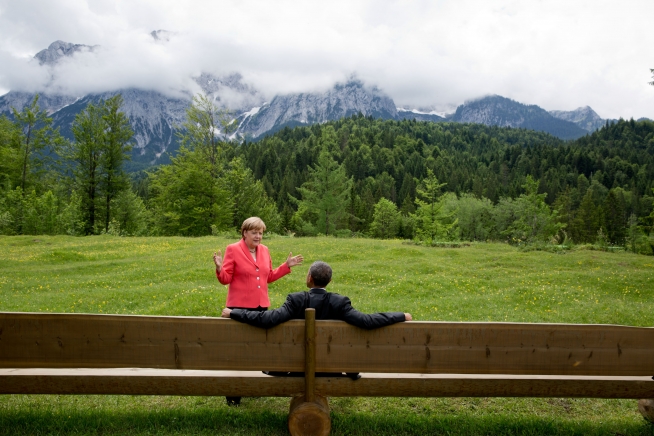
Merkel and Obama at G7 - the main topic was Russia and Ukraine

Merkel and Obama at G7. Main topic was Russian threats to EU and Ukraine

An AICGS workshop with Dr. Thomas O’Donnell was held on May 27 in Washington, DC with a lively full-room attendance.

O’Donnell presented preliminary results of interviews he conducted in Washington during April and May to hear candid views of US energy-and-geopolitical experts on German and the EU energy policies.  The main topics were (1) European natural-gas vulnerabilities in light of the Ukraine crisis and dependence on Russian supplies and (2) implications of Germany’s commitment to a transition to renewable energy called the Energiewende.   Continue for Workshop PowerPoint & written Summary –>  Continue reading

“US Expert Perspectives on German Energy Vulnerabilities” – My AICGS/Washington Project

merkel_putin_dw_17481033

German Chancellor Merkel listens to Russian President Putin [Photo: dw.de 29.4.14]

Throughout April and May I’m researching US Expert Perspectives on German [and EU] Energy Vulnerabilities – as a visiting fellow of the American Institute for Contemporary German Studies (AICGS) in Washington, DC, funded by the German DAAD.  You can read the proposal below.  But, first, I’d like to ask Global Barrel readers for two things:

(1) Is there anyone you feel I should interview here in Washington–the idea is to interview US energy experts, government officials and business people?

(2) What is your opinion of German and EU energy policies and their geopolitical implications. This includes issues ranging from German/EU dependence on Russian gas, the Ukraine and Turkey as gas-transit states, the new European “Energy Union,”  the German Energiewende, and moreno matter on which side of the Atlantic you live. 

[I’ve deleted the names of people I propose to interview, as not all will agree to have their remarks made public. I’m happy to keep opinions private and use them in general summaries of my findings.]

USA Oil 3.0 | US energy experts on Europe, Russia & Ukraine

Note: I’m teaching a post-graduate course “The Global Oil System & US Policy” at JFK Institute of Freie U. in Berlin. In order to give students a feel for how US energy policy is developed–and to see the views of important US actors–I’m sending them frequent e-mails with supplemental readings and videos  from US think tanks, US government offices and from the US media on energy topics.

These are not my own in-depth analysis like I usually post on GlobalBarrel.com.  However I think they are worthwhile sharing with especially non-USA followers of my blog.  I’ll title these posts “USA OIL” plus a number to label them).  I hope these are useful.  Here’s today’s ‘optional material’ I sent to my students:

How is US energy policy developed? You might find this video of interest.

Some background: The CSIS (Center for Study of International Security) is a non-partisan (i.e., not Democratic or Republican) think tank in Washington, DC. It performs an important role in US foreign policy. Continue reading

My DGAP article | Energiewende vs. USA Shale Gas: Can German industry compete?

ImageIn Germany, the impact of the country’s renewable energy transition on the economy is a very hot topic.  Tuesday, Mrs. Merkel’s  new Minister of Economy & Environment (and chair of the Social Democratic Party), Mr. Sigmar Gabriel, declared: “We need to keep in mind that the whole economic future of our country is riding on this,” (NYT, 21Jan14).

Here’ is my article in the DGAP’s (German Council on Foreign Affairs’) IP Journal of 30Dec13  (submitted 24Nov13):

Germany’s Energiewende (renewable-energy transition) is under intense pressure both from consumers facing soaring electric bills and from German manufacturers fretting about their falling energy competitiveness vís-a-vís the US, where manufacturers are benefiting from the boom in cheap natural gas production. What should be done to address these concerns has become a major topic of the CDU-SPD negotiations forming Chancellor Merkel’s new coalition government.  

From the viewpoint of German manufacturers, there are two ways the US shale gas revolution implies a worrisome competitive challenge. First, cheaper natural gas in the US is lowering electricity and other energy costs for American manufacturers, while Germany’s continue to rise. This is especially of concern to energy-intensive industries, where the EU now has 36 percent of world capacity and the US only 10 percent. Secondly, as the US begins to build facilities for export of liquefied gas (LNG), this capacity could have a significant effect on the price of electricity and gas in Asia. … Continue reading at DGAP’s (Deutsche Gesellschaft für Auswärtige Politik e.V.) IP Journal.