USA Oil Seminar 5.0 | USA as Rising Energy Superpower?

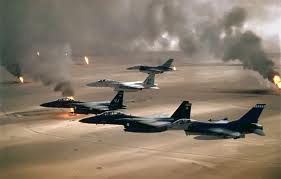
us_air_force_jets_oil_buring_iraqNote: These “USA Oil Seminar” posts are extra readings for my students to better understand how US energy policy is developed and to hear the views of US experts.  The seminar is: “The Global Oil System & US Policy” at JFK Institute of FU-Berlin. 

RECOMMENDATIONS:

  1. This Friday, watch live (or the recording later on): Is the U.S. a Rising Energy Superpower? Implications for Global Markets and Asia, the Middle East, Russia, and Europe.  CSIS upcoming talk by Fereidun Fesharaki.  FRIDAY, MAY 16, 2014 | 10:00 AM – 11:30 AM .  Moderated by David Pumphrey.
  2. Read the paper: Fueling a New Order? The New Geopolitical and Security Consequences of Energy |April 15, 2014. By: Bruce Jones, David Steven and Emily O’Brien.  Brookings Institute; Washington, DC.

BACKGROUND:  This week, the class reading assignments are a couple conference papers I wrote a few years ago on the history and structure of today’s global oil system, and how it grew to replace the neo-colonial oil system. Continue reading

My IP Journal article | Addressing Europe’s Energy Dependence on Russia: Gas globalization?

 25371_460x259Globalizing gas market, creating OECD strategic reserves could make embargoes history | By Thomas W. O’Donnell  6May14| Post-war Western Europe was twice the target of energy embargoes, each dramatically altering its energy landscape. A lesson for today is that Europe’s present natural gas dependence on Russia can be addressed with a gas policy like that adopted by the OECD for oil in 1973 – one that launched today’s collective, market centered, and embargo-proof global oil security system.

Russian President Vladimir Putin wrote a letter made public April 10, 2014, warning several EU heads of state that Ukraine must pay its past due gas bill of $2.2 billion or Russian energy giant, Gazprom, “will completely or partially cease gas deliveries” to the country and be “compelled” to insist on payments one month in advance for any future deliveries – including $5 billion to refill Ukraine’s gas reserves before next winter.  CONTINUE READING AT:  odonnell-addressing_europes_energy_eependence_on_russia_IP_Journal-06may14


USA Oil 3.0 | US energy experts on Europe, Russia & Ukraine

Note: I’m teaching a post-graduate course “The Global Oil System & US Policy” at JFK Institute of Freie U. in Berlin. In order to give students a feel for how US energy policy is developed–and to see the views of important US actors–I’m sending them frequent e-mails with supplemental readings and videos  from US think tanks, US government offices and from the US media on energy topics.

These are not my own in-depth analysis like I usually post on GlobalBarrel.com.  However I think they are worthwhile sharing with especially non-USA followers of my blog.  I’ll title these posts “USA OIL” plus a number to label them).  I hope these are useful.  Here’s today’s ‘optional material’ I sent to my students:

How is US energy policy developed? You might find this video of interest.

Some background: The CSIS (Center for Study of International Security) is a non-partisan (i.e., not Democratic or Republican) think tank in Washington, DC. It performs an important role in US foreign policy. Continue reading

My AQ piece: Maduro’s Conundrum as UNASUR Starts Venezuelan Peace Talks

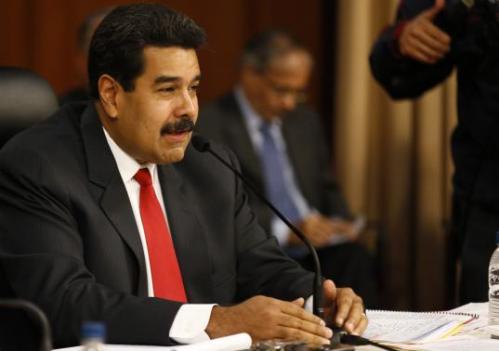
Venezuela Pres. Nicolas Maduro during first UNASUR-and-Vatican mediated peace talk with opposition in Caracas 10 April (Reuters)

Venezuelan President Nicolas Maduro speaking during the first UNASUR-and-Vatican mediated peace talks with the opposition in Caracas 10 April (Reuters)

Here’s my commentary at Americas Quarterly today, 11 April:

A delegation of foreign ministers from the Union of South American Nations (UNASUR) returned to Caracas on April 7 and 8, securing an agreement to hold peace talks to calm political polarization and protests in Venezuela.  The talks are being mediated by the foreign ministers of Colombia, Brazil and Ecuador, plus a Vatican representative.

The UNASUR delegation first visited in late March, recommending that Venezuelan President Nicolás Maduro and leaders of the opposition’s Mesa de Unidad Democrática (MUD) enter into a dialogue.  The U.S. State Department had expressed support, as had Organization of American States (OAS) General Secretary José Miguel Insulza.

However, UNASUR’s plan will be complicated by Maduro’s reliance on paramilitaries within his Partido Socialista Unido de Venezuela (United Socialist Party of Venezuela—PSUV), whose loyalty requires his polarizing words and deeds. This conundrum already wrecked a previous dialogue.

In early February, before protests broke out, a highly placed government official explained to me,  …  CLICK to Continue Reading at Americas Quarterly. Continue reading

Venezuelan state’s economic response to protests: Rationing plus Chinese and Russian loans to float a liberal dollar market

The anti-government protest in eastern Caracas 13 March ended in clashes with Venezuelan police BBC
The anti-government protest in eastern Caracas 13 March ended in clashes with Venezuelan police. Three more died in widespread protests. BBC

As protests continue against Venezuela’s faltering “oil revolution,” the political strategy of the chavista administration is striking for its intransigence. President Maduro has refused to recognize any grievances by students or other protesters. He calls protesters “fascists” and blames them for all the ills of the economy.  Protests are attacked by the national guard and often by state-organized paramilitary gangs on motorcycles who are praised by the president.

The administration’s strategy so far appears to be that protests will burn themselves out if they can be delegitimized and contained within middle-class areas.  Accordingly, the president’s rhetoric aims at inciting poorer citizens against protesters.  All in all, this is a risky strategy.  Protests have constantly intensified, with perhaps 25 persons dead now.
After a month of protests, the administration has taken urgent economic measures it hopes will undermine the protests and prevent their spread to poor and working-class barrios.
1. Ramirez announces Chinese and Russian loans and the launch of a very liberal Sicad 2

My DGAP article | Energiewende vs. USA Shale Gas: Can German industry compete?

ImageIn Germany, the impact of the country’s renewable energy transition on the economy is a very hot topic.  Tuesday, Mrs. Merkel’s  new Minister of Economy & Environment (and chair of the Social Democratic Party), Mr. Sigmar Gabriel, declared: “We need to keep in mind that the whole economic future of our country is riding on this,” (NYT, 21Jan14).

Here’ is my article in the DGAP’s (German Council on Foreign Affairs’) IP Journal of 30Dec13  (submitted 24Nov13):

Germany’s Energiewende (renewable-energy transition) is under intense pressure both from consumers facing soaring electric bills and from German manufacturers fretting about their falling energy competitiveness vís-a-vís the US, where manufacturers are benefiting from the boom in cheap natural gas production. What should be done to address these concerns has become a major topic of the CDU-SPD negotiations forming Chancellor Merkel’s new coalition government.  

From the viewpoint of German manufacturers, there are two ways the US shale gas revolution implies a worrisome competitive challenge. First, cheaper natural gas in the US is lowering electricity and other energy costs for American manufacturers, while Germany’s continue to rise. This is especially of concern to energy-intensive industries, where the EU now has 36 percent of world capacity and the US only 10 percent. Secondly, as the US begins to build facilities for export of liquefied gas (LNG), this capacity could have a significant effect on the price of electricity and gas in Asia. … Continue reading at DGAP’s (Deutsche Gesellschaft für Auswärtige Politik e.V.) IP Journal.

A new syllabus: The USA & the global oil system: The formation of American energy policy

global_barrel_graphic_twodDuring Spring 2014, I’m teaching a post-graduate seminar in Berlin  on the USA and  the global market-centered oil system (a.k.a.”The Global Barrel”)–the syllabus sketch is below here.

While I’ve often taught seminars on “the Geopolitics of Global Oil,” the JFK Institute at Berlin’s Freie Universität had a special request: they would like their students to learn “how these policies are decided in the USA.”

For an American energy “expert”, the how of the USA’s policy-decision process is fairly familiar. However, not only for German students, but also for most US citizens, this process–whose outcome has such a profound impact on the entire world– indeed seems at best rather opaque, and, at worst, like an unseemly, vested-interest-driven and hopelessly partisan process. Continue reading

Petrobras of Brazil v. Pdvsa of Venezuela – Reply to press interns in Sao Paulo

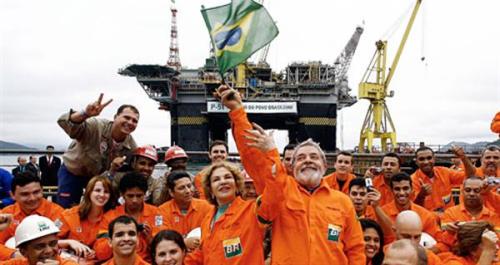
Lula and Petrobras

Lula and Petrobras

I had a pleasant exchange with an intern – in the end a class of interns – at the Brazilian newspaper “O Estado de São Paulo” a couple of weeks ago.  The questions were insightful. I tried to answer in an informative and direct manner.  Indeed, things are not going well at Petrobras lately, and looking at the politics of Pdvsa and Petrobras next to one another is a useful exercise. Here’s the interview.

1) Do you agree that PDVSA and Petrobras have both had political mishaps in their administrations? Why?

Yes. Hugo Chavez used Pdvsa as the “goose that lays the golden eggs.” However, he took so much from Pdvsa — especially to support his frequent election campaigns, before each of which he increased public spending to win votes — that the “goose” has been left to starve.

Chavez’ revolution was, in his own words, an “oil revolution” and “oil socialism.” However, he did not understand how to run the national oil company. While he distributed largess from the country’s oil wealth to the poor, he was incapable of introducing a new, higher productivity of labor in Venezuelan society, which is what any real social revolution requires for success. He left the country in a very dangerous situation with a shortage of foreign exchange. If the price of oil falls further due to a US & EU accord with Iran and/or an improvement in the oil production situation in Libya, and Iraq, then Venezuela will face a deep crisis.

Petrobras too, under Lula, began to be viewed as a cash cow after it discovered the pre-salt. As a president. Lula was much more competent organizationally and in economic matters than Hugo Chavez. However, Continue reading

China y América Latina: ¿Quién gana y quién pierde? – Petroguía 2014 (Spanish)

Inversiones energéticos de  China en Latino américa.  Nota que Venezuela está en tercer lugar, en contra de las intenciones iniciales de Beijing en 2007-08.

Inversiones energéticos de China en Latino américa. Nota que Venezuela está en cuatro lugar, en contra de las intenciones iniciales de Beijíng en 2007-08. HAZ CLICK para magnificar. (Grafico por T.O’D.)

[English readers: This post is an analysis I did in Spanish for Petroguía 2014 – the annual hard-copy guide for the LatAm petroleum sector – of China’s oil and gas investments in LatAm and the Carribean.  For Beijing’s other investments, or a presentation, etc. drop me a line. ]

NOTA: La siguiente es mi análisis publicado en Petroguía 2014, la guía anual para el sector petrolífero latinoamericano.  Soy agradecido a los directores del Petroguía por haberme permitido publicar el artículo aquí.  El artículo es una resumen de una investigación que hizo sobre todas las inversiones de China en Latino américa. Si tienen interés en una reportaje o presentación detallada, por favor contactarme.

China y América Latina: ¿Quién gana y quién pierde?

Sumario. El mercado de hidrocarburos ya no está en el norte de América sino hacia el este,  y la mejor estrategia de intercambio con esa plaza la lleva Brasil, mientras que Venezuela y Argentina están a la zaga.

Por Thomas W. O’Donnell

El petróleo y el gas que exportará América Latina en las décadas venideras irán mayormente a China y otras partes de Asia. Y eso es por el efecto combinado de menores necesidades de energía importada en Estados Unidos, gracias a la utilización de los nuevos métodos de fractura hidráulica (fracking) que produce cada vez más petróleo liviano, y por el tope que ha alcanzado su demanda doméstica. Continue reading

For Obama, an Iran deal trumped Syrian aid: USA “core interests” are in “flow of energy”

Geneva negotiations between P5+1 and Iran in early November (Reuters)

Geneva negotiations between P5+1 and Iran in early November (Reuters)

In September, President Obama came under withering criticism in Washington for not punishing Assad after crossing his “red line” on chemical weapons.  By October, even Riyadh had joined those in the State Department, the White House and Congress who, according to US press reports, saw Mr. Obama as “aloof” and “indecisive” on Syria.

While Mr. Obama’s refusal to arm the more democratic and secular rebel forces has indeed permitted Assad to retrench–increasing the humanitarian disaster as well as the ability of jihadi forces to insinuate themselves into the conflict– nonetheless, imagining this is due to presidential indecision ignores the realpolitik driving his policy.

Why Has Obama Not Forcefully Supported Syrian Rebels? The Iran Factor

Consider first: What if forceful US action in Syria had scuttled any talks with Iran, or, for that matter, if the present negotiations in Geneva between the P5+1 and Iran end up in failure? Continue reading

Beijing ups Venezuelan oil investments, but refuses Chavista leaders’ plea for a cash bailout

folha_header_08apr13folha_quote of the day_venez-and-china_08apr13Back in April, Brazil’s Folha de SaoPaulo ran an article entitled: The Future of Venezuela Depends on China and highlighted this quote:  Translation: “If Maduzo wins, he’ll have to regain the confidence of the Chinese.”  TOM O’DONNELL, petroleum consultant

Indeed, it is now clear that the short-term strategy of the post-Chavez Maduro-Cabello administration was to escape the country’s severe dollar crisis: convincing Beijing to extend it a $5 billion cash loan alleviating food-import shortages before 8 December elections.  In particular, the cash was to fund a new dollar exchange system (see El Nacional,25 Sept 2013). Continue reading

DW in Spanish || Obama y Rouhani: ¿Llegarán a un acuerdo nuclear/petrolífero?

ObamaRouhani-usip

[Note: This post on the Iran crisis is in Spanish, consisting of my written answers to the host of “Agenda” on the Deutsche Welle network–the German international TV service.] 

Hoy mi blog es en Español. Trata de la crisis nuclear entre Iran y los EEUU. Aquí abajo están mis respuestas que escribí a las preguntas del entrevistador de el programa ‘Agenda’ en Deutsche Welle, la red internacional de televisión de Alemania (con algo explicaciones adicionales).

Pregunta: Irán quiere poner en marcha las negociaciones con grandes potencias por el tema nuclear, porque creé usted que lo hace ahora?  En qué términos?

Repuesta: Pues, permítame explicarle las razones por las cuales ambos lados ahora quieren reiniciar negociaciones:

(a) Para el gobierno de los EEUU Continue reading

AQ Follow-up | Caracas & Maracaibo: Venezuela’s Private Sector Anxious to Invest if PDVSA Builds Confidence

Americas Quarterly today carries a followup that to my 29 August piece on Post-Chavez changes at PDVSA.

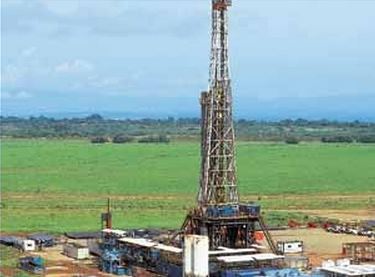
Drilling rig (PDVSA)

Drilling rig (PDVSA)

NOTE:  During the past couple weeks, while in Maracaibo and Caracas, I was repeatedly told of a new offshore payment mechanism that PDVSA has begun offering to its Joint Venture foreign partners.  Venezuelan private sector leaders took credit  for the general idea. Continue reading

My AS/COA piece: PDVSA Post-Chavez: Will Partnerships with the Private Sector and Chinese Experts Boost PDVSA Oil Production?

PDVSA oil rigs in Venezuela (TalCual)

PDVSA oil rigs in Venezuela (TalCual)

Throughout 2012, and especially after President Hugo Chávez’ death in early March 2013, Venezuela’s national oil firm, Petróleos de Venezuela S.A. (PDVSA), has taken measures beyond anything done in the past decade to raise its lagging production. While the likely impact merits cautious analysis, the drivers of the Bolivarian Republic’s scramble for increased oil revenues are clear.  … Continue reading

Competing with China in Latin America: Is Germany losing its high-tech advantage?

Wilfredo R. Rodriguez H., CC BYAn article I wrote for the IP Journal of the German Council on Foreign Relations is online today. It examines data on China, the EU and Germany’s trade with Latin America and the Caribbean, including in energy. Here’s a quote from near the end:

…  China’s exports to Latin America in the low-, medium-, and  high-tech categories were below those of Germany and the EU in 2003; but in 2012 [China’s exports] exceeded the combined totals of the EU15 in the medium-tech and even in the high-tech categories. The only place the EU15 surpasses China is, rather oddly, in the low-tech manufactured goods …

-> READ THE ARTICLE at GCFP’s IP Journal or Research Gate.