Category Archives: German Green Party

My Dublin talk: “The role of renewables in securing Europe’s energy” [at EU Commission Representation, Polish Presidency event]

I felt greatly honored to speak in Ireland, the home of my ancestors, at a high-level Irish-Polish event, invited by the Polish embassy as part of Poland’s Presidency of the European Council. [Spoiler alert: my assessment of the Green Deal’s impact on EU energy security and competitiveness was highly critical. And, I called for a radical reform, modeled on the 1970-80’s French Messmer nuclear program, the response to a similarly dire European energy and competitiveness crisis.]

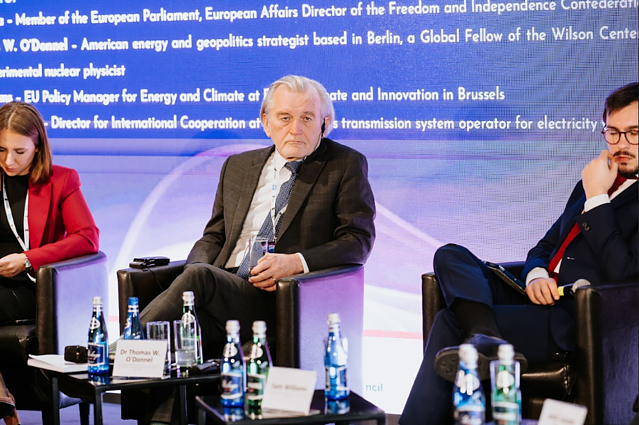
For Ireland we had Secretary General Oonagh Buckley and Wind Energy Ireland CEO Noel Cunniffee; for Poland, Daniel Piekarsky, Head of Energy Security Unit in the Foreign Ministry, and myself, Global Fellow of the Wilson Center, Washington (external) working in Europe, from Berlin.

Our moderator, from the Polish Embassy, Dublin, was the Polish diplomat and patriot, Dr. Jacek Rosa — a good friend, with whom I had the great pleasure of closely collaborating, for several years, in opposition to the Russian-German Nord Stream 2 gas-pipeline partnership, before the 2022 full-scale invasion of Ukraine. Below is the lineup, the initial invitation and some pictures. The event was off-the-record, so I show here only my own, slightly redacted talk.

Continue reading

My interview at Lithuania’s LRT: Trump could seriously harm Russia if he wants to | Trumpas, jeigu tik norėtų, galėtų stipriai pakenkti Rusijai

My long print interview at Lithuania’s LRT [Lithuanian PDF | English PDF​] with Aleksandra ​Ketlerienė, deputy editor-in-chief of Lithuania’s LRT.lt, published 7January. We spoke in Warsaw, 19 November. My thanks to Aleksandra for her insightful questioning and editorial care. We discussed:

  • The EU’s systemic energy​-policy “own goals” ​since its initial energy-crisis win ​after Moscow began cutting gas exports early in 2021​.
  • Reforming failed/ineffective Russian price-cap sanctions for real sanctions, and how the global oil market is now favorable for “maximum pressure.”
  • Historical perspectives on oil, gas, renewables, and nuclear sectors, essential for realistic policy formation.
  • An historical overview of China’s decades-long effort to overcome its energy security, learning lessons of Japan’s WW2 weaknesses.
  • (​See topics summary))
Continue reading

Part 2: “Does EU Climate Policy Need Evolution or Revolution? What Should We Change in the Green Deal?” My critical remarks at “Energy Security in CEE Conference,” Warsaw

This is a continuation of my remarks in Warsaw, on 18 November. Part 1, which posted on 19 December, reviewed failures to develop critical tech elements required by the EU Green Deal, a program modeled on the German Energiewende. I argued that, after decades of R&D efforts, these technology failures indicate the systemic failure of heavily renewable models, pointing to a need for “radical reform” of the Green Deal. I advocated for the historically proven Messmer model, which succeeded, some 40 years ago, in decarbonizing French electrical generation using nuclear power, without any need for new grids or long-term grid-scale storage tech.

Below, Part 2 (edited for clarity) focuses on the political intransigence of the new Von der Leyen commission, which is doubling down on the Green Deal’s renewable model. I argue this is not “reindustrializing” Europe or making it “more competitive” as claimed, but rather driving it into deindustrialization. This mirrors the process underway in Germany via its continuing push for new “green tech,” on the theory this should spark a broad new European industrial competitiveness. From an historical perspective, this is theoretical and practical nonsense – or so I argue. Critiques are welcomed. (PS, Happy holidays!)

Leon (moderator): So, I’m going to turn to Thomas again. You argued that that some form of radical overhaul is necessary, you know, with regards to the EU Green Deal, if I understand it correctly, and you’ve cited one of the issues is the complexity of the fact that there are certain technologies that haven’t emerged over the last 30 years that have just been growing incrementally rather than rapidly to meet our needs. But at the same time there’s seems to be some sort of political rationale for why this sort of revolutionary approach. How would you respond to that?

Tom: Yes, politically, I do think the new Commission presents a big problem for European competitiveness, for energy policy and security.

The new commission is anti-energy-policy reform

Firstly this is because Ms. Teresa Ribera, from Spain, is President Von der Leyen’s new chief executive vice-president.  She is in charge of attaining both the Green Deal and has also been given responsibility for “industrialization of Europe,” for making it competitive again.

The problem is, Ms. Ribera is a true believer in all-renewable energy systems, I would say a career-long renewable fundamentalist.

For example, she’s said to be so good at negotiating that she managed to get the Spanish nuclear industry and civil society to agree on a timetable to close all the Spanish nuclear power plants, and she’s very proud of this. This is politically and ideologically identical to what Mr. Robert Habeck, the German Green Party leader, who is energy and economics minister, carried out with the approval of Chancellor Scholz of the SPD-party. Habeck closed Germany’s last three nuclear power plants during a wartime, Russian-instigated, European energy crisis.

The fact that Von der Leyen fought hard to appoint Ribera and then put her in charge of the Green Deal and of European industrialization, and made her the most powerful commissioner, the executive vice president of the commission, shows that Von der Leyen, a member of the German conservatives, the CDU, has no interest in reform of the renewables model despite its suffering technological failures on several key aspects.

The problem is not that Europe has not had an industrial policy. Europe has had an industrial policy, one that has failed

Continue reading

NAPEC ’24, Oran: Why does the EU insist Algeria develop hydrogen & a big pipeline despite Equinor & Shell refusals due to “no customers”?

I explain EU/German motives for seeking “green H2” import pipes, then (at time 11:30) questions I raised moderating at NAPEC re. EU-Algerian pipeline MOU.

Here’s my video from Oran, Algeria, after a very informative “Africa and Mediterranean Energy & Hydrogen Exhibition & Conference,” NAPEC 2024 (video highlights here). Two parts to my analysis:

First, (up to time 11:30) I explain the rationale and impetus for the EU drive for massive green hydrogen gas imports. This is primarily driven by Germany’s increasing desperation at being locked into over-reliance on weather-variable renewables, whose high prices are sparking its “deindustrialization,” especially after losing Russian gas pipeline imports due to Putin’s war on Ukraine, plus due to the own-goal shutting down of their zero-carbon, amortized (paid for) nuclear plants during the European energy crisis. (Note: I misspoke: “Grey” hydrogen would NOT have the CO2 stored, “Blue” would. Both are derived from natural gas.)

I also explain how this massive green hydrogen “fix” to “renewables fundamentalist” policy is a techno-panacea that simply cannot work. Then ..

Continue reading

My Al Qahera, Cairo: Germany’s VW auto crisis, Green Energy Errors & Deindustrialization (English/Arabic)

English audio here. Arabic video is below.
Arabic video here. English video is above.

Al Qahera, news TV in Cairo, asked me questions on Germany’s VW crisis. VW announced yesterday it will close at least two facilities and move to break the long-term agreement with its workers’ union for no layoffs till 2029. This is serious in that 1) VW, since its founding in 1937, has never shut any plants, and 2) it’s not just VW. and it’s not just the German auto sector.


I told Al Qahera that the same story can be told about Germany’s steel industry (i.e., Thyssen-Krupp), or its chemical industry (i.e., BASF).


German energy intensive industries are facing not merely the creeping uncompetitiveness long decried in the country, but outright deindustrialization.


I described to Al Qahera how this decline of German industry reminds me of USA deindustrialization (the “rust belt” collapse) during my years working in the USA auto industry in the mid-1970’s to early 1980’s (both at Chrysler and Ford, in Detroit) and USA Railways (I worked on the Michigan Central when it was consolidated with other railways, by the federal government, to form Conrail). I remarked how it took the USA some 15 or more years to restructure and again become a modern, digitalized manufacturer. There is no guarantee Germany could pull this restructuring off, and there was no guarantee the USA would either, but that was a special case of a mammoth economy,

Continue reading

At ‘Berlin Energy Forum,’ 2 Sept., I’ll argue: Germany’s green-hydrogen import strategy is unrealistic & ignores African needs

NOTE: Last call to Sign Up Here for our 2nd Berlin Energy Forum, on “Germany’s Quest for Green Hydrogen: from Ukraine to Mauritania & back,” 4:00 – 5:30 PM (CET), Berlin Capital Club, followed by networking and drinks. The Capital Club is atop the Hilton Hotel, adjacent to Gendarme Market in Berlin’s Mitte district. Looks like we’ll have a full house again. There is also a delayed-video sign-up option. -o-o-o-o-o- Speakers: I’ll be joined by Dr. Dawud Ansari of SWP think tank where he leads H2 research, and Ms. Olena Pavlenko, President Kyiv’s Dixie Group via video link. Moderation: Ben Aris, Editor-in-chief & founder of bneIntelliNews, & our forum co-organizer.

Second: While writing my talk, I began rethinking a 2023 post on Germany’s  green-hydrogen import scheme for Mauritania. Below is my update. — Tom O’D.

German Green Hydrogen Import Strategy is Unworkable & Ignores Mauritania’s needs

Referring to the green hydrogen MOU signed with Mauritania in 2023, Conjuncta CEO Stefan Liebing said, “(This project) will have a strong link to Germany both as a technology provider and a potential offtaker of green energy.” (“Consortium signs $34 billion MoU for hydrogen project in Mauritania,” Reuters, 8 Mar 23.)

German public broadcaster Deutsche Welle seemed quite impressed: “It has a planned capacity of 10 gigawatts – the output of roughly five to six standard nuclear power plants. The first phase of the project is set to be completed by 2028” (“Mauritania set to export green hydrogen to Germany,” DW Business, 09Mar23 archived at YouTube.)

Indeed, the MOU aims for “10 gigawatts” of electrolyzers outputting “8 million tonnes/year” (Mt/y) of green hydrogen (H2) and other products, such as ammonia. However, according to the press announcement, in 2028 the facility will have a 400 MW capacity, or one-twenty-fifth of 10 gigawatts envisioned .

The German coalition government faces a formidable energy dilemma.

On one hand, it must urgently develop enough natural gas generation capacity at a reasonable cost to halt deindustrialization, and shut coal plants it brought back online when it closed the last nuclear plants To this end, Minister Habeck (Greens) urgently won approval for installation of 25 GW capacity of new natural gas turbine generation by 2030. In addition, this new natural gas capacity is needed to back up Germany’s growing, renewable-electricity dependence, as it simply has no feasible grid storage tech to offset its weather-variability.

So too, in response to Russia cutting off gas deliveries to Germany, as part of its full scale invasion of Ukraine, Germany urgently moved to install up to seven offshore LNG floating regasification ships (FRSOs). These aimed for a new natural gas import capacity of 25 bcm/year as LNG in 2023,

In January 2024, the Bundesnetzagentur (BNetzA) reported that, “According to preliminary figures, the total volume of natural gas imported into Germany in 2023 was 968 T”Wh (2022: 1,437 TWh).” of which 7% or almost 70 TWh was LNG. The reduction from 2022 largely reflects the fall in industrial production it is now suffering.

On the other hand, Germany urgently seeks enough future “green energy” import projects to eventually replace all this natural gas if it is to meet its decarbonization targets. The government published its “National Hydrogen Strategy” in summer 2023. (Also, “Gremany’s National Hydrogen Strategy,” Factsheet, 26 Jul 2023, by Sören Amelang and Julian Wettengela, Clean Energy Wire, is very useful.)

The (IMHO) dogmatic insistence on refusing to re-open several still-operable nuclear plants and to develop new German nuclear capacity means that the only low-carbon way the government coalition and many other political and business actors can imagine to replace all this natural gas is with green hydrogen produced from renewables in distant African, Mideast, Latin American and other states, or from developing new renewable-generated electricity it can import from nearby European countries.

This self-induced straitjacketing of the German energy system is, as I have described it, a sort of “renewable fundamentalism” — a maximalist insistence to fuel everything with 100% renewables and absolutely no nuclear.

How much of Germany’s new LNG-supplied energy could the Mauritania project replace in 2028?

Continue reading

1st “Berlin Energy Forum” 21 May | A monthly disruption of the local ‘energy echo chamber.’

Dear Colleagues & friends, Below is an invite to our first Berlin Energy Forum (jump to details | jump to register), but first a personal note.

First, a personal note: As some of you know, this is an idea I’ve been floating in Berlin since well before Corona. Then, last October, I had an experimental test run, a one-off, sponsored by the Qatari embassy’s Divan – and it went very well.

However, the biggest success from that event was that Ben Aris, co-founder and editor-in-chief of bne IntelliNews enthusiastically joined me to found the Berlin Energy Forum as a regular monthly sort of membership club. Amongst the longest serving foreign correspondents in Eastern Europe, Ben has been covering Russia since 1993, with stints in the Baltics and Central Asia. He is a former Moscow bureau chief for the Daily Telegraph and was a contributing editor at The Banker and Euromoney for a decade amongst writing for many other publications. He is also a professional photographer, and nowadays based in Berlin.

Ben is one of those rare people who relishes doing analysis and data-driven writing (non-stop!), AND who knows how to do business – and thoroughly enjoys doing it. Just the partner for this endeavor.

My model and inspiration for this forum was always the New York Energy Forum, which has run for over 40 years now. I happily attended while teaching in NYC. My experience with that forum, plus familiarity with a few top DC think tanks, and various foreign diplomats (esp. in NYC/UN), is how, as an academic, I got to know a broad spectrum of USA oil and gas executives, journalists, financial-institution analysts and government officials. Those personal connections have, over the years, anchored my assessments of USA, of OPEC MENA-and-Latin American members’, and of Russian and Chinese strategy. This sort of community doesn’t exist in Europe in such a focused manner, save perhaps in London. Perhaps we can now bring a bit of that world to Berlin with our new BEF.

Continue reading

My Asharq with Saudi expert: MENA green hydrogen exports will be inefficient & counter-productive for climate. Renewables still almost “nonexistent”, nuclear is pragmatic.

My Asharq interview, along with Mohammed Al-Dabai, Saudi energy journalist, on 13 April 23. (This post has English interpreter’s audio and my voice over the Arabic. View in Arabic here.)

At about timestamp 5:30, I discuss the difficulties with the Gulf states exporting “green hydrogen” to Germany and the EU.

So little renewable carbon-free energy is produced in MENA and esp. in Gulf states (i.e., almost none), and it would be so inefficient to convert this into “green hydrogen” and then further into “green ammonia” (as many in Germany and the EU now advocate), and then to ship it all the way to Germany or elsewhere in the EU, that it would make little sense, except in so far as Germany and EU states are willing to pay a good price.

However, it would also leave the MENA region with little improvement in their carbon-heavy electricity consumption. Mr. Al-Dabai generally concurred on the “scientific” problems, as he described them, of producing and exporting green hydrogen.

We were discussing a recent Ember consultancy report (London, link below) on the progress of renewable electricity worldwide, and how there is little progress in the Gulf and larger MENA region.

However, I briefly pointed to nuclear developments, the building of new So. Korean Generation 3+ plants in the UAE, and to Saudi plans, as very promising.

However, as with other renewables-focused outfits, Ember doesn’t seem to see any value in this pragmatic approach, not to mention the benefits of coal-to-natural-gas switching as a very reasonable, carbon-emmissions-reduction strategy.

Continue reading

EU Energy Crisis: Germany & EU long ignored US warnings that Putin can weaponize gas, attack Ukraine – On David Foster’s Roundtable, London

26.01.2022. Experts Wahid Machram, market analyst in Dubai; Samuel Ramadi at Oxford University, UK. and TRT Roundtable host David Foster in London made important points. Here’s a key assessment I made.:

There is a new and growing asymmetry between the European Union and Russia in energy supplies – one increasingly favoring Moscow.

Europe has opened itself to energy blackmail. The present winter 2021-22 gas shortage and skyrocketing prices are only one part. There is also the real possibility of Putin cutting off the pipeline gas he is still supplying in the event that Europe, esp. Germany, opposes any Russian invasion of Ukraine.

About the new EU-Russia growing energy asymmetry:

  • On the demand side, Germany and Europe generally increasingly need natural gas, and are growing more dependent on Russian supplies, contrary to the promises of rapid progress to a carbon-free future of the German Green Party and others. The EU, and especially Berlin, have adopted ideologically-determind, technologically unrealistic and expensive energy-transition policies, with little concern for energy-supply security. This has made Europe increasingly dependent on Russian gas imports – 40% at present of total gas imports,
  • Meanwhile, on the supply side, Russia, the major European supplier, is increasingly finding ways to diversify its gas customer base away from Europe, to the Far East, especially to China, and to Eurasia generally. It also has new outlets for its vast Arctic gas resources by converting it to LNG that can go by ship to anywhere in the world.
Continue reading

EU Commission openness to nuclear as green, betrays falling confidence in the German 100%-renewables model [English & Polish]

Dr. Thomas W. O’Donnell, Berlin 27.01.22 (Polish original 22.09.22)

Printed in Polish by Banker.pl as Komisja Europejska może uznać energetykę jądrową za “zieloną” 2021-09-22, from a written interview with Artur Chierskiwsky (PAP, Brussels) Here’s the unpublished English.-Tom O’D. [Edit:: Headline word “betrays” was initially miswritten “belays”].

Reportedly, the EU Commission plans to soon include nuclear power in its green finance taxonomy, finally making it eligible for favorable financing and carbon credits on a par with wind and solar.[1]

This could be spun two ways: as a victory for science over populist capture of climate policies, or as a tipping point in Brussels angst at the growing complexities and costs of the “100% renewables and no nuclear” model.

In reality, it’s some and some.

On the one hand, in March, the Commission received reports solicited from the Joint Research Centre (JRC), its scientific expert arm, finding that nuclear waste is “manageable”, posing no “significant” harm to the environment, and that nuclear energy has been demonstrated to be eminently safe.[2]

However, these assessments are not surprising. Had the Commission requested these years ago, they undoubtedly would have concluded similarly. Nuclear, public-health, risk-assessment and other expert bodies have been saying these things for years (full disclosure: my PhD is in experimental nuclear physics [3]).  

The question then is, why is this scientific consensus only now becoming actionable for the Commission?

Continue reading

Plan C: Gazprom’s failures on Nord Stream 2 | My talk, Ukrainian Energy Security Dialogue [English & Ukrainian]

ENGLISH – Dr. Tom O’Donnell spoke from Berlin (Українське відео розміщене нижче)
Українська мова: з Берліна говорив доктор Томас О’Доннел

Here is my talk [English & Ukrainian videos] for the Ukraine Energy Security Dialogue of 01.12.21, via Zoom, organized by Kyiv’s Dixie Group. Program & Speakers are below.

I outlined failures of the legal and political models Russia’s Gazprom has embraced to eventually bring the Nord Stream 2 pipeline into operation under the anti-monopoly provisions of the EU’s Third Energy Package law..

Critical observers have understandably interpreted the public optimism and “gas-Godfather”-like posturing of Kremlin and Gazprom officials as evidence of self-confidence, even arrogance. In contrast, here I outlined what actually amounts to a history of repeated failures of Nord Stream 2 AG strategies.

I termed its first two failed strategies as “Plan A” and “Plan B,” and the current one as “Plan C.”

Continue reading

Reply of IEA’s Dr. Fatih Birol to my critical questions on Germany’s “100% renewables & no nuclear” at P-TECC in Warsaw

Video is set to Dr. Fadi Birol’s interesting answers to my two critical questions. However, I recommend going back and watching his entire talk – and others.

I was quite happy with the answer of IEA (International Energy Agency*) director, Dr. Fadi Birol, to two critical questions I posed, first on how the European Commission should include nuclear power in its “green financing taxonomy,” and secondly, against German over-reliance on variable renewables (I termed this “renewable fundamentalism”) which I said produces high “organizational entropy,” that is, unworkable and unaffordable, completely “reinvented” so-called “smart grids” with “grid scale stage” whose technology is not sufficiently developed all to cope with the problem of unavoidable wind and solar energy fluctuations, which become more massive as the percentage of installed renewables increases. This is a significant contribution to Germany’s (and the EU’s) present crises of energy supply and price security. (The video above is set to start at my two questions.)

Continue reading

Video overview of my class: Energizing Europe. A critique of the German energy-transition model

My talk starts at 1:30, after FU-Best program intro. My webpage for students in the course is here.

I recorded this last Fall, 2020, during Corona lockdown, to give an overview of my course for prospective students.

I’ve taught this course twice per year since 2016 – save this past year’s Corona shutdown. This is a longish video summary of 12 class sessions. It should give a good sense of my critical assessment of the German model of “Energiewende” – a policy of “100% renewables and no nuclear.” I analyze this model as a set back to the German and global fights to reduce CO2 emissions. Why?

Most succulently: If climate change is the huge problem the German Green Party says it is (and it is), if it really requires a “war on carbon emissions;” then why shut Germany’s nuclear fleet? These 17 (!) nuclear plants produced approximately as much carbon-free electricity as all the solar and wind Germany has so far installed. Obviously this is NOT a war on carbon, it is a war on carbon AND nuclear, with BOTH targeted at the same level of alarm.

At bottom, this “100% renewables with no nuclear” policy, the “Energiewende“, is a romantic, unscientific program to which Merkel surrendered within 48 hours after the report of the Fukushima failure due to a monster sunami having hit this nuclear facility on the Japanese coast.

This precipitous “atomic exit,” in my estimation, marked complete victory of Green populism over science-driven policy in Germany. This German model soon attained hegemony worldwide. However, it is now being seriously questioned by climate activists, as Germany has failed to meet its CO2 reduction and renewable generation targets at home, while its price of electricity is the world’s high-test amongst large industrialized countries. As I mention in the video, the Eighth Independent Monitors Report on the progress of the Energiewende made the rather alarming assessment that it will be impossible to ever supply Germany’s domestic market with electricity supplied by domestic renewable sources. Interestingly, this assessment has not been a point of discussion in the present German national election campaigning.

Continue reading