Tag Archives: Poland

My TVP live: Merz election drama. Merz visit to Tusk reevokes security & migration frictions. If Merz fails to halt German deindustrialization, Poland too faces crisis.

In the last two weeks, I was in Warsaw twice. First, for the Three Seas One Opportunity conference (3S1O) on 27 April, organized by the Opportunity Think Tank, where I co-chaired a session. This was an official side event of the Three Seas Summit (a ministerial conference). Second, for the Warsaw Security Forum’s Public Dialogue. (WSF) 7 May. I will soon post here about both these very interesting events.

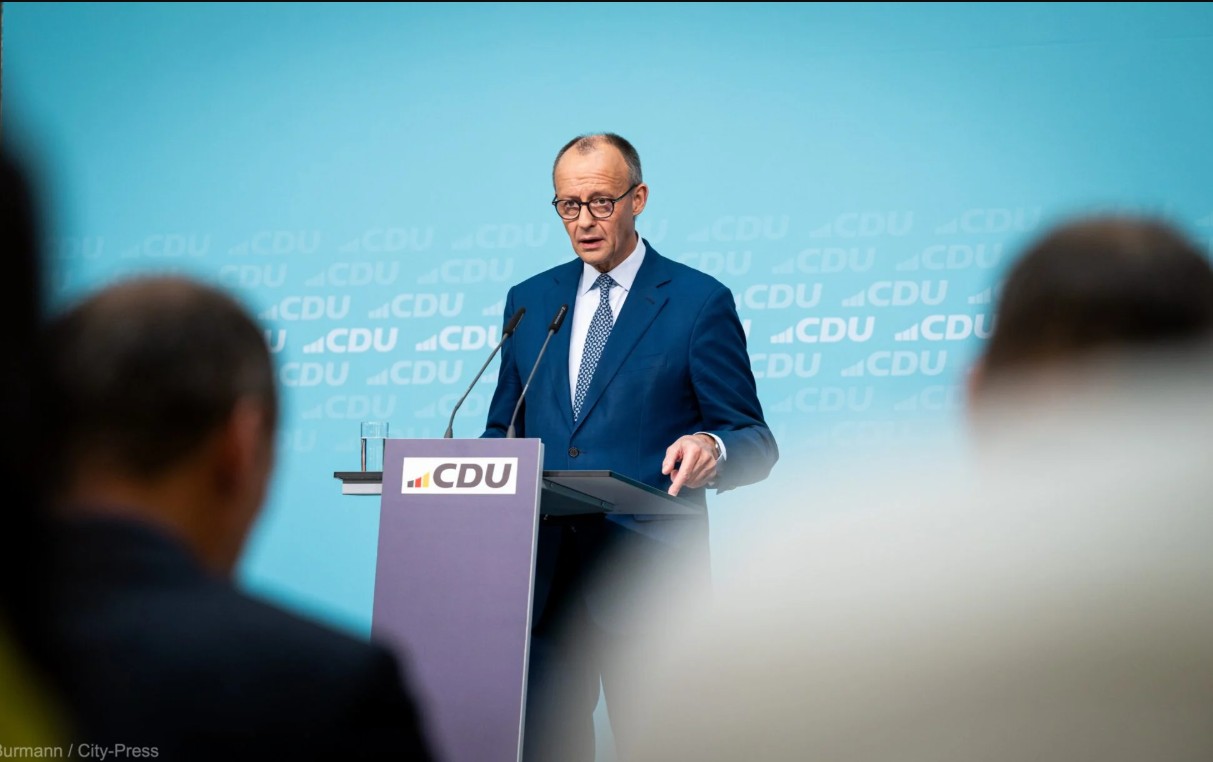
However, I was asked by TVP, the Polish national broadcaster, to come to their Warsaw studios on 8 May, the day after the WSF, for a live-on-air commentary on the recent drama in the German Bundestag (parliament) where the new Chancellor, Fredrich Merz, embarrassingly failed to get the necessary votes on the first ballot. He finally succeeded on second ballot, after intense politicking and consultations within his party, the center-right CDU, in its Bavarian sister party, the CSU, and in his coalition-partner party, the center-left SPD.

So, first; I was asked to explain this surprising electoral fiasco for the new chancellor, Merz, and his party, and how it may have weakened his new government.

Secondly, Merz immediately, after being sworn in, undertook a one-day whirlwind trip to Paris and then Warsaw, to visit his prospective main partners in the European Union, President Macron of France and Prime Minister Tusk of Poland. (Continued ….)

Continue reading

My Dublin talk: “The role of renewables in securing Europe’s energy” [at EU Commission Representation, Polish Presidency event]

I felt greatly honored to speak in Ireland, the home of my ancestors, at a high-level Irish-Polish event, invited by the Polish embassy as part of Poland’s Presidency of the European Council. [Spoiler alert: my assessment of the Green Deal’s impact on EU energy security and competitiveness was highly critical. And, I called for a radical reform, modeled on the 1970-80’s French Messmer nuclear program, the response to a similarly dire European energy and competitiveness crisis.]

For Ireland we had Secretary General Oonagh Buckley and Wind Energy Ireland CEO Noel Cunniffee; for Poland, Daniel Piekarsky, Head of Energy Security Unit in the Foreign Ministry, and myself, Global Fellow of the Wilson Center, Washington (external) working in Europe, from Berlin.

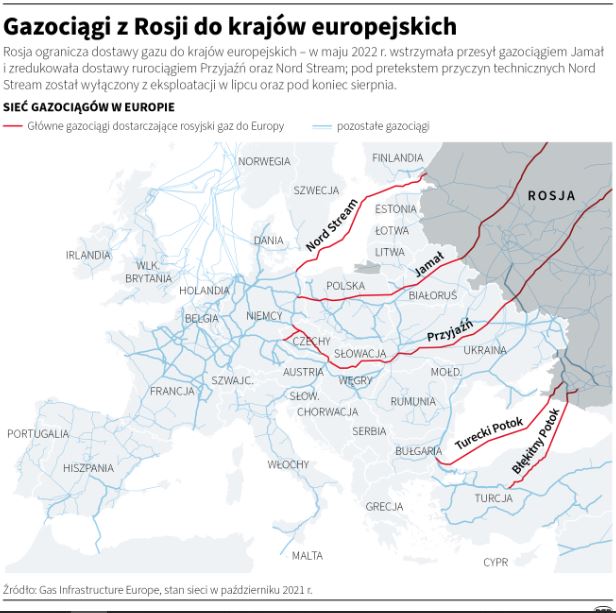
Our moderator, from the Polish Embassy, Dublin, was the Polish diplomat and patriot, Dr. Jacek Rosa — a good friend, with whom I had the great pleasure of closely collaborating, for several years, in opposition to the Russian-German Nord Stream 2 gas-pipeline partnership, before the 2022 full-scale invasion of Ukraine. Below is the lineup, the initial invitation and some pictures. The event was off-the-record, so I show here only my own, slightly redacted talk.

Continue reading

My Q1 Polish press: |1|Does Germany want Russian gas back? |2|Green Deal model has a tech problem. |3|German deindustrialization: bankruptcies up. |4|Warsaw, Paris & London must act fast for Ukraine!

Opening of Nord Stream1 pipeline, 2011. Gazprom via PAP

Below are links to 12 articles that appeared in the Polish press in the last few months, interviewing or quoting me on four topics I feel are important. The topics are listed in the title above.

The links are below, sorted by topic. The first or left column has English translations of the titles, and the second or right column has the original Polish — which unfortunately I don’t speak! If you follow the links, Google Translate or Deepl will translated the Polish articles pretty well into English. My special thanks to the intrepid Polish journalist, Artur Ciechanowicz at BiznesAlert in Warsaw for his interviews in the list. (I also had about 33 quotes or interviews in several other languages since December [1]).

ENGLISH titles and links:

  1. On German (far-right) & USA (Trump) each plotting a Russian gas return to Germany
    • A former Stasi agent lobbies for the resumption of Nord Stream. Expert: One of the gas pipeline lines ready to be launched,, By,: Artur Ciechanowicz, March 3, 2025, biznesAlert.pl
    • Some EU countries believed that Gazprom gas would be in Europe forever BiznesAlert.pl
    • “Like a Drug Addict Returning to Heroin.” Analyst on the Idea of ​​Unblocking Gas Imports from Russia to Europe, Author: Artur Ciechanowicz, February 1, 2025, 07:21
  2. Failures of EU Green Deal on technology and energy security.
    • American expert: recommendation to reduce emissions by 90 percent by 2040 is “fantasy” | Energetyka24
    • Expert: EC recommendation to reduce gas emissions is fantasy wpolityce.pl
    • Unrealistic EU climate plan. Expert opinion crushes – Super Business
    • “Rearranging deckchairs on the sinking Titanic”. Expert slams the eco-target dictates of Brussels Eurocrats PCH24.pl
  3. Trump, EU & Poland: Ukraine War crisis.
    • First talk with Putin. Trump has visions of ending the war in Ukraine | Newsweek Jan 21
    • How Trump Can Bring Down the Russian Economy: Analysts: He Has an Arsenal of Means to Do It, By Artur Ciechanowicz, Jan 24, 2025 | Biznes Alert
    • Trump may use [oil] sanctions to finish off Moscow, which is running out of money for the National Welfare Fund. – 16 January 2026 UBN
    • Expert: Washington, London, Warsaw should work quickly. Kiev can’t afford to be patient – Dziennik.pl
  4. German deindustrialization: Energy & economic crisis
    • Major shoe retailer goes bankrupt A sharp increase in bankruptcies in Germany

Polish titles and links:

  1. First topic.
    • Agent Stasi lobbuje za wznowieniem Nord Stream. Ekspert: Jedna z nitek gazociągu gotowa do uruchomienia biznesalert.pl
    • Część krajów Unii uwierzyła, że gaz z Gazpromu będzie w Europie na zawsze BiznesAlert.pl
    • “Jak powrót narkomana do heroiny”. Analityk o pomyśle odblokowania importu gazu z Rosji do Europy | BizNes Alert
  2. 2nd Topic
    • Amerykański ekspert: zalecenie redukcji emisji o 90 proc. do 2040 r. to „fantastyka” | Energetyka24
    • Ekspert: Zalecenie KE redukcji emisji gazów to fantastyka wpolityce.pl
    • Nierealny plan klimatyczny UE. Opinia eksperta miażdży – Super Business
    • “Przestawianie leżaków na tonącym Titanicu”. Ekspert nie zostawia suchej nitki na eko-dyktaturze brukselskich eurokratów – PCH24.pl
  3. Third topic
    • Donald Trump chce uchronić świat przed III wojną światową | Newsweek
    • Jak Trump może złamać rosyjską gospodarkę?
    • Trump may use [oil] sanctions to finish off Moscow, which is running out of money for the National Welfare Fund. – UBN
    • Ekspert: Waszyngton, Londyn, Warszawa powinny szybko działać. Kijowa nie stać na cierpliwość – Dziennik.pl
  4. Fourth topic

Notes:

  • [1] Other than being cited/interviewed in Poland, I was also quoted elsewhere about 33 times so far in 2025, mainly in the USA, with many then translated to languages of Europe, Asia and Latin America. I never know what to do with all these print interviews. Here at GlobalBarrel.com, I often publish videos of some of my live-on-air expert commentary, usually accompanied by a detailed blog post. So, my idea is I will make a new tab at the top of the GlobalBarrel.com site, next to the “About Me” tab, where I can simply list link to my recent press citations or Op-Eds. [Back to text]

My TVP: To cripple Putin, Trump can sanction oil ports, let Ukraine strike them / Seeking a new North Stream deal is Merkel 2.0; realism is a new, nuclear ‘Green’ Deal

[TWO “discoveries” just after this interview:

First, Bloomberg reported Ukraine had destroyed an oil pumping station on the pipeline feeding Russia’s big Ust Luga oil export terminal on the Baltic Sea. This is the first time Kyiv has shutdown a Russian oil port, … which is exactly what I advocated in the interview above and since early-2024 as a military tactic to accompany imposition of “real” USA-EU oil sanctions on the three Russian west-facing oil ports, replacing the failed “oil price cap” policy.

Second, Christof Ruhl, former-BP VP, and -World Bank Moscow rep., now at the Columbia U. Energy Center, had an OP-ED in the FT, with a similar argument that Russian oil can be replaced with OPEC crude. I recommend it: Trump should call on Opec in his bid to negotiate with Putin Ukraine’s western allies must join forces with the oil cartel to really squeeze Russia’s war economy” Christof Ruhl, 30jan25.]

There are two topics in this interview with Diana Skya of Poland’s national broadcaster, TVP:

  1. Putin’s oil export income can be slashed via new sanctions and military policies, in line with Trump’s interest in forcing a “deal”
  2. EU member states that seek a new Putin gas partnership are dysfunctionally replaying Merkel-ism and avoiding the real solution of reforming the Green Deal to put nuclear energy in the center. (See: “EU debates return to Russian gas as part of Ukraine peace deal. Advocates say reopening pipelines could help settlement with Moscow and cut energy costs” Henry Foy and Alice Hancock in Brussels and Christopher Miller in Kyiv, FT, 30jan25)
  1. OIL SANCTIONS:

I have argued for three years that the rationale behind the USA-EU imposition of a Russian “oil-price cap” rather than simply imposing real oil sanctions has been flawed, and the policy has failed.

It was conceived in early-2022, apparently by former-central-banker Mario Draghi of Italy and taken up by then-USA-Treasury-head Janet Yellen, neither of whom understood global oil trade sufficiently to see how easily the Russians could get around this scheme, as they have with a “shadow fleet” of oil tankers insured by Chinese, Russian or other non-EU, non-UK firms.

Continue reading

Part 2: “Does EU Climate Policy Need Evolution or Revolution? What Should We Change in the Green Deal?” My critical remarks at “Energy Security in CEE Conference,” Warsaw

This is a continuation of my remarks in Warsaw, on 18 November. Part 1, which posted on 19 December, reviewed failures to develop critical tech elements required by the EU Green Deal, a program modeled on the German Energiewende. I argued that, after decades of R&D efforts, these technology failures indicate the systemic failure of heavily renewable models, pointing to a need for “radical reform” of the Green Deal. I advocated for the historically proven Messmer model, which succeeded, some 40 years ago, in decarbonizing French electrical generation using nuclear power, without any need for new grids or long-term grid-scale storage tech.

Below, Part 2 (edited for clarity) focuses on the political intransigence of the new Von der Leyen commission, which is doubling down on the Green Deal’s renewable model. I argue this is not “reindustrializing” Europe or making it “more competitive” as claimed, but rather driving it into deindustrialization. This mirrors the process underway in Germany via its continuing push for new “green tech,” on the theory this should spark a broad new European industrial competitiveness. From an historical perspective, this is theoretical and practical nonsense – or so I argue. Critiques are welcomed. (PS, Happy holidays!)

Leon (moderator): So, I’m going to turn to Thomas again. You argued that that some form of radical overhaul is necessary, you know, with regards to the EU Green Deal, if I understand it correctly, and you’ve cited one of the issues is the complexity of the fact that there are certain technologies that haven’t emerged over the last 30 years that have just been growing incrementally rather than rapidly to meet our needs. But at the same time there’s seems to be some sort of political rationale for why this sort of revolutionary approach. How would you respond to that?

Tom: Yes, politically, I do think the new Commission presents a big problem for European competitiveness, for energy policy and security.

The new commission is anti-energy-policy reform

Firstly this is because Ms. Teresa Ribera, from Spain, is President Von der Leyen’s new chief executive vice-president.  She is in charge of attaining both the Green Deal and has also been given responsibility for “industrialization of Europe,” for making it competitive again.

The problem is, Ms. Ribera is a true believer in all-renewable energy systems, I would say a career-long renewable fundamentalist.

For example, she’s said to be so good at negotiating that she managed to get the Spanish nuclear industry and civil society to agree on a timetable to close all the Spanish nuclear power plants, and she’s very proud of this. This is politically and ideologically identical to what Mr. Robert Habeck, the German Green Party leader, who is energy and economics minister, carried out with the approval of Chancellor Scholz of the SPD-party. Habeck closed Germany’s last three nuclear power plants during a wartime, Russian-instigated, European energy crisis.

The fact that Von der Leyen fought hard to appoint Ribera and then put her in charge of the Green Deal and of European industrialization, and made her the most powerful commissioner, the executive vice president of the commission, shows that Von der Leyen, a member of the German conservatives, the CDU, has no interest in reform of the renewables model despite its suffering technological failures on several key aspects.

The problem is not that Europe has not had an industrial policy. Europe has had an industrial policy, one that has failed

Continue reading

Part 1: “Does EU Climate Policy Need Evolution or Revolution? What Should We Change in the Green Deal?” My critical remarks at “Energy Security in CEE Conference,” Warsaw

This is long, so posted in two parts. It ended up a sort of manifesto for radical reform of the EU Green Deal model. First, I explain key technological failings of the all-renewables model. Second, I stressed that political intransigence of the new Commission to reforming this model is weakening EU war-time energy security and driving industrial decline.

  • Anna Bryłka – Member of European Parliament, European Affairs Director Freedom & Independence Confederation
  • Dr. Thomas W. O’Donnell – American energy & geopolitics strategist based in Berlin, Global Fellow of Wilson Center, Wash, DC (external) & an experimental nuclear physicist
  • Sam Williams – EU Policy Manager, energy & climate at EPICO Climate & Innovation Brussels
  • prof. Leszek Jesień – Director, International Cooperation at PSE. Poland’s transmission system operator for electricity (TSO)
  • Moderator: Dr. Leon Hartwell – Senior Associate LSE IDEAS, London School of Econ., co-founder Russia-Ukraine Dialogues, & former Sotirov Fellow.

Note: The conference video is unpublished, so I print only my own remarks, unfortunately not my co-panelists’ as well. Starting from an AI transcript I greatly reworked into more like a long article, but with the moderator’s questions unchanged. I also added subtitles.

Dr. Leon Hartwell: Now, I’m going to now turn to you, Thomas, because you’ve written about everything from oil to nuclear energy, and I hope you’ll throw a few spanners in the wheel. So, to give us some food for thought. The title of our panel of course, Evolution or Revolution. What does the Green Deal need and why? What’s your take on this, Tom?

Dr. Tom O’Donnell: Thanks, Leon. Well, first off, I’m not going to say anything I haven’t said for 20 something years, I didn’t just write it for this panel.  I have also taught seminars critiquing the Green Transition Model, the German Model, over many years.

Dr. Tom O’Donnell, CEE Energy Security Conference, Warsaw 18.11.24

So, the question posed is: “Evolution or Revolution in the Green New Deal?” and the other iterations of it, “Fit for 55” and such?  I would say it would be nice to have evolution, but it’s not possible.

It’s a failure, a policy disaster, which is going to require radical action by Europe if you’re not going to deindustrialize, and also for security reasons. There are two aspects here to this failure.

Continue reading

My BiznesAlert: German elites have no idea how to get out of the crisis / Ekspert dla Biznes Alert: niemieckie elity nie mają pomysłu na wyjście zkryzysu

Last night, leaving the Polish Sejm, after a long discussion, invited by a leader.

URL CORRECTIONS: ENGLISH Biznes Interview LINK & POLISH Biznes Interview LINK

[Warsaw, 21 Nov] Here’s my interview with BiznesAlert’s Artur Ciechanowicz (in EN & Pl) on Germany’s energy, industrial and political crises. I spoke here in Warsaw Monday at the CEE Energy Security Conference, attended Wednesday’s 25 Years of NATO Membership conference, and was invited yesterday evening, by a leader of the Sejm (parliament) for a long talk in his offices, joined by Mark Voyger (American University Kyiv and former-NATO). More soon. Tom O’D.

Continue reading

My PAP, Poland: “Expert: EC recommendation to reduce greenhouse gas emissions by 90% by 2040 is fantasy” / “Ekspert: zalecenie KE redukcji emisji gazów cieplarnianych o 90% do 2040 roku to fantastyka”

I’ve been thinking about what to say on Monday in Warsaw: at the “Energy Security in Central & Eastern Europe” conference. As soon as I saw the title of my panel: “Does EU Climate Policy Need Evolution or Revolution? What Should We Change in the European Green Deal?” I accepted! This question goes beyond politics – left, right or center – it is a pressing matter for European energy security

Then, I recalled my syndicated interview with Polish AP’s Arthur Ciechanowicz (Brussels) this February. It’s exactly what I should say in Warsaw (see below: LHS in EN, RHS in PL), especially given President Von der Leyen’s choices of long-time anti-nuclear politicians to be her top commissioners for climate and (re)industrialization (Teresa Ribera), and for energy (Dan Jørgensen). (**Details in footnotes). See what you think.

* Footnotes: References on new EU Commissioners’ anti-nuclear attitudes:

Continue reading

New “CEE Nuclear Energy Network” holds 1st policy consultation with Polish officials & experts.

On 4 April, in Warsaw, the first meeting of our new CEE Nuclear Expert Network (a policy network) was held to consult with Polish officials and experts. The network organizers include:

Below, I explain: i) Our event, who attended and such, and ii) our other planned 2024 Nuclear Expert Network events for Poland and the 3 Seas Region.

i) 1st “Chatham House” Nuclear Expert Network meeting

Attending were representatives of the Ministry of Climate and Environment, the Ministry of Technology and Development, the Prime Minister’s office, National Development Bank of Poland (BGK), Industrial Development Agency (ARP), Polskie Sieci Elektroenergetyczne S.A. (PSE – the national electric grid operator or TSO), a consultancy advising the ministry, and others. (See also Kamil Lipinski’s LinkedIn Post’s list below.),

Continue reading

My Polish press interview: “Europe can replace Russian oil & gas by 2027” but “in war there are casualties” (Pl. & Eng.)

This image has an empty alt attribute; its file name is capture-pap-poland-energy-war-25nov22.jpg

This interview with Artur Ciechanowich (Polish Associated Press-PAP, Brussels) appeared on Sunday, 25 November 2022 in several Polish press, TV and radio outlets (links below this post). Polish & English (via Google Translate) versions follow:

ENGLISH – via Google Translate

Europe without gas and oil from Russia? An expert gives a possible date

If the European Union does not bow to the Russian energy attack, it may completely replace gas and oil imports from this country with raw materials from other sources within four to six years, said Thomas O’Donnell, an energy market analyst and lecturer at a university in Berlin …..

  • Russia is waging an energy war against Europe, which is part of a larger war between Russia and Ukraine. We see that the war on the battlefield is not going Russia’s way, so the Kremlin is counting on its energy policy to cause enough economic problems for Europeans to divide the EU and withdraw from solidarity with Ukraine, says O’Donnell.

The question of replacing gas and oil imports from Russia

  • Vladimir Putin has a much greater influence on Europe through the supply of gas than oil. This is because gas is mainly supplied by pipelines. Around 2027, Europe, the United States, Qatar and others will increase the export capacity of liquefied natural gas enough to replace the EU’s dependence on Russian gas and allow gas prices in the EU to fall to levels close to the low prices in the US, the analyst predicts.

However, he does not hide that before this happens, citizens of EU countries will have to go through a more difficult period. “This is an energy war, and in a war both sides suffer – consumers and businesses in the EU will suffer. It will take at least four years to implement huge new LNG export projects from the US and Qatar, he cautions, adding that the EU will also need to receive as much gas as possible from Algeria, Egypt and Norway.

  • This year Europe filled up its gas storages. It will be harder next year. It should be understood that the storage facilities – under normal conditions – have never been used to provide normal gas supplies to consumers. They’re just too small for that. They were created with the idea of ​​storing the raw material saved in the summer and using it in the winter, when the Russian and Norwegian pipelines could not keep up with the demand, explains Thomas O’Donnell.

He points out that, therefore, Germany has repealed the regulations requiring the maintenance of a minimum temperature in homes, and in some EU countries there are debates about power cuts for citizens. – Europe has become dependent not only on Russian gas, but also on completely unpredictable wind energy. If the wind is weak – as in the 2020-21 season – combined with the lack of appropriate transmission networks and the lack of technical capacity to store electricity on a large scale, it can mean a disaster. These are the facts. In times of war, citizens must know the whole truth, the expert argues.

PAP
He emphasizes that Russia is waging an energy war against Europe in order to break its solidarity towards Ukraine. – In the US and Qatar, but also in Norway, Algeria, Azerbaijan, Israel, Egypt and so on, there are plenty of new gas reserves, financing opportunities, technologies and functioning markets. In four to six years, Europe’s dependence on Russia will be completely replaced by imports from other directions. This also applies to crude oil. Russia, meanwhile, will be reduced from an energy superpower to an OPEC second or third tier country, concludes O’Donnell.

TVN24 live – watch on TVN24 GO
The material is part of the TVN24 GO website
Author:kris/ToL

Source: PAP

Main photo source: Marcin Bielecki/PAP

POLISH – as from PAP

Europa bez gazu i ropy z Rosji? Ekspert podaje możliwy termin

Jeżeli Unia Europejska nie ugnie się przed rosyjskim atakiem energetycznym, to w czasie od 4 do 6 lat może całkowicie zastąpić import gazu i ropy naftowej z tego kraju surowcami z innych kierunków – stwierdził Thomas O’Donnell, analityk rynku energetycznego i wykładowca na prywatnej berlińskiej uczelni ….

  • Rosja prowadzi przeciwko Europie wojnę energetyczną, która jest częścią większej wojny Rosji z Ukrainą. Widzimy, że wojna na polu bitwy nie idzie po myśli Rosji, więc Kreml liczy na to, że jej polityka energetyczna wywoła u Europejczyków wystarczające problemy ekonomiczne, by podzielić UE i odstąpić od solidarności z Ukrainą – mówi O’Donnell.

Kwestia zastąpienia importu gazu i ropy z Rosji

  • Władimir Putin ma znacznie większy wpływ na Europę poprzez dostawy gazu niż ropy naftowej. Dzieje się tak, ponieważ gaz dostarczany jest głównie rurociągami. Około 2027 roku Europa, Stany Zjednoczone, Katar i inne kraje zwiększą możliwości eksportowe skroplonego gazu ziemnego na tyle, aby zastąpić zależność UE od rosyjskiego gazu i pozwolić na obniżenie cen gazu w UE do poziomu zbliżonego do niskich cen w USA – przewiduje analityk.

Nie ukrywa jednak, że zanim to się stanie, to obywatele państw Unii będą musieli przejść przez trudniejszy okres. – To wojna energetyczna, a na wojnie obie strony ponoszą ofiary – ucierpią konsumenci i firmy w UE. Co najmniej cztery lata zajmie wdrożenie ogromnych nowych projektów eksportu LNG z USA i Kataru – zastrzega, dodając, że UE będzie musiała otrzymywać jak najwięcej gazu także z Algierii, Egiptu i Norwegii.

  • W tym roku Europa napełniła swoje magazyny gazu. W przyszłym roku będzie trudniej. Należy rozumieć, że magazyny – w normalnych warunkach – nigdy nie służyły do zapewniania normalnych dostaw gazu konsumentom. Są na to po prostu za małe. Powstawały z myślą przechowania surowca zaoszczędzonego latem i wykorzystania go zimą, kiedy rosyjskie i norweskie rurociągi nie nadążały z zaspokojeniem popytu – tłumaczy Thomas O’Donnell.

Zwraca uwagę, że w związku z tym, Niemcy uchylili przepisy nakazujące utrzymywanie w domach minimalnej temperatury, a w niektórych krajach Unii toczą się debaty na temat przerw w dostawach prądu dla obywateli. – Europa uzależniła się nie tylko od rosyjskiego gazu, ale postawiła też na całkowicie nieprzewidywalną energię wiatrową. Jeśli wiatr będzie słaby – jak w sezonie 2020-21 – to w połączeniu z brakiem odpowiednich sieci przesyłowych i brakiem technicznych możliwości magazynowania prądu na wielką skalę, może to oznaczać katastrofę. Takie są fakty. W czasie wojny obywatele muszą znać całą prawdę – przekonuje ekspert.

PAP
Podkreśla, że Rosja prowadzi wojnę energetyczną przeciwko Europie, aby rozbić jej solidarność wobec Ukrainy. – W USA i Katarze, ale też w Norwegii, Algierii, Azerbejdżanie, Izraelu, Egipcie i tak dalej, istnieje mnóstwo nowych rezerw gazu, możliwości finansowania, technologii i funkcjonujących rynków. Za cztery do sześciu zależność Europy od Rosji zostanie całkowicie zastąpiona importem z innych kierunków. Dotyczy to również ropy naftowej. Rosja tymczasem zostanie zredukowana z supermocarstwa energetycznego do drugoligowego lub trzecioligowego kraju OPEC – konkluduje O’Donnell.

TVN24 na żywo – oglądaj w TVN24 GO
Materiał jest częścią serwisu TVN24 GO
Autor:kris/ToL

Źródło: PAP

Źródło zdjęcia głównego: Marcin Bielecki/PAP

Here are links to some of the Polish media where the PAP interview was published:

* Europa bez gazu i ropy z Rosji? Ekspert podaje możliwy termin

https://tvn24.pl › biznes › ze-swiata

1 day ago — … 4 do 6 lat może całkowicie zastąpić import gazu i ropy naftowej z tego kraju surowcami z innych kierunków – stwierdził Thomas O’Donnell, …

* Ekspert: Europa może poradzić sobie bez gazu i ropy z Rosji …

https://www.pap.pl › aktualnosci › ne…

·Translate this page

21 hours ago — Rosja tymczasem zostanie zredukowana z supermocarstwa energetycznego do drugoligowego lub trzecioligowego kraju OPEC” – konkluduje O’DonnellZ …

* UE może obejść się bez gazu i ropy z Rosji. „Jeśli pozostanie …

https://www.tvp.info › ue-moze-obej…

1 day ago — Jeśli Unia Europejska nie ugnie się przed atakiem energetycznym ze strony Rosji, to w ciągu 4-6 lat zastąpi całkowicie import gazu i ropy …

* Ekspert: UE może w ciągu 4-6 lat całkowicie zastąpić import …

https://www.bankier.pl › wiadomosc

·Translate this page

1 day ago — Jeśli Unia Europejska nie ugnie się przed atakiem energetycznym ze strony Rosji, to w ciągu 4-6 lat zastąpi całkowicie import gazu i ropy …

* Ile lat potrzeba UE aby uniezależnić się od importu ropy i gazu …

https://polskieradio24.pl › artykul

1 day ago — Jeśli Unia Europejska nie ugnie się przed atakiem energetycznym ze strony Rosji, to w ciągu 4-6 lat zastąpi całkowicie import gazu i ropy …

Czy Europa jest wystarczająco silna, aby poradzić sobie bez …

https://mycompanypolska.pl › artykul

27 Sept 2022 — Czy Europa jest wystarczająco silna, aby poradzić sobie bez ropy i gazu z Rosji? … Polska, podobnie jak pozostałe państwa Unii Europejskiej, …

gaz w PolskieRadio.pl

https://www.polskieradio.pl › gaz › T…

Ile lat potrzeba UE aby uniezależnić się od importu ropy i gazu z RosjiEkspert wyjaśnia. Jeśli Unia Europejska nie ugnie się przed atakiem energetycznym …

* Ekspert: Polska jest dobrze przygotowana na odcięcie dostaw gazu …

https://www.gospodarkamorska.pl › …

Ekspert: Polska jest dobrze przygotowana na odcięcie dostaw gazu z Rosji, … sprawę z takiego niebezpieczeństwa – mówi w rozmowie z PAP Thomas O’Donnell, …Open document settingsOpen publish panel

  • Post
  • Paragraph

Notifications

30 blocks selected.

EU Commission openness to nuclear as green, betrays falling confidence in the German 100%-renewables model [English & Polish]

Dr. Thomas W. O’Donnell, Berlin 27.01.22 (Polish original 22.09.22)

Printed in Polish by Banker.pl as Komisja Europejska może uznać energetykę jądrową za “zieloną” 2021-09-22, from a written interview with Artur Chierskiwsky (PAP, Brussels) Here’s the unpublished English.-Tom O’D. [Edit:: Headline word “betrays” was initially miswritten “belays”].

Reportedly, the EU Commission plans to soon include nuclear power in its green finance taxonomy, finally making it eligible for favorable financing and carbon credits on a par with wind and solar.[1]

This could be spun two ways: as a victory for science over populist capture of climate policies, or as a tipping point in Brussels angst at the growing complexities and costs of the “100% renewables and no nuclear” model.

In reality, it’s some and some.

On the one hand, in March, the Commission received reports solicited from the Joint Research Centre (JRC), its scientific expert arm, finding that nuclear waste is “manageable”, posing no “significant” harm to the environment, and that nuclear energy has been demonstrated to be eminently safe.[2]

However, these assessments are not surprising. Had the Commission requested these years ago, they undoubtedly would have concluded similarly. Nuclear, public-health, risk-assessment and other expert bodies have been saying these things for years (full disclosure: my PhD is in experimental nuclear physics [3]).  

The question then is, why is this scientific consensus only now becoming actionable for the Commission?

Continue reading

My Kongres590/Warsaw talk: “Building a Joint Three-Seas-Initiative Nuclear Energy R&D-and-Training Center” [Polish & English]

Note: The Polish Interpreter’s voice dominates; however with headphones I could follow the English. Apologies, there’s no separate English audio.

“Cooperation in energy transformation and trade to increase the economic strength of the Three Seas Region …”

Kongres590 – Warsaw – 14 October 2021

  • Moderator: prof. dr. hab. Zbigniew Krysiak, Chairman of the Program Council of the Institute of Schuman Thought
    Panellists:
  • Dr. Thomas W. O’Donnell, (PhD Nuclear Physics; Lecturer in Berlin & Energy & Geopolitical Analyst),
  • Julius Zellah, (President of the Light for Africa Online Foundation)
  • Paweł Kotowski, (Deputy Director of the Department of Economic Cooperation, Ministry of Foreign Affairs)
  • Jarosław Malczewski, (President of the Polish Dairy Group),
  • Dr. Krzysztof Malczewski, (President of the B-2M Company)

Key points of my talk:

1. Poland has no previous experience in nuclear energy; and this is a difficult problem that needs to be tackled starting now. Also, any institute needs a sufficient scale to guarantee both high standards and employment security to those trained for industry, academia, safety, and planning.  It is for this reason that nuclear training in Poland’ should be done jointly, together with all 12 of the Three Seas Initiative members (i.e., the eastern EU member states, and this may soon include also Ukraine – many of which countries already have established nuclear programs). And, as part of the Three Seas Initiative, this means also in conjunction with the USA, in particular its Department of Energy with a vast network of nationl laboratories and obviously decades of nuclear experience to draw on. Continue reading

“EU leaders will consider creating a strategic gas reserve” [TVPoland explains I proposed this in August: “Ukraine as a Central Bank of Energy”]

ursula_von-der-leyen_EU_gas_strategic_reserve_tvp_pap_03oct21For explanation of  my proposal, go below to bold text on my August Tagesspiegel Op-Ed.

RAJA ME  |

EU leaders will discuss the idea of ​​creating a strategic EU gas reserve and decoupling electricity prices from gas prices, said the head of the European Commission, Ursula von der Leyen.

– When it comes to gas, we are dependent on imports – 90 percent. gas is imported. The economies in the world are growing, so is the demand. But the supply is not correspondingly greater. We are very grateful that Norway is increasing production, but it seems that this is not the case in Russia, noted the head of the European Commission, visiting Estonia. In her opinion, the solution to the problem are investments in renewable energy sources, which should make the Community independent of imports and stabilize prices.

– In the short term, we will talk at the European Council, not only this evening (Tuesday), but in two weeks’ time at the formal Council of Europe, how to deal with storage, the strategic reserve and we will look at the overall price structure on the electricity market. Electricity prices are high due to high gas prices and we have to consider the possibility of (them) decoupling because we have much cheaper energy from renewable sources, said von der Leyen

On Tuesday evening, an informal meeting of European leaders will take place in Slovenia ahead of the EU-Western Balkans summit scheduled for Wednesday.

According to unofficial diplomatic sources in Brussels, Poland wants the European Commission to conduct investigations into the manipulation of the natural gas market by the Russian company Gazprom, which are causing the increase in gas prices in the EU. This issue is expected to appear at the EU summit on October 21-22.

Back in April, American energy market analyst Thomas O’Donnell predicted that Russia would use gas supplies to build strategic domination. The EU’s response should be to create a kind of gas ‘central bank’ in Ukrainian warehouses and use this country as a buffer, he proposed.

Ukraine is a key element of the strategic gas reserve

– Shortly after the beginning of the Maidan revolution and the Russian aggression, Ukraine, with the support of the EU, quickly made technical modifications to the export pipelines to Slovakia, Poland, Hungary and Romania in such a way as to enable a reverse. This quickly freed Kiev from having no alternative to buying Russian gas, said the expert.

– Moreover, the Kremlin cannot so easily promote favorable oligarchs – he envisaged adding that the implementation of this idea was only a matter of legislation.

– The EU could designate warehouses in Ukraine, Germany and France as the so-called strategic reserves that must always hold a certain minimum amount of gas. In the event of any aggression by Russia against Ukraine or other countries, these warehouses would be launched by a special EU-US committee or within the OECD, and Russian pipelines would be cut, the analyst suggested.

– Gas belonging to Gazprom, which stores huge amounts of gas in Germany and other EU countries, should in this case be nationalized – the expert believes.

Responding to the objection that such ideas sounded a bit fantastic, he explained that this is almost exactly how the international oil security system has operated for 50 years: in the event of a crisis, 90-day strategic oil reserves are deployed in each member state of the International Energy Agency.

Reply of IEA’s Dr. Fatih Birol to my critical questions on Germany’s “100% renewables & no nuclear” at P-TECC in Warsaw

Video is set to Dr. Fadi Birol’s interesting answers to my two critical questions. However, I recommend going back and watching his entire talk – and others.

I was quite happy with the answer of IEA (International Energy Agency*) director, Dr. Fadi Birol, to two critical questions I posed, first on how the European Commission should include nuclear power in its “green financing taxonomy,” and secondly, against German over-reliance on variable renewables (I termed this “renewable fundamentalism”) which I said produces high “organizational entropy,” that is, unworkable and unaffordable, completely “reinvented” so-called “smart grids” with “grid scale stage” whose technology is not sufficiently developed all to cope with the problem of unavoidable wind and solar energy fluctuations, which become more massive as the percentage of installed renewables increases. This is a significant contribution to Germany’s (and the EU’s) present crises of energy supply and price security. (The video above is set to start at my two questions.)

Continue reading

My Warsaw Op-Ed: Nord Stream 2 deal marks a German win in setting allied strategy on Russia & Ukraine | Niemcy nie boją się Rosji. Boją się ryzyka płynącego z Ukrainy.

My Op-Ed on German motives for Nord Stream 2 appeared in the Dziennik Gazeta Pravwna 4 Aug. 2021 (no. 149 dziennik.pl, forsal.pl), derived from an English interview (below here) with Artur Ciechanowiicz (PAP, Brussels). [Polish Op-Ed link]

Read the Polish Op-Ed (PDF) “Germany is not afraid of Russia. It fears risks coming from Ukraine”

Here is my full English interview, expanded for clarity:

1) [AC] What are the consequences of the Nord Stream 2 deal between Washington and Berlin?

[T O’D] Stepping back a bit: this deal marks a victory by Berlin in its long and intensifying contest with its ally, the USA, over which of these two biggest transatlantic powers will decide the alliance’s strategy with respect to Russia and China. The two allies deeply disagree on this matter.

In the USA, both Democrats and Republicans have agreed since the Obama administration that “Great Power Competition” must be the strategy for the alliance versus Russia and China. The Americans strongly feel it is necessary to “decouple” from globalism’s deep trade and tech integration with China and Russia, that these states must either change their disrespect for global trade rules and moderate their increasingly aggressive geopolitical activities, or be isolated and forcibly contained.

Germany, with almost 50% of its GDP from global trade, deeply disagrees with this US strategy [i.e., German exports provide 46.9% of GDP, the USA’s only 11.7%]. Berlin likes global rules; but its unbalanced economy cannot afford trade decoupling and it broadly opposes forceful military containment of China and Russia. Instead, it wants only negotiations and occasional sanctions.

So, Nord Stream 2 is an iconic example of this clash, this “leadership fight” between the USA and Germany over the transatlantic alliance’s strategy towards Russia. Berlin wants to maintain energy ties at all costs, while the USA has long advocated maximum European energy independence from Russia, and to constrain Russia (and defend Ukraine) by forcing Putin to continue having to send gas across Ukraine to reach his European customers.

Russia, for its part, wants to re-incorporate former-Soviet Ukraine [plus Belarus, Moldova and Georgia, and minimally keep them outside of the EU and NATO], and has wanted to avoid having to send its gas to Europe via Ukraine. Moscow’s transit dependence on Ukraine not only provided income for Ukraine, this constrained Russian subversion and military aggression there, for fear that the transit pipelines could be interrupted by either Ukrainian state or non-state actors.

For Germany, the “insecurity” of having to import Russian gas through Ukraine deeply alarmed Berlin. And so it made a strategic decision over 20 years ago to partner with Russia, to build new pipelines to bring gas directly from Russia to Germany [via Nord Stream 1 and Nord Stream 2] and on to European customers long supplied with the same Russian gas but via Ukraine. The aim was to make Germany the new hub for distribution of Russian gas in Europe.

Given Berlin’s logic, the 2014 Russian war on Ukraine and its annexation of Crimea only made it more sure than ever of the dangers of relying on Russian gas imports that have to transit Ukraine, and it redoubled its efforts to complete NS2, notwithstanding this would undermine German relations with three consecutive US administrations and with many of its EU allies, esp. Poland and East-Central Europe – a region where its much-prized soft power has been sacrificed.

Continue reading