A wide-ranging interview on the “perfect storm” of low prices from low demand plus rising production, the Saudi market strategy and some geopolitical implications.
Posted in Aramco, Energy and Geopolitics, Energy and Geostrategy, Global Oil Market, Global Oil system, international relations, Iran sanctions, Iraqi oil, Libya, Oil prices, Oil supply, OPEC, Resource conflicts, Russia, Saudi Arabia, Saudi Arabit, shale oil, U.S. oil, Uncategorized
Tagged Ali Al-Naimi, Energy, geopolitics, Iraq, oil sector, OPEC, Saudi Arabia, Saudi market strategy
My latest at the IP Journal of the German Council on Foreign Relations (DGAP): US-EU Cooperate on Iranian Nonproliferation: Agreement positions Tehran as regional leader — IP Journal 14/08/2014
Although negotiators failed to reach agreement on Iran’s nuclear program by the late-July deadline set last November, as Iran’s Foreign Minister Mohammad Javad Zarif put it: “We have made enough headway to be able to tell our political bosses that this is a process worth continuing. … I am sure Secretary Kerry will make the same recommendation.” Indeed, Washington, Brussels, and Tehran readily agreed on a four-month extension.
This represents a sea change in tone from the period prior to November 2013, Continue reading
Posted in China, Energy and Geopolitics, Energy and Geostrategy, Euroepen Union, Global Oil Market, international relations, Iran nuclear, Iran sanctions, Iraq, Obama, P5+1, Persian Gulf, Sanctions
Tagged EEUU, Energy, Europe, European Union, foreign policy, geopolitics, German Council on Foreign Affairs, German Council on Foreign Relations, Germany, Global Oil System, Iran, Iraq, Israel, nuclear negotiations, Nuclear program of Iran, Obama, oil market, Sanctions against Iran, Saudi Arabia, Tehran, US-Iran

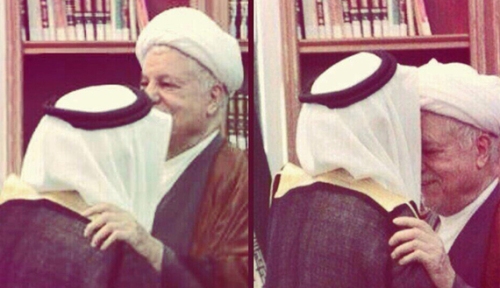
Kiss between Rafsanjani and Saudi ambassador stirs controversy Former Iranian President, Ayatollah Hashemi Rafsanjani (R) exchanges greetings with the new Saudi Arabian ambassador to Iran, Abdulrahman Bin Groman Shahri in Tehran, Al Monitor, April 22, 2014. (photo by Twitter/ISNA)
Appreciation: I am honored to again be invited by my Iranian colleagues in New York, Professors Reza Ghorashi, Hamidah Zangeneh and Hamid Sedghi, to join this panel and discuss the geopolitics of US-Iranian relations. And, my thanks to Prof. Sedghi for reading my paper as I am teaching in Berlin and cannot be with you today. I only ask that those who dislike my message, kindly refrain from shooting the messenger.
Introduction
The US-Iran nuclear confrontation finally appears close to resolution. This is because both Presidents Obama and Rouhani desire a diplomatic solution, and both countries need to move on. With such an agreement, it is possible that relations will slowly become normalized.
Of particular note—as a direct consequence—are the recent secret negotiations between Iran and Saudi Arabia towards a rapprochement. These were initially facilitated by Oman (e.g. see reports here, here, and here). Until very recently the Saudis had remained fiercely opposed to any US deal with Iran. However, the Saudi’s are realists, and know when it is time to adapt. Figure 1. is a photo of kisses exchanged on 22 April between ex-President Rafsanjani of Iran and King Abdullah’s ambassador to Iran, which caused quite a stir in the region. Agreements reached in these recently revealed negotiations have already significantly affected the presidential-succession crisis in Lebanon, sectarian conflicts in Iraq, and the conflict in Yemen. Next the two sides are expected to negotiate regarding their interests in the Syrian conflict.
In addition, the nature of the US-Saudi relationship is changing, transferring much more responsibility on the Kingdom and its Gulf partners for their own defense–albeit strongly supported with US weapons and logistics. This is part of the US disengagement from direct regional interventions, which will be significantly furthered by a successful US-Iran agreement (e.g., see here and here, and this report on Saudi defense buildup from Balfour at Harvard).
How are these new developments to be understood? Continue reading
Posted in Energy and Geopolitics, Energy and Geostrategy, Global Oil Market, Global Oil system, international relations, Iran nuclear, Iran sanctions, Iraq, Iraqi oil, negotiations, Obama, OPEC, P5+1, Persian Gulf, Rouhani, Sanctions, Saudi Arabia, Syria, The USA, U.S. oil, Uncategorized
Tagged Energy, Hassan Rouhani, Iran, Iraq, Middle East, Obama, oil sector, OPEC, Persian Gulf, Saudi, Saudi Arabia, Washington
Note: These “USA Oil Seminar” posts are extra readings for my students to better understand how US energy policy is developed and to hear the views of US experts. The seminar is: “The Global Oil System & US Policy” at JFK Institute of FU-Berlin.
RECOMMENDATIONS:
BACKGROUND: This week, the class reading assignments are a couple conference papers I wrote a few years ago on the history and structure of today’s global oil system, and how it grew to replace the neo-colonial oil system. Continue reading
Posted in China, Energy and Geopolitics, Energy and Geostrategy, Euroepen Union, Gas globalization, Global Oil Market, Global Oil system, international relations, Latin America, LNG, Oil course, Oil prices, Oil supply, OPEC, Persian Gulf, Resource conflicts, Russia, Saudi Arabia, Seminar, shale gas, shale oil, The USA, Tight oil, Trade and Commerce, U.S. oil, unconventional energy
Tagged Bruce Jones, Business and Economy, China, David Pumphrey., David Steven, Energy, Fereidun Fesharaki, Global Oil System, Iran, Iraq, Latin America, Middle East, oil sector, OPEC, Persian Gulf, Saudi, Saudi Arabia, South China Sea, United States, Washington
Globalizing gas market, creating OECD strategic reserves could make embargoes history | By Thomas W. O’Donnell 6May14| Post-war Western Europe was twice the target of energy embargoes, each dramatically altering its energy landscape. A lesson for today is that Europe’s present natural gas dependence on Russia can be addressed with a gas policy like that adopted by the OECD for oil in 1973 – one that launched today’s collective, market centered, and embargo-proof global oil security system.
Russian President Vladimir Putin wrote a letter made public April 10, 2014, warning several EU heads of state that Ukraine must pay its past due gas bill of $2.2 billion or Russian energy giant, Gazprom, “will completely or partially cease gas deliveries” to the country and be “compelled” to insist on payments one month in advance for any future deliveries – including $5 billion to refill Ukraine’s gas reserves before next winter. CONTINUE READING AT: odonnell-addressing_europes_energy_eependence_on_russia_IP_Journal-06may14
Posted in Energy and Geopolitics, Energy and Geostrategy, Euroepen Union, Gas globalization, gas internationalization, Germany, Global Oil Market, Global Oil system, international relations, LNG, Oil supply, OPEC, Putin, Resource conflicts, Russia, Sanctions, Saudi Arabia, shale gas, The USA, Trade and Commerce, Ukraine, unconventional energy
Tagged Business and Economy, Energy, energy landscape, Europe, natural gas, OECD, OPEC, Saudi Arabia, Thomas W. O'Donnell, United States, Washington, Western Europe
Note: I’m teaching a post-graduate course “The Global Oil System & US Policy” at JFK Institute of Freie U. in Berlin. In order to give students a feel for how US energy policy is developed–and to see the views of important US actors–I’m sending them frequent e-mails with supplemental readings and videos from US think tanks, US government offices and from the US media on energy topics.
These are not my own in-depth analysis like I usually post on GlobalBarrel.com. However I think they are worthwhile sharing with especially non-USA followers of my blog. I’ll title these posts “USA OIL” plus a number to label them). I hope these are useful. Here’s today’s ‘optional material’ I sent to my students:
How is US energy policy developed? You might find this video of interest.
Some background: The CSIS (Center for Study of International Security) is a non-partisan (i.e., not Democratic or Republican) think tank in Washington, DC. It performs an important role in US foreign policy. Continue reading
Posted in Energiewende, Energy and Environment, Energy and Geopolitics, Energy and Geostrategy, Euroepen Union, European Union, Germany, Global Oil Market, Global Oil system, international relations, Iran nuclear, Oil course, Persian Gulf, Putin, Russia, Saudi Arabia, Saudi Arabit, The USA, Trade and Commerce, Trade policy, U.S. oil, Ukraine, Uncategorized, unconventional energy
Tagged Beijing, Berlin, China, CSIS, Energy, energy issues, foreign policy, Germany, Iran, JFK Institute of Freie U., Middle East, Obama, oil sector, OPEC, Petróleos de Venezuela, Saudi Arabia, United States, US energy policy, Washington, Zbigniew Brzezinski
During Spring 2014, I’m teaching a post-graduate seminar in Berlin on the USA and the global market-centered oil system (a.k.a.”The Global Barrel”)–the syllabus sketch is below here.
While I’ve often taught seminars on “the Geopolitics of Global Oil,” the JFK Institute at Berlin’s Freie Universität had a special request: they would like their students to learn “how these policies are decided in the USA.”
For an American energy “expert”, the how of the USA’s policy-decision process is fairly familiar. However, not only for German students, but also for most US citizens, this process–whose outcome has such a profound impact on the entire world– indeed seems at best rather opaque, and, at worst, like an unseemly, vested-interest-driven and hopelessly partisan process. Continue reading
Posted in Energy and Environment, Energy and Geopolitics, Energy and Geostrategy, Euroepen Union, Germany, Global Oil Market, Global Oil system, heavy oil, Institutions and rule of law, international relations, Latin America, Oil course, Oil prices, Oil supply, OPEC, Peak Oil, Resource conflicts, Saudi Arabia, Seminar, South China Sea, The USA, Tight oil, Trade and Commerce, Trade policy
Tagged Berlin, Business and Economy, China, Energy, JFK Institute at Berlin, Middle East, oil sector, OPEC, post-graduate seminar, Saudi, Saudi Arabia, United States, Washington
For Spanish speakers: below is an article from Tal Cual daily in Venezuela summarizing my blog on Saudi oil minister al-Naimi’s opinons on the “North American tight-oil revolution” and their implications for Venezuela and Iran. The article is by Jose Suarez Nunez.
Para hispano parlantes: Aquí abajo está un artículo en Español publicado en Tal Cual de Caracas, un resumen de mi blog de la última semana que trató en las opiniones del ministro de energía saudita Sr. al-Naimi, y en las implicaciones para Venezuela e Irán. Continue reading
Posted in Aramco, Chavez lagacy, Faja of the Orinoco, heavy oil, Hugo Chávez, international relations, Iran nuclear, Iran sanctions, Oil prices, Oil supply, PDVSA, Peak Oil, Persian Gulf, Resource conflicts, Saudi Arabia, Saudi Arabit, shale oil, Tight oil, U.S. oil
Tagged Caracas, Iran, Latin America, Naimi, Saudi Arabia, saudi oil, South America, Tight oil, u s energy, Venezuela
Last week in Washington, I attended a talk by Saudi Oil Minister and head of Aramco, Ali al-Naimi, at CSIS. Energy and foreign policy veterans from Daniel Yergin to Brent Scowcroft and Dr. James Schlesinger were on hand to hear al-Naimi’s views. You can read the transcript here, or watch the video embedded below.
Al-Naimi’s contrasted his central theme: “the enduring relevance of oil,” to the predictions made for many years by the adherents of “peak oil”–a theory that he said had itself “peaked in 2009” and has now been shown to be “utterly incorrect.”
Bad News for Venezuela and Iran?
Listening to him describe the global impact that the U.S.A. tight-oil “revolution” will have on the market, plus with Alberta’s heavy oil and so many other new sources from around the globe all coming to market, brought to my mind images of the 1980’s. The 1980’s were the “lost decade” in Latin America. It strikes me that, if he’s right about the trajectory of the global oil sector, the consequences for OPEC’s “price hawk” faction would be sobering. Continue reading
Posted in Aramco, China, Economic Crisis, Energy and Environment, Faja of the Orinoco, heavy oil, international relations, Iran sanctions, Oil prices, Oil supply, OPEC, PDVSA, PDVSA weakness, Peak Oil, Persian Gulf, Resource conflicts, Sanctions, Saudi Arabit, shale oil, The USA, Tight oil, U.S. oil, Venezuelan weak institutions
Tagged Al-Naimi, Ali Al-Naimi, Brent Scowcroft, Daniel Yergin, Saudi, Saudi Arabia, United States, Washington
What are the factors driving up the price of oil? Some cite fundamentals, others over-active speculation,
and there are certainly major geopolitical issues in OPEC‘s Mideast and North African (MENA) member states–which is what this post is about.
The Present Saudi Pumping Surge is a Key Element of the US & EU Iran Sanctions Strategy
It is certain that the Iran confrontation will only intensify as the mid-summer sanctions deadline approaches. By July, Washington and the EU hope to significantly curtail Iran’s ability to export oil. In this situation, it is perhaps surprising that prices have not gone higher.
This past week, the normally understated Economist, while noting the Saudis’ extraordinary efforts to pump excess capacity, nevertheless warned that the Iran crisis could trigger a worst-ever oil shock:
Posted in China, Economic Crisis, Euroepen Union, international relations, Iran nuclear, Iran sanctions, OPEC, Persian Gulf, Resource conflicts, Sanctions, The USA, U.S. oil, Uncategorized
Tagged China, Iran, Middle East, Obama, OPEC, Saudi, Saudi Arabia, United States
In my travels and interviews in Venezuela this summer, it became clear that there has been a major advance in the relationship between China and the Bolivarian administration of President Chavez. China’s dogged persistence and large state-sponsored investments in Venezuela – apparently the largest they’ve made to date in any country – are finally beginning to bear fruit. The new Chinese influence is being simultaneously extended to both oil and non-oil sectors.
Partly this development is due to the many crises affecting the Bolivarian state, and decisions it has been forced to take to make increasing national oil production a priority. To advance this program, President Chavez’ administration has made initial moves to grant Beijing access to Venezuelan oil in major ways it had not previously.
However, there are two sides to this story: on the other side, increasing Chinese participation is also a product of China having step-by-step put some quite sharp demands on PDVSA and the Venezuelan Bolivarian state for financial transparency and accountability, for geopolitical stabilization, and in particular, for Chinese firms being granted large-scale access to new heavy-oil fields in the Faja of the Orinoco River. The key ingredient here is that Continue reading
Northampton, MA (Area of “the five colleges,” UMass Amhers, etc.)
On Thursday, the lead headline story in the WSJ asserted “New Cracks in Oil Cartel: OPEC Fails to Agree on Production Boost Amid Rising Saudi-Iran Tensions.” The “cracks” may have widened at this meeting, but they are hardly “new.” Continue reading
Posted in OPEC
Tagged Ali Al-Naimi, Business and Economy, geopolitics, Iran, MENA, Middle East, Northampton Massachusetts, oil rents, OPEC, Persian Gulf, Qatar, Saudi Arabia, United States, Wall Street Journal