Category Archives: Uncategorized

Wikistrat Report “Saudi Arabia & the Future of Oil” cites my views

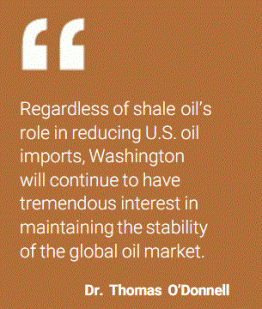
Wikistrat - my quote on US continued interestThis Wikistrat Report on the Saudi kingdom’s “reform” plans and the future of oil is from a press webinar I did on 17 May together with Dr. Ariel Cohen (Atlantic Council, Washington) and Prof. Shaul Mishal (Middle East Division, IDC Herzliya & Tel Aviv U.).  A nicely done report on oil market and geopolitical hot topics.

30May16 note: A couple typos I had found have been fixed by Wikistrat since I initially posted this Report.  The latest version is now linked here. – T.O’D.

I’m quoted by MarketWatch: Five key issues for OPEC’s June meet

Oil ministers of Venezuela, Saudi Arabia & Qatar had agreed in February to freeze output if others did too. AFP/Getty Images

After a Wikistrat Webinar I did, MarketWatch asked me about Saudi & OPEC policy, ond US Shale. Read on here, or at MarketWactch! – Tom O’D.

5 key issues OPEC must wrestle with at its June meeting

Oil output freeze is needed to ‘create a firm price floor’: analyst

The oil market has given members of the Organization of the Petroleum Exporting Countries a reason to crack a cautious smile when they meet June 2 in Vienna.

Signs of a more stable oil market have emerged since the cartel members last held a regularly-scheduled meeting. Oil prices CLN6, +0.04% LCON6, -0.38%  have gained more than 30% so far this year. And both West Texas Intermediate, the U.S. benchmark, and Brent crude, the global benchmark, briefly traded above $50 on Thursday.

Global production is falling following a larger-than-expected weekly decline in crude supplies, according to a report from the American Petroleum Institute late Tuesday. The report comes as the number of active-drilling rigs have been in a steady state of decline and oil-company spending cuts, oil-and-gas sector bankruptcies, and recent outages in Africa and North America, have been supportive for crude prices.

“OPEC members are likely to be a little happier going into June’s meeting than they were in December,” Tom Pugh, commodities economist at Capital Economics, said in recent research note.

Oil prices have “surged by about a third since the start of the year,” he said. The “higher prices will have removed some of the pressure on [OPEC] to act to prop up prices.”

But that doesn’t mean major oil producers can sit back and relax when they get together. Oil market supply and demand haven’t fully stabilized and there a lot of factors than can, and probably will, rock OPEC’s boat.

Here’s a rundown of what analysts see as the key issues at hand and possible outcomes for the OPEC summit: Continue reading


Falling oil price & Saudi strategy: My Sky News interview (London)

Here’s my live interview recently on Sky News – the all-news UK channel. It just went up.

Here’s the gist: Years-long high prices brought the US shale revolution and other new higher-cost oil online like offshore of Brazil and Africa. This glut was already dropping prices when the Saudi’s decided in November 2014 that OPEC alone could not cut enough production to reverse the slide. So what to do if Russia and Mexico won’t join an OPEC cut? Continue reading

My AQ piece: “Russia Is Beating China to Venezuela’s Oil Fields”

map_aq_russia-pdvsa_oil_a

Russian Production & Stakes in Venezuelan Oil Projects (40% stake is limit)

Last October & November I succeeded in interviewing several people in the Venezuelan private sector directly knowledgeable of Russian oil projects with PDVSA. Many Venezuelans wonder what all the Russians-known for their secrecy-are up to there.  Some of my key findings are in Americas Quarterly‘s Winter 2016 edition. Read on … 

Russia Is Beating China to Venezuela’s Oil Fields – By THOMAS W. O’DONNELL

The profits, politics and luck behind Russia’s growing footprint.

Russian companies produce more oil in joint projects with PDVSA than their Chinese counterparts This article is adapted from our 1st print issue of 2016. 

The late Venezuelan President Hugo Chávez, had long envisioned China becoming Venezuela’s biggest oil-sector production partner. So when Rafael Ramírez, then president of Petróleos de Venezuela, S.A. (PDVSA), announced in January 2013 that Russia would produce enough oil with PDVSA by 2021 to become “the biggest petroleum partner of our country,” very few people believed him. It sounded like empty hype.

Yet it turns out that Ramírez was serious. Three years later, Russian companies are already producing more oil in joint projects with PDVSA than their Chinese counterparts. Official figures are either unreliable or unavailable, but according to field data provided by Global Business Consultants (GBC), a Caracas-based energy consulting firm, Russia-Venezuela production as of late 2015 was 209,000 barrels per day (bpd), compared to China-Venezuela’s at a bit over 171,000 bpd.

Continue reading

“The Road to Paris: COP21 …” Berlin HEEN Conference

heen_logoCOP21 begins soon in Paris.  A very interesting discussion of the issues, with diplomats from EU states and China, takes place tomorrow, Friday evening, at Hertie School of Governance in Berlin to open the Hertie Energy & Environmental Network’s (HEEN) conference. I’ll be moderating the session. The session is open to those interested. Read on:
Opening remarks by German Undersecretary of State, ret. Rolf-Dieter Schnelle, fellows & friends of the Hertie Foundation

Panelists:
• Philippe Etienne, Ambassador of France to Germany
• Friis Arne Petersen, Ambassador of Denmark to Germany
• Wang Tianling, Counsellor, Embassy of the People’s Republic of China in Berlin
• Iwona Jakuszko-Dudka, First Secretary to the Embassy of Poland to Germany
• Dr. Jan Minx, Professor for Science Policy and Sustainable Development, Hertie School of Governance, Head of Working Group on Applied Sustainability Science, Mercator Research Institute on Global Commons and Climate Change

• Moderation by Dr. Thomas O’Donnell, Hertie School of Governance

Please register until 25 November 2015 via the following link https://docs.google.com/f

Background

In December 2015, the COP 21 climate conference in Paris will bring together world leaders, scientists, pressure groups and United Nations agencies, with the task to craft an agreement at the highest political level to tackle global warming. The representatives from 196 countries must reach an agreement to replace the Kyoto protocol. The COP 15 summit in Copenhagen (2009) is remembered more for the difficulty of reaching a global consensus than for tangible progress.

What will the legacy of COP 21 in Paris be?

  •  Is putting a price on carbon worldwide politically feasible?
  •  Is the gap between the cost of energy produced from fossil fuels and energy produced from renewable energy sources narrowing as much as to be a game-changer?
  •  How would policy proposals that raise the cost of energy go down with national leaders from the developing world, under pressure to deliver standard-of-living improvements?
  •  How will Intended Nationally Determined Contributions (INDC) impact the negotiations?
  •  How will China’s early pledge to peak emissions ahead of 2030, and the USA’s commitment to deep reductions by 2025 shape what is globally possible?
  •  Will the European Commission get a critical mass of support for the Paris Protocol?
  •  Will all parties arrive at an robust enough agreement?
  •  What is the future of the Green Climate Fund?
  •  How will the financing volume necessary to keep global warming below 2 degrees be secured?

Speakers will provide their take on the above, and engage in a lively and dynamic discussion with the audience about the major challenges which will be tackled at the COP 21 in Paris in December 2015.

The Hertie Energy and Environment Network (HEEN) is an established platform bringing together fellows of the Gemeinnützige Hertie-Stiftung with professional experience in the field of Energy and Environment (E&E) in the public, private, academic or civil society sector. HEEN’s purpose is to facilitate dialogue, knowledge-sharing and learning, to provide a trust-based environment for career path reflection, and to facilitate the development of lasting professional connections among outstanding individuals of diverse backgrounds who share a common interest and motivation for further professional development in the E&E field.

cop21_logo

“US Expert Perspectives on German Energy Vulnerabilities” – My AICGS/Washington Project

merkel_putin_dw_17481033

German Chancellor Merkel listens to Russian President Putin [Photo: dw.de 29.4.14]

Throughout April and May I’m researching US Expert Perspectives on German [and EU] Energy Vulnerabilities – as a visiting fellow of the American Institute for Contemporary German Studies (AICGS) in Washington, DC, funded by the German DAAD.  You can read the proposal below.  But, first, I’d like to ask Global Barrel readers for two things:

(1) Is there anyone you feel I should interview here in Washington–the idea is to interview US energy experts, government officials and business people?

(2) What is your opinion of German and EU energy policies and their geopolitical implications. This includes issues ranging from German/EU dependence on Russian gas, the Ukraine and Turkey as gas-transit states, the new European “Energy Union,”  the German Energiewende, and moreno matter on which side of the Atlantic you live. 

[I’ve deleted the names of people I propose to interview, as not all will agree to have their remarks made public. I’m happy to keep opinions private and use them in general summaries of my findings.]

Paralyzed on Economic Reforms, Venezuela Will Mortgage Citgo [My Americas Quarterly analysis]

listverse.com-28jan15-178789073

Photo:: Listverse.com

[My post at Americas Quarterly, 5 Feb 2015]  Since before the death of Venezuelan President Hugo Chávez in March 2013, his successor, Nicolás Maduro, has remained paralyzed to enact reforms needed to escape the economic dysfunction Chávez left behind.

In his latest national address on the economy on January 21, Maduro finally acknowledged the recession and shortages faced by Venezuelan citizens. Yet, he failed again to clearly implement any of the pragmatic economic reforms[1] advocated by Rafael Ramírez, the former minister of energy and former president of Petróleos de Venezuela, S.A. (Petroleum of Venezuela—PDVSA)— such as a de facto bolívar-to-dollar devaluation via unification of Venezuela’s multi-tier foreign exchange (FX) system, measures to attract more foreign financing for oil production, and removing internal price controls, especially for gasoline.  Meanwhile, in September 2014, Ramírez was demoted to foreign minister, and then to UN ambassador several months later.

According to insiders, Maduro’s failure to implement pragmatic reforms stems principally from two sources.
Continue reading

[Spanish] Mi opinión en Petroquía: China se involucra en los principales proyectos de América Latina

Here’s my piece [in Spanish] in Petroguía 2015, the oil-&-gas sector catalog for Latin America  Note: Hemispheric integration (e.g., energy infrastructure) was endlessly promoted by Hugo Chavez.  In the end, he built none. The region’s resources continue going mainly to develop other regions, such as China. Continue reading

Watch: Falling Oil Price & Geopolitics – Saudis & OPEC, Russia, USA, .. | My Real News Network interview

A wide-ranging interview on the “perfect storm” of low prices from low demand plus rising production, the Saudi market strategy and some geopolitical implications.

“Venezuela: Petroleum, Politics & Economics in the Post-Chavez Era”–My Columbia U. talk, with Luiz Pinto, 9 October

If you’re in New York:  Luiz Pinto and I speak at Columbia University’s Institute for Latin American Studies (ILAS) on post-Chavez Venezuela, 12-noon, Thursday, 9 October: ilas_venezuela_columbia_talk_09oct14

“Oil & the US-Iran Crisis” – My talk at American University, Washington DC:

If you are in Washington, DC, this historical overview of the US-Iran Crisis and the role of oil might be of interest:
american_u_iran_talk_01oct14JPG

My talk on Iran, NYC | After an Iran-USA deal: A Mideast without democracy, run by Iran & Saudi Arabia?

Figure 1.  Ayatollah Hashemi Rafsanjani (R) exchanges greetings with the new Saudi Arabian ambassador to Iran, Abdulrahman Bin Groman Shahri in Tehran, April 22, 2014. (photo by Twitter/ISNA)    Read more: http://www.al-monitor.com/pulse/originals/2014/04/rafsanjani-saudi-ambassador-kiss-controversy.html#ixzz32ktJuoKR

Kiss between Rafsanjani and Saudi ambassador stirs controversy   Former Iranian President, Ayatollah Hashemi Rafsanjani (R) exchanges greetings with the new Saudi Arabian ambassador to Iran, Abdulrahman Bin Groman Shahri in Tehran, Al Monitor, April 22, 2014. (photo by Twitter/ISNA)

Appreciation: I am honored to again be invited by my Iranian colleagues in New York, Professors Reza Ghorashi, Hamidah Zangeneh and Hamid Sedghi, to join this panel and discuss the geopolitics of US-Iranian relations.  And, my thanks to Prof. Sedghi for reading my paper as I am teaching in Berlin and cannot be with you today. I only ask that those who dislike my message, kindly refrain from shooting the messenger.

Introduction

The US-Iran nuclear confrontation finally appears close to resolution.  This is because both Presidents Obama and Rouhani desire a diplomatic solution, and both countries need to move on. With such an agreement, it is possible that relations will slowly become normalized.

Of particular note—as a direct consequence—are the recent secret negotiations between Iran and Saudi Arabia towards a rapprochement.  These were initially facilitated by Oman (e.g. see reports here, here, and here). Until very recently the Saudis had remained fiercely opposed to any US deal with Iran.  However, the Saudi’s are realists, and know when it is time to adapt.  Figure 1. is a photo of kisses exchanged on 22 April between ex-President Rafsanjani of Iran and King Abdullah’s ambassador to Iran, which caused quite a stir in the region. Agreements reached in these recently revealed negotiations have already significantly affected the presidential-succession crisis in Lebanon, sectarian conflicts in Iraq, and the conflict in Yemen. Next the two sides are expected to negotiate regarding their interests in the Syrian conflict.

In addition, the nature of the US-Saudi relationship is changing, transferring much more responsibility on the Kingdom and its Gulf partners for their own defense–albeit strongly supported with US weapons and logistics. This is part of the US disengagement from direct regional interventions, which will be significantly furthered by a successful US-Iran agreement (e.g., see here and here, and this report on Saudi defense buildup from Balfour at Harvard).

How are these new developments to be understood? Continue reading

USA Oil 3.0 | US energy experts on Europe, Russia & Ukraine

Note: I’m teaching a post-graduate course “The Global Oil System & US Policy” at JFK Institute of Freie U. in Berlin. In order to give students a feel for how US energy policy is developed–and to see the views of important US actors–I’m sending them frequent e-mails with supplemental readings and videos  from US think tanks, US government offices and from the US media on energy topics.

These are not my own in-depth analysis like I usually post on GlobalBarrel.com.  However I think they are worthwhile sharing with especially non-USA followers of my blog.  I’ll title these posts “USA OIL” plus a number to label them).  I hope these are useful.  Here’s today’s ‘optional material’ I sent to my students:

How is US energy policy developed? You might find this video of interest.

Some background: The CSIS (Center for Study of International Security) is a non-partisan (i.e., not Democratic or Republican) think tank in Washington, DC. It performs an important role in US foreign policy. Continue reading

My AQ piece: Maduro’s Conundrum as UNASUR Starts Venezuelan Peace Talks

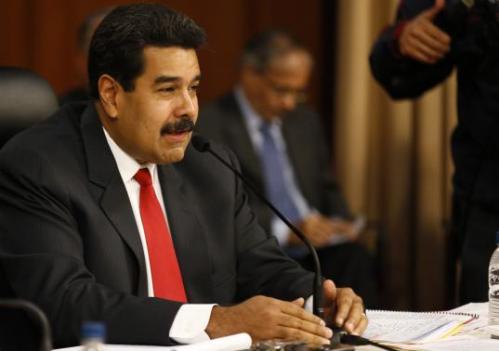
Venezuela Pres. Nicolas Maduro during first UNASUR-and-Vatican mediated peace talk with opposition in Caracas 10 April (Reuters)

Venezuelan President Nicolas Maduro speaking during the first UNASUR-and-Vatican mediated peace talks with the opposition in Caracas 10 April (Reuters)

Here’s my commentary at Americas Quarterly today, 11 April:

A delegation of foreign ministers from the Union of South American Nations (UNASUR) returned to Caracas on April 7 and 8, securing an agreement to hold peace talks to calm political polarization and protests in Venezuela.  The talks are being mediated by the foreign ministers of Colombia, Brazil and Ecuador, plus a Vatican representative.

The UNASUR delegation first visited in late March, recommending that Venezuelan President Nicolás Maduro and leaders of the opposition’s Mesa de Unidad Democrática (MUD) enter into a dialogue.  The U.S. State Department had expressed support, as had Organization of American States (OAS) General Secretary José Miguel Insulza.

However, UNASUR’s plan will be complicated by Maduro’s reliance on paramilitaries within his Partido Socialista Unido de Venezuela (United Socialist Party of Venezuela—PSUV), whose loyalty requires his polarizing words and deeds. This conundrum already wrecked a previous dialogue.

In early February, before protests broke out, a highly placed government official explained to me,  …  CLICK to Continue Reading at Americas Quarterly. Continue reading

Venezuelan state’s economic response to protests: Rationing plus Chinese and Russian loans to float a liberal dollar market

The anti-government protest in eastern Caracas 13 March ended in clashes with Venezuelan police BBC
The anti-government protest in eastern Caracas 13 March ended in clashes with Venezuelan police. Three more died in widespread protests. BBC

As protests continue against Venezuela’s faltering “oil revolution,” the political strategy of the chavista administration is striking for its intransigence. President Maduro has refused to recognize any grievances by students or other protesters. He calls protesters “fascists” and blames them for all the ills of the economy.  Protests are attacked by the national guard and often by state-organized paramilitary gangs on motorcycles who are praised by the president.

The administration’s strategy so far appears to be that protests will burn themselves out if they can be delegitimized and contained within middle-class areas.  Accordingly, the president’s rhetoric aims at inciting poorer citizens against protesters.  All in all, this is a risky strategy.  Protests have constantly intensified, with perhaps 25 persons dead now.
After a month of protests, the administration has taken urgent economic measures it hopes will undermine the protests and prevent their spread to poor and working-class barrios.
1. Ramirez announces Chinese and Russian loans and the launch of a very liberal Sicad 2