Category Archives: Saudi Arabia

“Oil & the US-Iran Crisis” – My talk at American University, Washington DC:

If you are in Washington, DC, this historical overview of the US-Iran Crisis and the role of oil might be of interest:
american_u_iran_talk_01oct14JPG

My talk on Iran, NYC | After an Iran-USA deal: A Mideast without democracy, run by Iran & Saudi Arabia?

Figure 1.  Ayatollah Hashemi Rafsanjani (R) exchanges greetings with the new Saudi Arabian ambassador to Iran, Abdulrahman Bin Groman Shahri in Tehran, April 22, 2014. (photo by Twitter/ISNA)    Read more: http://www.al-monitor.com/pulse/originals/2014/04/rafsanjani-saudi-ambassador-kiss-controversy.html#ixzz32ktJuoKR

Kiss between Rafsanjani and Saudi ambassador stirs controversy   Former Iranian President, Ayatollah Hashemi Rafsanjani (R) exchanges greetings with the new Saudi Arabian ambassador to Iran, Abdulrahman Bin Groman Shahri in Tehran, Al Monitor, April 22, 2014. (photo by Twitter/ISNA)

Appreciation: I am honored to again be invited by my Iranian colleagues in New York, Professors Reza Ghorashi, Hamidah Zangeneh and Hamid Sedghi, to join this panel and discuss the geopolitics of US-Iranian relations.  And, my thanks to Prof. Sedghi for reading my paper as I am teaching in Berlin and cannot be with you today. I only ask that those who dislike my message, kindly refrain from shooting the messenger.

Introduction

The US-Iran nuclear confrontation finally appears close to resolution.  This is because both Presidents Obama and Rouhani desire a diplomatic solution, and both countries need to move on. With such an agreement, it is possible that relations will slowly become normalized.

Of particular note—as a direct consequence—are the recent secret negotiations between Iran and Saudi Arabia towards a rapprochement.  These were initially facilitated by Oman (e.g. see reports here, here, and here). Until very recently the Saudis had remained fiercely opposed to any US deal with Iran.  However, the Saudi’s are realists, and know when it is time to adapt.  Figure 1. is a photo of kisses exchanged on 22 April between ex-President Rafsanjani of Iran and King Abdullah’s ambassador to Iran, which caused quite a stir in the region. Agreements reached in these recently revealed negotiations have already significantly affected the presidential-succession crisis in Lebanon, sectarian conflicts in Iraq, and the conflict in Yemen. Next the two sides are expected to negotiate regarding their interests in the Syrian conflict.

In addition, the nature of the US-Saudi relationship is changing, transferring much more responsibility on the Kingdom and its Gulf partners for their own defense–albeit strongly supported with US weapons and logistics. This is part of the US disengagement from direct regional interventions, which will be significantly furthered by a successful US-Iran agreement (e.g., see here and here, and this report on Saudi defense buildup from Balfour at Harvard).

How are these new developments to be understood? Continue reading

USA Oil Seminar 5.0 | USA as Rising Energy Superpower?

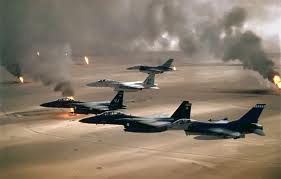
us_air_force_jets_oil_buring_iraqNote: These “USA Oil Seminar” posts are extra readings for my students to better understand how US energy policy is developed and to hear the views of US experts.  The seminar is: “The Global Oil System & US Policy” at JFK Institute of FU-Berlin. 

RECOMMENDATIONS:

  1. This Friday, watch live (or the recording later on): Is the U.S. a Rising Energy Superpower? Implications for Global Markets and Asia, the Middle East, Russia, and Europe.  CSIS upcoming talk by Fereidun Fesharaki.  FRIDAY, MAY 16, 2014 | 10:00 AM – 11:30 AM .  Moderated by David Pumphrey.
  2. Read the paper: Fueling a New Order? The New Geopolitical and Security Consequences of Energy |April 15, 2014. By: Bruce Jones, David Steven and Emily O’Brien.  Brookings Institute; Washington, DC.

BACKGROUND:  This week, the class reading assignments are a couple conference papers I wrote a few years ago on the history and structure of today’s global oil system, and how it grew to replace the neo-colonial oil system. Continue reading

My IP Journal article | Addressing Europe’s Energy Dependence on Russia: Gas globalization?

 25371_460x259Globalizing gas market, creating OECD strategic reserves could make embargoes history | By Thomas W. O’Donnell  6May14| Post-war Western Europe was twice the target of energy embargoes, each dramatically altering its energy landscape. A lesson for today is that Europe’s present natural gas dependence on Russia can be addressed with a gas policy like that adopted by the OECD for oil in 1973 – one that launched today’s collective, market centered, and embargo-proof global oil security system.

Russian President Vladimir Putin wrote a letter made public April 10, 2014, warning several EU heads of state that Ukraine must pay its past due gas bill of $2.2 billion or Russian energy giant, Gazprom, “will completely or partially cease gas deliveries” to the country and be “compelled” to insist on payments one month in advance for any future deliveries – including $5 billion to refill Ukraine’s gas reserves before next winter.  CONTINUE READING AT:  odonnell-addressing_europes_energy_eependence_on_russia_IP_Journal-06may14


USA Oil 3.0 | US energy experts on Europe, Russia & Ukraine

Note: I’m teaching a post-graduate course “The Global Oil System & US Policy” at JFK Institute of Freie U. in Berlin. In order to give students a feel for how US energy policy is developed–and to see the views of important US actors–I’m sending them frequent e-mails with supplemental readings and videos  from US think tanks, US government offices and from the US media on energy topics.

These are not my own in-depth analysis like I usually post on GlobalBarrel.com.  However I think they are worthwhile sharing with especially non-USA followers of my blog.  I’ll title these posts “USA OIL” plus a number to label them).  I hope these are useful.  Here’s today’s ‘optional material’ I sent to my students:

How is US energy policy developed? You might find this video of interest.

Some background: The CSIS (Center for Study of International Security) is a non-partisan (i.e., not Democratic or Republican) think tank in Washington, DC. It performs an important role in US foreign policy. Continue reading

A new syllabus: The USA & the global oil system: The formation of American energy policy

global_barrel_graphic_twodDuring Spring 2014, I’m teaching a post-graduate seminar in Berlin  on the USA and  the global market-centered oil system (a.k.a.”The Global Barrel”)–the syllabus sketch is below here.

While I’ve often taught seminars on “the Geopolitics of Global Oil,” the JFK Institute at Berlin’s Freie Universität had a special request: they would like their students to learn “how these policies are decided in the USA.”

For an American energy “expert”, the how of the USA’s policy-decision process is fairly familiar. However, not only for German students, but also for most US citizens, this process–whose outcome has such a profound impact on the entire world– indeed seems at best rather opaque, and, at worst, like an unseemly, vested-interest-driven and hopelessly partisan process. Continue reading

For Obama, an Iran deal trumped Syrian aid: USA “core interests” are in “flow of energy”

Geneva negotiations between P5+1 and Iran in early November (Reuters)

Geneva negotiations between P5+1 and Iran in early November (Reuters)

In September, President Obama came under withering criticism in Washington for not punishing Assad after crossing his “red line” on chemical weapons.  By October, even Riyadh had joined those in the State Department, the White House and Congress who, according to US press reports, saw Mr. Obama as “aloof” and “indecisive” on Syria.

While Mr. Obama’s refusal to arm the more democratic and secular rebel forces has indeed permitted Assad to retrench–increasing the humanitarian disaster as well as the ability of jihadi forces to insinuate themselves into the conflict– nonetheless, imagining this is due to presidential indecision ignores the realpolitik driving his policy.

Why Has Obama Not Forcefully Supported Syrian Rebels? The Iran Factor

Consider first: What if forceful US action in Syria had scuttled any talks with Iran, or, for that matter, if the present negotiations in Geneva between the P5+1 and Iran end up in failure? Continue reading

DW in Spanish || Obama y Rouhani: ¿Llegarán a un acuerdo nuclear/petrolífero?

ObamaRouhani-usip

[Note: This post on the Iran crisis is in Spanish, consisting of my written answers to the host of “Agenda” on the Deutsche Welle network–the German international TV service.] 

Hoy mi blog es en Español. Trata de la crisis nuclear entre Iran y los EEUU. Aquí abajo están mis respuestas que escribí a las preguntas del entrevistador de el programa ‘Agenda’ en Deutsche Welle, la red internacional de televisión de Alemania (con algo explicaciones adicionales).

Pregunta: Irán quiere poner en marcha las negociaciones con grandes potencias por el tema nuclear, porque creé usted que lo hace ahora?  En qué términos?

Repuesta: Pues, permítame explicarle las razones por las cuales ambos lados ahora quieren reiniciar negociaciones:

(a) Para el gobierno de los EEUU Continue reading

My talk: JFK Institute, Berlin: How “The Global Barrel” shapes Washington-EU relations

You’re invited to my lecture at The JFK Institute of North American Studies at Freie Universität in Berlin, Germany, Tuesday 6 PM. Here is the flyer, then the Abstract.  Tschüß!

ABSTRACT:

“The Global Barrel”

Today’s globalized market-centered energy system defines Washington’s relations with the EU, Japan and OPEC states Continue reading

En Espanol: Venezuela’s “Tal Cual” on my al-Naimi post

For Spanish speakers: below is an article from Tal Cual daily in Venezuela summarizing my blog on Saudi oil minister al-Naimi’s opinons on the “North American tight-oil revolution” and their implications for Venezuela and Iran.  The article is by Jose Suarez Nunez.

Para hispano parlantes: Aquí abajo está un artículo en Español publicado en Tal Cual de Caracas, un resumen de mi blog de la última semana que trató en las opiniones del ministro de energía saudita Sr. al-Naimi, y en las implicaciones para Venezuela e Irán. Continue reading