Category Archives: Iran nuclear

Wikistrat Report “Saudi Arabia & the Future of Oil” cites my views

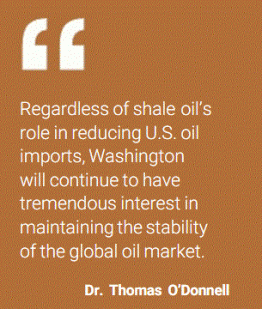
Wikistrat - my quote on US continued interestThis Wikistrat Report on the Saudi kingdom’s “reform” plans and the future of oil is from a press webinar I did on 17 May together with Dr. Ariel Cohen (Atlantic Council, Washington) and Prof. Shaul Mishal (Middle East Division, IDC Herzliya & Tel Aviv U.).  A nicely done report on oil market and geopolitical hot topics.

30May16 note: A couple typos I had found have been fixed by Wikistrat since I initially posted this Report.  The latest version is now linked here. – T.O’D.

The EU-US “Oil Weapon”: Putin’s overtures to OPEC, China & Iran reveal desperation

Foto: Presidents Rouhani of Iran and Putin of Russia holding discussions Presidents Rouhani of Iran and Putin of Russia holding discussions

(AICGS Analysis, by Tom O’Donnell)  Since Russia’s president, Vladimir Putin, decided to annex Crimea and back east Ukrainian separatists with troops, many have worried he might use his “energy weapon” to counter U.S.-EU sanctions, as Russia supplies around a third of the EU’s natural gas imports.  But what about Russian retaliation in the oil sector?

That’s hard to imagine. While gas is marketed in bi-lateral, pipeline-mediated relationships, oil is not. It’s liquid, fungible, and marketed in a unified open market—“the global barrel” [and name of this blog, T.O’D.]—which means there are no bi-lateral oil dependencies.

So, when EU leaders were cajoled by Germany’s Angela Merkel into joining the United States in applying sanctions, Russia could do little to retaliate from within the oil sector.  In reality, it is the EU and the U.S., not Russia, that have an “oil weapon” in hand.  And, the flurry of Russian oil diplomacy with OPEC, Iran and China over the past couple of weeks has a distinct whiff of desperation to it. Continue reading

The P5+1–Iran Deal: Obama’s Initial Challenge was to Rally EU-3 Allies to the Cause

Iran-negotiations-pic

EU Foreign Affairs Representative. Federica Mogherini, and Iranian Foreign Minister, Mohammad Javad Zarif, announce the P5+1 deal with Iran. 3 April 2015

On April 3, the High Representative of the European Union for Foreign Affairs, Federica Mogherini, together with Iran’s Foreign Minister Mohammad Javad Zarif announced a framework agreement significantly limiting Iran’s future nuclear program.

Clearly, this deal was only possible with the patient collaboration of the British, French, German, and EU foreign ministers and U.S. secretaries of state. However, this common front was only forged through a multiple-step process orchestrated by Mr. Obama, beginning when he took office.  Continue reading

Oil Price Collaterals: Saudi strategy shakes Russia, Iran & Venezuela, but they’re not targets

Obama and Saudi King in Saudi Arabia after the death of previous king

Falling oil prices are not a US-EU-Saudi plot against Russia, Iran and Venezuela… though their effect is certainly not unwelcomed..Foto: REUTERS/Jim Bourg


[Printed in IP Journal, German Council on Foreign Affairs] Pin-pointing the reason for the dramatic – and continuing – fall in the price of oil is relatively easy: OPEC held its 166th conference in late-November 2014 to decide on a strategy to address oil prices, which had been falling at five to ten percent per month since July. Rather than pursue a production cut

Continue reading

“Oil & the US-Iran Crisis” – My talk at American University, Washington DC:

If you are in Washington, DC, this historical overview of the US-Iran Crisis and the role of oil might be of interest:
american_u_iran_talk_01oct14JPG

My IP Journal latest: “A firm US-EU partnership on Iran came at great cost, and made a deal possible”

EU and Iranian foreign ministers (foto: Austrian Foreign Ministry)

EU and Iranian foreign ministers in Vienna (Austrian Foreign Ministry)

My latest at the IP Journal of the German Council on Foreign Relations (DGAP)US-EU Cooperate on Iranian Nonproliferation:  Agreement positions Tehran as regional leader — IP Journal 14/08/2014 

Although negotiators failed to reach agreement on Iran’s nuclear program by the late-July deadline set last November, as Iran’s Foreign Minister Mohammad Javad Zarif put it: “We have made enough headway to be able to tell our political bosses that this is a process worth continuing. … I am sure Secretary Kerry will make the same recommendation.” Indeed, Washington, Brussels, and Tehran readily agreed on a four-month extension.

This represents a sea change in tone from the period prior to November 2013, Continue reading

My talk on Iran, NYC | After an Iran-USA deal: A Mideast without democracy, run by Iran & Saudi Arabia?

Figure 1.  Ayatollah Hashemi Rafsanjani (R) exchanges greetings with the new Saudi Arabian ambassador to Iran, Abdulrahman Bin Groman Shahri in Tehran, April 22, 2014. (photo by Twitter/ISNA)    Read more: http://www.al-monitor.com/pulse/originals/2014/04/rafsanjani-saudi-ambassador-kiss-controversy.html#ixzz32ktJuoKR

Kiss between Rafsanjani and Saudi ambassador stirs controversy   Former Iranian President, Ayatollah Hashemi Rafsanjani (R) exchanges greetings with the new Saudi Arabian ambassador to Iran, Abdulrahman Bin Groman Shahri in Tehran, Al Monitor, April 22, 2014. (photo by Twitter/ISNA)

Appreciation: I am honored to again be invited by my Iranian colleagues in New York, Professors Reza Ghorashi, Hamidah Zangeneh and Hamid Sedghi, to join this panel and discuss the geopolitics of US-Iranian relations.  And, my thanks to Prof. Sedghi for reading my paper as I am teaching in Berlin and cannot be with you today. I only ask that those who dislike my message, kindly refrain from shooting the messenger.

Introduction

The US-Iran nuclear confrontation finally appears close to resolution.  This is because both Presidents Obama and Rouhani desire a diplomatic solution, and both countries need to move on. With such an agreement, it is possible that relations will slowly become normalized.

Of particular note—as a direct consequence—are the recent secret negotiations between Iran and Saudi Arabia towards a rapprochement.  These were initially facilitated by Oman (e.g. see reports here, here, and here). Until very recently the Saudis had remained fiercely opposed to any US deal with Iran.  However, the Saudi’s are realists, and know when it is time to adapt.  Figure 1. is a photo of kisses exchanged on 22 April between ex-President Rafsanjani of Iran and King Abdullah’s ambassador to Iran, which caused quite a stir in the region. Agreements reached in these recently revealed negotiations have already significantly affected the presidential-succession crisis in Lebanon, sectarian conflicts in Iraq, and the conflict in Yemen. Next the two sides are expected to negotiate regarding their interests in the Syrian conflict.

In addition, the nature of the US-Saudi relationship is changing, transferring much more responsibility on the Kingdom and its Gulf partners for their own defense–albeit strongly supported with US weapons and logistics. This is part of the US disengagement from direct regional interventions, which will be significantly furthered by a successful US-Iran agreement (e.g., see here and here, and this report on Saudi defense buildup from Balfour at Harvard).

How are these new developments to be understood? Continue reading

USA Oil 3.0 | US energy experts on Europe, Russia & Ukraine

Note: I’m teaching a post-graduate course “The Global Oil System & US Policy” at JFK Institute of Freie U. in Berlin. In order to give students a feel for how US energy policy is developed–and to see the views of important US actors–I’m sending them frequent e-mails with supplemental readings and videos  from US think tanks, US government offices and from the US media on energy topics.

These are not my own in-depth analysis like I usually post on GlobalBarrel.com.  However I think they are worthwhile sharing with especially non-USA followers of my blog.  I’ll title these posts “USA OIL” plus a number to label them).  I hope these are useful.  Here’s today’s ‘optional material’ I sent to my students:

How is US energy policy developed? You might find this video of interest.

Some background: The CSIS (Center for Study of International Security) is a non-partisan (i.e., not Democratic or Republican) think tank in Washington, DC. It performs an important role in US foreign policy. Continue reading

For Obama, an Iran deal trumped Syrian aid: USA “core interests” are in “flow of energy”

Geneva negotiations between P5+1 and Iran in early November (Reuters)

Geneva negotiations between P5+1 and Iran in early November (Reuters)

In September, President Obama came under withering criticism in Washington for not punishing Assad after crossing his “red line” on chemical weapons.  By October, even Riyadh had joined those in the State Department, the White House and Congress who, according to US press reports, saw Mr. Obama as “aloof” and “indecisive” on Syria.

While Mr. Obama’s refusal to arm the more democratic and secular rebel forces has indeed permitted Assad to retrench–increasing the humanitarian disaster as well as the ability of jihadi forces to insinuate themselves into the conflict– nonetheless, imagining this is due to presidential indecision ignores the realpolitik driving his policy.

Why Has Obama Not Forcefully Supported Syrian Rebels? The Iran Factor

Consider first: What if forceful US action in Syria had scuttled any talks with Iran, or, for that matter, if the present negotiations in Geneva between the P5+1 and Iran end up in failure? Continue reading

DW in Spanish || Obama y Rouhani: ¿Llegarán a un acuerdo nuclear/petrolífero?

ObamaRouhani-usip

[Note: This post on the Iran crisis is in Spanish, consisting of my written answers to the host of “Agenda” on the Deutsche Welle network–the German international TV service.] 

Hoy mi blog es en Español. Trata de la crisis nuclear entre Iran y los EEUU. Aquí abajo están mis respuestas que escribí a las preguntas del entrevistador de el programa ‘Agenda’ en Deutsche Welle, la red internacional de televisión de Alemania (con algo explicaciones adicionales).

Pregunta: Irán quiere poner en marcha las negociaciones con grandes potencias por el tema nuclear, porque creé usted que lo hace ahora?  En qué términos?

Repuesta: Pues, permítame explicarle las razones por las cuales ambos lados ahora quieren reiniciar negociaciones:

(a) Para el gobierno de los EEUU Continue reading

Can Obama & Rouhani End Iranian Nukes+Oil Crisis? – My Beijing press interviews in “Sanlian Lifeweek”

August 3, Iran's Supreme Leader Ayatollah Ali Khamenei (third left) gives letter of appointment to new president Rohani (third right). by: Sanlian Life, Beijing

August 3, Iran’s Supreme Leader Ayatollah Ali Khamenei (third left) gives letter of appointment to new president Rohani (third right). by: Sanlian Life, Beijing

What does H. Rouhani’s  election mean for the Iran nuclear crisis?  What separates the US and Iran in negotiations? What’s the role of oil?

The Beijing-based weekly, SanLian Lifeweek, interviewed me several times in recent months on the US-Iran crisis (also on Iranian-Egyptian relations, the South China Sea disputes, and Russia’s trade surge in Latin America).   Below are their three articles on US-Iran relations quoting me and other experts.  Since these are in Chinese (my name O’Donnell appears as “奥唐奈”), I’m including my written English answers to their questions.

(1a) Chinese:  “Iran’s new president: US-Iran talks turnaround and challenges” P20-21观察 3 August 2013

(1b) My English answers (full text):

Q (Sanlian Lifeweek): When election has just ended, many assumed that Rohani’s win will possibly bring a breakthrough in Iran-U.S. relations. Recently, with him showing the intention of appointing Mohammed Javad Zarif, who many of us know well from his days in New York as the Iranian ambassador to the United Nations, as the new foreign minister, some believe that US-Iranian negotiation is now realistic for the first time in many years.

Do you agree with this comment? If not, what kind of difficulties do you think Rohani will be facing domestically in seeking moderate U.S. policies? Continue reading

My talk: JFK Institute, Berlin: How “The Global Barrel” shapes Washington-EU relations

You’re invited to my lecture at The JFK Institute of North American Studies at Freie Universität in Berlin, Germany, Tuesday 6 PM. Here is the flyer, then the Abstract.  Tschüß!

ABSTRACT:

“The Global Barrel”

Today’s globalized market-centered energy system defines Washington’s relations with the EU, Japan and OPEC states Continue reading

En Espanol: Venezuela’s “Tal Cual” on my al-Naimi post

For Spanish speakers: below is an article from Tal Cual daily in Venezuela summarizing my blog on Saudi oil minister al-Naimi’s opinons on the “North American tight-oil revolution” and their implications for Venezuela and Iran.  The article is by Jose Suarez Nunez.

Para hispano parlantes: Aquí abajo está un artículo en Español publicado en Tal Cual de Caracas, un resumen de mi blog de la última semana que trató en las opiniones del ministro de energía saudita Sr. al-Naimi, y en las implicaciones para Venezuela e Irán. Continue reading

Did Iran release Abu Ghaith to show the USA its good faith in February nuclear negotiations?

Abu Graith and Bin Laden after 9-11, video, Oct 7 2001 (Hurriyet, 7feb13)

Abu Ghaith, arrested by the US March 7, after his release by Iran, shown alongside Bin Laden in October 7, 2001 video after 9/11 attacks (credit: Hurriyet)

Is Tehran serious about nuclear negotiations with the P5+1?

If Tehran wants an agreement, how might they demonstrate good faith to Washington? Consider the following:

In the month before the recent round of negotiations held in Almaty, Kazakhstan on February 26 and 27, Iran released into neighboring Turkey Osama Bin Laden’s brother-in-law, Mr. Suleiman Abu Ghaith.  The Islamic Republic of Iran had been detaining him since his capture some 11 years ago, when he entered Iran along with other top Al Qaeda leaders to escape the U.S. invasion of Afghanistan.  His precise date of release into Turkey is not clear, however, according to the English-language Turkish paper, Hürriyet, he was arrested by Turkish authorities in an Ankara “luxury hotel” on a “tip from the CIA.”  Turkey then held him for “33 days” before deporting him to Jordan on March 1, and he was arrested by the U.S. on March 7. Continue reading

Iranian National Oil Company & PDVSA Respond to My Exposé?!

A curious announcement in The Tehran Times: “Tehran, Caracas to ink $2 billion oil deal soon” (29 May, web 30 May) followed on the heels of my exposé about this relationship that was published just two weeks prior.  The Tehran Times’ piece was brought to my attention by James Bourne, Senior Latin American Editor at Energy Intelligence NYC, who requested a comment.  Energy Intelligence has kindly provided GlobalBarrel.com a PDF of Bourne’s piece in their subscriber-only Oil Daily of 31 May, which you can read at this link: Continue reading