Category Archives: Global Oil Market

Wikistrat Report “Saudi Arabia & the Future of Oil” cites my views

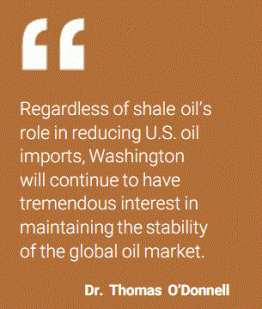
Wikistrat - my quote on US continued interestThis Wikistrat Report on the Saudi kingdom’s “reform” plans and the future of oil is from a press webinar I did on 17 May together with Dr. Ariel Cohen (Atlantic Council, Washington) and Prof. Shaul Mishal (Middle East Division, IDC Herzliya & Tel Aviv U.).  A nicely done report on oil market and geopolitical hot topics.

30May16 note: A couple typos I had found have been fixed by Wikistrat since I initially posted this Report.  The latest version is now linked here. – T.O’D.

I’m quoted by MarketWatch: Five key issues for OPEC’s June meet

Oil ministers of Venezuela, Saudi Arabia & Qatar had agreed in February to freeze output if others did too. AFP/Getty Images

After a Wikistrat Webinar I did, MarketWatch asked me about Saudi & OPEC policy, ond US Shale. Read on here, or at MarketWactch! – Tom O’D.

5 key issues OPEC must wrestle with at its June meeting

Oil output freeze is needed to ‘create a firm price floor’: analyst

The oil market has given members of the Organization of the Petroleum Exporting Countries a reason to crack a cautious smile when they meet June 2 in Vienna.

Signs of a more stable oil market have emerged since the cartel members last held a regularly-scheduled meeting. Oil prices CLN6, +0.04% LCON6, -0.38%  have gained more than 30% so far this year. And both West Texas Intermediate, the U.S. benchmark, and Brent crude, the global benchmark, briefly traded above $50 on Thursday.

Global production is falling following a larger-than-expected weekly decline in crude supplies, according to a report from the American Petroleum Institute late Tuesday. The report comes as the number of active-drilling rigs have been in a steady state of decline and oil-company spending cuts, oil-and-gas sector bankruptcies, and recent outages in Africa and North America, have been supportive for crude prices.

“OPEC members are likely to be a little happier going into June’s meeting than they were in December,” Tom Pugh, commodities economist at Capital Economics, said in recent research note.

Oil prices have “surged by about a third since the start of the year,” he said. The “higher prices will have removed some of the pressure on [OPEC] to act to prop up prices.”

But that doesn’t mean major oil producers can sit back and relax when they get together. Oil market supply and demand haven’t fully stabilized and there a lot of factors than can, and probably will, rock OPEC’s boat.

Here’s a rundown of what analysts see as the key issues at hand and possible outcomes for the OPEC summit: Continue reading

Falling oil price & Saudi strategy: My Sky News interview (London)

Here’s my live interview recently on Sky News – the all-news UK channel. It just went up.

Here’s the gist: Years-long high prices brought the US shale revolution and other new higher-cost oil online like offshore of Brazil and Africa. This glut was already dropping prices when the Saudi’s decided in November 2014 that OPEC alone could not cut enough production to reverse the slide. So what to do if Russia and Mexico won’t join an OPEC cut? Continue reading

My AQ piece: “Russia Is Beating China to Venezuela’s Oil Fields”

map_aq_russia-pdvsa_oil_a

Russian Production & Stakes in Venezuelan Oil Projects (40% stake is limit)

Last October & November I succeeded in interviewing several people in the Venezuelan private sector directly knowledgeable of Russian oil projects with PDVSA. Many Venezuelans wonder what all the Russians-known for their secrecy-are up to there.  Some of my key findings are in Americas Quarterly‘s Winter 2016 edition. Read on … 

Russia Is Beating China to Venezuela’s Oil Fields – By THOMAS W. O’DONNELL

The profits, politics and luck behind Russia’s growing footprint.

Russian companies produce more oil in joint projects with PDVSA than their Chinese counterparts This article is adapted from our 1st print issue of 2016. 

The late Venezuelan President Hugo Chávez, had long envisioned China becoming Venezuela’s biggest oil-sector production partner. So when Rafael Ramírez, then president of Petróleos de Venezuela, S.A. (PDVSA), announced in January 2013 that Russia would produce enough oil with PDVSA by 2021 to become “the biggest petroleum partner of our country,” very few people believed him. It sounded like empty hype.

Yet it turns out that Ramírez was serious. Three years later, Russian companies are already producing more oil in joint projects with PDVSA than their Chinese counterparts. Official figures are either unreliable or unavailable, but according to field data provided by Global Business Consultants (GBC), a Caracas-based energy consulting firm, Russia-Venezuela production as of late 2015 was 209,000 barrels per day (bpd), compared to China-Venezuela’s at a bit over 171,000 bpd.

Continue reading

Venezuela: Default risks grow (I’m quoted in Platts)

PDVSA president, Eulogio Del Pino, leads a meeting to

PDVSA president, Eulogio Del Pino, meets to “consolidate the new PDVSA.” (‏@delpinoeulogio Aug 11)

Mery Mogollon quotes me several times on PDVSA’s trajectory in Platt’s September Energy Economist.  Here it is:

Venezuela, South America’s biggest oil producer, has seen the value of its oil exports fall to its lowest level since 2004. The economy faces hyperinflation and increasing shortages of basic goods. Debt default seems highly likely. State oil company PDVSA has neither the institutional capacity nor the funds to expand oil production. It is a downward spiral that will lead to political change.  Continue reading

US Experts on German & EU Energy Vulnerabilities (My D.C. seminar)

Merkel and Obama at G7 - the main topic was Russia and Ukraine

Merkel and Obama at G7. Main topic was Russian threats to EU and Ukraine

An AICGS workshop with Dr. Thomas O’Donnell was held on May 27 in Washington, DC with a lively full-room attendance.

O’Donnell presented preliminary results of interviews he conducted in Washington during April and May to hear candid views of US energy-and-geopolitical experts on German and the EU energy policies.  The main topics were (1) European natural-gas vulnerabilities in light of the Ukraine crisis and dependence on Russian supplies and (2) implications of Germany’s commitment to a transition to renewable energy called the Energiewende.   Continue for Workshop PowerPoint & written Summary –>  Continue reading

The EU-US “Oil Weapon”: Putin’s overtures to OPEC, China & Iran reveal desperation

Foto: Presidents Rouhani of Iran and Putin of Russia holding discussions Presidents Rouhani of Iran and Putin of Russia holding discussions

(AICGS Analysis, by Tom O’Donnell)  Since Russia’s president, Vladimir Putin, decided to annex Crimea and back east Ukrainian separatists with troops, many have worried he might use his “energy weapon” to counter U.S.-EU sanctions, as Russia supplies around a third of the EU’s natural gas imports.  But what about Russian retaliation in the oil sector?

That’s hard to imagine. While gas is marketed in bi-lateral, pipeline-mediated relationships, oil is not. It’s liquid, fungible, and marketed in a unified open market—“the global barrel” [and name of this blog, T.O’D.]—which means there are no bi-lateral oil dependencies.

So, when EU leaders were cajoled by Germany’s Angela Merkel into joining the United States in applying sanctions, Russia could do little to retaliate from within the oil sector.  In reality, it is the EU and the U.S., not Russia, that have an “oil weapon” in hand.  And, the flurry of Russian oil diplomacy with OPEC, Iran and China over the past couple of weeks has a distinct whiff of desperation to it. Continue reading

“US Expert Perspectives on German Energy Vulnerabilities” – My AICGS/Washington Project

merkel_putin_dw_17481033

German Chancellor Merkel listens to Russian President Putin [Photo: dw.de 29.4.14]

Throughout April and May I’m researching US Expert Perspectives on German [and EU] Energy Vulnerabilities – as a visiting fellow of the American Institute for Contemporary German Studies (AICGS) in Washington, DC, funded by the German DAAD.  You can read the proposal below.  But, first, I’d like to ask Global Barrel readers for two things:

(1) Is there anyone you feel I should interview here in Washington–the idea is to interview US energy experts, government officials and business people?

(2) What is your opinion of German and EU energy policies and their geopolitical implications. This includes issues ranging from German/EU dependence on Russian gas, the Ukraine and Turkey as gas-transit states, the new European “Energy Union,”  the German Energiewende, and moreno matter on which side of the Atlantic you live. 

[I’ve deleted the names of people I propose to interview, as not all will agree to have their remarks made public. I’m happy to keep opinions private and use them in general summaries of my findings.]

Paralyzed on Economic Reforms, Venezuela Will Mortgage Citgo [My Americas Quarterly analysis]

listverse.com-28jan15-178789073

Photo:: Listverse.com

[My post at Americas Quarterly, 5 Feb 2015]  Since before the death of Venezuelan President Hugo Chávez in March 2013, his successor, Nicolás Maduro, has remained paralyzed to enact reforms needed to escape the economic dysfunction Chávez left behind.

In his latest national address on the economy on January 21, Maduro finally acknowledged the recession and shortages faced by Venezuelan citizens. Yet, he failed again to clearly implement any of the pragmatic economic reforms[1] advocated by Rafael Ramírez, the former minister of energy and former president of Petróleos de Venezuela, S.A. (Petroleum of Venezuela—PDVSA)— such as a de facto bolívar-to-dollar devaluation via unification of Venezuela’s multi-tier foreign exchange (FX) system, measures to attract more foreign financing for oil production, and removing internal price controls, especially for gasoline.  Meanwhile, in September 2014, Ramírez was demoted to foreign minister, and then to UN ambassador several months later.

According to insiders, Maduro’s failure to implement pragmatic reforms stems principally from two sources.
Continue reading

[Spanish] Mi opinión en Petroquía: China se involucra en los principales proyectos de América Latina

Here’s my piece [in Spanish] in Petroguía 2015, the oil-&-gas sector catalog for Latin America  Note: Hemispheric integration (e.g., energy infrastructure) was endlessly promoted by Hugo Chavez.  In the end, he built none. The region’s resources continue going mainly to develop other regions, such as China. Continue reading

Watch: Falling Oil Price & Geopolitics – Saudis & OPEC, Russia, USA, .. | My Real News Network interview

A wide-ranging interview on the “perfect storm” of low prices from low demand plus rising production, the Saudi market strategy and some geopolitical implications.

“Oil & the US-Iran Crisis” – My talk at American University, Washington DC:

If you are in Washington, DC, this historical overview of the US-Iran Crisis and the role of oil might be of interest:
american_u_iran_talk_01oct14JPG

My IP Journal latest: “A firm US-EU partnership on Iran came at great cost, and made a deal possible”

EU and Iranian foreign ministers (foto: Austrian Foreign Ministry)

EU and Iranian foreign ministers in Vienna (Austrian Foreign Ministry)

My latest at the IP Journal of the German Council on Foreign Relations (DGAP)US-EU Cooperate on Iranian Nonproliferation:  Agreement positions Tehran as regional leader — IP Journal 14/08/2014 

Although negotiators failed to reach agreement on Iran’s nuclear program by the late-July deadline set last November, as Iran’s Foreign Minister Mohammad Javad Zarif put it: “We have made enough headway to be able to tell our political bosses that this is a process worth continuing. … I am sure Secretary Kerry will make the same recommendation.” Indeed, Washington, Brussels, and Tehran readily agreed on a four-month extension.

This represents a sea change in tone from the period prior to November 2013, Continue reading

My talk on Iran, NYC | After an Iran-USA deal: A Mideast without democracy, run by Iran & Saudi Arabia?

Figure 1.  Ayatollah Hashemi Rafsanjani (R) exchanges greetings with the new Saudi Arabian ambassador to Iran, Abdulrahman Bin Groman Shahri in Tehran, April 22, 2014. (photo by Twitter/ISNA)    Read more: http://www.al-monitor.com/pulse/originals/2014/04/rafsanjani-saudi-ambassador-kiss-controversy.html#ixzz32ktJuoKR

Kiss between Rafsanjani and Saudi ambassador stirs controversy   Former Iranian President, Ayatollah Hashemi Rafsanjani (R) exchanges greetings with the new Saudi Arabian ambassador to Iran, Abdulrahman Bin Groman Shahri in Tehran, Al Monitor, April 22, 2014. (photo by Twitter/ISNA)

Appreciation: I am honored to again be invited by my Iranian colleagues in New York, Professors Reza Ghorashi, Hamidah Zangeneh and Hamid Sedghi, to join this panel and discuss the geopolitics of US-Iranian relations.  And, my thanks to Prof. Sedghi for reading my paper as I am teaching in Berlin and cannot be with you today. I only ask that those who dislike my message, kindly refrain from shooting the messenger.

Introduction

The US-Iran nuclear confrontation finally appears close to resolution.  This is because both Presidents Obama and Rouhani desire a diplomatic solution, and both countries need to move on. With such an agreement, it is possible that relations will slowly become normalized.

Of particular note—as a direct consequence—are the recent secret negotiations between Iran and Saudi Arabia towards a rapprochement.  These were initially facilitated by Oman (e.g. see reports here, here, and here). Until very recently the Saudis had remained fiercely opposed to any US deal with Iran.  However, the Saudi’s are realists, and know when it is time to adapt.  Figure 1. is a photo of kisses exchanged on 22 April between ex-President Rafsanjani of Iran and King Abdullah’s ambassador to Iran, which caused quite a stir in the region. Agreements reached in these recently revealed negotiations have already significantly affected the presidential-succession crisis in Lebanon, sectarian conflicts in Iraq, and the conflict in Yemen. Next the two sides are expected to negotiate regarding their interests in the Syrian conflict.

In addition, the nature of the US-Saudi relationship is changing, transferring much more responsibility on the Kingdom and its Gulf partners for their own defense–albeit strongly supported with US weapons and logistics. This is part of the US disengagement from direct regional interventions, which will be significantly furthered by a successful US-Iran agreement (e.g., see here and here, and this report on Saudi defense buildup from Balfour at Harvard).

How are these new developments to be understood? Continue reading

USA Oil Seminar 5.0 | USA as Rising Energy Superpower?

us_air_force_jets_oil_buring_iraqNote: These “USA Oil Seminar” posts are extra readings for my students to better understand how US energy policy is developed and to hear the views of US experts.  The seminar is: “The Global Oil System & US Policy” at JFK Institute of FU-Berlin. 

RECOMMENDATIONS:

  1. This Friday, watch live (or the recording later on): Is the U.S. a Rising Energy Superpower? Implications for Global Markets and Asia, the Middle East, Russia, and Europe.  CSIS upcoming talk by Fereidun Fesharaki.  FRIDAY, MAY 16, 2014 | 10:00 AM – 11:30 AM .  Moderated by David Pumphrey.
  2. Read the paper: Fueling a New Order? The New Geopolitical and Security Consequences of Energy |April 15, 2014. By: Bruce Jones, David Steven and Emily O’Brien.  Brookings Institute; Washington, DC.

BACKGROUND:  This week, the class reading assignments are a couple conference papers I wrote a few years ago on the history and structure of today’s global oil system, and how it grew to replace the neo-colonial oil system. Continue reading