Category Archives: Oil supply

Saudi & Russia seek oil deal as OPEC fight v US shale fails [My RTRadio Interview]

economonitor-com-putin_and_prince_g20_sept16

RT Radio-Edinburgh’s Jack Foster interviewed me on the upcoming 30 November OPEC summit where the Saudis hope to set a cap on OPEC and Russian production. Here’s the interview:   Listen from time-stamp 9:00-to-17:30 (Streaming MP3) 

This would  mark the first-ever Russian cooperation with OPEC. However, market realities look bleak for OPEC and Russia whether they reach an agreement or not. The reason is the unprecedented continuing challenge from US shale, which has dramatically cut its costs via tech and operational innovations to stay profitable at low prices. Continue reading

“Energy independence” won’t free the USA from global oil market & geopolitics [I’m cited: CNNMoney]

160809121848-us-oil-imports-shrink-780x439

Credit: CNNMoney, 9 August 2016

Mr. Trump promises he’d use the USA’s shale-oil revolution to deliver “complete” independence from foreign oil, telling voters in May: “Imagine a world in which our foes and the oil cartels (sic) can no longer use energy as a weapon. Wouldn’t that be nice?” But, he is confusing two quite distinct things:

“Energy independence” – in the sense of the USA producing more oil than the country consumes – is indeed possible, even “tantalizingly close” as this CNNMoney article (Aug. 9, 2016, by Matt Egan) makes clear, citing myself and other experts.  For clarity, I’ll call this “net oil-exporter status.”

However, Donald Trump asks us to “imagine” he can use this net oil exporter status, to make the US independent of the global oil market and oil in geopolitics where our “foes” and “cartels” have leverage. Continue reading

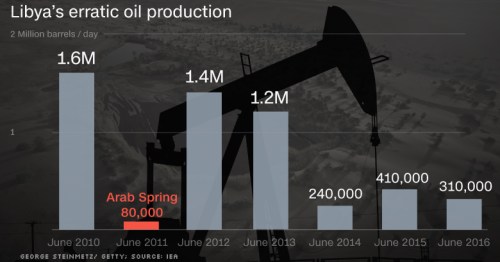
How fast can Libyan oil recover? (I’m quoted by CNN)

160719181131-chart-libya-oil-production-780x439

CNN 20 July 2016

The oil market remains glutted, with price in the mid-$40’s.  Despite furtive hopes over recent weeks  by the business press about “imminent re-balancing” of global supply v. demand and about “draw downs” of record-high global storage inventories, data reveal only incremental re-balancing has occurred since fall of 2014 when this all began. (And, from November 2014,  the Saudi’s responded by fighting for their market-share rather than for boosting price, which would have been impossible for OPEC to do on its own given the huge supply glut.)

Continue reading

What’s keeping foreign oil firms out of Iran? IRG? [CNNMoney quotes me]

iran_oil_production-sanctioneffect_17jun16

To put Iran’s recent production increases in perspective: On its own, for 37 years, Iran has struggled to produce two-thirds of its pre-revolutionary level of 6 million barrels/day. Now, domestic opposition is again limiting foreign oil companies’ participation to boost production.

Since the Obama-administration’s and Europe’s nuclear sanctions were lifted early this year (marked ‘e’ on the chart), Iran has been expanding its production and exports more rapidly than most experts had expected. Tehran has actually tripled exports since late-2015 (see point ‘f’).  But, here’s the big question: Can Iran sustain this years’ production gains?
If to, this could seriously undermine Saudi Arabia’s global oil-market share, and boost Iran’s sanctions-damaged economy to a long-awaited recovery.
The short answer: Now that foreign sanctions are finally lifted, the battle to boost Iran’s oil exports has shifted to a domestic clash over whether to allow foreign oil companies to have significant upstream involvement. This is a domestic Iranian issue with a long history.
Historical perspective
Let’s start with some historical perspective: The Iranian National Oil Company (NIOC) can only do so much on its own to boost production. After decades of sanctions, it lacks the needed technology and finance.  I told CNNMoney‘s Matt Egan, on Wednesday, that the faster Iran expands on its own, the faster production will plateau. (His CNNMoney article today quotes me .).
This was what happened after the 1980-1988 Iran-Iraq war.(‘b’ on the chart). By about 1992, production had plateaued at almost 4 million barrels/day, under 2/3 of the pre-revolutionary, late-1970’s level of roughly 6 million barrels per day. (‘a’ on chart).  The Iranian president at the time, Rafsanjani, argued to religious conservative and nationalist members of the Majilis that only foreign oil companies’ technology and investments could expand production further. However, he only won grudging approval for an offshore project due to fears that foreigners would bring their irreligious ways ashore and/or undermine the hard-won nationalization of Iran’s oil sector.
Continue reading
Aside

Last night Investor’s Business Daily NEWS’ Gillin Rich interviewed me. The title reflects some rumors, but my point of view, as she reports, emphasizes market realities that bode against any output limit – esp. if the Iranians are still intransigent … and … Continue reading

Rate this:

Don’t write off American oil boom despite OPEC – CNNMoney cites my analysis

cnn_money-chart-oil-production-down-slow-01jun16

I was interviewed today by CNNMoney’s Matt Egan on what  OPEC should expect from US shale as they hold their 169th “Ordinary Meeting” in Vienna tomorrow (2 June).  Indeed, at some point oil production and demand will balance (likely in 2017), and then the Saudis and OPEC will have to cautiously test the presently unknown dynamics of high-tech US shale on the rebound. -Egan cites my point  of view in his article. Read on … – Tom O’D.

Don’t bet against the resilience of U.S. oil companies

by Matt Egan @mattmegan5 CNNMoney (New York) June 1, 2016: 12:23 PM ET

Many expected U.S. oil output would collapse under the weight of a lengthy price war with the mighty OPEC, the fractured oil cartel that’s meeting in Vienna Thursday.

The U.S. oil boom, fueled by the shale revolution, has obviously taken a few punches from OPEC’s strategy of all-out pumping. But the latest numbers show that American production continues to remain stubbornly high in recent months despite the crash in crude to as low as $26 a barrel in February.

The U.S. pumped 9.13 million barrels per day in March, down by a miniscule 6,000 barrels from the prior month, according to stats released this week by the U.S. Energy Information Administration. That represents a deceleration from recent monthly declines. By comparison, daily U.S. output dropped by 58,000 barrels in February and by 83,000 barrels in December.

Continue reading

Wikistrat Report “Saudi Arabia & the Future of Oil” cites my views

Wikistrat - my quote on US continued interestThis Wikistrat Report on the Saudi kingdom’s “reform” plans and the future of oil is from a press webinar I did on 17 May together with Dr. Ariel Cohen (Atlantic Council, Washington) and Prof. Shaul Mishal (Middle East Division, IDC Herzliya & Tel Aviv U.).  A nicely done report on oil market and geopolitical hot topics.

30May16 note: A couple typos I had found have been fixed by Wikistrat since I initially posted this Report.  The latest version is now linked here. – T.O’D.

I’m quoted by MarketWatch: Five key issues for OPEC’s June meet

Oil ministers of Venezuela, Saudi Arabia & Qatar had agreed in February to freeze output if others did too. AFP/Getty Images

After a Wikistrat Webinar I did, MarketWatch asked me about Saudi & OPEC policy, ond US Shale. Read on here, or at MarketWactch! – Tom O’D.

5 key issues OPEC must wrestle with at its June meeting

Oil output freeze is needed to ‘create a firm price floor’: analyst

The oil market has given members of the Organization of the Petroleum Exporting Countries a reason to crack a cautious smile when they meet June 2 in Vienna.

Signs of a more stable oil market have emerged since the cartel members last held a regularly-scheduled meeting. Oil prices CLN6, +0.04% LCON6, -0.38%  have gained more than 30% so far this year. And both West Texas Intermediate, the U.S. benchmark, and Brent crude, the global benchmark, briefly traded above $50 on Thursday.

Global production is falling following a larger-than-expected weekly decline in crude supplies, according to a report from the American Petroleum Institute late Tuesday. The report comes as the number of active-drilling rigs have been in a steady state of decline and oil-company spending cuts, oil-and-gas sector bankruptcies, and recent outages in Africa and North America, have been supportive for crude prices.

“OPEC members are likely to be a little happier going into June’s meeting than they were in December,” Tom Pugh, commodities economist at Capital Economics, said in recent research note.

Oil prices have “surged by about a third since the start of the year,” he said. The “higher prices will have removed some of the pressure on [OPEC] to act to prop up prices.”

But that doesn’t mean major oil producers can sit back and relax when they get together. Oil market supply and demand haven’t fully stabilized and there a lot of factors than can, and probably will, rock OPEC’s boat.

Here’s a rundown of what analysts see as the key issues at hand and possible outcomes for the OPEC summit: Continue reading

Falling oil price & Saudi strategy: My Sky News interview (London)

Here’s my live interview recently on Sky News – the all-news UK channel. It just went up.

Here’s the gist: Years-long high prices brought the US shale revolution and other new higher-cost oil online like offshore of Brazil and Africa. This glut was already dropping prices when the Saudi’s decided in November 2014 that OPEC alone could not cut enough production to reverse the slide. So what to do if Russia and Mexico won’t join an OPEC cut? Continue reading

Oil Price Collaterals: Saudi strategy shakes Russia, Iran & Venezuela, but they’re not targets

Obama and Saudi King in Saudi Arabia after the death of previous king

Falling oil prices are not a US-EU-Saudi plot against Russia, Iran and Venezuela… though their effect is certainly not unwelcomed..Foto: REUTERS/Jim Bourg


[Printed in IP Journal, German Council on Foreign Affairs] Pin-pointing the reason for the dramatic – and continuing – fall in the price of oil is relatively easy: OPEC held its 166th conference in late-November 2014 to decide on a strategy to address oil prices, which had been falling at five to ten percent per month since July. Rather than pursue a production cut

Continue reading

Watch: Falling Oil Price & Geopolitics – Saudis & OPEC, Russia, USA, .. | My Real News Network interview

A wide-ranging interview on the “perfect storm” of low prices from low demand plus rising production, the Saudi market strategy and some geopolitical implications.

USA Oil Seminar 5.0 | USA as Rising Energy Superpower?

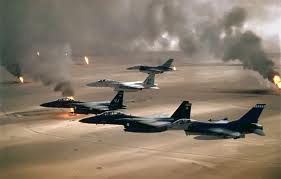
us_air_force_jets_oil_buring_iraqNote: These “USA Oil Seminar” posts are extra readings for my students to better understand how US energy policy is developed and to hear the views of US experts.  The seminar is: “The Global Oil System & US Policy” at JFK Institute of FU-Berlin. 

RECOMMENDATIONS:

  1. This Friday, watch live (or the recording later on): Is the U.S. a Rising Energy Superpower? Implications for Global Markets and Asia, the Middle East, Russia, and Europe.  CSIS upcoming talk by Fereidun Fesharaki.  FRIDAY, MAY 16, 2014 | 10:00 AM – 11:30 AM .  Moderated by David Pumphrey.
  2. Read the paper: Fueling a New Order? The New Geopolitical and Security Consequences of Energy |April 15, 2014. By: Bruce Jones, David Steven and Emily O’Brien.  Brookings Institute; Washington, DC.

BACKGROUND:  This week, the class reading assignments are a couple conference papers I wrote a few years ago on the history and structure of today’s global oil system, and how it grew to replace the neo-colonial oil system. Continue reading

My IP Journal article | Addressing Europe’s Energy Dependence on Russia: Gas globalization?

 25371_460x259Globalizing gas market, creating OECD strategic reserves could make embargoes history | By Thomas W. O’Donnell  6May14| Post-war Western Europe was twice the target of energy embargoes, each dramatically altering its energy landscape. A lesson for today is that Europe’s present natural gas dependence on Russia can be addressed with a gas policy like that adopted by the OECD for oil in 1973 – one that launched today’s collective, market centered, and embargo-proof global oil security system.

Russian President Vladimir Putin wrote a letter made public April 10, 2014, warning several EU heads of state that Ukraine must pay its past due gas bill of $2.2 billion or Russian energy giant, Gazprom, “will completely or partially cease gas deliveries” to the country and be “compelled” to insist on payments one month in advance for any future deliveries – including $5 billion to refill Ukraine’s gas reserves before next winter.  CONTINUE READING AT:  odonnell-addressing_europes_energy_eependence_on_russia_IP_Journal-06may14


A new syllabus: The USA & the global oil system: The formation of American energy policy

global_barrel_graphic_twodDuring Spring 2014, I’m teaching a post-graduate seminar in Berlin  on the USA and  the global market-centered oil system (a.k.a.”The Global Barrel”)–the syllabus sketch is below here.

While I’ve often taught seminars on “the Geopolitics of Global Oil,” the JFK Institute at Berlin’s Freie Universität had a special request: they would like their students to learn “how these policies are decided in the USA.”

For an American energy “expert”, the how of the USA’s policy-decision process is fairly familiar. However, not only for German students, but also for most US citizens, this process–whose outcome has such a profound impact on the entire world– indeed seems at best rather opaque, and, at worst, like an unseemly, vested-interest-driven and hopelessly partisan process. Continue reading

China y América Latina: ¿Quién gana y quién pierde? – Petroguía 2014 (Spanish)

Inversiones energéticos de  China en Latino américa.  Nota que Venezuela está en tercer lugar, en contra de las intenciones iniciales de Beijing en 2007-08.

Inversiones energéticos de China en Latino américa. Nota que Venezuela está en cuatro lugar, en contra de las intenciones iniciales de Beijíng en 2007-08. HAZ CLICK para magnificar. (Grafico por T.O’D.)

[English readers: This post is an analysis I did in Spanish for Petroguía 2014 – the annual hard-copy guide for the LatAm petroleum sector – of China’s oil and gas investments in LatAm and the Carribean.  For Beijing’s other investments, or a presentation, etc. drop me a line. ]

NOTA: La siguiente es mi análisis publicado en Petroguía 2014, la guía anual para el sector petrolífero latinoamericano.  Soy agradecido a los directores del Petroguía por haberme permitido publicar el artículo aquí.  El artículo es una resumen de una investigación que hizo sobre todas las inversiones de China en Latino américa. Si tienen interés en una reportaje o presentación detallada, por favor contactarme.

China y América Latina: ¿Quién gana y quién pierde?

Sumario. El mercado de hidrocarburos ya no está en el norte de América sino hacia el este,  y la mejor estrategia de intercambio con esa plaza la lleva Brasil, mientras que Venezuela y Argentina están a la zaga.

Por Thomas W. O’Donnell

El petróleo y el gas que exportará América Latina en las décadas venideras irán mayormente a China y otras partes de Asia. Y eso es por el efecto combinado de menores necesidades de energía importada en Estados Unidos, gracias a la utilización de los nuevos métodos de fractura hidráulica (fracking) que produce cada vez más petróleo liviano, y por el tope que ha alcanzado su demanda doméstica. Continue reading