Category Archives: Euroepen Union

Containing Gazprom: Putin may be overplaying his hand on gas – but no thanks to Berlin and Paris

Russia’s President has used Europe’s dependence on Russian gas as a powerful geopolitical lever. But energy geopolitics is a risky game, especially with the world awash in cheap gas – and Brussels now poised to take advantage of opportunities to permanently slash Gazprom’s market share in Europe.

Russia’s president has used Europe’s dependence on Russian gas as a powerful geopolitical lever. But energy geopolitics is a risky game, especially with the world awash in cheap gas – and Brussels now poised to seize opportunities to permanently slash Gazprom’s market share in Europe.

Here is my article in today’s Berlin Policy Journal. Continue reading

A Strange “No!” Alignment: Greeks, IMF and Washington v. Berlin and Brussels

What a strange rebellion against the international financial order.  On Sunday 5 July, Greece voted “No!” by a resounding 61% to the bailout conditions insisted upon by Berlin, Brussels and “the creditors.”  But, what is truly unique here is the alignment of international forces for renegotiation of Greek debt.

Throughout the post-War era, whenever it came down to imposing “discipline” on other small, debt-defaulting states, the most intrepid champions of the norms of the international financial order have consistently been Washington and the IMF (just ask Argentina’s Mrs. Kirchner, she’ll tell you).

Yet, look who agrees with the Greeks that their debts–in their present magnitude and structure–are impossible and potentially disastrous for the country: Continue reading

MY REPORT | Washington Viewpoints: Assessing Berlin’s Leadership on EU Energy Security

merkel_obama_dinner-denver_post_06jun2014

Merkel and Obama answer questions. 6 June 2014 [Denver Post]

During April and May, I interviewed over a dozen Washington-based experts in European energy and geopolitics.  My report on these interviews–along with some policy proposals in light of Brussels’ “institutional incapacities” and the “fundamental contradictions” of German leadership–is here: [PDF with a Table of Contents for navigation] or at the AICGS website [HTML].

This work was conducted as a resident fellow of the AICGS (American Institute of Contemporary German Studies) in Washington, DC and supported by a generous grant from the German Academic Exchange Office (DAAD) with additional support from the Foreign Office.  My thanks to the AICGS for their collegial support and warm hospitality.

Next, the plan is to interview in Berlin and perhaps Brussels energy experts and officials for their viewpoints on European energy vulnerabilities and on their work with the U.S. side.

US Experts on German & EU Energy Vulnerabilities (My D.C. seminar)

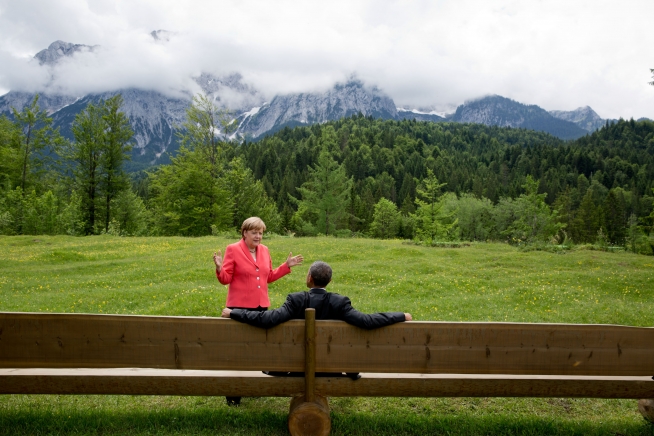
Merkel and Obama at G7 - the main topic was Russia and Ukraine

Merkel and Obama at G7. Main topic was Russian threats to EU and Ukraine

An AICGS workshop with Dr. Thomas O’Donnell was held on May 27 in Washington, DC with a lively full-room attendance.

O’Donnell presented preliminary results of interviews he conducted in Washington during April and May to hear candid views of US energy-and-geopolitical experts on German and the EU energy policies.  The main topics were (1) European natural-gas vulnerabilities in light of the Ukraine crisis and dependence on Russian supplies and (2) implications of Germany’s commitment to a transition to renewable energy called the Energiewende.   Continue for Workshop PowerPoint & written Summary –>  Continue reading

The EU-US “Oil Weapon”: Putin’s overtures to OPEC, China & Iran reveal desperation

Foto: Presidents Rouhani of Iran and Putin of Russia holding discussions Presidents Rouhani of Iran and Putin of Russia holding discussions

(AICGS Analysis, by Tom O’Donnell)  Since Russia’s president, Vladimir Putin, decided to annex Crimea and back east Ukrainian separatists with troops, many have worried he might use his “energy weapon” to counter U.S.-EU sanctions, as Russia supplies around a third of the EU’s natural gas imports.  But what about Russian retaliation in the oil sector?

That’s hard to imagine. While gas is marketed in bi-lateral, pipeline-mediated relationships, oil is not. It’s liquid, fungible, and marketed in a unified open market—“the global barrel” [and name of this blog, T.O’D.]—which means there are no bi-lateral oil dependencies.

So, when EU leaders were cajoled by Germany’s Angela Merkel into joining the United States in applying sanctions, Russia could do little to retaliate from within the oil sector.  In reality, it is the EU and the U.S., not Russia, that have an “oil weapon” in hand.  And, the flurry of Russian oil diplomacy with OPEC, Iran and China over the past couple of weeks has a distinct whiff of desperation to it. Continue reading

The P5+1–Iran Deal: Obama’s Initial Challenge was to Rally EU-3 Allies to the Cause

Iran-negotiations-pic

EU Foreign Affairs Representative. Federica Mogherini, and Iranian Foreign Minister, Mohammad Javad Zarif, announce the P5+1 deal with Iran. 3 April 2015

On April 3, the High Representative of the European Union for Foreign Affairs, Federica Mogherini, together with Iran’s Foreign Minister Mohammad Javad Zarif announced a framework agreement significantly limiting Iran’s future nuclear program.

Clearly, this deal was only possible with the patient collaboration of the British, French, German, and EU foreign ministers and U.S. secretaries of state. However, this common front was only forged through a multiple-step process orchestrated by Mr. Obama, beginning when he took office.  Continue reading

“US Expert Perspectives on German Energy Vulnerabilities” – My AICGS/Washington Project

merkel_putin_dw_17481033

German Chancellor Merkel listens to Russian President Putin [Photo: dw.de 29.4.14]

Throughout April and May I’m researching US Expert Perspectives on German [and EU] Energy Vulnerabilities – as a visiting fellow of the American Institute for Contemporary German Studies (AICGS) in Washington, DC, funded by the German DAAD.  You can read the proposal below.  But, first, I’d like to ask Global Barrel readers for two things:

(1) Is there anyone you feel I should interview here in Washington–the idea is to interview US energy experts, government officials and business people?

(2) What is your opinion of German and EU energy policies and their geopolitical implications. This includes issues ranging from German/EU dependence on Russian gas, the Ukraine and Turkey as gas-transit states, the new European “Energy Union,”  the German Energiewende, and moreno matter on which side of the Atlantic you live. 

[I’ve deleted the names of people I propose to interview, as not all will agree to have their remarks made public. I’m happy to keep opinions private and use them in general summaries of my findings.]

Oil Price Collaterals: Saudi strategy shakes Russia, Iran & Venezuela, but they’re not targets

Obama and Saudi King in Saudi Arabia after the death of previous king

Falling oil prices are not a US-EU-Saudi plot against Russia, Iran and Venezuela… though their effect is certainly not unwelcomed..Foto: REUTERS/Jim Bourg


[Printed in IP Journal, German Council on Foreign Affairs] Pin-pointing the reason for the dramatic – and continuing – fall in the price of oil is relatively easy: OPEC held its 166th conference in late-November 2014 to decide on a strategy to address oil prices, which had been falling at five to ten percent per month since July. Rather than pursue a production cut

Continue reading

My IP JOURNAL article | EU’s “Stress Test” of a Russian gas cutoff: Official optimism?

EC's Gas Stress Test: Would solidarity suffice to cope with any concerted Russian use of gas as a geopolitical weapon?  REUTERS/Wojciech Kardas/Agencja Gazeta

EC’s Gas Stress Test: Could the EU cope with a Russian use of gas as a geopolitical weapon?  REUTERS/Wojciech Kardas/Agencja Gazeta

What if Russia cuts off gas exports to EU states this winter?  This is a very possible means for Russian President Putin to escalate pressure on the EU and USA over the future of Ukraine. What could the EU do? The European Commission has just released the results of a simulation it ordered, involving 38 EU and neighboring states.   Here’s my analysis for the IP Journal of The German Council on Foreign Relations:

My IP Journal latest: “A firm US-EU partnership on Iran came at great cost, and made a deal possible”

EU and Iranian foreign ministers (foto: Austrian Foreign Ministry)

EU and Iranian foreign ministers in Vienna (Austrian Foreign Ministry)

My latest at the IP Journal of the German Council on Foreign Relations (DGAP)US-EU Cooperate on Iranian Nonproliferation:  Agreement positions Tehran as regional leader — IP Journal 14/08/2014 

Although negotiators failed to reach agreement on Iran’s nuclear program by the late-July deadline set last November, as Iran’s Foreign Minister Mohammad Javad Zarif put it: “We have made enough headway to be able to tell our political bosses that this is a process worth continuing. … I am sure Secretary Kerry will make the same recommendation.” Indeed, Washington, Brussels, and Tehran readily agreed on a four-month extension.

This represents a sea change in tone from the period prior to November 2013, Continue reading

USA Oil Seminar 5.0 | USA as Rising Energy Superpower?

us_air_force_jets_oil_buring_iraqNote: These “USA Oil Seminar” posts are extra readings for my students to better understand how US energy policy is developed and to hear the views of US experts.  The seminar is: “The Global Oil System & US Policy” at JFK Institute of FU-Berlin. 

RECOMMENDATIONS:

  1. This Friday, watch live (or the recording later on): Is the U.S. a Rising Energy Superpower? Implications for Global Markets and Asia, the Middle East, Russia, and Europe.  CSIS upcoming talk by Fereidun Fesharaki.  FRIDAY, MAY 16, 2014 | 10:00 AM – 11:30 AM .  Moderated by David Pumphrey.
  2. Read the paper: Fueling a New Order? The New Geopolitical and Security Consequences of Energy |April 15, 2014. By: Bruce Jones, David Steven and Emily O’Brien.  Brookings Institute; Washington, DC.

BACKGROUND:  This week, the class reading assignments are a couple conference papers I wrote a few years ago on the history and structure of today’s global oil system, and how it grew to replace the neo-colonial oil system. Continue reading

My IP Journal article | Addressing Europe’s Energy Dependence on Russia: Gas globalization?

 25371_460x259Globalizing gas market, creating OECD strategic reserves could make embargoes history | By Thomas W. O’Donnell  6May14| Post-war Western Europe was twice the target of energy embargoes, each dramatically altering its energy landscape. A lesson for today is that Europe’s present natural gas dependence on Russia can be addressed with a gas policy like that adopted by the OECD for oil in 1973 – one that launched today’s collective, market centered, and embargo-proof global oil security system.

Russian President Vladimir Putin wrote a letter made public April 10, 2014, warning several EU heads of state that Ukraine must pay its past due gas bill of $2.2 billion or Russian energy giant, Gazprom, “will completely or partially cease gas deliveries” to the country and be “compelled” to insist on payments one month in advance for any future deliveries – including $5 billion to refill Ukraine’s gas reserves before next winter.  CONTINUE READING AT:  odonnell-addressing_europes_energy_eependence_on_russia_IP_Journal-06may14


USA Oil 3.0 | US energy experts on Europe, Russia & Ukraine

Note: I’m teaching a post-graduate course “The Global Oil System & US Policy” at JFK Institute of Freie U. in Berlin. In order to give students a feel for how US energy policy is developed–and to see the views of important US actors–I’m sending them frequent e-mails with supplemental readings and videos  from US think tanks, US government offices and from the US media on energy topics.

These are not my own in-depth analysis like I usually post on GlobalBarrel.com.  However I think they are worthwhile sharing with especially non-USA followers of my blog.  I’ll title these posts “USA OIL” plus a number to label them).  I hope these are useful.  Here’s today’s ‘optional material’ I sent to my students:

How is US energy policy developed? You might find this video of interest.

Some background: The CSIS (Center for Study of International Security) is a non-partisan (i.e., not Democratic or Republican) think tank in Washington, DC. It performs an important role in US foreign policy. Continue reading

My DGAP article | Energiewende vs. USA Shale Gas: Can German industry compete?

ImageIn Germany, the impact of the country’s renewable energy transition on the economy is a very hot topic.  Tuesday, Mrs. Merkel’s  new Minister of Economy & Environment (and chair of the Social Democratic Party), Mr. Sigmar Gabriel, declared: “We need to keep in mind that the whole economic future of our country is riding on this,” (NYT, 21Jan14).

Here’ is my article in the DGAP’s (German Council on Foreign Affairs’) IP Journal of 30Dec13  (submitted 24Nov13):

Germany’s Energiewende (renewable-energy transition) is under intense pressure both from consumers facing soaring electric bills and from German manufacturers fretting about their falling energy competitiveness vís-a-vís the US, where manufacturers are benefiting from the boom in cheap natural gas production. What should be done to address these concerns has become a major topic of the CDU-SPD negotiations forming Chancellor Merkel’s new coalition government.  

From the viewpoint of German manufacturers, there are two ways the US shale gas revolution implies a worrisome competitive challenge. First, cheaper natural gas in the US is lowering electricity and other energy costs for American manufacturers, while Germany’s continue to rise. This is especially of concern to energy-intensive industries, where the EU now has 36 percent of world capacity and the US only 10 percent. Secondly, as the US begins to build facilities for export of liquefied gas (LNG), this capacity could have a significant effect on the price of electricity and gas in Asia. … Continue reading at DGAP’s (Deutsche Gesellschaft für Auswärtige Politik e.V.) IP Journal.

A new syllabus: The USA & the global oil system: The formation of American energy policy

global_barrel_graphic_twodDuring Spring 2014, I’m teaching a post-graduate seminar in Berlin  on the USA and  the global market-centered oil system (a.k.a.”The Global Barrel”)–the syllabus sketch is below here.

While I’ve often taught seminars on “the Geopolitics of Global Oil,” the JFK Institute at Berlin’s Freie Universität had a special request: they would like their students to learn “how these policies are decided in the USA.”

For an American energy “expert”, the how of the USA’s policy-decision process is fairly familiar. However, not only for German students, but also for most US citizens, this process–whose outcome has such a profound impact on the entire world– indeed seems at best rather opaque, and, at worst, like an unseemly, vested-interest-driven and hopelessly partisan process. Continue reading