Tag Archives: United States

Wikistrat Report “Saudi Arabia & the Future of Oil” cites my views

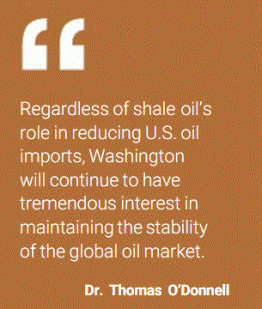
Wikistrat - my quote on US continued interestThis Wikistrat Report on the Saudi kingdom’s “reform” plans and the future of oil is from a press webinar I did on 17 May together with Dr. Ariel Cohen (Atlantic Council, Washington) and Prof. Shaul Mishal (Middle East Division, IDC Herzliya & Tel Aviv U.).  A nicely done report on oil market and geopolitical hot topics.

30May16 note: A couple typos I had found have been fixed by Wikistrat since I initially posted this Report.  The latest version is now linked here. – T.O’D.

I’m quoted by MarketWatch: Five key issues for OPEC’s June meet

Oil ministers of Venezuela, Saudi Arabia & Qatar had agreed in February to freeze output if others did too. AFP/Getty Images

After a Wikistrat Webinar I did, MarketWatch asked me about Saudi & OPEC policy, ond US Shale. Read on here, or at MarketWactch! – Tom O’D.

5 key issues OPEC must wrestle with at its June meeting

Oil output freeze is needed to ‘create a firm price floor’: analyst

The oil market has given members of the Organization of the Petroleum Exporting Countries a reason to crack a cautious smile when they meet June 2 in Vienna.

Signs of a more stable oil market have emerged since the cartel members last held a regularly-scheduled meeting. Oil prices CLN6, +0.04% LCON6, -0.38%  have gained more than 30% so far this year. And both West Texas Intermediate, the U.S. benchmark, and Brent crude, the global benchmark, briefly traded above $50 on Thursday.

Global production is falling following a larger-than-expected weekly decline in crude supplies, according to a report from the American Petroleum Institute late Tuesday. The report comes as the number of active-drilling rigs have been in a steady state of decline and oil-company spending cuts, oil-and-gas sector bankruptcies, and recent outages in Africa and North America, have been supportive for crude prices.

“OPEC members are likely to be a little happier going into June’s meeting than they were in December,” Tom Pugh, commodities economist at Capital Economics, said in recent research note.

Oil prices have “surged by about a third since the start of the year,” he said. The “higher prices will have removed some of the pressure on [OPEC] to act to prop up prices.”

But that doesn’t mean major oil producers can sit back and relax when they get together. Oil market supply and demand haven’t fully stabilized and there a lot of factors than can, and probably will, rock OPEC’s boat.

Here’s a rundown of what analysts see as the key issues at hand and possible outcomes for the OPEC summit: Continue reading

Falling oil price & Saudi strategy: My Sky News interview (London)

Here’s my live interview recently on Sky News – the all-news UK channel. It just went up.

Here’s the gist: Years-long high prices brought the US shale revolution and other new higher-cost oil online like offshore of Brazil and Africa. This glut was already dropping prices when the Saudi’s decided in November 2014 that OPEC alone could not cut enough production to reverse the slide. So what to do if Russia and Mexico won’t join an OPEC cut? Continue reading

Bypass Operation: Nord Stream 2, Russia-to-Germany pipeline deal, raises questions

BPJ_online_ODonnell_NordStream2_cut

Here’s my latest at Berlin Policy Journal (DGAP):  With Nord Stream 2, Russia’s President Vladimir Putin is nearing his goal of cutting Ukraine out of the gas supply picture.  October 20, 2015

On 18 June, during the annual St. Petersburg International Economic Forum, an agreement was signed to build a controversial new “Nord Stream 2” pipeline under the Baltic Sea that would go directly from Russia to northern Germany, with a capacity of 55 billion cubic meters (bcm). The project, which consists of two segments that would run along the same route as the existing two segments of the 55 bcm Nord Stream line, completed in 2011, has met with strong opposition from energy officials in Brussels, as well as leaders in Ukraine and some other EU states.

Indeed, the agreement between Russia’s Gazprom and a consortium of German, Austrian, French,, and Anglo-Dutch companies came as a surprise. After all, in January 2015 Gazprom announced it had abandoned the project, blaming both the falling price of gas over the previous year and anti-monopoly restrictions in the EU’s Third Energy Package, which prohibit suppliers of gas from also owning pipelines delivering it. This provision has prevented Gazprom from ever filling the original North Stream more than half way.[1] In retrospect, the sudden signing of a Nord Stream 2 agreement only six months after the project was supposedly abandoned, plus the fact that the consortium foresees a quick start reveals the prior cancellation to have been a political ruse. Continue reading

Containing Gazprom: Putin may be overplaying his hand on gas – but no thanks to Berlin and Paris

Russia’s President has used Europe’s dependence on Russian gas as a powerful geopolitical lever. But energy geopolitics is a risky game, especially with the world awash in cheap gas – and Brussels now poised to take advantage of opportunities to permanently slash Gazprom’s market share in Europe.

Russia’s president has used Europe’s dependence on Russian gas as a powerful geopolitical lever. But energy geopolitics is a risky game, especially with the world awash in cheap gas – and Brussels now poised to seize opportunities to permanently slash Gazprom’s market share in Europe.

Here is my article in today’s Berlin Policy Journal. Continue reading

A Strange “No!” Alignment: Greeks, IMF and Washington v. Berlin and Brussels

What a strange rebellion against the international financial order.  On Sunday 5 July, Greece voted “No!” by a resounding 61% to the bailout conditions insisted upon by Berlin, Brussels and “the creditors.”  But, what is truly unique here is the alignment of international forces for renegotiation of Greek debt.

Throughout the post-War era, whenever it came down to imposing “discipline” on other small, debt-defaulting states, the most intrepid champions of the norms of the international financial order have consistently been Washington and the IMF (just ask Argentina’s Mrs. Kirchner, she’ll tell you).

Yet, look who agrees with the Greeks that their debts–in their present magnitude and structure–are impossible and potentially disastrous for the country: Continue reading

MY REPORT | Washington Viewpoints: Assessing Berlin’s Leadership on EU Energy Security

merkel_obama_dinner-denver_post_06jun2014

Merkel and Obama answer questions. 6 June 2014 [Denver Post]

During April and May, I interviewed over a dozen Washington-based experts in European energy and geopolitics.  My report on these interviews–along with some policy proposals in light of Brussels’ “institutional incapacities” and the “fundamental contradictions” of German leadership–is here: [PDF with a Table of Contents for navigation] or at the AICGS website [HTML].

This work was conducted as a resident fellow of the AICGS (American Institute of Contemporary German Studies) in Washington, DC and supported by a generous grant from the German Academic Exchange Office (DAAD) with additional support from the Foreign Office.  My thanks to the AICGS for their collegial support and warm hospitality.

Next, the plan is to interview in Berlin and perhaps Brussels energy experts and officials for their viewpoints on European energy vulnerabilities and on their work with the U.S. side.

US Experts on German & EU Energy Vulnerabilities (My D.C. seminar)

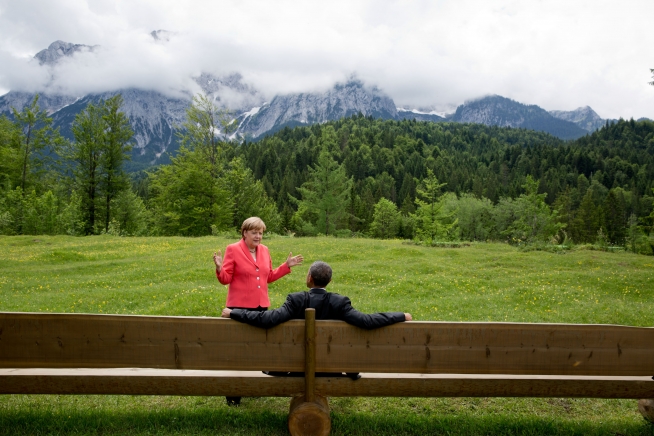
Merkel and Obama at G7 - the main topic was Russia and Ukraine

Merkel and Obama at G7. Main topic was Russian threats to EU and Ukraine

An AICGS workshop with Dr. Thomas O’Donnell was held on May 27 in Washington, DC with a lively full-room attendance.

O’Donnell presented preliminary results of interviews he conducted in Washington during April and May to hear candid views of US energy-and-geopolitical experts on German and the EU energy policies.  The main topics were (1) European natural-gas vulnerabilities in light of the Ukraine crisis and dependence on Russian supplies and (2) implications of Germany’s commitment to a transition to renewable energy called the Energiewende.   Continue for Workshop PowerPoint & written Summary –>  Continue reading

The EU-US “Oil Weapon”: Putin’s overtures to OPEC, China & Iran reveal desperation

Foto: Presidents Rouhani of Iran and Putin of Russia holding discussions Presidents Rouhani of Iran and Putin of Russia holding discussions

(AICGS Analysis, by Tom O’Donnell)  Since Russia’s president, Vladimir Putin, decided to annex Crimea and back east Ukrainian separatists with troops, many have worried he might use his “energy weapon” to counter U.S.-EU sanctions, as Russia supplies around a third of the EU’s natural gas imports.  But what about Russian retaliation in the oil sector?

That’s hard to imagine. While gas is marketed in bi-lateral, pipeline-mediated relationships, oil is not. It’s liquid, fungible, and marketed in a unified open market—“the global barrel” [and name of this blog, T.O’D.]—which means there are no bi-lateral oil dependencies.

So, when EU leaders were cajoled by Germany’s Angela Merkel into joining the United States in applying sanctions, Russia could do little to retaliate from within the oil sector.  In reality, it is the EU and the U.S., not Russia, that have an “oil weapon” in hand.  And, the flurry of Russian oil diplomacy with OPEC, Iran and China over the past couple of weeks has a distinct whiff of desperation to it. Continue reading

The P5+1–Iran Deal: Obama’s Initial Challenge was to Rally EU-3 Allies to the Cause

Iran-negotiations-pic

EU Foreign Affairs Representative. Federica Mogherini, and Iranian Foreign Minister, Mohammad Javad Zarif, announce the P5+1 deal with Iran. 3 April 2015

On April 3, the High Representative of the European Union for Foreign Affairs, Federica Mogherini, together with Iran’s Foreign Minister Mohammad Javad Zarif announced a framework agreement significantly limiting Iran’s future nuclear program.

Clearly, this deal was only possible with the patient collaboration of the British, French, German, and EU foreign ministers and U.S. secretaries of state. However, this common front was only forged through a multiple-step process orchestrated by Mr. Obama, beginning when he took office.  Continue reading

Paralyzed on Economic Reforms, Venezuela Will Mortgage Citgo [My Americas Quarterly analysis]

listverse.com-28jan15-178789073

Photo:: Listverse.com

[My post at Americas Quarterly, 5 Feb 2015]  Since before the death of Venezuelan President Hugo Chávez in March 2013, his successor, Nicolás Maduro, has remained paralyzed to enact reforms needed to escape the economic dysfunction Chávez left behind.

In his latest national address on the economy on January 21, Maduro finally acknowledged the recession and shortages faced by Venezuelan citizens. Yet, he failed again to clearly implement any of the pragmatic economic reforms[1] advocated by Rafael Ramírez, the former minister of energy and former president of Petróleos de Venezuela, S.A. (Petroleum of Venezuela—PDVSA)— such as a de facto bolívar-to-dollar devaluation via unification of Venezuela’s multi-tier foreign exchange (FX) system, measures to attract more foreign financing for oil production, and removing internal price controls, especially for gasoline.  Meanwhile, in September 2014, Ramírez was demoted to foreign minister, and then to UN ambassador several months later.

According to insiders, Maduro’s failure to implement pragmatic reforms stems principally from two sources.
Continue reading

Oil Price Collaterals: Saudi strategy shakes Russia, Iran & Venezuela, but they’re not targets

Obama and Saudi King in Saudi Arabia after the death of previous king

Falling oil prices are not a US-EU-Saudi plot against Russia, Iran and Venezuela… though their effect is certainly not unwelcomed..Foto: REUTERS/Jim Bourg


[Printed in IP Journal, German Council on Foreign Affairs] Pin-pointing the reason for the dramatic – and continuing – fall in the price of oil is relatively easy: OPEC held its 166th conference in late-November 2014 to decide on a strategy to address oil prices, which had been falling at five to ten percent per month since July. Rather than pursue a production cut

Continue reading

USA Oil Seminar 5.0 | USA as Rising Energy Superpower?

us_air_force_jets_oil_buring_iraqNote: These “USA Oil Seminar” posts are extra readings for my students to better understand how US energy policy is developed and to hear the views of US experts.  The seminar is: “The Global Oil System & US Policy” at JFK Institute of FU-Berlin. 

RECOMMENDATIONS:

  1. This Friday, watch live (or the recording later on): Is the U.S. a Rising Energy Superpower? Implications for Global Markets and Asia, the Middle East, Russia, and Europe.  CSIS upcoming talk by Fereidun Fesharaki.  FRIDAY, MAY 16, 2014 | 10:00 AM – 11:30 AM .  Moderated by David Pumphrey.
  2. Read the paper: Fueling a New Order? The New Geopolitical and Security Consequences of Energy |April 15, 2014. By: Bruce Jones, David Steven and Emily O’Brien.  Brookings Institute; Washington, DC.

BACKGROUND:  This week, the class reading assignments are a couple conference papers I wrote a few years ago on the history and structure of today’s global oil system, and how it grew to replace the neo-colonial oil system. Continue reading

My IP Journal article | Addressing Europe’s Energy Dependence on Russia: Gas globalization?

 25371_460x259Globalizing gas market, creating OECD strategic reserves could make embargoes history | By Thomas W. O’Donnell  6May14| Post-war Western Europe was twice the target of energy embargoes, each dramatically altering its energy landscape. A lesson for today is that Europe’s present natural gas dependence on Russia can be addressed with a gas policy like that adopted by the OECD for oil in 1973 – one that launched today’s collective, market centered, and embargo-proof global oil security system.

Russian President Vladimir Putin wrote a letter made public April 10, 2014, warning several EU heads of state that Ukraine must pay its past due gas bill of $2.2 billion or Russian energy giant, Gazprom, “will completely or partially cease gas deliveries” to the country and be “compelled” to insist on payments one month in advance for any future deliveries – including $5 billion to refill Ukraine’s gas reserves before next winter.  CONTINUE READING AT:  odonnell-addressing_europes_energy_eependence_on_russia_IP_Journal-06may14


USA Oil 3.0 | US energy experts on Europe, Russia & Ukraine

Note: I’m teaching a post-graduate course “The Global Oil System & US Policy” at JFK Institute of Freie U. in Berlin. In order to give students a feel for how US energy policy is developed–and to see the views of important US actors–I’m sending them frequent e-mails with supplemental readings and videos  from US think tanks, US government offices and from the US media on energy topics.

These are not my own in-depth analysis like I usually post on GlobalBarrel.com.  However I think they are worthwhile sharing with especially non-USA followers of my blog.  I’ll title these posts “USA OIL” plus a number to label them).  I hope these are useful.  Here’s today’s ‘optional material’ I sent to my students:

How is US energy policy developed? You might find this video of interest.

Some background: The CSIS (Center for Study of International Security) is a non-partisan (i.e., not Democratic or Republican) think tank in Washington, DC. It performs an important role in US foreign policy. Continue reading