Tag Archives: oil sector

China y América Latina: ¿Quién gana y quién pierde? – Petroguía 2014 (Spanish)

Inversiones energéticos de  China en Latino américa.  Nota que Venezuela está en tercer lugar, en contra de las intenciones iniciales de Beijing en 2007-08.

Inversiones energéticos de China en Latino américa. Nota que Venezuela está en cuatro lugar, en contra de las intenciones iniciales de Beijíng en 2007-08. HAZ CLICK para magnificar. (Grafico por T.O’D.)

[English readers: This post is an analysis I did in Spanish for Petroguía 2014 – the annual hard-copy guide for the LatAm petroleum sector – of China’s oil and gas investments in LatAm and the Carribean.  For Beijing’s other investments, or a presentation, etc. drop me a line. ]

NOTA: La siguiente es mi análisis publicado en Petroguía 2014, la guía anual para el sector petrolífero latinoamericano.  Soy agradecido a los directores del Petroguía por haberme permitido publicar el artículo aquí.  El artículo es una resumen de una investigación que hizo sobre todas las inversiones de China en Latino américa. Si tienen interés en una reportaje o presentación detallada, por favor contactarme.

China y América Latina: ¿Quién gana y quién pierde?

Sumario. El mercado de hidrocarburos ya no está en el norte de América sino hacia el este,  y la mejor estrategia de intercambio con esa plaza la lleva Brasil, mientras que Venezuela y Argentina están a la zaga.

Por Thomas W. O’Donnell

El petróleo y el gas que exportará América Latina en las décadas venideras irán mayormente a China y otras partes de Asia. Y eso es por el efecto combinado de menores necesidades de energía importada en Estados Unidos, gracias a la utilización de los nuevos métodos de fractura hidráulica (fracking) que produce cada vez más petróleo liviano, y por el tope que ha alcanzado su demanda doméstica. Continue reading →

As Chavez’ oil alliance with China gets serious, Beijing holds PDVSA to its word

Groundbreaking at CNPC refinery for PDVSA heavy oil, set tol be China's largest.

Groundbreaking, PetroChina-CNPC refinery for PDVSA heavy oil. It is to be China’s largest. (April 2012)

Over the past few weeks, I have been looking at the state of the Venezuelan-Chinese oil alliance that Hugo Chavez has so fervently championed.  The picture that emerges is not what one might expect. Here is an overview, in qualitative terms. [Correction: I originally wrote Ramirez reported that PDVSA produced “60,000” new barrels of Faja oil in 2013. He actually said “20,000”.]

A. Structural Changes – Vertical Integration with China

Till now, commentators have looked primarily at the obligations of the Bolivarian Republic of Venezuela (BRV) to send oil to China to repay Beijing’s huge loans.  However, there are major changes afoot in the structure of this relationship, no matter who succeeds Hugo Chavez.  Developments on the ground in both countries show an energy infrastructure buildup will soon bring significant cross-border vertical integration.  Soon, Venezuelan oil will not be shipped to China simply to fulfill financial-and-contractual obligations, but also for locked-in infrastructural reasons. 

All indications are that the Chinese side is actively fulfilling the obligations it entered into ca. five years ago (esp. December 2007) to build oil tankers, pipelines and refineries in China in order to import and process Venezuelan heavy crude.

Continue reading →

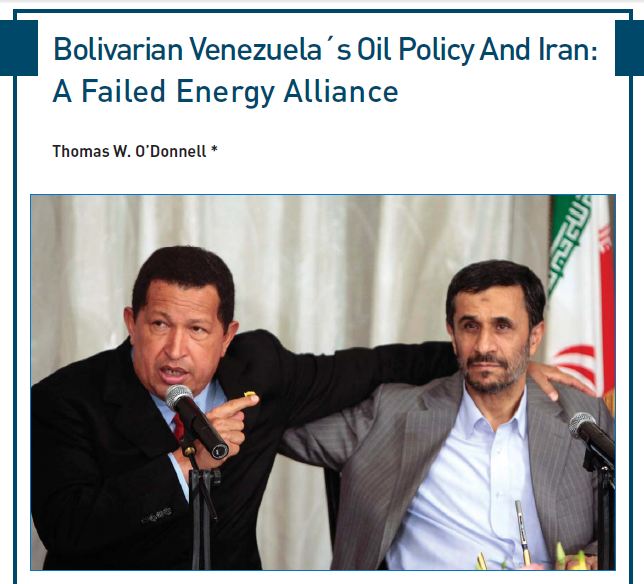
Bolivarian Venezuela’s Oil Policy & Iran: A Failed Energy Alliance

My study of Iran in Bolivarian Venezuela’s oil sector is just out in the May 2012 edition of Energy and Geopolitical Risk-published by MEES: Middle East Economic Survey.  You can read it here: Venezuela_Iran_failed_energy_alliance-Geopolitical-Risk-May-2012-3. Continue reading →