
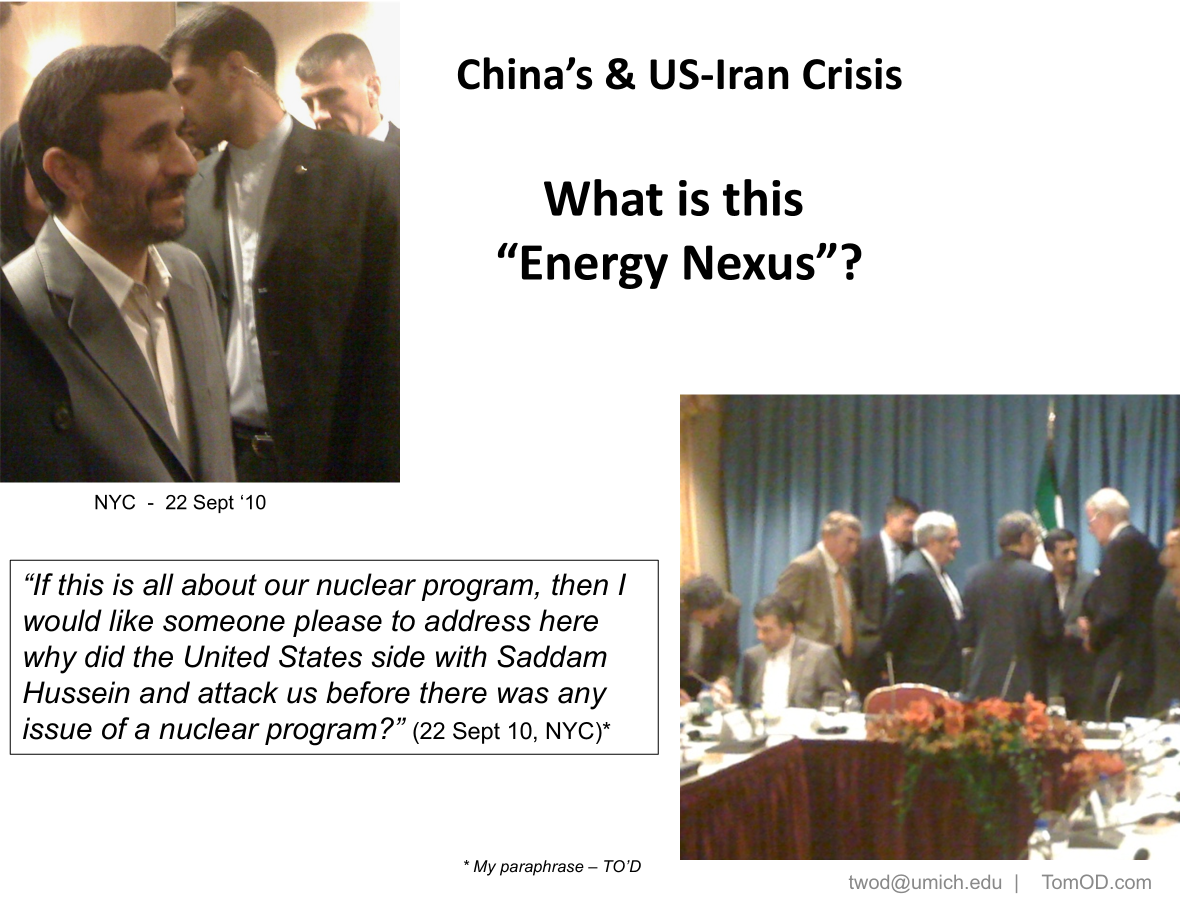
Some years ago, I was invited to dinner with President Ahmadinejad in NYC during the annual opening of the General Assembly.
The American think-tanks, consultancies, and x-diplomats present went on and on asking detailed questions about this or that scenario where US experts might work with Iranian experts to observe or limit the Iranian nuclear enrichment program. (I mentioned this 2010 dinner in a later post: “China’s Iran-Oil Import Angst. Part I” Feb 13, 2012.)
It became rather tiresome. Ahmadinejad clearly was growing tired of it. He then asked us,
“If this is all about our nuclear program, then I would like someone please to address here why did the United States side with Saddam Hussein and attack us before there was any issue of a nuclear program?” (Iranian President M. Ahmadinejad, 22 Sept 10, NYC, my notes, T.O’D.)
Everyone ignore his question, and simply kept up with their obviously pre-prepared technical questions. But, what had he meant?
To me, clearly he was referring to the Iran-Iraq war, when the USA, at a certain point, decided to take Iraq’s side and, among other things, sunk the entire Iranian Navy in a day, took over air traffic control for the Iraqi air force, started directly advising Iraq on strategy, and etc.
In the end, Iran had to accept an Iraqi peace deal after a crushing defeat facilitated by the USA. I recall now all these details vividly. And, all this was indeed well before any nuclear program.
What I myself had been arguing, back then, during the Iran-Iraq War, during the time Ahmadinejad was obviously referring to, was that the US-Iran confrontation was actually about the US opposition to any country, either from inside the Gulf Region or outside the Region, gaining hegemony over the Gulf and the Straits of Hormuz. This had to do with guaranteeing the free flow of oil, and that the global oil market would be a “real” market that no one state could unduly control. I had even coined a term, “The Global Barrel,” for this market-centered, post-OPEC-nationalizations collective oil-security system, a system initiated by Henry Kissinger in 1973.
This is also why the USA intervened in Iraq, just after Iraq had won the Iran-Iraq war, and Saddam had taken the oil fields of Kuwait (1991). The USA opposed Iraq establishing its hegemony over the world’s most important oil producing region. Greenspan had said, at the time, it was to ensure that the global oil market remained a “real market,” and could not be controlled by one actor.
All during the Iran’-Iraq war, under Reagan, the USA had taken advantage of the opportunity to secretly support BOTH SIDES with weapons, while actually revealing to the other side how to defeat them. The USA had long had a policy of balancing off one country against the other, to prevent either from attaining regional hegemony. But, the war presented an opportunity, apparently, to radically degrade the powers of both countries in the crucial, oil-rich Gulf Region. So the USA policy, discretly of course, was to help to both intensify and prolong that war. However, it was important that one or the other country not come out significantly on top and be able to dominate the region without their existential rival to check its ambitions.
So, when it developed that Iran might win the Iran-Iraq war, the USA, under Reagan, intervened decisively. It suddenly had to decide to take a side. The US decided to take Iraq’s side and helped it smash Iran’s capacity to win that war, preventing Iran from asserting its hegemony over the world’s most crucial oil producing region. (Of course, we all know now that this, instead, set up Saddam to play with doing the same, later on, in 1991.)
This was all consistent with the Carter Doctrine, asserted when the USSR had invaded Afghanistan and the USA worried it was a prelude to Moscow moving on, through Afghanistan, into Iran (which it had occupied in WWII) to assert hegemony over this globally crucial oil-producing region. What is the Carter Doctrine?
President Jimmy Carter – and his national security advisor, the Polish-born Zbigniew Brzezinski – asserted that it is in the USA’s vital national interest that any power that seeks to assert their dominance over the Persian Gulf Region will be repulsed “by any means necessary.” In this case, they were obviously thinking about the outside power, the USSR. However, as we saw over the next 30+ years, regional powers, in particular Saddam’s Ba’athist Iraq, and the mullah’s Iranian Islamic Republic also would not be permitted local hegemony – again, “by any means necessary.”
Aside: I always took this particular choice of words as particularly meaningful, from an American domestic perspective. These are the words made famous by Malcolm X – my hero in my High School years – in that, in achieving liberation for Black people oppressed in the USA, he resolutely rejected the methods of Martin Luther King. King specifically limited himself and his followers to purely peaceful, non-violent means, as a matter of principle. Malcolm, on the other hand, was never against peaceful means of liberation, but pointedly taught his people that they must not limit themselves to this, but be constantly ready and willing to use whatever violent means are necessary. He also said, as I recall clearly, that the particular sort of violence and its intensity are determined by the violence used by the oppressor.
Now, I thought it particularly interesting that the president of the USA should take the motto of a Black nationalist radical to make clear to the Kremlin his resolve to guarantee, for the Free World, the unimpeded flow of oil from the Gulf Region.
I imagine this imagery was lost on many people – though certainly not on Americans.
However, undoubtedly some KGB cultural-expert on the USA had explained to the leadership of the CCCP what this meant, i.e., that the USA would be willing to use “whatever means necessary,” to sacrifice life and limb (and treasure) in the spirit of the Black nationalist radical Malcolm X who fought, and had given his life, to free his oppressed people, in the government’s pursuit to keep the Gulf and Hormuz open to the free flow of oil.
Interesting, no?
Meanwhile, Jimmy Carter, as president, became known as “Mr. Human Rights,” as the first world leader to (ostensibly) put “Human Rights” in a prominent place in foreign affairs. But I digress….
In any case, returning to President Ahmadinejad’s question … the answer is that the USA had attacked his country long before Iran had had any significant nuclear program because it viscerally opposed even the possibility that his country, Iran, or any other country for that matter, might assert hegemony over the Persian Gulf (and regardless of the fact it was called the “Persian” Gulf).
And, so, today, we have to draw lessons from this very long and very consistent history.
President Trump is simply channeling President Carter (and Bush, Obama, Bush II, and Biden) in rejecting Iranian regional hegemony. In the administration’s estimation, Iran has simply gone too far now. As Marco Rubio said towards the start of the present war with Iran: if the USA does not act now, soon it might not be possible to prevent Iran from asserting hegemony using its elaborate missile and drone arsenal, not to mention with a nuclear weapons.
And consider that, if there is to be a war instigated by China in the Pacific, something Xi keeps hinting at by wanting his military to “be ready by 2027”, then. there is another USA concern regarding the Gulf. Specifically: what if the Chinese, during such a peer-to-peer conflict with the USA in the Pacific, asked its Iranian allies to close the Strait of Hormuz, “in solidarity” with China?
The answer to this is that, in this eventuality, the USA would have to divert perhaps three aircraft carrier groups and two marine landing forces to reopen the Straight. If the USA did not do this, our Japanese, South Korean, Australian, Indian, Philippine, and other allies and friendly countries in the Indo-Pacific region, would be severely short of oil they normally get from the Gulf.
So, in my estimation, this aspect of preparations for Great Power conflicts, is likely a major motivation for the USA to now, rather urgently, move to reassert hegemony over the Gulf and the Strait of Hormuz. Better now than to have to fight to reopen it during a Pacific armed conflict started by China. Unfortunately, once again, distaste for Trump’s lack of consultations and methods of hyperbole, diversion and deception in public statements (though not always does he do this) in his dealings with allies, leads to a lack of objectivity in assessing US policy among allies and the media, as well as among professional analysts in the USA and Europe
So, the Trump administration will resolve this issue of who will exercise hegemony over the world’s largest single source of oil. Back in the 1970s, about 95-97% of everything in the world that moved, in every country, was fueled by about 60% of the world’s oil production. Fifty years later, about 91-93% is fueled by a bit over 50%. Not a huge change. In China, with all its attempts to escape oi-import dependence, electric vehicles have gotten oil-for-transport dependence down to about 87%. So, it it is a matter of your national security, you might gain a few percentage points less oil dependence if you create an electric vehicle production sector like Chia’s.
In any case, in light of this history and the persistent critical role of Gulf energy supplies to the world, and how much the USA needs to fortify its position as the sole global superpower, one capable of checking the challenges of both Russia and especially China, I can not imagine the present administration, or any other administration, now following through and taking physical control of the Straits ASAP.
In this sense, I also see the combination of the USA taking control of Venezuelan oi, of checking Russian oil exports during its Ukraine aggression and not aiming to take Hormuz, as well as actively guaranteeing India non-Russian supplies, as “shaping operations” of the sort Great Powers historically engage in when preparing for a coming war with other Great Powers.
Read more:For my analysis of why Iran did not take Hormuz during last June’s 12-day War (and to see why they certainly would take it during this war, after the existential threat to both leadership and infrastructure), read my detailed piece from June 2025
“12-Day War”: Why no energy crisis? Iran regime was cornered. Seeing USA’s limited aims, it dared not escalate, gave up. | My Al Jazeera comments June 26, 2025: Answer to Ahmadinejad’s question, over dinner: “To block your control of oil, like with Saddam.”
:
 The Global Barrel