Last Wednesday, the NYT quoted my view in, “Europe says Putin’s Gas War is Weakening” (print ed’n, p.1; 7 Sept 2022). I was interviewed by Erika Solomon, in Berlin. It’s a short quote; I explain it further, below the article here: (Or, go directly to the NYT.)
One point I stressed in this and other interviews last week is the short- vs. long-term prospects of the EU-Russian energy war.
Putin’s is now exploiting the EU’s long overdepedence on Russian exports – a dependence actively built up by serial German and Austrian governments against ever-fiercer opposition from successive USA administrations,”Three Seas Region” EU Member states, Ukraine and others. (More on the difficult German policy adjustments being developed now in a future post.)
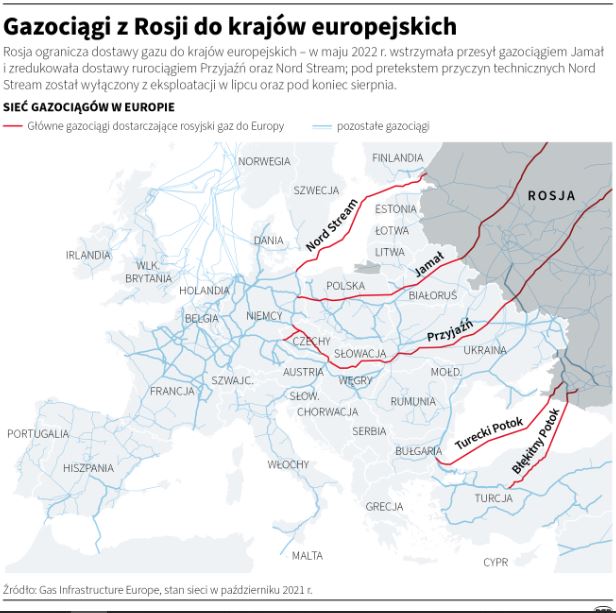
Short term Putin can and will cause maximum energy and economic crises in the EU by cutting off gas supplies via pipelines from NW Siberia. However, longer term, things are very different.
The EU has already begun increasing its LNG and pipeline imports from other regions, especially the USA, Norway, Qatar, Algeria, Azerbaijan, soon Israel via Egyptian LNG, and etc. Short term this will be a very heavy burden and a fierce test of EU Members solidaarity with Ukraine. Long term, there is plenty of gas in the non-Russian & transatlantic allies’ world, plenty of finance, technology and functioning markets.
Over the remainder of this year and the next one-or-two years, Russia will lose demand for its lucrative pre-war gas business in Europe, a crushing loss to the Russian nation. This will end up depriving Moscow of significant income.
However, this and perhaps a few more winters in Europe promise to be very difficult, with the next two likely the worst energy crises in Europe since WWII.
Published Aug 22, 2022 – Dr. Tom O’Donnell, GlobalBarrel.com
A more detailed blog post is below. } Above is the English Audio. Below is Arabic video.
My Asharq interview, 21 AUg 2022, with a Jordanian economic expert. Our host is in Doha; I am in Berlin.
In our Asharq interview on 21 August, a Jordanian expert and I discussed Middle East and North African (MENA) states’ food shortages, inflation, and the risk of recession and political unrest as a consequence of Russia’s war on Ukraine.
I especially commented on the troubled domestic policy responses in Egypt (and also in Turkey, which is not a “MENA” state; but deeply involved in Libya, Syria, and etc.).
Beyond the region’s domestic monetary and social policies, I stressed that in external policy, the region should collectively condemn Russia for its Ukrainian war, holding Moscow responsible for driving these crises in MENA. (Unfortunately, there was no time for me to elaborate on this latter point. Hence, I will write more in it, further below here.)
I was also asked to compare the present situation to that which led to the Arab Spring uprisings of 2010-11. (During that period, I taught a post-graduate seminar at The New School, NYC, and spoke at public events on the uprisings). Many of the same precursors exist now as then; however, at what point might this lead to protests or uprisings is not possible to say.
The further reality is that any successes by the EU and other developed states in acquiring scarce food, minerals and energy equates to more difficulty for developing states – especially Pakistan, Bangladesh, Africa and poorer states of the MENA Region – to acquire these necessities.
We both noted, however, that, at the same time, the oil-exporting and LNG-producing states of MENA are now enjoying a revenue windfall, and it is of course their responsibility along with the developed world to aid their poorer neighbors during this crisis.
Note too, that the OPEC states of MENA have reportedly earned a windfall of $1.3 trillion so far this year from high oil and gas prices.
Given the global competition for expensive and temporarily scarce food and energy commodities, poorer MENA states have little recourse. Lebanon, in particular, is in dire circumstances – much of which is the responsibility of corrupt internal political elites and Iranian-backed Hezbollah.
The IMF of course is playing a crucial role now in assisting MENA states.
(I note that the USA this week, according to the UN, purchased 150,000 metric tons of grain from Ukraine to distribute to developing states.)
Meanwhile, Russia is continuing to steal and/or destroy large quantities of Ukrainian grain which would otherwise be exported to MENA states.
My first answer in the interview was rather generic; about the World Bank’s recent report on the Region,
Turkey
Later, elaborating on the attempt of the region’s central banks to fight inflation with higher interest rates, and the risks of recession this is unavoidably causing, I emphasized that Turkey, at the direction of President Erdogan, is following a highly unorthodox policy (read: monetarily incorrect, and rather corrupt) of lowering interest rates to address inflation. This counter-intuitive decision is known to be a pet theory of the Turkish president. I explained how this dangerous policy caused a spurt of inflation during the latter part of 2021, the first time the central bank implemented lower rates to “fight inflation.” It was widely assumed that would be the end of this experiment. Nevertheless, the Turkish central bank once again cut rates earlier this week. And, again, Turkish lira inflation has begun to soar. This is clearly unsustainable.
I pointed out this policy is exacerbating the crisis for Turkish business and for the Turkish people who are increasingly unable to afford food and other necessities when they are actually available. Further, the central bank is running out of foreign exchange to support the lira.
Egypt
So too, I discussed the crisis in Egypt, the most populous MENA Arab state. 80% of its flour imports, as I understand (FT), are normally imported from Ukraine and Russia, explaining why the Egyptian wheat crisis is particularly severe. Its central bank head resigned just this week, reflecting the depth of its financial and monetary crisis.
Russia’s contradictory propaganda, and MENA’s response
One point I very much wanted to elaborate, but lacked the time, was the rediculous situation where, in many developing states there are significant sections of the political and business elites who believe – or decided to ‘believe’ – that Moscow”s claim it is fighing in Ukraine to defeat “nazis” and to “preempt” supposed Ukranian and/or NATO plans to atttack Russia. In tandem with this false propaganda, Putin, Lavrov and other Russian leaders are actively offering to aid them with wheat and other aid.
This is all rather absurd in that it is Russia which is exacerbating the global post-COVID food and commodities shortages and high prices by its war, and especially by its systematic stealing and/or destruction of Ukrainian grain. It is the mark of corruption that various business and political elites of developing states are willing to pretend, along with the Putin regime, that Russia is a poor victim of Ukraine and that NATO and the USA had supposedly been positioning themselves for launching future aggression against Russia.
However, what brings this Russian narrative to the level of absurdity is that these same elites in various developing states (along with Hungary’s Victor Orban and some others inside the EU) further accept Russian claims that it is the savior of the Ukraine war’s attendant food and commodities crises. At minimum, what I can say is that this is certainly quite consistent with the tradition of the “Big Lie” pioneered by the Hitler regime in Berlin in the 1930-40’s. In fact, one should not underestimate how this narrative has found resonance among naive and also especially those who – often quite legitimately – feel lingering indignation at historical mistreatment or hypocritical policies of the USA and European powers. This indignation is being manipulated and cynically appropriated both by the Russian leadership and allied local business and political elites in various developing states, including the MENA region. This dangerous fake news (no quotation marks on this expression in this case) must be more actively combated with patient explanations and impactful refutations.
Dear readers: I have so many interviews on the present energy-and-war crisis that I cannot post them all here. Here are two recent ones.
My interview with Deutsche Welle (Berlin) host Daniel Winters on i) OPEC+ decision to only up production 100k barrels. & Could an EU price cap on Russian natural gas & other gas help with supplies, with costs to citizens and businesses? Here is the English Audio for Al Jazeera video BELOW.
On Sunday night, (Al Jazeera) I refuted a Moscow expert who said Russia’s leadership (i.e., Putin) is planning to divide EU over natural gas, saying the EU was never united. The English response audio is above the YouTube video, which is in Arabic.
Some comments on the DW interveiw above:
I spoke with DW.de Business show host Daniel Winter about the OPEC decision today, which some decried, and the EU plans to put a price cap on natural gaas – Russian and otherwise. You might find my take on the OPEC decision surprising?
He did not insist, as have various Russian Federation officials lately, that Nord Stream 1 gas flow has been cut for technical reasons to do with the lack of a Siemens compressor.
The compressor in question was sent to Canada for repairs, but its return has been waived from sanctions restrictions. As Chancellor Scholz rightly said, the lack of a compressor is clearly not what cutting gas to Europe is about. It is political.
Nor did the expert in Moscow claim it was due to bureaucratic German-Russian difficulties with paperwork, as Putin and others have claimed..
He instead pointed out that the EU has said it will stop by year’s end the import of Russian oil, and Germany has said it will not use Russian gas in two years, and, without this and some sort of “political compromise,” gas could undoubtedly be fully flowing again from Russian into the EU.
So, I asked – rhetorically – just what possible sort of “compromise” might Putin be angling for? The Donbas for gas? Odessa for gas?
I asserted my opinion that “Europeans have their sense of dignity” and would never agree to such a “compromise.” Put that way, they will prefer to be cold this winter and to have industries and businesses have to shut for lack of gas.
We also discussed a few details of what sort of suffering – rationing of energy, low temperature heating and closing of businesses – Germany and the EU can expect to have to endure this winter.
Al Jazeera asked me how will the cut in gas to Latvia effect that country and other Baltic states?
I said they are much better prepared than Germany, for example. The Baltic states of Latvia, Lithuania and Estonia, as well as Poland, had no illusions about Putin’s Russia eventually weaponizing the EU’s dependence on Russian gas as it is now during the Ukraine war.
Lithuania has a gas import floating terminal and also supplies non-Russian imports to its neighbors, including Poland. Poland also has an LNG import terminal, and is now completing a new non-RUssian-gas pipeline form Norway to Poland.
They are in a much better place, prepared much better than Germany in the event of a complete cut off of Russian imports.
Al Jazeera also asked about the cut in Nord Stream 1 supplies to (and through) Germany to only 20%. I said this will have a heavy effect on Germany and other EU states this winter. Germany will not be able now to fill storage for winter.
We discussed other aspects of this in the brief, 4.5 minute interview on the nightly news show.
It’s always great to talk with Deutschewelle’s Rob Watson on “DW Business.” We spoke at midday 26 Jul 2022 on the new NS1 . gas pipeline cut in flows to only 20% by Putin’s regime.
The title tells most of it. I explain why I think Putin is playing with gas, not oil and the EU and German vulnerabilities.
Now, German storage will not be able to be filled to the ministry’s target level of 95% by November, according to the Federal Transmission System chief, Mr. Klaus Muller – in fact, even if NS1 were still flowing at 40%.
Not only that, although Energy Minister Habeck has agreed to bring back online all the coal power plants possible, in fact Germany has a poorly thought-out over dependence on wind and it simply is not blowing much this summer. So, in actuality, we are burning more gas now to produce electricity than last year – a complete waste of gas. Also, the Rhine is low and coal barges are having difficulty delivering coal to power plants.
We discuss the excuses Putin is giving for cutting Nord Stream 1 flows now from 40% to only 20%. I asserted that they are nonsense. (Various links are below, under Read More.)
This pipeline has been in service since 2011 and there has never been a cut back of flow due to a defective or poorly maintained compressor, and now Russia is claiming a second one is in disrepair. Putin, in Tehran, last week warned he would do this and also said that Ukraine refusing to transit Russian gas through territory Russia has forcibly occupied is another reason he might cut Nord Stream 1 flows. So, this is clearly political, not technical.
This will mean, according to comments recently by Klaus Mueller – head of the German Federal Gas Transit Agency, that it will be impossible to fill German storage to the 95% level the minister has ordered — Mueller had said this was the case even at the former 40% flows of NS1.
I explained the reason Putin is playing this game with gas deliveries – because natural gas brings his regime far less revenues than the all-important business of Russian oil exports, while at the same time natural gas is much harder now for Europe to replace for some years hence from other sources – as it arrives mostly via pipelines from Russia, not by sea like most oil. So, gas is Putin’s greatest lever for now in the energy front of the economic war being waged in support of Russia’s war of aggression against Ukraine.
I will be speaking at this roundtable here in Berlin on Thursday with two eminent German oil market experts. [See PDF invite, below].
What is happening in oil markets bewteen Russia and esp. Saudi Arabia, competing for the Chiese and larger Asian market? This is a key issue in the effectiveness of EU & USA sanctions against Russia’s oil exports, aimed at limiting the Putin regime’s capacity to war agaisnt Ukraine.
You are cordially invited to this live-only event in Berlin. Our roundtable includes:
Dr. Birgit WETZEL – Wirtschaftsjournalistin mit Schwerpunkten Energie und postsowjetische Staaten
Mathias BRÜGGMANN – International Correspondent im “Handelsblatt”
Dr. Thomas W. O’DONNELL – Wissenschaftler an der Freien Universität Berlin, Experte für globale Energiesysteme, erneuerbare Energien und die Transformation fossiler Brennstoffe
Moderation: Ewald KÖNIG, Journalist
Please register ASAP at : events@ggd-berlin.org as room is limited. Sponsored by the Berlin-Gulf Dialogue for Energy Dialogue e.V.
Euronews Now host, Mariam Zaidi, interviews me Thursday AM, 21 July, about the meaning of Nord Stream 1 coming back online (albeit by a mere 40%), and why the EU has to prepare for a complet cutoff of Russian natural gas this winter.
In two or so years, the EU will be completly free of dependence on Putin’s gas; and he knows it. So, Putin has two years to use it – as a weapon – or lose it. We have to be ready. Filling storage is not sufficient. There would be gas rationing and cutoffs.
From: Inside Story, 20 July 2020 – The Saudi Arabian foreign minister, in Tokyo, said the problem with high prices at the pump is a lack of global capacity to refine crude. Out panal included::
Bob Cavnar – Energy and oil industry analyst – Houston
Thomas O’Donnell – Energy and geopolitical analyst – Berlin
Josh Young – Chief investment officer at Bison Interests – Houston
English audio track is above. – Arabic video is below here.
19 July 2020. I was interviewed by Al Jazeera (Arabic here; English audio is at GlobalBarrel[dot]com) about the strong possibility that Gazprom might not turn Nord Stream 1 back on this Thursday, or might soon thereafter cut its flows to Germany and Europe.
This would mean a severe EU gas crisis this winter.
We discussed what the EU plans to do to prepare? The key will be solidarity in sharing sparce gas between Member states and, within Member states it will depend on rationins and conservation, including closing of less-critical businesses when necessary. How effective will these measures be?
I was interviewed, 11 July, together with former-Foreign Minister of Russia, Andrey A. Fedorov, about the possibility of Moscow cutting off gas supplies to Germany and the EU via Nord Stream 1 after 21 July, when the scheduled maintaince of this large pipeline from Russia to Germany and the EU ends.
Many leaders in Brussels and in Member states have warned of this possibility in recent days.
Issues included:
– Whether and how Putin is weaponizing gas exports? – What will be the effect of a Nord Stream 1 gas cutoff?
I was interviewed today, 11 July, by Al Jazeera about the Siemens compressor for Nord Stream 1 (NS1) gas pipeline sent by Gazporm to Canada for repairs. Russia cut 60% of the usual 55 billion cubic feet/year (bcm) flow to Germany (and on into other countries) on 17 June claiming it can’t supply more without the compressor returned.
Germany asked for it to be send to Germany and they’d return it to Russia to get Nord Stream 1 flowing. Obviously, Germany is very concerned that there will be a shortage of gas and a major crisis in Germany and the EU if this pipeline flow is cut for long. Putin may cut it anyway, at any time. Certainly, he seems to be planning a 2022-23 wintertime cut to cause a crisis, hoping to disrupt the countries allied with Ukraine against his war there. This is an Economic War of the western alliance of the USA, Canada, EU and others against Russia and its few alliess alongside the hot war in Ukraine.
Ukraine objects to the turbine being returned to Russia and to any sanctions excemptions.
Asharq, Bloomberg’s affillliate in the Gulf Region, interviewed me on the EU and German energy crisis that’s looming as a result of Russian natural gas cuts to Europe and what will this mean as far as an economic crisis? I made clear that this is Putin’s economic and energy war on Europe in support of his war on Ukraine, to undermine European solidarity with Ukraine. Asharq asked about how this will affect different countries across Europe. Also, what is the effect so far of sanctions on the Russian economy. Lastly, we discussed the Russian push to export its oil, now under increasing sanctions by the EU, to India and China and how this is being accomplished and the effects
Jun 17, 2022 Today, Gazprom announced a further cut in exports of gas via Nord Stream 1 to Germany and on into Europe. Earlier this week, they had cut 40%, now it is 60% of the 55 billion cubic meters per year (bcm) that normally flows in this pipe.
I explained that the Gazprom excuse – -that it could not re-import some compressor parts it had sent to Siemens to repair in Canada due to sanctions — appears as a convenient, manufactured excuse.
I pointed out that a one-off sanctions waiver from the USA, EU and/or Canada for the reimportation of these very specific parts could likely be easily arranged – and if the gas did not again flow fully, Gazprom’s ruse would be clearly exposed.
However, as I said, this is more accurately understood as simply another step in the weaponization of the over-dependence of the European Union (and esp. of Germany, Austria and Italy) on Russian gas imports, a game which Mr. Putin began in earnest in August of 2021.