Category Archives: France

My TVP live: Merz election drama. Merz visit to Tusk reevokes security & migration frictions. If Merz fails to halt German deindustrialization, Poland too faces crisis.

In the last two weeks, I was in Warsaw twice. First, for the Three Seas One Opportunity conference (3S1O) on 27 April, organized by the Opportunity Think Tank, where I co-chaired a session. This was an official side event of the Three Seas Summit (a ministerial conference). Second, for the Warsaw Security Forum’s Public Dialogue. (WSF) 7 May. I will soon post here about both these very interesting events.

However, I was asked by TVP, the Polish national broadcaster, to come to their Warsaw studios on 8 May, the day after the WSF, for a live-on-air commentary on the recent drama in the German Bundestag (parliament) where the new Chancellor, Fredrich Merz, embarrassingly failed to get the necessary votes on the first ballot. He finally succeeded on second ballot, after intense politicking and consultations within his party, the center-right CDU, in its Bavarian sister party, the CSU, and in his coalition-partner party, the center-left SPD.

So, first; I was asked to explain this surprising electoral fiasco for the new chancellor, Merz, and his party, and how it may have weakened his new government.

Secondly, Merz immediately, after being sworn in, undertook a one-day whirlwind trip to Paris and then Warsaw, to visit his prospective main partners in the European Union, President Macron of France and Prime Minister Tusk of Poland. (Continued ….)

Continue reading

My Al Jazeera: The EU will retaliate against Trump’s arbitrary tariffs | Attacking allies, Trump dilutes fight vs. real threats from highly subsidized Chinese exports.

Last night, I was live on Al Jazeera’s evening news to give an “EU perspective” on Trump’s sweeping tariffs on the EU and have a bit of a debate with Hon. Robert Arlett, Sussex County Council, Delaware, USA – a MAGA supporter. I was happy to do so.

I think I made several decent points of criticism about how the entire premise for “retaliation” against the EU on trade was “made up” under an “arbitrary” formula that “makes no sense.” I allowed that, as is often the case with Trump, much of this, the “retaliatory” portion, might be a pressure tactic for some other, still-to-be-revealed concession Trump is aiming for from Europe.

Of course, this is the geo-economic side to Trump’s geostrategic undermining of a unified USA-EU approach to facing Russia over its invasion of Ukraine. (However exactly how that new geostrategic relationship with Europe and NATO might all fit into Trump’s larger, global security strategy is still mostly up in the air, a matter still taking shape.)

However, as for these massive tariffs on Europe and Asian allies, these are a systematic attempt to dismantle globalization as we have known it and instead to focus on the subordination of European and Asian allies to a system where hegemon is unwilling to pay certain costs of maintaining its allies within its system.

Trump envisions a system where the USA makes no sacrifices or pays no communal costs, but must profit at every step from each and every ally. Indeed, the USA has powerful tools afforded it from its geo-economic dominance, tools which Trump seeks to exploit to unilaterally shape international economic and geopolitical relations, while forcing its allies to pay for the privilege and advantages of belonging to the USA-hegemon-maintained system.

Continue reading

Part 2: “Does EU Climate Policy Need Evolution or Revolution? What Should We Change in the Green Deal?” My critical remarks at “Energy Security in CEE Conference,” Warsaw

This is a continuation of my remarks in Warsaw, on 18 November. Part 1, which posted on 19 December, reviewed failures to develop critical tech elements required by the EU Green Deal, a program modeled on the German Energiewende. I argued that, after decades of R&D efforts, these technology failures indicate the systemic failure of heavily renewable models, pointing to a need for “radical reform” of the Green Deal. I advocated for the historically proven Messmer model, which succeeded, some 40 years ago, in decarbonizing French electrical generation using nuclear power, without any need for new grids or long-term grid-scale storage tech.

Below, Part 2 (edited for clarity) focuses on the political intransigence of the new Von der Leyen commission, which is doubling down on the Green Deal’s renewable model. I argue this is not “reindustrializing” Europe or making it “more competitive” as claimed, but rather driving it into deindustrialization. This mirrors the process underway in Germany via its continuing push for new “green tech,” on the theory this should spark a broad new European industrial competitiveness. From an historical perspective, this is theoretical and practical nonsense – or so I argue. Critiques are welcomed. (PS, Happy holidays!)

Leon (moderator): So, I’m going to turn to Thomas again. You argued that that some form of radical overhaul is necessary, you know, with regards to the EU Green Deal, if I understand it correctly, and you’ve cited one of the issues is the complexity of the fact that there are certain technologies that haven’t emerged over the last 30 years that have just been growing incrementally rather than rapidly to meet our needs. But at the same time there’s seems to be some sort of political rationale for why this sort of revolutionary approach. How would you respond to that?

Tom: Yes, politically, I do think the new Commission presents a big problem for European competitiveness, for energy policy and security.

The new commission is anti-energy-policy reform

Firstly this is because Ms. Teresa Ribera, from Spain, is President Von der Leyen’s new chief executive vice-president.  She is in charge of attaining both the Green Deal and has also been given responsibility for “industrialization of Europe,” for making it competitive again.

The problem is, Ms. Ribera is a true believer in all-renewable energy systems, I would say a career-long renewable fundamentalist.

For example, she’s said to be so good at negotiating that she managed to get the Spanish nuclear industry and civil society to agree on a timetable to close all the Spanish nuclear power plants, and she’s very proud of this. This is politically and ideologically identical to what Mr. Robert Habeck, the German Green Party leader, who is energy and economics minister, carried out with the approval of Chancellor Scholz of the SPD-party. Habeck closed Germany’s last three nuclear power plants during a wartime, Russian-instigated, European energy crisis.

The fact that Von der Leyen fought hard to appoint Ribera and then put her in charge of the Green Deal and of European industrialization, and made her the most powerful commissioner, the executive vice president of the commission, shows that Von der Leyen, a member of the German conservatives, the CDU, has no interest in reform of the renewables model despite its suffering technological failures on several key aspects.

The problem is not that Europe has not had an industrial policy. Europe has had an industrial policy, one that has failed

Continue reading

My TRT Istanbul: Türkiye’s African Energy & Geo Strategies. Somalia & Niger gas & mineral deals.

Note: I haven’t posted TV or print commentary for three months! There’s been too much to do; but now I’ll try to catch up.

ALSO! The next Berlin Energy Forum (BEF), “Germany’s Quest for Green Hydrogen: from Ukraine to Mauritania & back” is 2 Sept 2024. More info & sign up here for in-person or virtual attendance. We have Dawud Ansari, head of SWP-Berlin’s H2 research group, Olena Pavlenko, president of Dixie Group, Ukraine speaking from Kyiv, plus myself, (Wilson Center) and moderated by Ben Aris of bne IntelliNews.

I was interviewed along with Dr. Michael Amoah (LSE), by TRT, Türkiye’s national broadcaster, on the Istanbul show “Straight Talk,” on 23 July 2024. Topic: Turkey’s new energy and mineral deals with Niger and Somalia. The TRT blurb:

What Is Türkiye’s Energy Strategy in Africa? It was a busy week for Türkiye’s energy diplomacy with Africa. Over just two days, Ankara secured two key agreements, one with uranium and mineral-rich Niger, and the other with Somalia. Turkish Energy and Natural Resources Minister Alparslan Bayraktar, who attended both meetings, said significant progress had been made and that for Somalia, the search for hydrocarbons off the horn of Africa will begin this year. The Turkish seismic vessel Oruc Reis is expected to set sail for the Somali coast by the end of this year as part of the agreement. In March, Turkiye and Somalia signed a deal on offshore oil and natural gas cooperation, which followed a defense agreement in February. And last week, a high-level delegation from Türkiye visited Niger’s capital Niamey to cover everything from energy, defense, intelligence sharing and mining. The visit came after the West African nation severed mining contracts with key Western countries, including France, and called for French and US troops to leave the country.

Guests:

— Dr. Thomas O’Donnell Global Fellow at Wilson Center

— Dr. Michael Amoah Visiting Senior Fellow at LSE

Go back

Your message has been sent

Warning
Warning
Warning
Warning.

EU Commission openness to nuclear as green, betrays falling confidence in the German 100%-renewables model [English & Polish]

Dr. Thomas W. O’Donnell, Berlin 27.01.22 (Polish original 22.09.22)

Printed in Polish by Banker.pl as Komisja Europejska może uznać energetykę jądrową za “zieloną” 2021-09-22, from a written interview with Artur Chierskiwsky (PAP, Brussels) Here’s the unpublished English.-Tom O’D. [Edit:: Headline word “betrays” was initially miswritten “belays”].

Reportedly, the EU Commission plans to soon include nuclear power in its green finance taxonomy, finally making it eligible for favorable financing and carbon credits on a par with wind and solar.[1]

This could be spun two ways: as a victory for science over populist capture of climate policies, or as a tipping point in Brussels angst at the growing complexities and costs of the “100% renewables and no nuclear” model.

In reality, it’s some and some.

On the one hand, in March, the Commission received reports solicited from the Joint Research Centre (JRC), its scientific expert arm, finding that nuclear waste is “manageable”, posing no “significant” harm to the environment, and that nuclear energy has been demonstrated to be eminently safe.[2]

However, these assessments are not surprising. Had the Commission requested these years ago, they undoubtedly would have concluded similarly. Nuclear, public-health, risk-assessment and other expert bodies have been saying these things for years (full disclosure: my PhD is in experimental nuclear physics [3]).  

The question then is, why is this scientific consensus only now becoming actionable for the Commission?

Continue reading

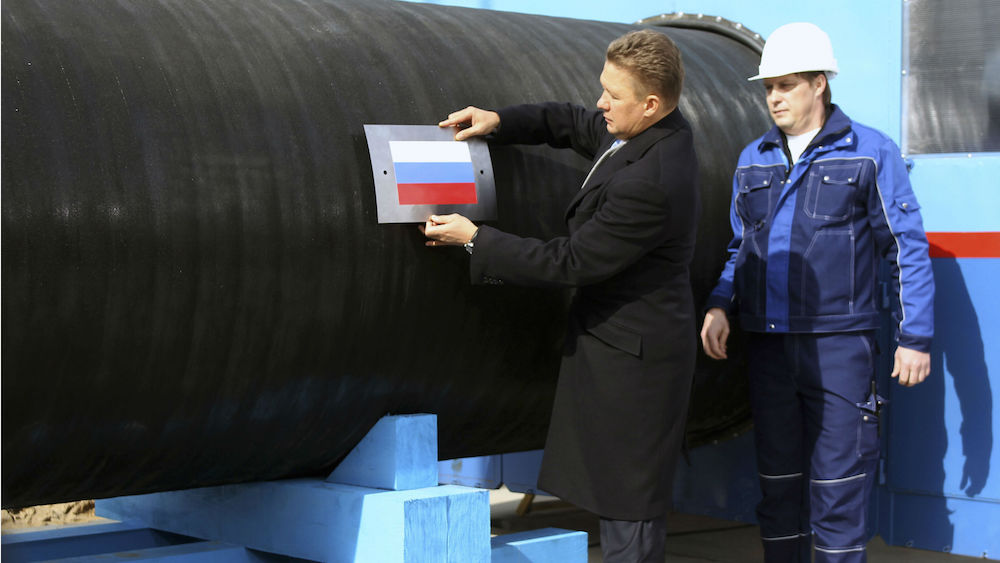
Pipe Dream? Polish ruling complicates Nord Stream 2 pipeline for Gazprom & EU partners [My Berlin Policy Journal piece]

bpj_online_odonnell_nordstream2_cutHere’s my latest analysis in Berlin Policy Journal (German Council on Foreign Relations -DGAP).Pipe Dream? The Nord Stream 2 pipeline project is in danger of being derailed.
THOMAS W. O’DONNELL , SEPTEMBER 22, 2016 

A pipeline project to double Gazprom’s export capacity to Europe has always been controversial. A recent ruling by Poland’s competition authority could seriously undercut the support it has accrued, leaving its European backers at odds.

The proposed Nord Stream 2 pipeline project has bitterly pitted European states that back the project, including Germany, the Netherlands, Austria, and France, against project opponents, including Ukraine, Poland, and other former Soviet-bloc states. The project aims to double the capacity of the existing huge, 55-billion-cubic-meter-per-year Nord Stream 1 pipeline, running in parallel to it under the Baltic Sea from near St. Petersburg in Russia directly to Greifswald in Germany.

This dispute has exposed two very different views of Gazprom, Russia’s state-owned gas-export monopoly, and of Vladimir Putin’s Russia itself – one side sees it as a “necessary” and “reliable” energy supplier, the other a dangerous and manipulative adversary. This dispute is but one more collision inflicting lasting harm on the European Project.

Polish competition authority rejects project

The latest row involves a ruling in late July by the Polish Office of Competition and Consumer Protection (Urzed Ochrony Konkurencji i Konsumentow, or UOKiK) rejecting an application by five private western European energy firms proposing to partner with Gazprom to build and operate Nord Stream 2. The firms are Germany’s E.ON (soon to be Uniper) and Wintershall, Austria’s OMV, Anglo-Dutch Shell, and France’s Engie.

Shortly before the Polish announcement, the five companies agreed to withdraw their association proposal to avoid UOKiK initiating a legal process against them. The commission’s president, Marek Niechcial, declared categorically on August 12 that the Polish rejection was definitive, asserting “This will stop the [Nord Stream 2] deal.” The five firms have nevertheless made it clear they are seeking a strategy to work around the decision, and expect to proceed as planned. Gazprom has said the same.

So why go through this proceeding in the first place? To understand these events better, I spoke with several experts and diplomats working on these matters in Moscow, Berlin, Washington, Paris, and Warsaw.

Commercial Arguments

An often-heard line of argument is that at least some of the five companies might actually have little commercial interest in the project, but need to preserve their relationships in Russia where they have large investments in energy projects. After all, the Kremlin has a track record of taking over projects from foreign partners with whom it has fallen out. A further theme in this vein is that Nord Stream 2 is not really needed in northwestern Europe, even though the Groningen field in the Netherlands and Norway’s reserves in the North Sea are declining, because future demand in northwestern Europe is overestimated and Liquefied Natural Gas (LNG) will be available from the United States. This view led to press speculation that the five firms likely welcomed the Polish decision, allowing them a graceful exit.

However, virtually all the experts I spoke with had no doubt Nord Stream 2 would be a lucrative commercial enterprise over the long run, and that the five firms seem genuinely enthusiastic. Continue reading

Bypass Operation: Nord Stream 2, Russia-to-Germany pipeline deal, raises questions

BPJ_online_ODonnell_NordStream2_cut

Here’s my latest at Berlin Policy Journal (DGAP):  With Nord Stream 2, Russia’s President Vladimir Putin is nearing his goal of cutting Ukraine out of the gas supply picture.  October 20, 2015

On 18 June, during the annual St. Petersburg International Economic Forum, an agreement was signed to build a controversial new “Nord Stream 2” pipeline under the Baltic Sea that would go directly from Russia to northern Germany, with a capacity of 55 billion cubic meters (bcm). The project, which consists of two segments that would run along the same route as the existing two segments of the 55 bcm Nord Stream line, completed in 2011, has met with strong opposition from energy officials in Brussels, as well as leaders in Ukraine and some other EU states.

Indeed, the agreement between Russia’s Gazprom and a consortium of German, Austrian, French,, and Anglo-Dutch companies came as a surprise. After all, in January 2015 Gazprom announced it had abandoned the project, blaming both the falling price of gas over the previous year and anti-monopoly restrictions in the EU’s Third Energy Package, which prohibit suppliers of gas from also owning pipelines delivering it. This provision has prevented Gazprom from ever filling the original North Stream more than half way.[1] In retrospect, the sudden signing of a Nord Stream 2 agreement only six months after the project was supposedly abandoned, plus the fact that the consortium foresees a quick start reveals the prior cancellation to have been a political ruse. Continue reading

Containing Gazprom: Putin may be overplaying his hand on gas – but no thanks to Berlin and Paris

Russia’s President has used Europe’s dependence on Russian gas as a powerful geopolitical lever. But energy geopolitics is a risky game, especially with the world awash in cheap gas – and Brussels now poised to take advantage of opportunities to permanently slash Gazprom’s market share in Europe.

Russia’s president has used Europe’s dependence on Russian gas as a powerful geopolitical lever. But energy geopolitics is a risky game, especially with the world awash in cheap gas – and Brussels now poised to seize opportunities to permanently slash Gazprom’s market share in Europe.

Here is my article in today’s Berlin Policy Journal. Continue reading