Category Archives: international relations

Competing with China in Latin America: Is Germany losing its high-tech advantage?

Wilfredo R. Rodriguez H., CC BYAn article I wrote for the IP Journal of the German Council on Foreign Relations is online today. It examines data on China, the EU and Germany’s trade with Latin America and the Caribbean, including in energy. Here’s a quote from near the end:

…  China’s exports to Latin America in the low-, medium-, and  high-tech categories were below those of Germany and the EU in 2003; but in 2012 [China’s exports] exceeded the combined totals of the EU15 in the medium-tech and even in the high-tech categories. The only place the EU15 surpasses China is, rather oddly, in the low-tech manufactured goods …

-> READ THE ARTICLE at GCFP’s IP Journal or Research Gate.

Can Obama & Rouhani End Iranian Nukes+Oil Crisis? – My Beijing press interviews in “Sanlian Lifeweek”

August 3, Iran's Supreme Leader Ayatollah Ali Khamenei (third left) gives letter of appointment to new president Rohani (third right). by: Sanlian Life, Beijing

August 3, Iran’s Supreme Leader Ayatollah Ali Khamenei (third left) gives letter of appointment to new president Rohani (third right). by: Sanlian Life, Beijing

What does H. Rouhani’s  election mean for the Iran nuclear crisis?  What separates the US and Iran in negotiations? What’s the role of oil?

The Beijing-based weekly, SanLian Lifeweek, interviewed me several times in recent months on the US-Iran crisis (also on Iranian-Egyptian relations, the South China Sea disputes, and Russia’s trade surge in Latin America).   Below are their three articles on US-Iran relations quoting me and other experts.  Since these are in Chinese (my name O’Donnell appears as “奥唐奈”), I’m including my written English answers to their questions.

(1a) Chinese:  “Iran’s new president: US-Iran talks turnaround and challenges” P20-21观察 3 August 2013

(1b) My English answers (full text):

Q (Sanlian Lifeweek): When election has just ended, many assumed that Rohani’s win will possibly bring a breakthrough in Iran-U.S. relations. Recently, with him showing the intention of appointing Mohammed Javad Zarif, who many of us know well from his days in New York as the Iranian ambassador to the United Nations, as the new foreign minister, some believe that US-Iranian negotiation is now realistic for the first time in many years.

Do you agree with this comment? If not, what kind of difficulties do you think Rohani will be facing domestically in seeking moderate U.S. policies? Continue reading

My talk: JFK Institute, Berlin: How “The Global Barrel” shapes Washington-EU relations

You’re invited to my lecture at The JFK Institute of North American Studies at Freie Universität in Berlin, Germany, Tuesday 6 PM. Here is the flyer, then the Abstract.  Tschüß!

ABSTRACT:

“The Global Barrel”

Today’s globalized market-centered energy system defines Washington’s relations with the EU, Japan and OPEC states Continue reading

Why is Chinese production in Iraq booming, and in Venezuela lagging?

Iraqi oil production has surged. Source: EIA

[Updated/edited 5 June] The New York Times had an interesting article: “China is reaping biggest benefits of Iraqi oil boom” on June 2, 2013.  The question that comes to mind is …

Why is Chinese production in Iraq booming, and in Venezuela lagging?

As late as 2007 and 2008, China clearly intended its investments in Venezuela to be its largest anywhere, to ramp up development of Venezuela’s huge Faja Orinoco extra-heavy oil reserves.  In those years, Iraq was still mired in sectarian war.  Yet, here we are in 2013, with Chinese production in Iraq surging and its companies’ production in Venezuela lagging.  Why?  Let’s first look at the Chinese relationship and logic in Iraq, then in Venezuela.

Geostrategic interests behind profit issue

The NYT article says that Chinese success in Iraq is largely because their oil companies aren’t especially interested in profits because they don’t have to answer to investors demanding higher returns; they just want to secure oil to bring home.

Yes, but one should see that this is also strongly a geostrategic imperative for Beijing. It is true Chinese firms can get along with lower profits, and they also have much more cash than others, which also helps them get in now at small profits for the long run.  However, unlike other firms, they are under specific instructions by Beijing to persist at getting into countries with huge reserves like Iraq and Venezuela because it is in the geostrategic energy interests of Beijing to do so.

Chinese geostrategic motivations to stick in Iraq (and Venezuela)

Before examining the better situation, on the ground, for Chinese firms dealing with Baghdad as verses Caracas, it is important to recognize Beijing won’t ever give up on either state. Beijing is the one power having serious reservations about too much reliance on the US/Saudi-dominated “global barrel” market-and-security system.  It is the only major power (aside from Russia) with aspirations to project power against the USA and its naval carrier fleets, at least in its near-home waters.  For any such confrontation of any duration, it needs  to have a certain significant percentage of oil brought directly home independent of the USA and the global market the USA dominates.  So, China’s energy firms tend to blend their deepening integration into global oil-market processes with old-fashioned bi-lateral mercantilist relationships with producing states like Iraq and Venezuela. (See also the Addenda below.)

Different contractual and working relationships in Iraq and Venezuela

Venezuelan oil production has lagged. EIA 2012

Chinese firms are clearly more willing to work with the difficult  resource-nationalistic conditions imposed by the Iraqi and Venezuelan states.  However, in many ways Iraq’s are more difficult, yet Chinese–and many others–do better getting production going in Iraqi than Venezuela.  Why? Continue reading

En Espanol: Venezuela’s “Tal Cual” on my al-Naimi post

For Spanish speakers: below is an article from Tal Cual daily in Venezuela summarizing my blog on Saudi oil minister al-Naimi’s opinons on the “North American tight-oil revolution” and their implications for Venezuela and Iran.  The article is by Jose Suarez Nunez.

Para hispano parlantes: Aquí abajo está un artículo en Español publicado en Tal Cual de Caracas, un resumen de mi blog de la última semana que trató en las opiniones del ministro de energía saudita Sr. al-Naimi, y en las implicaciones para Venezuela e Irán. Continue reading

Listening to Saudi Oil Minister Al Naimi at CISIS in Washington: Bad news for Venezuela & Iran?

Al-Naimi at CSIS

Al-Naimi at CSIS

 Last week in Washington, I attended a talk by Saudi Oil Minister and head of Aramco, Ali al-Naimi, at CSIS.  Energy and foreign policy veterans from Daniel Yergin to Brent Scowcroft and Dr. James Schlesinger were on hand to hear al-Naimi’s views. You can read the transcript here, or watch the video embedded below.

Al-Naimi’s contrasted his central theme: “the enduring relevance of oil,” to the predictions made for many years by the adherents of “peak oil”–a theory that he said had itself “peaked in 2009” and has now been shown to be “utterly incorrect.”

Bad News for Venezuela and Iran?

Listening to him describe the global impact that the U.S.A. tight-oil “revolution” will have on the market,  plus with Alberta’s heavy oil and so many other new sources from around the globe all coming to market, brought to my mind images of the 1980’s.  The 1980’s were the “lost decade” in Latin America. It strikes me that, if he’s right about the trajectory of the global oil sector, the consequences for OPEC’s “price hawk” faction would be sobering. Continue reading

NYC Lecture: THE LEGACY OF HUGO CHAVEZ: Is ‘Oil-Socialism’ a Sustainable Alternative Development?

English: Hugo Chávez

I’m invited to deliver a public lecture Wednesday, 24 April, at 3:30 in New York City at The New School University‘s Graduate International Affairs. This will be a  critical examination of the legacy of Hugo Chavez’ “oil socialism” as an “alternative developmental model” for Latin America. Continue reading

Did Iran release Abu Ghaith to show the USA its good faith in February nuclear negotiations?

Abu Graith and Bin Laden after 9-11, video, Oct 7 2001 (Hurriyet, 7feb13)

Abu Ghaith, arrested by the US March 7, after his release by Iran, shown alongside Bin Laden in October 7, 2001 video after 9/11 attacks (credit: Hurriyet)

Is Tehran serious about nuclear negotiations with the P5+1?

If Tehran wants an agreement, how might they demonstrate good faith to Washington? Consider the following:

In the month before the recent round of negotiations held in Almaty, Kazakhstan on February 26 and 27, Iran released into neighboring Turkey Osama Bin Laden’s brother-in-law, Mr. Suleiman Abu Ghaith.  The Islamic Republic of Iran had been detaining him since his capture some 11 years ago, when he entered Iran along with other top Al Qaeda leaders to escape the U.S. invasion of Afghanistan.  His precise date of release into Turkey is not clear, however, according to the English-language Turkish paper, Hürriyet, he was arrested by Turkish authorities in an Ankara “luxury hotel” on a “tip from the CIA.”  Turkey then held him for “33 days” before deporting him to Jordan on March 1, and he was arrested by the U.S. on March 7. Continue reading

PDVSA Future Uncertain After Chavez – My views in “Platts” today

PDVSA: Reform?

Venezuela’s troubled national oil company, PDVSA — Post-Chavez Reforms ?

What’s the future of PDVSA post-Hugo Chavez?  My comments to Platts Energy writer Mery Mogollon were quoted in detail today in Oilgram News.  A JPEG  image is below (click it to enlarge).   My thanks for permission to post it here.  Continue reading

Problems of the Global Oil System: Why teach about oil?

Oil pumpjacks in Venezuela (TalCual Digital, Caracas)

Recently, I sent off a proposal for a new course, “Problems of the Global Oil System.”  The introduction asks rhetorically: “Why Teach About Oil?”

Debates in the U.S. over oil and energy policy often resemble election campaigns, fought out with factoids and unconstrained partisanship.  Of course, deciding technical-scientific policy is inherently political.  But there are politics and there are politics.  In the proposal, I argue that  “Oil’s persistent domestic & global centrality” will extend at least another 25-to-30 years, so teaching about oil is necessary to  empower students to participate in forming energy policy democratically.

But, do the facts actually support the conclusion that petroleum’s central role in society–in both domestic and international affairs–will persist for at least 25-30 years hence?  Here is the brief argument in the introduction (and the conceptual outline of the course) for your consideration: Continue reading

I’m cited: “(BN) Chavez Buys Enemy U.S.’s Fuel While Lauding Iran”

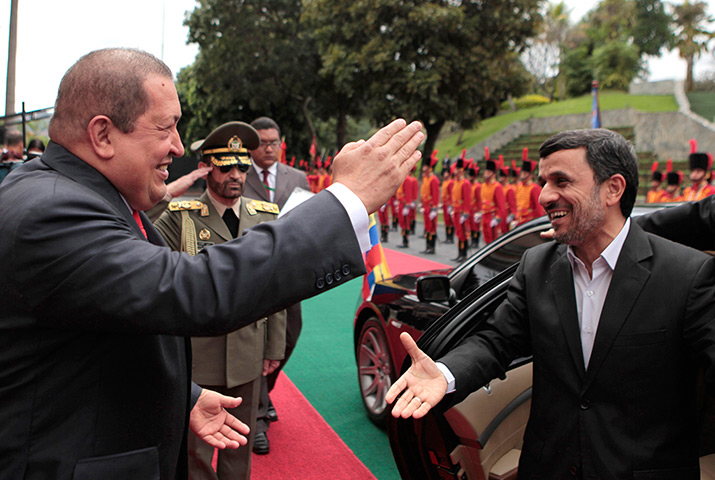
Presidents Chavez and Ahmadinejad met in Caracas in January (here) and June 2012

I was cited a number of times yesterday in a Bloomberg News article by Nathan Crooks in Caracas and Paul Burkhardt in NYC.  I reprint it below because the authors’ research further illustrates an issue I’ve often stressed here.

That is: in spite of President Chavez’ rhetoric promising to stand by Presidents Ahmadinejad of Iran (and Assad of Syria, and previously Qaddafi of Libya), he is actually in no position to withstand the U.S. sanctions that could be imposed on Venezuela for aiding Iran. Continue reading

Venezuelan Faja Surprise: USA’s Harvest sells not to China but Indonesia

Petrodelta,SA rig in the south of Monagas state, Venezuela (PDVSA 2011 Annual Rept)

In March, U.S.-based Harvest Natural Resources (HNR) had disclosed to shareholders it was in exclusive confidential negotiations with a national oil company (NOC) to sell its 32% stake in Petrodelta SA–a lucrative, mature, medium-heavy Faja oil field in the south of Monagas state, in which PDVSA holds a 60% share.  Thursday evening, Harvest surprised observers by announcing they had signed an agreement with the Indonesian National Oil company, Pertamina.

The big question immediately being asked was: “Indonesia?  Why not China?”  I was quoted at length Friday morning on this question by Bloomberg’s Nathan Crooks in Caracas (See:

Continue reading

Iranian National Oil Company & PDVSA Respond to My Exposé?!

A curious announcement in The Tehran Times: “Tehran, Caracas to ink $2 billion oil deal soon” (29 May, web 30 May) followed on the heels of my exposé about this relationship that was published just two weeks prior.  The Tehran Times’ piece was brought to my attention by James Bourne, Senior Latin American Editor at Energy Intelligence NYC, who requested a comment.  Energy Intelligence has kindly provided GlobalBarrel.com a PDF of Bourne’s piece in their subscriber-only Oil Daily of 31 May, which you can read at this link: Continue reading

My Iran-in-Venezuelan-Oil Study: Summarized in “Tal Cual” today in Caracas; in Spanish

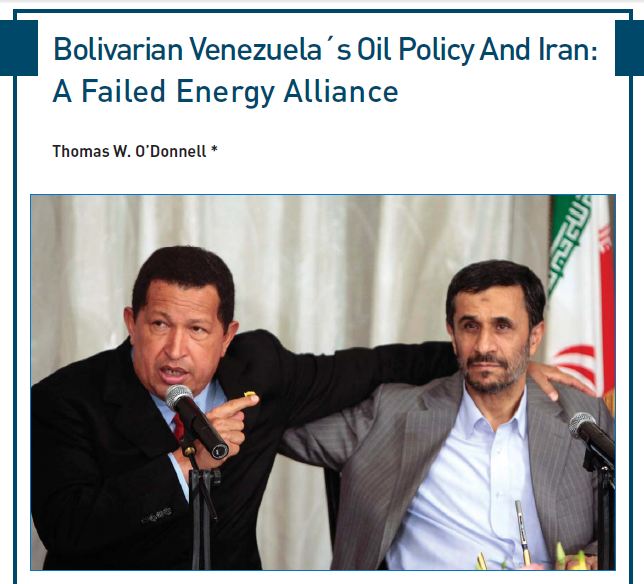
For those who read Spanish:  Today Tal Cual in Caracas carried a detailed summary in Spanish by Jose Suárez Núñez of my study, “Bolivarian Venezuela’s Oil Policy & Iran: A Failed Energy Alliance” (which appeared in Middle East Economic Survey’s [MEES] Energy and Geopolitical Risk for May 2012).

Suárez Núñez is the Tal Cual oil columnist, and one of Venezuela´s most senior oil journalists.  Here are the links: Continue reading

Bolivarian Venezuela’s Oil Policy & Iran: A Failed Energy Alliance

My study of Iran in Bolivarian Venezuela’s oil sector is just out in the May 2012 edition of Energy and Geopolitical Risk-published by MEES: Middle East Economic Survey.  You can read it here: Venezuela_Iran_failed_energy_alliance-Geopolitical-Risk-May-2012-3. Continue reading