Category Archives: Faja of the Orinoco

En Espanol: Venezuela’s “Tal Cual” on my al-Naimi post

For Spanish speakers: below is an article from Tal Cual daily in Venezuela summarizing my blog on Saudi oil minister al-Naimi’s opinons on the “North American tight-oil revolution” and their implications for Venezuela and Iran.  The article is by Jose Suarez Nunez.

Para hispano parlantes: Aquí abajo está un artículo en Español publicado en Tal Cual de Caracas, un resumen de mi blog de la última semana que trató en las opiniones del ministro de energía saudita Sr. al-Naimi, y en las implicaciones para Venezuela e Irán. Continue reading

Listening to Saudi Oil Minister Al Naimi at CISIS in Washington: Bad news for Venezuela & Iran?

Al-Naimi at CSIS

Al-Naimi at CSIS

 Last week in Washington, I attended a talk by Saudi Oil Minister and head of Aramco, Ali al-Naimi, at CSIS.  Energy and foreign policy veterans from Daniel Yergin to Brent Scowcroft and Dr. James Schlesinger were on hand to hear al-Naimi’s views. You can read the transcript here, or watch the video embedded below.

Al-Naimi’s contrasted his central theme: “the enduring relevance of oil,” to the predictions made for many years by the adherents of “peak oil”–a theory that he said had itself “peaked in 2009” and has now been shown to be “utterly incorrect.”

Bad News for Venezuela and Iran?

Listening to him describe the global impact that the U.S.A. tight-oil “revolution” will have on the market,  plus with Alberta’s heavy oil and so many other new sources from around the globe all coming to market, brought to my mind images of the 1980’s.  The 1980’s were the “lost decade” in Latin America. It strikes me that, if he’s right about the trajectory of the global oil sector, the consequences for OPEC’s “price hawk” faction would be sobering. Continue reading

NYC Lecture: THE LEGACY OF HUGO CHAVEZ: Is ‘Oil-Socialism’ a Sustainable Alternative Development?

English: Hugo Chávez

I’m invited to deliver a public lecture Wednesday, 24 April, at 3:30 in New York City at The New School University‘s Graduate International Affairs. This will be a  critical examination of the legacy of Hugo Chavez’ “oil socialism” as an “alternative developmental model” for Latin America. Continue reading

“Tough Policy Choices Await Chavez Successor”- My viewpoint in Petroleum Intelligence Weekly

Below is a “Special Reprint of Petroleum Intelligence Weekly for The Global Barrel”–I was quoted in three EIG articles last week.

A special thanks to James Bourne, Energy Intelligence’s Senior Editor for Latin America. James is moving on to new challenges in Singapore   His frequent calls with probing questions and insightful analysis of Venezuela and Latin America will be sorely missed here!!  Una buena despidida – mucho éxito en todo! 

tough_choices_after_chavez_energy_intell_11Mar13

PDVSA Future Uncertain After Chavez – My views in “Platts” today

PDVSA: Reform?

Venezuela’s troubled national oil company, PDVSA — Post-Chavez Reforms ?

What’s the future of PDVSA post-Hugo Chavez?  My comments to Platts Energy writer Mery Mogollon were quoted in detail today in Oilgram News.  A JPEG  image is below (click it to enlarge).   My thanks for permission to post it here.  Continue reading

As Chavez’ oil alliance with China gets serious, Beijing holds PDVSA to its word

Groundbreaking at CNPC refinery for PDVSA heavy oil, set tol be China's largest.

Groundbreaking, PetroChina-CNPC refinery for PDVSA heavy oil. It is to be China’s largest. (April 2012)

Over the past few weeks, I have been looking at the state of the Venezuelan-Chinese oil alliance that Hugo Chavez has so fervently championed.  The picture that emerges is not what one might expect. Here is an overview, in qualitative terms. [Correction: I originally wrote Ramirez reported that PDVSA produced “60,000” new barrels of Faja oil in 2013. He actually said “20,000”.]

A. Structural Changes – Vertical Integration with China

Till now, commentators have looked primarily at the obligations of the Bolivarian Republic of Venezuela (BRV) to send oil to China to repay Beijing’s huge loans.  However, there are major changes afoot in the structure of this relationship, no matter who succeeds Hugo Chavez.  Developments on the ground in both countries show an energy infrastructure buildup will soon bring significant cross-border vertical integration.  Soon, Venezuelan oil will not be shipped to China simply to fulfill financial-and-contractual obligations, but also for locked-in infrastructural reasons. 

All indications are that the Chinese side is actively fulfilling the obligations it entered into ca. five years ago (esp. December 2007) to build oil tankers, pipelines and refineries in China in order to import and process Venezuelan heavy crude.

Continue reading

Problems of the Global Oil System: Why teach about oil?

Oil pumpjacks in Venezuela (TalCual Digital, Caracas)

Recently, I sent off a proposal for a new course, “Problems of the Global Oil System.”  The introduction asks rhetorically: “Why Teach About Oil?”

Debates in the U.S. over oil and energy policy often resemble election campaigns, fought out with factoids and unconstrained partisanship.  Of course, deciding technical-scientific policy is inherently political.  But there are politics and there are politics.  In the proposal, I argue that  “Oil’s persistent domestic & global centrality” will extend at least another 25-to-30 years, so teaching about oil is necessary to  empower students to participate in forming energy policy democratically.

But, do the facts actually support the conclusion that petroleum’s central role in society–in both domestic and international affairs–will persist for at least 25-30 years hence?  Here is the brief argument in the introduction (and the conceptual outline of the course) for your consideration: Continue reading

I’m cited: “(BN) Chavez Buys Enemy U.S.’s Fuel While Lauding Iran”

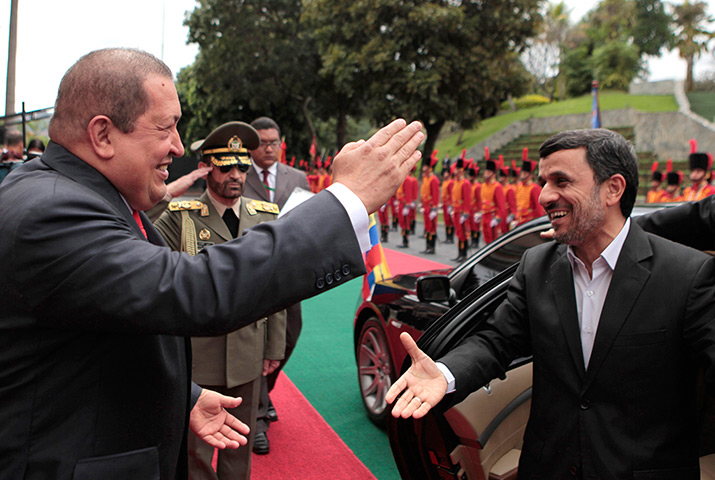
Presidents Chavez and Ahmadinejad met in Caracas in January (here) and June 2012

I was cited a number of times yesterday in a Bloomberg News article by Nathan Crooks in Caracas and Paul Burkhardt in NYC.  I reprint it below because the authors’ research further illustrates an issue I’ve often stressed here.

That is: in spite of President Chavez’ rhetoric promising to stand by Presidents Ahmadinejad of Iran (and Assad of Syria, and previously Qaddafi of Libya), he is actually in no position to withstand the U.S. sanctions that could be imposed on Venezuela for aiding Iran. Continue reading

Venezuelan Faja Surprise: USA’s Harvest sells not to China but Indonesia

Petrodelta,SA rig in the south of Monagas state, Venezuela (PDVSA 2011 Annual Rept)

In March, U.S.-based Harvest Natural Resources (HNR) had disclosed to shareholders it was in exclusive confidential negotiations with a national oil company (NOC) to sell its 32% stake in Petrodelta SA–a lucrative, mature, medium-heavy Faja oil field in the south of Monagas state, in which PDVSA holds a 60% share.  Thursday evening, Harvest surprised observers by announcing they had signed an agreement with the Indonesian National Oil company, Pertamina.

The big question immediately being asked was: “Indonesia?  Why not China?”  I was quoted at length Friday morning on this question by Bloomberg’s Nathan Crooks in Caracas (See:

Continue reading

Iranian National Oil Company & PDVSA Respond to My Exposé?!

A curious announcement in The Tehran Times: “Tehran, Caracas to ink $2 billion oil deal soon” (29 May, web 30 May) followed on the heels of my exposé about this relationship that was published just two weeks prior.  The Tehran Times’ piece was brought to my attention by James Bourne, Senior Latin American Editor at Energy Intelligence NYC, who requested a comment.  Energy Intelligence has kindly provided GlobalBarrel.com a PDF of Bourne’s piece in their subscriber-only Oil Daily of 31 May, which you can read at this link: Continue reading

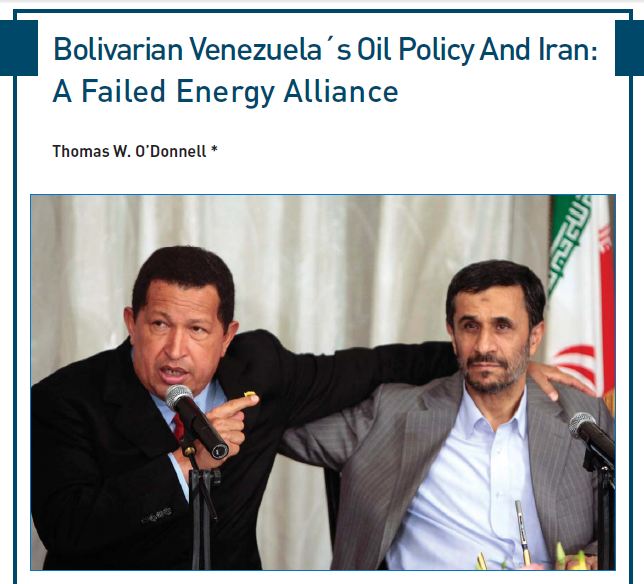
Bolivarian Venezuela’s Oil Policy & Iran: A Failed Energy Alliance

My study of Iran in Bolivarian Venezuela’s oil sector is just out in the May 2012 edition of Energy and Geopolitical Risk-published by MEES: Middle East Economic Survey.  You can read it here: Venezuela_Iran_failed_energy_alliance-Geopolitical-Risk-May-2012-3. Continue reading

PDVSA ships fuel to Syrian regime: Chavez risks sanctions?

[Edited Tues  630 EDT] The Negra Hipólita, a tanker operated by an affiliate of PDVSA, should be arriving at the Syrian port of Banias after a 15-17 day voyage from the Venezuelan refinery at Puerto La Cruz (El Universal, 17Feb12).

Syrian tanks are seen in Bab Amro near the city of Homs,12Feb12. Photo Reuters

Puerto La Cruz produces about 187k bbl/day and, the Negra Hipólito, if fully loaded, will deliver 47,000 (47k) tonnes of diesel fuel to alleviate reported widespread shortages of fuel in Syria. That’s about 330k barrels of fuel usable as home heating oil, or as fuel for Assad’s Russian tanks “indiscriminately” shelling neighborhoods, as in the city of Homs.  Note:

In Vienna, the U.N. chief demanded the Syrian regime stop using indiscriminate force against civilians caught up in fighting between government troops and Assad’s opponents. “We see neighborhoods shelled indiscriminately,” Ban told reporters. “Hospitals used as torture centers. Children as young as ten years old jailed and abused. We see almost certain crimes against humanity.” (Time World, Syrian Troops Shell Central City with Tanks. 17Feb12).

What, however, is the geopolitical significance of this shipment?  Let’s examine three issues:

  1. Chavez’ motivations: Why risk sanctions?
  2. Is this a significant material assistance to Assad’s regime?
  3. Has Chavez blundered by miscalculation? Continue reading

A Santos-Chavez Pipeline: Where’s the demand for Latin America’s oil boom?

President Santos of Colombia recently went to Caracas where he and PresidentChavez signed a letter of commitment  for the “Binational Project on the Venezuela-Colombia Oil Pipeline” to run 3,000 km. from Venezuela’s Faja heavy-oil region, west across Colombia to the Pacific port of Tumaco.  (El Universal and El Universal).  After many disappointments in recent years in collaborations with PDVSA, Latin American presidents haven’t endorsed many joint projects lately.  Nevertheless, Santos was beside himself with enthusiasm after the five-hour meeting on 28 November, declaring “Wherever we’ve mentioned this, people’s eyes open wide.” (Reuters)

Let’s look at some data to see if Santos and Chavez are really onto somehing here. Continue reading

Part IV: Another $6.5b in loans: The frustrated Beijing-Caracas courtship

(Greetings! It’s good to be back blogging.)  The common perception is that Chinese oil companies in Venezuela are winning big deals on very favorable terms.  However, as I’ve stressed in previous posts, Beijing is actually very frustrated not to be getting the deals it expects for new Faja heavy oil fields, especially considering its big investments in the Bolivarian state.  More evidence continues to emerge.

From 21-23 November the “10th Meeting of the China-Venezuela High-Level Committee” took place in Caracas at the Hotel Gran Meliá, with something like 400 businesses and state representatives coming from China.    Continue reading

Part III: Venezuelan heavy oil: China’s persistence is finally paying off

First, here is an outline of this and the next three or four blogs on this topic:

I. Changes on the Venezuelan side that are enhancing the Chinese role:

a.  Chavez’ recent interest in increasing national oil production 

b.  The existential crisis Chavismo faces from the slow collapse of dysfunctional state institutions, civil infrastructure, and nationalized enterprises

II. Changes on China’s side that enhance its role in Venezuela:

a.  China has now loaned Venezuela so much money, and Venezuela so badly needs continued Chinese financing (lately it  also feels a need for managerial and technical assistance), that Beijing has been able to insist Caracas not only begin to come through on long-awaited heavy-oil contracts, but that it also comply with certain  geo-political and fiscal-accountability conditions. A couple of these are pretty amazing.

———————————————————————————————-

I. Changes on the Venezuelan side enhancing the Chinese role:   a. Chavez’ new interest in increasing national oil production

One reason for China’s deepening influence in Venezuela is that PDVSA‘s president and energy minister, Rafael Ramirez, is no longer alone in insisting that PDVSA’s level of production has to rise.  President Chavez now seems to have gotten behind the need to increase national production.  If the price of oil falls significantly (many feel six months at an average of $60/barrel would be ruinous) and PDVSA’s exports per day have not risen to compensate, Venezuela will be in real trouble.  Venezuela is extraordinarily dependent on imported goods, from food to machinery for which dollars are needed; and it also must keep up payments to foreign bond holders, for which a steady stream of dollars are also needed.  Chavez and Ramirez have every reason to expect that the world’s economic woes will lead to a decrease in oil demand over the next year or two, and this of course can lead to significantly lower prices.  These fears were not apparent in the recent past. It has been more or less a tenent of Chavista faith at elite-and-professional levels that the price of oil will never again fall significantly.  I have been told this many times.  Continue reading